When your manager schedules big deliveries with no people left
Why is this Management PMs meme funny?
Level 1: Big Plan, No Team
Imagine you’re in a school group project where the teacher expects a huge, amazing presentation at the end of the week. But one by one, all your teammates have left the project or gone home sick, and now you’re the only one left to do everything. The teacher (like the manager in the meme) is still excitedly talking about all the things “your group” will deliver, pointing at the big list of tasks (kind of like planning moves on a chessboard). You look around and realize: there is no group – it’s just you! You’d probably give a side-eyed, “are you serious?” look too. It’s a bit like if a coach planned a big game-winning play but all the other players have left the field. You’re standing there alone while the coach is drawing complex plays on the board. It’s both funny and frustrating because obviously one person can’t do the work of five. In the meme, the dog with the skeptical face is that lone person giving the look that says, “This isn’t going to work,” and thinking about quitting (or in the game analogy, just walking off the field). The humor comes from how ridiculous the situation is: a big plan with no team to carry it out. Even a kid can see that if no one is there to help, the big project or game is not fair – and the easiest solution is to just stop playing. That’s exactly the feeling in the meme: the boss is planning something impossible, and the worker is so fed up they just want to walk away from the whole thing.
Level 2: All Roadmap, No Team
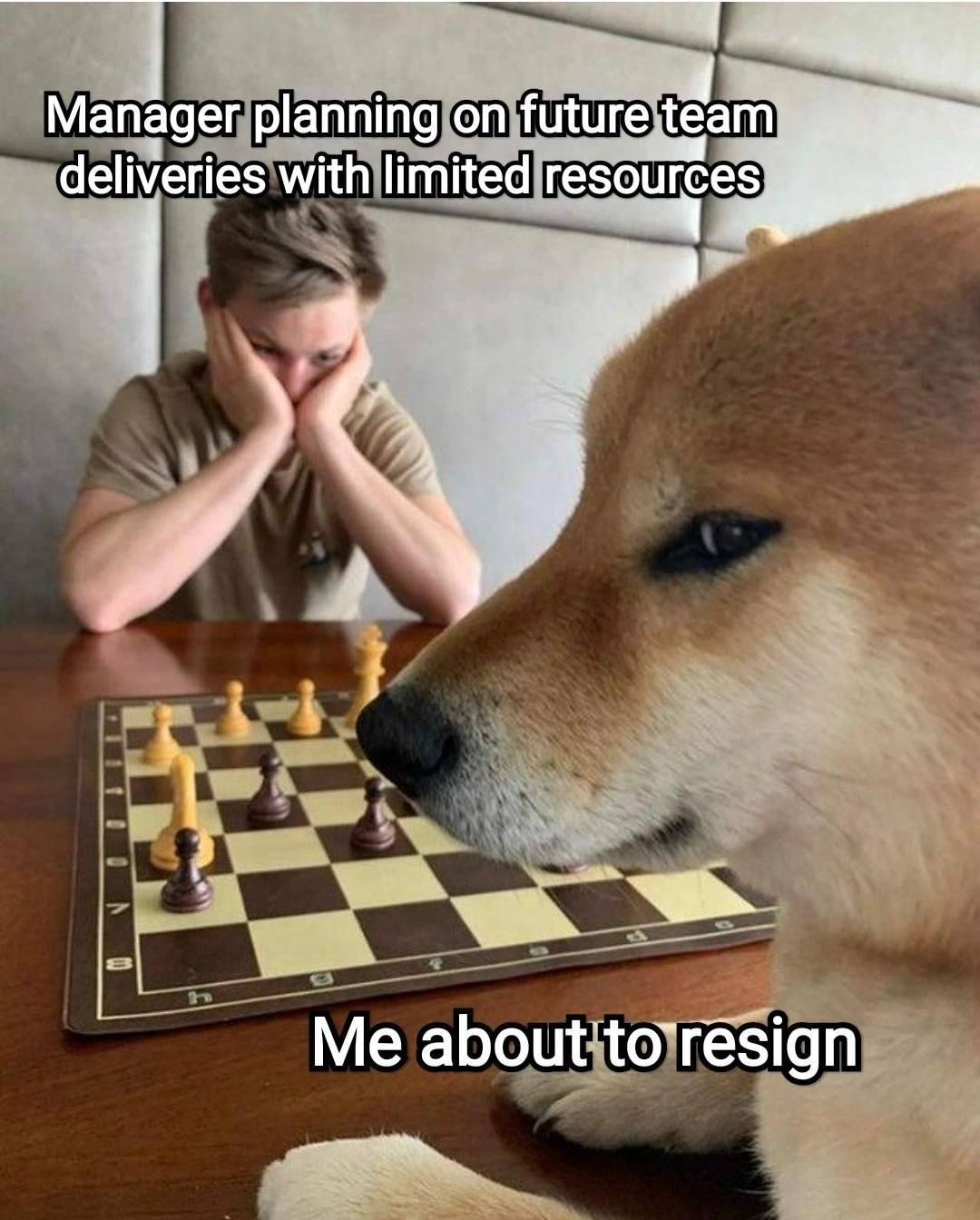
Stepping down to a less jaded, more explanatory tone: this meme uses a simple scenario to illustrate ManagerExpectations versus actual capacity. In the image, a Shiba Inu dog (famous from the sceptical_doge_meme) represents the developer. The dog’s unimpressed, side-eyed expression (“skeptical Doge”) perfectly captures DeveloperFrustration. The top text says “Manager planning on future team deliveries with limited resources,” which means the manager is mapping out big projects and due dates (the roadmap of features to deliver) even though the team is understaffed (“limited resources” in corporate-speak usually means not enough people or time). The chessboard in front of them has only a few chess pieces scattered around – a visual metaphor for an underpowered team: imagine trying to play chess without enough pieces; it symbolizes trying to execute a plan without enough developers. The manager in the background looks stressed with hands on face, showing he’s deep in thought or worry, likely because he’s trying to solve the impossible puzzle of “how do I ship a huge project with almost no one to work on it?”
The bottom caption says “Me about to resign.” “Resign” here refers to the developer thinking of quitting their job. In context, the person behind that doge-face has had enough. Why? Because being the last developer (or one of a tiny few) on a project with UnrealisticDeadlines is a nightmare scenario. Let’s break down some terms:
- Big deliveries: In software, a “delivery” means finishing and releasing a product or feature to users or stakeholders. A “big delivery” implies a major feature or a lot of work due, often tied to a deadline.
- Limited resources: This means the project has very few resources – usually referring to people (developers, testers, etc.) or sometimes budget and time. Here it clearly means not enough team members. It’s a polite way managers talk about staff: calling people “resources”, which many developers find dehumanizing. If your team shrank from 5 developers to 1, that’s extremely limited resources.
- Planning future team deliveries: This phrase indicates the manager is scheduling or committing to future work (features, releases) for the team. They’re likely making a roadmap or a timeline of what will be delivered in the coming months or quarters.
- ManagerExpectations vs Reality: Often, managers might promise certain features by certain dates (expectations) without adjusting for a smaller team (reality). This mismatch is the core of MisalignedExpectations.
- DeadlinePressure: When a due date (deadline) is approaching and there’s too much work and not enough hands to do it, developers feel intense pressure. That stress is palpable in the blurred man’s face in the meme.
- DeveloperBurnout: If a single developer or tiny team tries to shoulder the load of a much larger project to meet the deadline, they’ll work crazy hours and exhaust themselves. Burnout is a state of mental, physical, and emotional exhaustion. The meme implies the developer is on the verge: the dog looks done, like “I can’t take this anymore.”
- CorporateCulture & TeamDynamics: In some company cultures, management might push forward despite red flags. The dynamic between the manager and the remaining developer becomes strained – the manager is desperate to deliver, the developer feels unsupported and overwhelmed. This is a recipe for conflict or resignation.
- Career_HR angle: “Me about to resign” also highlights a real career decision. If you’re the last person standing on an overcommitted project, leaving the job (resigning) might seem like the only sane option to preserve your well-being and career. HR departments see this often as part of turnover when WorkplaceReality doesn’t match what was promised.
In simpler terms, this meme is basically describing a project in trouble. The boss is still making big plans even though the team has fallen apart, and the lone developer is so frustrated they’re considering quitting. The chessboard analogy helps visualize the situation: a chessboard normally has a full set of pieces for each side (16 pieces each). Here, only a few pieces remain, suggesting most of the “team” is gone. Yet, the manager is still pondering strategy (like trying to win the game anyway). The dog (developer) is giving that side-eye that says, “This is ridiculous. I’m not doing this.” It’s a familiar story in tech teams: if management doesn’t adjust goals when people leave, the remaining people feel they’re set up to fail. And if nothing changes, those remaining folks (even the reliable senior ones) will eventually decide to leave too – exactly what “me about to resign” conveys.
For a junior developer or someone new to the industry, the meme is a cautionary tale of WorkplaceReality. You might not have experienced it yet, but it’s common:
- Think of a time when you had a group assignment at school and most of your teammates didn’t do their part or dropped out. Suddenly you’re alone, and the teacher still expects the entire project to be completed. That’s what “limited resources but big deliveries” feels like in a job.
- Or imagine your boss promised a new app feature to the client by end of month, but two out of three developers on your team quit. If your boss still says “we must meet the date,” you’d probably be stunned like that Shiba Inu, wondering how on earth you’ll do the work of three people. It’s not just difficult – it’s practically impossible without something breaking (either the project, or you, or both).
In summary, this level explains why the meme’s scenario is problematic in straightforward terms: it’s poking fun at a manager’s unrealistic planning (“big deliveries”) when there’s hardly anyone left to do the work (“limited resources”), and the lone developer’s reaction is to give a meme-famous sceptical Doge stare and consider quitting (“about to resign”). It’s funny to developers because we often joke about how oblivious some plans can be, but it’s also a bit sad because it really happens in the workplace more often than you’d think.
Level 3: The Resignation Gambit
At the most technical and experienced level, this meme highlights a classic case of corporate magical thinking where ManagerExpectations completely ignore reality. We have a manager hunched over a nearly empty chessboard (the project plan) trying to strategize big product deliveries with only a handful of pieces (developers) left. It’s as if they believe sheer willpower can overcome a limited_resources situation. Any seasoned engineer recognizes this scenario: the team has been whittled down to almost nothing (through attrition, layoffs, or transfers), yet leadership still commits to ambitious deadlines as if the team dynamics haven't changed at all.
In software project management, there's an old cautionary concept called Brooks’s Law from The Mythical Man-Month: “Adding manpower to a late software project makes it later.” Well, here we have the inverse – removing manpower but keeping the deadline – which might be even crazier. The chessboard with only a few pawns and knights left is a perfect metaphor: you can’t win a chess game with most of your pieces missing. Similarly, you can’t deliver a massive project with an understaffed (or practically empty) team. The manager in the background, face in hands, resembles a chess player in checkmate by reality, yet they’re still planning moves. Perhaps they’re hoping for a miracle queen to appear on the board (maybe an overnight hire or acquiring a new team magically) – a strategy doomed to fail. This is a resource_planning_fail at an epic level, and every senior dev who’s survived a death-march project can smell it a mile away.
Why is this so funny (and painful) to us? Because it satirizes a WorkplaceReality that is all too common in dysfunctional tech culture:
- UnrealisticDeadlines with Shrinking Teams: Upper management promises a big release to clients or stakeholders even after key team members leave. Deadlines remain fixed while the workforce vanishes – a recipe for sleepless nights.
- MisalignedExpectations: The boss plans as if developers are interchangeable cogs (or resources on a spreadsheet). They schedule tasks on a timeline ignoring that the people to do them are gone. It’s like planning a roadtrip in a car that’s missing three wheels.
- DeveloperFrustration and Burnout Loop: The remaining developers are expected to pick up all the slack. Overtime skyrockets, stress multiplies. The DeveloperBurnout this creates often leads to… you guessed it, even more people leaving. It’s a vicious cycle: as more devs resign, the pressure on the last ones increases.
- “Do More With Less” Delusion: There’s a dark corporate humor in phrases like “doing more with less.” In reality, less people means less capacity. Period. No fancy Agile process or heroic coding can bend fundamental limits (you can’t compress nine months of work into three with half the engineers – that’s basically trying to divide by zero in project planning).
- Career_HR Aftermath: Senior engineers know when they’re being set up for failure. Instead of sticking around for the inevitable crunch and blame, they choose to resign (taking their talents to a better-managed team). This meme’s “Me about to resign” caption is the battle-scarred engineer deciding to exit gracefully rather than go down with the sinking ship.
The dog’s skeptical side-eye is basically the developer’s inner voice saying, “Really? You still think we can release on time with no team? Good luck with that – I’m out.” In fact, the term “resign” here is a clever double entendre: in chess, to resign means you concede defeat when checkmated; in a job, it means you quit. The senior dev in this scenario is doing both – conceding that the project is doomed and quitting the job before the inevitable collapse. ManagerExpectations have effectively checkmated themselves.
This level of analysis resonates with those of us who’ve been in the trenches of CorporateCulture long enough. We’ve witnessed the planning meetings where a manager tries to move mountains with a team of one, treating the lone developer like a dozen pawns. We’ve fielded 3 AM production pages because corners were cut due to understaffing. We’ve heard the pep talks (“If we just push a little harder, we can still make the deadline!”) right after half the team walked out the door. The meme is darkly humorous because it’s too real – it’s the satire of a software industry that often values Deadlines over developers. And as every cynical veteran knows, when a chess game is unwinnable, the smartest move is to tip over your king (or in this case, update your résumé) and step away from the board.
Description
Photograph‐based meme: in the foreground a Shiba Inu ("sceptical Doge") gives a sideways, unimpressed stare while resting a paw on a brown wooden table that holds a chessboard with only a handful of scattered pieces. In the background a man wearing a beige polo shirt sits with elbows on the table, face blurred and hands pressed together in visible stress. Top caption text reads, "Manager planning on future team deliveries with limited resources"; bottom caption beneath the dog reads, "Me about to resign." The chessboard symbolizes strategic planning, the sparse pieces hint at understaffed teams, and the dog’s expression captures developer frustration, highlighting the all-too-familiar engineering scenario of ambitious roadmaps, unrealistic deadlines, and looming burnout that make senior engineers consider quitting
Comments
6Comment deleted
Manager’s Q4 roadmap is basically a Brooks’ Law speedrun - trying to castle with two pawns - so my next sprint is the two-week notice
The dog has a better understanding of capacity planning because at least it knows when to stop chasing its tail
When your manager plays 4D chess with the roadmap but forgot to check if the pieces (engineers) are still on the board - spoiler alert: they're updating their LinkedIn profiles and the only move left is 'resign()'. Classic case of optimistic resource allocation meeting the harsh reality of O(burnout) complexity
PM's forecasting checkmate in three sprints, but we're the king cornered by unstaffed epics and eternal tech debt
Manager forecasting mate in Q4 with three pawns and "constant velocity"; my two-week notice sets the bus factor to zero
PI planning modeled engineers as interchangeable pawns; Little’s Law corrected the estimate the moment my resignation knocked their Monte Carlo forecast off the board