A Manager's Simple Fix for a MySQL Outage
Why is this Management PMs meme funny?
Level 1: Borrowing Keys Analogy
Imagine your house key breaks and you can’t open your front door. You tell your friend, “We have a problem, my key won’t work.” Now imagine your friend shrugs and says, “Then use somebody else’s key.” 😕 That suggestion sounds silly, right? Your key is unique to your door – you can’t just take a neighbor’s key and expect it to open your lock. Your friend misunderstood the problem, thinking any key might work for your house.
That’s basically what’s happening in this meme, but with computers. The developer’s “key” is a system called MySQL (which is just the name of a big database where all their important information is stored). When that database system is broken (like the broken key), the manager mistakenly thinks they can use someone else’s database (like grabbing someone else’s key) to solve the issue. It’s a funny and absurd suggestion because that’s not how it works – just like only your key opens your door, only your database has your app’s data.
The reason people laugh at this is because we’ve all heard goofy suggestions when someone doesn’t really understand the problem. It’s like if you said, “My car’s engine stopped working,” and a passenger replied, “Just put an engine from another car in it right now!” They mean well, but it’s not helpful – it just shows they don’t get why the situation is hard. In the meme, the manager is that clueless friend giving an easy-but-impossible fix. The developer (and all of us in on the joke) can only shake their head and chuckle, because if only it were that simple to fix serious problems!
Level 2: MySQL vs “my SQL”
Let’s break down the technical terms and the joke for a less experienced audience. MySQL is a popular relational database management system. Think of MySQL as a big electronic filing cabinet where applications store and retrieve data. It’s widely used in web applications to keep track of information like user accounts, posts, transactions, etc. MySQL uses a language called SQL (Structured Query Language) for managing data. For example, a developer might write a query like:
SELECT * FROM Users WHERE id = 42;
to get a user’s data. SQL is the language, and MySQL is the software (database server) that understands this language and holds the data. Other database systems (like PostgreSQL or Microsoft SQL Server) also use SQL, but MySQL is one specific product name. The “My” in MySQL is just part of the name (fun fact: it was named after the co-founder’s daughter, not to indicate personal ownership). It’s not meant to literally mean “mine” in conversation.
Now, when the developer says, “We have a problem, MySQL is down,” it means the MySQL database server is not working. “Down” in tech speak means a service or system is unavailable or not functioning correctly. So if MySQL is down, the application that depends on it can’t get the data it needs, which likely means parts of the website or service are also down for users. This is a serious problem – imagine if you had a website and suddenly the database disconnects: users might see errors or missing information because the app can’t fetch anything from storage.
The manager’s response, “Then use somebody else’s SQL,” is where the joke lies. It highlights a communication gap between the technical team and the manager. The manager hears “My SQL” and interprets it as “my SQL” – as in the developer’s own SQL or some personal database. The manager doesn’t realize MySQL is a proper noun, a single software system that everyone’s using, rather than the developer’s private resource. So, thinking the developer’s personal SQL is broken, the manager suggests borrowing someone else’s SQL, as if each person has their own SQL database lying around.
This is funny to developers because that’s not how databases work. There isn’t a spare “SQL” you can just grab from someone else in an emergency. All the application’s important data lives in the MySQL server that’s down. If it’s down, your options are typically to fix that server, switch to a replicated backup server (if you set one up beforehand), or restore from backups. You can’t fix a MySQL outage by switching to a different brand of SQL on the fly without extensive preparation (and definitely not by borrowing from an unrelated company’s database!). The manager’s suggestion shows a lack of technical understanding – they’re treating a complex system as if it were a simple interchangeable part.
This kind of misunderstanding is common in tech workplaces. Non-technical managers or stakeholders sometimes latch onto certain words and offer solutions that don’t fit the problem. It’s part of the humor in software development: we call it misaligned expectations or a communication gap. The manager wants a quick fix (“Isn’t there an easy workaround?”) while the developer knows the situation is much more complicated (“Our entire database engine is down, this isn’t a quick toggle switch.”).
To put it plainly: MySQL being down is a big technical issue that can’t be solved by literally borrowing someone else’s “SQL.” The tweet’s phrasing is a play on words – MySQL vs somebody else’s SQL – poking fun at how a non-technical person might misunderstand the term. It’s a form of database humor that also reflects real situations where techies have to explain things to managers in simpler terms. Many developers find this tweet funny because they’ve been in that meeting or call where a manager says something facepalm-worthy about a serious outage. It’s a lighthearted way to vent about those experiences.
Level 3: MySQL Misunderstanding
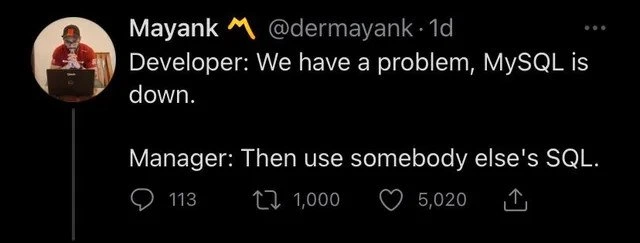
At the senior engineer level, this meme hits on a painfully familiar scenario: non-technical management making a naive suggestion during a production incident. The tweet shows a fictional exchange where a developer says "We have a problem, MySQL is down." and the manager responds "Then use somebody else’s SQL." This is a classic case of management misinterpreting technical jargon with comedic (and frustrating) results.
In reality, MySQL isn’t “your personal SQL” – it’s a specific database engine (one of the world’s most popular relational database systems). When a developer says “MySQL is down,” it means the central database service that the application relies on has crashed or become unavailable. That’s a big deal: if the database is down, the entire application often goes down with it because no data can be read or written. At 3 AM during an outage bridge, hearing "MySQL is down" is every on-call developer’s nightmare scenario.
Now enter the well-meaning but clueless manager. Hearing “MySQL” spoken aloud, they latch onto the literal phrasing: “my SQL”. The manager assumes the developer is referring to their own SQL (like it’s some personal document or script) rather than a shared infrastructure component. So the manager proposes a “simple” fix: just use somebody else’s SQL. In the manager’s mind, it sounds logical—if your SQL is broken, borrow someone else’s! To an engineer, though, this suggestion is absurd. It’s as if a manager heard "Our server is down" and replied "Just use another server from the office next door." It completely misses the point that the database is a shared, specialized system and not something you can replace on the fly with an unrelated instance.
The humor comes from the communication gap and misaligned expectations. Any seasoned developer has experienced this disconnect: we speak in terms of systems and architecture (MySQL the service, SQL the language, etc.), while some managers catch only the buzzwords and try to solutionize without context. It’s a form of wordplay here — the manager hears “my” vs “someone else’s” — but it’s also scarily true to life. On real outage calls, a non-technical leader under pressure might toss out similarly off-base ideas, like "Can’t we just download the data from the internet?" or "Is there a quick patch you can copy-paste from Google?". These suggestions often stem from a lack of understanding of how tightly integrated and unique our systems are.
This meme also subtly pokes fun at management’s desperation for quick fixes. During a crisis, managers want to show they’re helping solve the problem. Lacking the technical know-how, they sometimes grasp at linguistics: in this case, treating MySQL as literally "my SQL". It’s the same kind of logic as "If our database (DB) is down, why not use another team’s DB?" or "If our code is broken, why not borrow code from elsewhere?". We laugh (perhaps a bit darkly) because it’s a textbook example of how not to handle a database outage. Instead of focusing on real solutions (like checking replication status, failover to a backup, or investigating the last write-ahead log entry before the crash), the manager’s suggestion is a non-sequitur.
From a database architecture perspective, the idea of “using somebody else’s SQL” is nonsensical. SQL stands for Structured Query Language, which is a language for managing and querying data in relational databases. You don’t just adopt someone else’s SQL; the data and the database engine behind that SQL are unique to your application. If MySQL (the engine) is down, you can’t magically point your application to a stranger’s database and expect it to work. The schema won’t match, the data isn’t there, and you don’t have access. It’d be like losing the keys to your kingdom and a manager suggests, “Just borrow keys from another kingdom.” Sure, thanks boss, why didn’t I think of that?
This tweet resonated with over 1,000 retweets and 5,000 likes, implying a lot of developers found it relatable. It shines a light on the Management vs. Developer dynamic in outage communication. Beneath the humor, there’s a shared sigh: we’ve all dealt with a boss or product manager who fundamentally doesn’t grasp why a technical problem is hard and blurts out something that misses the mark. It’s both cathartic and cringe-inducing. As a battle-scarred ops engineer might say with a smirk: “We’ve tried nothing and we’re all out of ideas — might as well use someone else’s SQL!” This is developer humor born from real pain. The next time you’re on an outage call and someone in management asks if you can just do a quick, magical workaround, you’ll remember this meme and either laugh or cry (or both).
Description
A screenshot of a tweet from a user named Mayank (@dermayank). The tweet presents a short, humorous dialogue: 'Developer: We have a problem, MySQL is down.' followed by 'Manager: Then use somebody else's SQL.' The tweet shows significant engagement with over 1,000 retweets and 5,000 likes. The humor comes from the manager's complete technical misunderstanding. The manager interprets 'MySQL' - the proper name of a specific database system - as the possessive phrase 'my SQL'. Their proposed solution is a literal, yet technically absurd, response to this misinterpretation. This joke is highly relatable for senior developers and architects who have frequently experienced the communication gap between technical teams and non-technical management, where complex system names and concepts are often taken at face value

Comments
15Comment deleted
Of course, we'll switch to 'SomebodyElse'sSQL'. I hear its main feature is that its eventual consistency model also applies to who gets paged when the service inevitably goes down
No worries - once I finish ‘using somebody else’s SQL’, I’ll solve our storage latency by symlinking /var/lib/mysql to /dev/null
After 20 years in tech, the scariest realization isn't that MySQL can go down - it's discovering your manager thinks database selection works like borrowing a neighbor's lawnmower when yours breaks
This perfectly captures the moment when you realize your incident response plan didn't account for management suggesting you simply switch to PostgreSQL mid-outage because they think 'MySQL' means it's literally *your* SQL. At least when the database is down, you can't accidentally DROP TABLE during the ensuing facepalm
Ah yes, the legendary 'Somebody Else's SQL' cluster - zero-downtime HA until they pull the plug on their laptop
“MySQL is down.” Manager: “Then use somebody else’s SQL.” Great idea - I’ll hot‑swap a decade of MySQL‑specific collations, auto‑increment semantics, and ORM dialect hacks into Postgres before the SLA clock hits zero. Portability by acronym
Management’s DR plan: HA via pronoun substitution - no replicas, just “use somebody else’s SQL”; RTO now depends on Legal’s response time
ouch Comment deleted
Admins aren't anon anymore :o Comment deleted
*the moderator is not anon anymore Comment deleted
I mean...AWS MySQL? Comment deleted
OurSQL Comment deleted
Just pick it up goddamt Comment deleted
we have NoSQL, can this manager advise where can we get one? Comment deleted
Hahahahahahhaha. Use json like db Comment deleted