CS Degree Professionals vs. The Passionate Physics Coder
Why is this Career HR meme funny?
Level 1: The Surprising Winner
Imagine two friends are about to have a race. One friend went to a special racing school for years and learned all the rules and techniques to drive perfectly. The other friend never went to racing school but just loves driving and has been zooming around the neighborhood for fun. They line up their cars at the start. The first friend in the fancy car is super confident because of all that training. The second friend is in a quirky bright-colored car, smiling and ready to go just because racing is fun for them.
Now the race starts – and surprise! The friend who just enjoyed driving for fun takes off faster and is winning the race. The trained friend in the fancy car didn’t expect that! He’s looking over shocked, like “How is that guy ahead of me?!” It’s funny because usually you’d think the one with formal training (like the friend who went to racing school) would easily win. But sometimes, the person who practiced a lot because they loved it can do just as well or even better.
This is just like in coding: someone might have a fancy computer science degree (like going to racing school for coding), and another person might have learned coding on their own because they found it cool (like our friend who just liked driving). In the end, what matters is how well you drive the car or write the code, not where you learned to do it. The meme makes us laugh because it’s a role reversal – the underdog, the one nobody expected to lead, becomes the surprising winner. It feels good and validating, especially if you’re that person who learned in an unconventional way. The big lesson: passion and practice can beat credentials, just like a fun-loving driver can win a race against a formally trained one. And that little surprise is what makes it funny and heartwarming at the same time.
Level 2: No CS? No Problem.
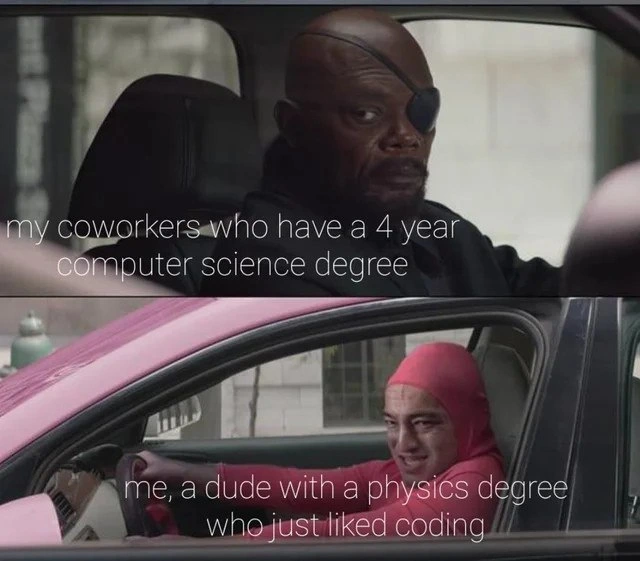
Not everyone writing code has a formal Computer Science (CS) degree, and that’s exactly what this meme highlights in a funny way. In the picture, one car has a serious-looking coworker labeled “has a 4 year computer science degree.” That represents people who went through a full university program in CS – learning things like algorithms, data structures, operating system design, and so on. In the other car, there’s a guy in a goofy pink outfit labeled “me, a dude with a physics degree who just liked coding.” This is the physics major dev: someone who studied physics in college but taught themselves programming because they enjoyed it. He’s the underdog in this race, but the joke is that he’s moving faster (shipping code changes quicker) than the formally trained folks.
Let’s break down the terms and why this scenario is humorous for developers:
Pull Requests (PRs): In collaborative software development (like on GitHub or GitLab), when you finish working on some code changes, you open a pull request. That’s basically asking, “Hey, I’ve got some code ready, can we merge it into the main project?” Shipping PRs means getting your code accepted and merged into the codebase. It implies you’ve completed a feature or fix and successfully integrated it. So, “ships PRs faster” means this person is completing and merging their coding tasks more quickly than others. Think of it as delivering your homework or project work faster than your peers – but in coding terms.
4-year CS degree vs. physics degree who liked coding: A typical CS degree is a structured education in computing. If someone has a 4-year CS degree, it usually means they’ve spent four years studying programming concepts, theory of computation, software engineering principles, etc. On the other hand, a physics major primarily studies how the physical world works – lots of math, formulas, experiments. However, physics often involves programming too (for simulations or data analysis). When the meme says “a dude with a physics degree who just liked coding,” it implies this person wasn’t formally trained in CS, but picked up coding as a hobby or tool out of genuine interest. Maybe they wrote programs to calculate physics formulas or just to make little games or projects on the side. In essence, they are self-taught (or informally taught) in programming.
Me vs. my coworkers: The meme sets up a contrast between me (the physics-grad coder) and my coworkers (the ones with CS degrees). This scenario is common in tech teams – people come from different backgrounds. Non_cs_background simply means not having a degree in computer science. Many developers might have degrees in mathematics, physics, engineering, or even totally non-technical fields, yet they end up in software because they learned to code elsewhere. This mix can lead to some friendly rivalry or surprise: “Hey, the guy who didn’t formally study this is outpacing those who did!”
Why is this funny or notable? In many workplaces (and certainly in the broader tech DevCommunity), there’s been debate about the value of a formal degree versus practical experience. Some companies used to gatekeep by only hiring CS graduates – a form of saying “we think only people with this credential can do the job.” That’s the gatekeeping mentality the meme hints at. But time and again, people without that specific degree prove they can be just as good if not better at coding. Here, the physics grad is an example of a gatekeeping_bypass – he likely got into the job through demonstrating skill, and now he’s excelling, perhaps even outperforming the “traditional” CS grads.
For a junior or someone learning: it’s a comforting message. It says your Learning-To-Code Journey can start anywhere. You might have a formal CS education, or you might be coming from another field (like physics, music, or even self-taught from online courses). What ultimately matters in a team is how well you can create software, solve problems, and contribute. This meme is relatable because a lot of developers have experienced or seen this dynamic. Maybe you’ve heard stories on Reddit or dev forums (those DevCommunities) about the art major or mechanical engineer who became the go-to programmer on their team. It’s a shared experience that lots of people in tech chuckle about: the idea that someone who “just liked coding” can end up being a superstar coder next to folks with formal training.
Let’s demystify the concept of “shipping code faster”. If you’re new: when a developer “ships code,” it means they finish it and deploy it or at least merge it into the main branch of the project where it becomes part of the product. Speed can come from many things – maybe they debug quickly, maybe they don’t overthink initial solutions, or maybe they simply put in more hours because it’s fun for them. Sometimes, a person deeply passionate about coding (doing it as a hobby) has written many small projects and scripts for fun. That practice can translate into being very productive when there’s a real task at hand. Meanwhile, someone who only coded during class assignments might have less hands-on practice building complete things.
Why the car race scene? It’s an easy analogy: two drivers side by side, like they’re about to race. The funny twist is one car is normal (like you’d expect a “serious” professional to drive), and the other is absurdly pink and the driver’s wearing a silly outfit. Visually, you’d assume the serious car would win and the pink guy is a joke. But here “me” in the pink car is actually beating the other – symbolizing that the unconventional coder is ahead of the conventional ones. It’s a visual gag matching the text’s message. Even if you didn’t know these specific characters, you can tell one driver is giving a stunned or annoyed look (the CS grads) and the other is smug or cheeky (the physics guy who’s proud he’s ahead).
In summary, No CS? No problem! There are many paths into programming. Having a computer science degree is great, but not having one doesn’t mean you’re slower or less capable. This meme reassures and amuses developers by showing an example that many find totally relatable: the idea that what you do on the job (writing good code, quickly adapting, continuously learning) often matters more than the exact title of your degree. It’s both a light-hearted jab at those who might be overconfident because of their degree, and an encouragement to all the self-taught programmers or career-changers that they belong in tech too – especially when they’re rocking it and pushing code like a pro.
Level 3: Credentials vs Commits
In the top panel, a stern driver (Samuel L. Jackson as Nick Fury) represents coworkers with a 4-year computer science degree – the formally trained engineers. In the bottom panel, a grinning guy in a bright pink car (a famously goofy internet persona) stands in for “me, a dude with a physics degree who just liked coding.” This meme lands with experienced devs because it playfully inverts expectations: the non-traditional developer (the physics major) is shipping pull requests faster than the formally educated CS grads. It’s a classic case of credentials vs. code output.
Seasoned engineers know that in the real world of software development, production systems don’t check your transcript. Your code repository doesn’t care if you aced Advanced Algorithms or barely passed an online tutorial – it only cares that the code works. This meme humorously nods to that fact. The CS grads (like Nick Fury eyeing the other car) might have deep theoretical knowledge of data structures and a framed diploma on the wall, but the physics-major-turned-developer is rapidly cranking out features and fixes. The humor is in that contrast: one side might have the classical training, yet the other side (with a non_cs_background) is outpacing them in practical output. It’s career humor wrapped in a Fast-and-Furious-style drag race visual.
Why is this so relatable in dev communities? Because many teams have that one cross_discipline_developer who came from biology, music, physics – you name it – and yet can code circles around others. Maybe the CS grads are over-engineering a solution, carefully refactoring for elegance or bike-shedding over code style, while the physics guy is like “Hey, I got it working, PR is up!” We’ve all seen the scenario where formal education meets self-taught hustle. The meme captures the SharedExperience of realizing that a degree is not the sole predictor of coding skill. In fact, sometimes passion and curiosity produce a developer who moves faster and solves problems more directly.
It also lightly pokes at gatekeeping in tech. There’s an old mindset that one must have a CS degree to be a "real" programmer (some job listings still say “BS in Computer Science required”). But here comes the physics major, effectively performing a gatekeeping_bypass by proving that the ability to ship quality code isn’t exclusive to CS grads. It’s a bit of LearningToCodeJourney reassurance: many great programmers started in other fields and learned on the job or as a hobby, and they often bring fresh perspectives. Senior devs chuckle at this because it echoes countless water-cooler stories: “Remember Alice with the PhD in Physics? She picked up Go in a week and ended up mentoring the CS folks on best practices!”
On a technical level, the CS graduates might be applying rigorous computer science principles – perhaps carefully analyzing algorithmic complexity or designing a perfectly normalized database. Meanwhile, the physics-degree developer might be leveraging a pragmatic approach: using high-level libraries, scripting quick solutions in Python, and applying brute-force or approximation methods learned from scientific computing. The result? Features delivered faster. It’s not that one approach is universally better, but the meme exaggerates the speed difference for comedic effect. It’s DeveloperHumor born from truth: sometimes the person with an unconventional background is the one who fixes the production bug at 2 AM while the “qualified” folks are still pondering the root cause.
To seasoned eyes, the image of Nick Fury’s skeptical side-eye and the ridiculous pink-clad driver is rich with subtext. It’s basically saying, “Your credentials might get you the job, but your commits will earn you respect.” Every senior dev has seen a junior with an unrelated degree or a coding bootcamp grad outperform others because they just dive in and code. This builds on the industry’s evolving understanding that diversity of background can be a strength. After all, many pioneers of computing had degrees in math or physics (or no degrees at all) – what mattered were their contributions.
The meme’s text overlay nails the punchline: “production systems rarely check your transcript before accepting a pull request.” It’s funny because it’s true – there’s no $ git push --verify-degree command! :wink: Ultimately, code either works or it doesn’t, regardless of who wrote it. The RelatableDeveloperExperience here is that delivery often trumps pedigree. As a senior dev might quip, “I’ve never seen a server crash because someone didn’t have a CS degree.” This two-panel scene encapsulates that reality in a way that’s both humorous and a little triumphant for self-taught and cross-discipline devs everywhere.
To put it in pseudo-code for the technically inclined:
// Pseudocode of the scenario:
while (csGrad.isBusyRefactoringForElegance()) {
physicsMajor.hackTogetherSolution();
physicsMajor.openPullRequest("Feature complete");
}
In plain English: while the CS graduate is still polishing the perfect solution, the physics guy already has a working fix and has opened a PR saying “feature complete!” That loop is the joke in code form. It’s an exaggeration, of course – many CS grads write efficient code and many self-taught devs appreciate theory. But for those who’ve been around, this meme hits a vein of truth about academic vs. pragmatic approaches. The DevCommunity consensus? However you got here – whether through a compsci program or a roundabout path – what matters is the code you contribute. And sometimes, the unorthodox path produces the fastest shipper on the team, much to everyone’s amused surprise.
Description
A two-panel meme comparing developers with different educational backgrounds. The top panel features a cinematic shot of Nick Fury from the Marvel universe, looking stern and professional in a car, with the caption: 'my coworkers who have a 4 year computer science degree'. The bottom panel shows the chaotic internet character Pink Guy (created by Joji), grinning mischievously while driving a pink car and wearing a full pink bodysuit, with the caption: 'me, a dude with a physics degree who just liked coding'. The meme humorously contrasts the formal, expected path of a Computer Science graduate with the often unconventional, passion-driven entry of professionals from other technical fields into software development. It highlights the diversity of backgrounds in tech, suggesting that capability isn't solely determined by a specific degree, and plays on the stereotype of the quirky, self-motivated coder versus the formally trained engineer
Comments
20Comment deleted
The CS grad spends a week designing a scalable, fault-tolerant sorting algorithm. The physics grad writes a bubble sort and then spends the next week arguing that for n < 50, O(n^2) is basically O(n log n) within the measurement error of the universe
They can recite the halting theorem; I just halt Jira tickets - same asymptotic impact on prod
The real computer science degree was the segfaults we debugged along the way - and somehow the physics major who learned programming to avoid MATLAB is now explaining why your O(n³) algorithm is making the microservice timeout
The irony is that the physics degree holder probably has a deeper understanding of computational complexity theory and algorithmic optimization from first principles, while the CS grads are still debating whether to use tabs or spaces. Both will eventually converge on the same Stack Overflow answers anyway - formal education just determines how guilty you feel about copying them
CS grads aced Algorithms; I numerically integrated partial diffs for fun - turns out both hack microservices chaos equally well
CS coworkers cite CLRS; the physics hire treats the retry storm like a damped oscillator - add jitter and backoff until prod stops paging
CS teaches Big-O, physics teaches order-of-magnitude; production speaks only in error budgets
But you'll be more successful in gamedev because they know physics bad )) Comment deleted
trust me, implementing physics usually is less about how actual physics work, and more about how physics feel to humans, and some shortcuts to make calculating them easier. Comment deleted
example: there are very few jump-n-run games that don't let you move in the air while falling. You're also usually jumping and falling way higher and faster than would be physically possible. Comment deleted
It needs math, sometimes forces, work with vectors Physics degree requires skill in similar calculations Comment deleted
Tell that to source engine devs :^) You're still right about movement but what about everything else? Comment deleted
Me, a dude without degree scrolling dev memes Comment deleted
Insert Yandex Lyceum t shirt and Thinkpad and you got me Guy without finished degree who teach and work Comment deleted
> My coworkers with 10+ years of experience > Me, Junior developer Comment deleted
in Poland a degree means they probably don't have a slightest idea about coding Comment deleted
Me a dude who've studied computer science for 3 years and have no fucking idea what have I done with my life Comment deleted
same, but I gave up in just two years Comment deleted
Me, who left from university Comment deleted
me who finished acting highschool and after that become a dental technician... Comment deleted