Skip to content
DevMeme
When the junior dev touches the legacy code
Juniors Post #53, on Feb 5, 2019 in TG

When the junior dev touches the legacy code

Why is this Juniors meme funny?

Level 1: The Friend Who Checks Your Homework

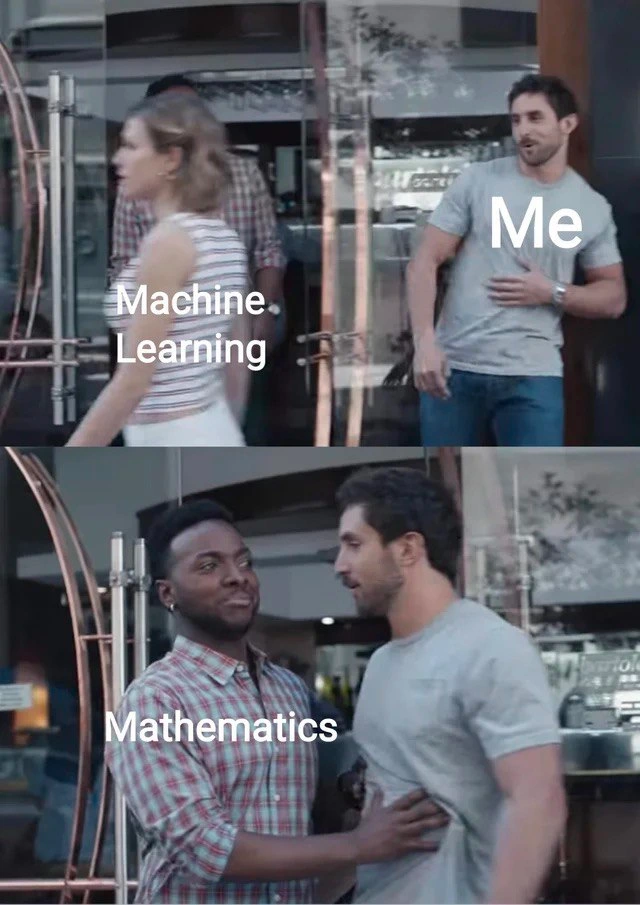
It's like a kid sprinting toward the roller coaster — the big, famous, exciting one — and a staff member gently stops them at the gate and points at the sign: you must be this tall to ride. The kid isn't banned from the ride; they just have some growing to do first. Machine learning is the roller coaster, mathematics is the height sign, and the joke is that look of pure determination meeting an unmovable hand. Everyone who has ever been excited about a shortcut, and then met the person holding the rulebook, knows exactly how that bottom panel feels.

Level 2: Meeting the Bouncer

The key labels, decoded:

  • Machine Learning (ML) — software that learns patterns from data instead of following hand-written rules. Spam filters, recommendation feeds, and chatbots are all ML.
  • Linear algebra — the math of vectors and matrices. In ML, your data is stored as giant grids of numbers, and "training" is mostly multiplying and adjusting those grids.
  • Calculus — the math of change. Training a model means nudging its numbers in the direction that reduces error; calculus (the gradient) tells you which direction that is. The workhorse algorithm is literally called gradient descent.
  • Statistics — the math of uncertainty. It answers whether your model actually learned something or just memorized the homework.

The relatable junior moment: you finish a Python course, watch a YouTube video where someone classifies cat photos in ten lines, and open the famous Coursera ML course feeling unstoppable. Slide three contains a partial derivative. Slide four contains a matrix transpose. That hand-on-the-chest feeling in the bottom panel is exactly week two of that course — and the intense, knowing eye contact from Mathematics is the moment you realize he was on the syllabus all along.

Level 3: import tensorflow as cope

The format — eager guy pursuing the attractive stranger, friend physically stopping him with a hand to the chest — captures the precise emotional sequence of every "I'm pivoting to ML" arc. The labels do the rest: "Me" strides after "Machine Learning", and "Mathematics" plants the palm. What experienced practitioners recognize is the moment the meme freezes: not failure, but interception. You don't get rejected by ML; you get redirected into a semester of prerequisites you thought you'd graduated past.

The industry context makes this sting. The 2017–2019 ML gold rush produced a generation of tutorials promising that model.fit(X, y) was the whole job, and frameworks genuinely did abstract away the calculus — right up until something went wrong. Loss is NaN? That's exploding gradients, and you need to know what a gradient is. Model performs beautifully in the notebook and embarrassingly in production? That's distribution shift and leakage — statistics. The abstraction is a loan, and the interest rate is denominated in linear algebra.

There's also a real, contested debate hiding in here about math gatekeeping. One camp insists you cannot responsibly deploy models without understanding the underlying theory. The other points out that plenty of productive ML engineering is plumbing — data pipelines, evaluation harnesses, monitoring — where deep theory is rarely touched. Both are right, which is why the meme works for both audiences: practitioners laugh at the aspirant being stopped, and aspirants laugh through the pain of their fourth attempt at understanding eigenvectors. The honest answer is that Mathematics doesn't block the door forever — he just checks ID, and the line moves slower than the bootcamp ads promised.

Level 4: The Chain Rule Holding the Door

The bouncer in the bottom panel has a specific face, and that face is the chain rule. Modern machine learning is, at its mathematical core, large-scale differentiable optimization: a neural network is a composition of functions $f_n \circ \dots \circ f_2 \circ f_1$, training is the minimization of a loss function over millions of parameters, and backpropagation — the algorithm that makes the whole field computationally feasible — is nothing more exotic than the chain rule from first-year calculus applied recursively through that composition, implemented as reverse-mode automatic differentiation. The reverse mode matters: it computes the gradient with respect to all parameters in roughly one extra pass, which is why we can train billion-parameter models at all.

Underneath that sits linear algebra as the load-bearing wall. Data lives in high-dimensional vector spaces; layers are matrix multiplications; understanding why anything works requires eigenvalues (covariance structure, PCA), singular value decomposition (low-rank approximation, the spectral lens on what a layer "does"), and norms (regularization). Probability and statistics supply the third pillar: the loss functions everyone types from memory are maximum-likelihood estimators in disguise — mean squared error assumes Gaussian noise, cross-entropy is negative log-likelihood under a categorical model. Even the famous bias-variance tradeoff is a statement about expectations over sampled datasets:

$$
\mathbb{E}[(y - \hat{f}(x))^2] = \text{Bias}^2 + \text{Variance} + \sigma^2
$$

The deep punchline is that the math isn't gatekeeping for cruelty's sake — the math is the mechanism. Gradient descent converges (or doesn't) for reasons expressible only in the language of convexity, Lipschitz constants, and learning-rate schedules. You can postpone the meeting with Mathematics, but he's not standing outside the building; he is the building.

Description

A popular meme format, the 'This is Fine' meme. A dog is sitting in a room that is on fire, calmly saying 'This is fine.' The dog is labeled 'The junior dev,' and the fire is labeled 'The legacy codebase.' This meme humorously depicts the blissful ignorance of a junior developer who is unaware of the potential consequences of their changes to a fragile and complex legacy system. For senior engineers, it’s a terrifyingly relatable image that triggers flashbacks of production outages caused by well-intentioned but inexperienced developers

Comments

8
Anonymous ★ Top Pick The difference between a junior and a senior dev is that the senior dev is the one screaming 'This is NOT fine!' while trying to put out the fire
  1. Anonymous ★ Top Pick

    The difference between a junior and a senior dev is that the senior dev is the one screaming 'This is NOT fine!' while trying to put out the fire

  2. Anonymous

    Told the execs we’d have a transformer in prod by Q3 - Mathematics put a hand on my chest and whispered, “Cool, now invert this 30 k × 30 k Jacobian without a single NaN.”

  3. Anonymous

    Started my ML journey thinking I'd be building Skynet, ended up spending six months debugging why my gradient descent keeps finding local minima that spell out "HELP" in the loss landscape

  4. Anonymous

    Everyone wants to do machine learning until the third slide of the lecture turns out to be a partial derivative - that's when you discover model.fit() was the easy part

  5. Anonymous

    Every senior engineer eventually realizes that 'I'll just use this pre-trained model' is code for 'I should have paid more attention in linear algebra.' You can abstract away the math with frameworks, but when your loss function plateaus at 3am and you're staring at gradient vanishing issues, that's when you wish you'd spent less time on Hugging Face tutorials and more time understanding why matrix multiplication isn't commutative

  6. Anonymous

    Trying to enter ML without math is like requesting prod access without tests - Mathematics waits at the door asking for proofs of convergence, normalized priors, and your Jacobian

  7. Anonymous

    ML seduces with plug-and-play tensors, but without math's firm grip, your model's just overfitting to noise

  8. Anonymous

    Machine Learning is the club; Mathematics is the bouncer: “Show linear algebra, probability, and why backprop is just the chain rule - otherwise you’re just importing hype.”

Use J and K for navigation