Skip to content
DevMeme
1195 of 7435
The Machine Learning Contribution Podium
AI ML Post #1333, on Apr 20, 2020 in TG

The Machine Learning Contribution Podium

Why is this AI ML meme funny?

Level 1: Celebrating Third Place

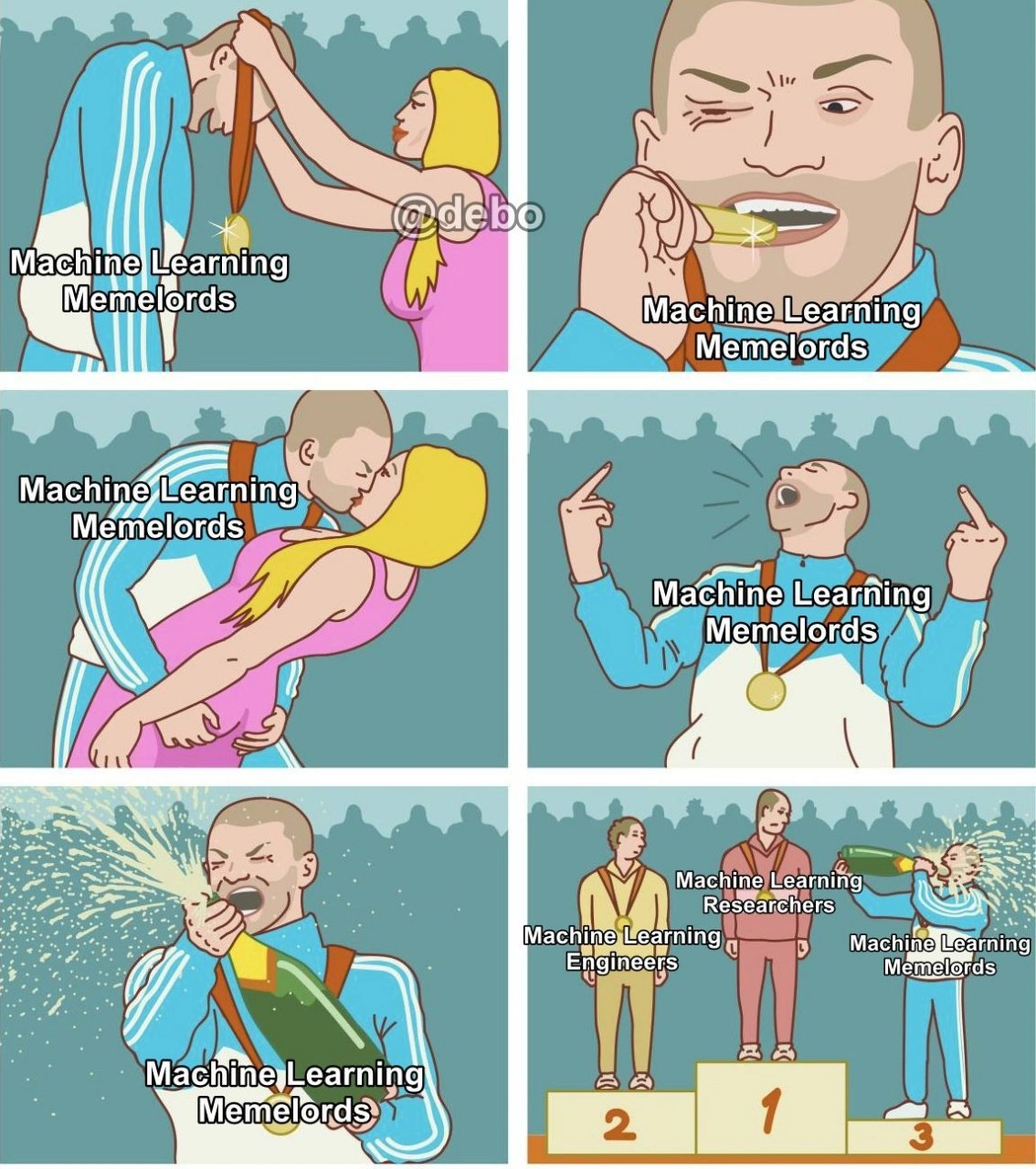
Imagine running a race at school and coming in third place, but then throwing a huge victory party like you won the whole thing. You’re jumping around, spraying juice everywhere, biting your bronze medal and shouting “I’m the champion!” Meanwhile, the real first-place winner is standing on the top podium quietly holding their gold medal, and the second-place kid is next to them with a silver, just clapping politely. It’s funny because everyone can see you only came in third, but you’re celebrating louder than anyone. The joke is basically about bragging a lot even when you didn’t actually win. It makes people laugh because it’s silly and over-the-top – the person who did the least is acting like they did the most, and everyone else is just looking on like, “Um, you know you didn’t get first, right?”

Level 2: Hype vs Reality

Let’s break down the scene and the labels in this meme. It’s using a drawn podium ceremony (like winners at the Olympics) to compare three groups in the machine learning community:

  • Machine Learning Researchers (1st place) – These are the top experts and scientists in AI. They’re the ones who come up with new algorithms and cutting-edge ideas. Machine Learning (ML) itself is a field of computer science where we teach computers to learn from data. Researchers push this field forward by inventing new techniques (for example, a new way for a neural network to recognize images). In the meme, they’re standing quietly with the gold medal, implying they’ve done the most important work.
  • Machine Learning Engineers (2nd place) – These are the developers and engineers who build real-world applications using those research ideas. They take the theories and models from researchers and write the code to make them work for products or services. For instance, an ML engineer might use a researcher’s algorithm to build a feature in a smartphone app that can detect songs or to deploy a recommendation system on a website. They’re shown with the silver medal, meaning they’re also highly important, turning theory into practice.
  • Machine Learning Memelords (3rd place) – “Memelord” is internet slang for someone who is great at making memes (funny images/jokes). In the ML community, these are people who mostly create or share funny content about AI and ML on social media. They might not be doing serious research or building projects, but they’re really good at getting laughs and likes with jokes about things like “my computer is training a brain” or silly over-the-top claims about AI. They’re represented by the bronze medal in the meme (the lowest of the three ranks in terms of actual contribution).

Now, here’s the funny part: in the meme, the Memelord (bronze, 3rd place) is going absolutely wild with celebration. He’s biting his medal, kissing a woman, and spraying champagne everywhere as if he’s the champion. He even flips the middle finger as a sign of “I’m #1!” attitude. But when you zoom out in the last panel, you see he’s actually on the third-place podium, below the real winners (the engineer in 2nd and the researcher in 1st) who are standing calmly.

The joke is showing how online hype and bragging can make someone act like they’re a big winner even if they’re not actually the top achiever. In many developer communities, especially around AI and Machine Learning, people who make popular memes or braggy posts (like our memelords) sometimes get a lot of attention and “celebrity” treatment, even more than the folks quietly doing the hard work. It’s poking fun at this imbalance. Essentially, the meme is saying: the memers are over-celebrating, while the real researchers and engineers who did the serious work are barely noticed in the celebration. That contrast is what makes it funny. You have the “class clown” of ML getting all the applause and acting triumphant, while the real heroes are just standing there with a polite smile.

Level 3: Champagne for Bronze

In the AI_ML world, this meme nails a familiar scenario: the loudest social-media hype about MachineLearning often comes from those not actually at the top of the field. It uses the classic podium meme template to parody the scene. The tracksuit-clad bronze medalist labeled Machine Learning Memelords is celebrating like he won Olympic gold—biting his medal, making obscene gestures, and spraying champagne in triumph. Meanwhile, on the same podium, the real gold medalist (labeled Machine Learning Researchers) and the silver medalist (Machine Learning Engineers) stand above him in 1st and 2nd place, looking comparatively modest. The humor comes from this role reversal: the lowest-ranked contributor is acting like a rockstar, overshadowing the true leaders just because he’s way more flamboyant about his minor win.

Seasoned developers recognize this as a satire of AIHypeVsReality in modern dev communities. It’s common in online developer circles: someone who’s great at churning out AIHumor and TechHumor memes with exaggerated claims (our Memelord) often garners more attention and clout than the quiet experts who actually advance the technology. The meme exaggerates it perfectly. Machine Learning Researchers (1st place) are usually the PhD-level folks publishing papers and advancing fundamental algorithms—like inventing new neural network architectures or proving novel machine learning theorems. They’re the real champions of the field, but they tend to celebrate in subtle ways: a humble note in a conference talk, a handshake from a colleague, maybe a new citation. Nothing flashy. Machine Learning Engineers (2nd place) are the builders who take those research breakthroughs and make them useful. They optimize models, deploy them to production, handle messy datasets, and fix scaling issues at 2 AM. Their victories might be reducing model latency by 50% or finally getting a model to run on a smartphone — achievements that earn respect among peers, maybe an internal shout-out, but not exactly rockstar treatment on social media.

Now look at the Machine Learning Memelords on that third-place podium. This label refers to those social media personalities or community jokers who specialize in tech humor and AI memes. They may have relatively shallow real contributions—perhaps a few online courses or a toy project—but they loudly broadcast every minor accomplishment. They create viral posts like “I just trained an AI to play Tic-Tac-Toe, superintelligence is coming!” or joke that they “accidentally built Skynet because I left import tensorflow running overnight.” These get thousands of likes and shares. In terms of actual ML advancement, that’s a bronze-medal effort at best. But in terms of hype and visibility, they’re acting like world champions. The meme’s sequence of images—medal biting (showing off), kissing a model (basking in public adoration), flipping the bird (dismissing any “haters”), and dousing in champagne (victory lap)—perfectly caricatures how online bravado works. The memelord bathes in internet points and becomes a mini-celebrity in developer meme circles, essentially over-celebrating third place.

This resonates with veteran devs because it’s a truth we see often: the substance of work doesn’t always get the spotlight, but the spectacle of hyping it does. The Researchers and Engineers do the heavy lifting for AI/ML progress (they’re literally 1st and 2nd on the podium, the real winners). Yet the Memelord steals the show with flashy antics. It’s a commentary on our digital age where entertaining content can overshadow deep expertise. We laugh because we’ve all seen it: perhaps you spent months debugging and tuning a model for a real project, only to see a meme page get 10k upvotes for a joke about “training ML on grandma’s recipes.” It’s funny and a bit exasperating at the same time.

In short, this meme humorously contrasts real achievements vs. performative hype in AI. It’s a lighthearted jab at how the Machine Learning Memelords celebrate way harder (and louder) than the actual Machine Learning Researchers or Engineers who truly earned the top spots. Seeing a third-place contender pop champagne and flaunt a bronze medal as if it’s gold is the perfect metaphor for those over-hyped AI posts on your feed. We find it hilarious because we all know at least one “bronze medalist” who acts like they run the ML world—thanks to a few spicy memes and a lot of swagger.

Description

A six-panel comic using the 'Third Place Celebration' meme format to depict the hierarchy of roles within the machine learning community. The first five panels show an athlete in a blue tracksuit, labeled 'Machine Learning Memelords,' celebrating extravagantly: he receives a medal, bites it, kisses a woman, flips off the crowd, and pops a champagne bottle. A watermark for '@debo' is visible. The final panel reveals the full winners' podium. 'Machine Learning Researchers' are in first place and 'Machine Learning Engineers' are in second, both with stoic expressions. The wildly celebrating 'Machine Learning Memelords' are in third place. The humor satirizes the perception of contribution versus visibility in the tech world. While researchers create foundational knowledge and engineers build practical applications, the 'memelords' who create cultural content and commentary often celebrate their tangential role with the most visible enthusiasm, a dynamic that senior developers recognize from online tech discourse

Comments

7
Anonymous ★ Top Pick The ML researcher publishes the paper, the ML engineer implements the model, and the memelord gets all the upvotes by putting a picture of a cat in front of the loss function graph
  1. Anonymous ★ Top Pick

    The ML researcher publishes the paper, the ML engineer implements the model, and the memelord gets all the upvotes by putting a picture of a cat in front of the loss function graph

  2. Anonymous

    In ML the objective functions are clear: researchers minimize cross-entropy, engineers minimize p99 latency, and the memelords - spraying champagne on bronze - just maximize the social-media reward signal and declare convergence

  3. Anonymous

    The memelords' loss function is just MSE: Maximum Stakeholder Engagement. Meanwhile, we're still trying to explain why our 99.2% accurate model keeps predicting everyone is a hot dog

  4. Anonymous

    This perfectly captures the ML ecosystem's unspoken hierarchy: researchers publish papers nobody implements, engineers build production systems nobody reads about, and memelords explain both using Drake formats - somehow ending up more influential than either while occupying the awkward middle ground of 'technically correct but professionally questionable.' The real insight? The memelords are biting the medal because they know their Twitter engagement metrics exceed most researchers' citation counts, yet HR still asks for a PhD

  5. Anonymous

    Memelords podium with zero GPUs, while researchers burn clusters and engineers babysit prod inference

  6. Anonymous

    Goodhart’s law in one image: researchers minimize loss, engineers chase p99 latency, and memelords optimize the OKR leadership actually reads - engagement - so third place wins the timeline

  7. Anonymous

    When the org sets the objective function to “engagement,” researchers chase loss, engineers chase p99, and the memelords take home the gold

Use J and K for navigation