Digital Transformation's Unscheduled Catalyst
Why is this CorporateCulture meme funny?
Level 1: Wrecking Ball Surprise
It’s like when someone keeps saying, “We don’t need to hurry, everything’s fine,” and then boom – something big happens that forces them to rush. Imagine a student who doesn’t study for a test because they think the test won’t happen for a long time. They’re relaxed, playing games, saying, “Ah, the exam is far away, no worries.” But then the teacher suddenly announces a pop quiz. That feeling of shock when the student realizes, “Oh no, I have to deal with this right now!” – that’s what’s happening in this meme. The business bosses were procrastinating (putting off changes) just like the student who didn’t study. COVID-19 arriving is like the surprise quiz or an unexpected huge problem that shows up “like a wrecking ball” and breaks their easy routine. It’s funny in a cartoonish way: the executives were confidently saying they wouldn’t need to change, and literally at that moment, reality comes crashing in. It’s the classic joke of someone being proven wrong immediately. You can almost hear the record scratch: “In fact, change is happening right now!” The humor comes from that sudden twist — overconfident people getting a big surprise that forces them to do exactly what they thought they could avoid. It’s a bit like watching a character in a cartoon say, “I’ll be safe here,” and then an anvil (or in this case a giant wrecking ball) drops on them. The meme makes us laugh because we all know the feeling of procrastinating and then getting caught off guard by a big event, and seeing it happen to these smug bosses is both relatable and satisfying in a silly way.
Level 2: Remote Reality Check
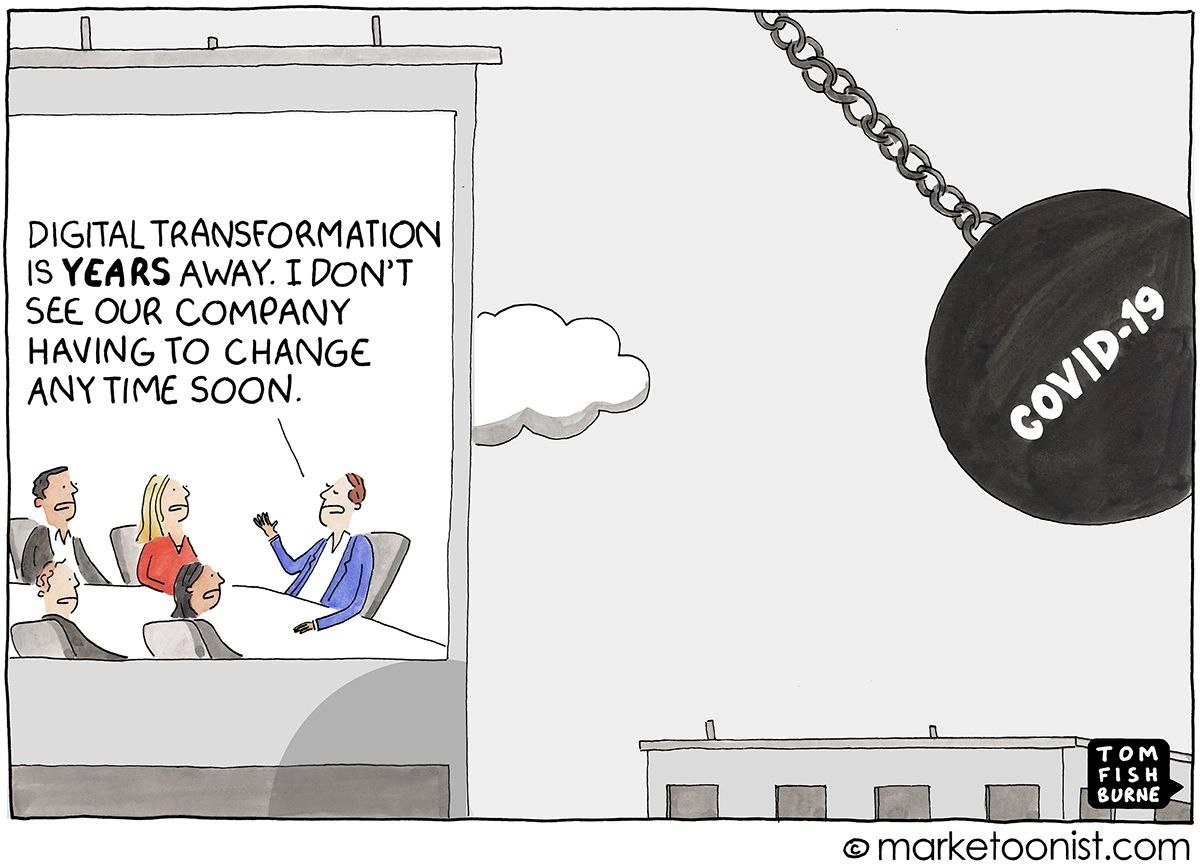
In this cartoon panel, a group of company executives (the big bosses) are sitting in a boardroom confidently stating that digital transformation is “years away” and that they don’t expect to change anything soon. Digital transformation is basically a fancy term for making a company’s technology and processes modern — for example, moving from old software and hardware (called legacy systems) to newer technologies, using online tools, and automating manual processes. In other words, it’s about catching up with the digital age: adopting cloud computing, improving online services, enabling employees to work digitally, etc. These executives in the cartoon have a legacy mindset, meaning they’re stuck thinking the old way of doing business will last forever. They’re pretty relaxed, maybe even smug, saying “no rush, we’re fine with our current setup.” This reflects a common CorporateCulture pattern where management postpones tough upgrades or changes, often due to cost or comfort with the status quo.
On the right side of the image, there’s a huge black wrecking ball labeled “COVID-19” swinging toward the building. A wrecking ball is a giant heavy metal ball on a chain used to literally smash and demolish buildings. Here it symbolizes a destructive force about to crash into the executives’ comfortable meeting. COVID-19, of course, refers to the COVID-19 pandemic that emerged in early 2020. This was a highly contagious virus that caused a global health crisis, leading countries to impose lockdowns, quarantines, and social distancing. In the context of businesses, COVID-19 was an enormous disruptive event. Practically overnight, offices had to close to keep people safe, and companies were forced to adopt Remote Work (having employees work from home) on a large scale.
Now, for many companies that hadn’t started their digital transformation, this was a huge challenge. Suddenly, those firms needed remote-work tooling: things like video conferencing (Zoom, Microsoft Teams), online collaboration platforms (Slack, Google Docs), VPNs (virtual private networks for secure remote access to office systems), and cloud-based systems that employees could reach from home. But implementing these isn’t always quick if you haven’t planned ahead. Some organizations were still running on older in-office setups – for example, important software might only be accessible from a computer at the office, or data might be stored on on-premises servers (meaning servers physically located at the company’s site). If nobody can go to the office, those LegacySystems become a big problem.
The meme is highlighting how the executives were saying “we won’t have to change for years,” but the pandemic forced change in a matter of days or weeks. It’s a RemoteRealityCheck for them. They thought remote work and going digital could wait, but COVID-19 basically said “nope, you have to do it right now.” This is a form of PandemicHumor because it’s using the stressful situation of the pandemic to make a joke: an external event (the virus) is depicted as a wrecking ball smashing through their denial. It’s funny in a revealing way — it shows how out-of-touch the managers were. One day they’re confidently saying the company doesn’t need to update, and the next day they’re scrambling to set up Zoom meetings and migrate to cloud services. (“Cloud” just means using powerful computers and servers via the internet, often run by other companies like Amazon AWS or Microsoft Azure, instead of your own local servers. Cloud services can be scaled up quickly, which is why they became crucial when everyone went remote.)
For a junior developer or someone new to the industry, think of digital transformation like updating an old video game or phone OS to a new version — except on a company-wide scale. It’s upgrading hardware, software, and mindsets. Legacy systems are like old devices or programs that still work but are outdated and hard to change. Before 2020, many large companies knew they should modernize, but they kept delaying because it was expensive, complex, or they just didn’t feel an immediate need. The executives in this meme represent that feeling of “eh, we’ll deal with it later.” The COVID-19 wrecking ball represents reality intervening: it forced everyone’s hand. Suddenly, workers had to log in from home, and companies had no choice but to rapidly change how they operate. This included everything from moving data to cloud servers so it’s accessible off-site, to adopting e-commerce because stores were closed, to digitizing paperwork so it could be done through websites or apps.
So, the cartoon’s joke is pretty straightforward: the guy in the suit says no big changes are needed anytime soon, but we (the viewers) can literally see a giant destructive ball about to crash into that notion. It’s an extreme visual metaphor for a real ManagementHumor scenario. The emotional core here is irony. The leaders were confident and maybe a bit smug, and then BAM! – an unexpected crisis (the pandemic) makes them eat their words immediately. Many people who worked in tech or business in 2020 find this funny because they lived through that sudden flip. One week you’re going to the office as usual, and the next week you’re trying to figure out how to do your entire job from your kitchen using a laptop and a shaky home Wi-Fi. Even if you’re new to work, you might remember schools and colleges in 2020 switching to online classes almost overnight – that’s the same kind of forced digital transformation. This meme basically sums up that crazy period when any stakeholder expectations about a slow, leisurely modernization were shattered. It points out how Modernization isn’t always a choice – sometimes, change is thrust upon you, ready or not, and often at the worst possible time. And that sudden change can be both terrifying and, in hindsight, a bit comical for how it catches people off guard.
Level 3: Digital Darwinism
The scene captures a classic case of enterprise complacency meeting an unstoppable force. In the boardroom, a confident executive proclaims “Digital transformation is years away. We won’t have to change any time soon.” — famous last words in tech. This smug legacy mindset assumes the business can coast along with its old systems and CorporateCulture inertia. The humor (tinged with pain) comes from how spectacularly wrong that assumption is: right as the exec declares no rush for modernization, the giant wrecking ball of COVID-19 is literally about to smash through their projection screen. It’s an industry trend punchline: Who actually ended up driving many companies’ digital transformation? Not the CTO, not the CEO, but a global pandemic.
In early 2020, this cartoon hit home because it depicted reality for countless organizations. Digital transformation — migrating legacy systems to the cloud, enabling remote work, modernizing online services — had been a buzzword on slide decks for ages. But entrenched management and Management/PMs often push it off, treating modernization as a nice-to-have future project rather than an urgent imperative. Then along comes COVID-19, a once-in-a-century event, acting “like a wrecking ball” to all those carefully procrastinated plans. The sudden_change from the pandemic forced even the stodgiest companies to embrace RemoteWork practically overnight. Offices closed worldwide in March 2020; by April (when this was posted), entire companies were scrambling to set up VPNs, cloud services, and video conferencing just to keep the lights on. The funny part is how extreme the whiplash was – years of transformation got compressed into a few frantic weeks. The not-so-funny part (for developers and IT teams) was the all-nighters, emergency budgets, and sheer chaos behind that rapid change. The cartoon turns that shared trauma into PandemicHumor, highlighting the absurdity that it took a crisis to get the company serious about modernization.
From a seasoned developer’s perspective, this meme nails the Modernization paradox: everyone knew the legacy systems and on-prem setup were brittle, but leadership was content to defer updates until “someday.” Then fate said someday is today. It’s a tech IndustryTrend version of Darwinism — adapt or face extinction. Companies that had invested in scalable online infrastructure and remote-work tools before 2020 fared much better, while those clinging to “business as usual” were caught flat-footed. The wrecking ball labeled COVID-19 is a perfect metaphor: an unexpected external force obliterating the LegacySystems comfort zone. In physics terms, the executives had plenty of inertia (resistance to change), and the pandemic delivered an immense unbalanced force, shattering that inertia instantly. StakeholderExpectations flipped overnight too: customers needed online options, employees needed to work from home securely. Suddenly the years-long roadmap became weeks, and it was adapt or perish.
A darkly comic undertone here is the I-told-you-so many IT folks were feeling. The Cynical Veteran in every company had warned for years that the old VPN can’t handle more than 50 people or that migrating to cloud infrastructure would provide resilience. Those warnings went unheeded… until suddenly RemoteWorkCulture was the only way to operate. It’s the kind of scenario that gives experienced engineers war flashbacks: provisioning thousands of laptops on a weekend, scaling up servers at 3 AM, teaching executives how to click the “Join Zoom meeting” button – all tasks that could’ve been gradual and planned, but instead happened in an adrenaline-fueled sprint. The meme’s humor is how accurately it skewers ManagementHumor and stakeholder expectations: the people in charge were blissfully saying “no need to hurry” right before reality walloped them. As an old sysadmin might quip, “The virus didn’t get the memo about our 5-year plan.”
To really illustrate the contrast, consider the plan vs reality before and during the pandemic:
| Executive Plan (Pre-2020) | COVID Reality (2020) |
|---|---|
| “Plenty of time to transform later.” | “We need digital solutions now!” |
| Core apps on on-prem servers. | Overnight migration to cloud services. |
| Limited VPN for a few remote users. | Entire workforce on VPN over a week. |
| Office-centric, travel-for-meetings. | All meetings on Zoom, RemoteWork by default. |
| Slow, cautious updates to legacy apps. | Rapid rollout of new collaboration tools. |
Every row in that table reflects an enterprise_complacency turned on its head. The ModernVsLegacy conflict got resolved by force, not by choice. And the reason developers find this cartoon hilarious (and maybe a bit triggering) is because it’s true. It condenses a massive, complex shift into one visual gag: the boss’s speech bubble saying “no change anytime soon” and fate replying with a giant "COVID-19" wrecking ball. It’s schadenfreude for the tech crowd – watching high-level execs learn the hard way that ignoring modernization has consequences. In short, the meme jokes that digital_transformation isn’t a matter of if but when, and if you wait too long, something (like a pandemic) will smack you into the future whether you’re ready or not.
# Pseudocode: plan vs. pandemic reality
try:
company.schedule_digital_transformation(start_year=2025)
print("All good, no rush...") # Executive complacency
except GlobalPandemicError: # Uh-oh, COVID-19 strikes
company.accelerate_transformation(start_immediately=True)
print("Emergency change: going digital now!") # Reality hits like a wrecking ball
Description
A single-panel cartoon by Tom Fishburne of 'marketoonist.com' that depicts a corporate meeting in a modern office building. Inside, a business executive in a blue suit confidently proclaims, 'DIGITAL TRANSFORMATION IS YEARS AWAY. I DON'T SEE OUR COMPANY HAVING TO CHANGE ANY TIME SOON.' Unseen by the meeting attendees, a massive black wrecking ball labeled 'COVID-19' is swinging toward their window. The cartoon uses dramatic irony to highlight the massive, unforeseen impact of the pandemic on the business world. It satirizes corporate complacency and the sudden, brutal acceleration of digital adoption (like remote work and cloud infrastructure) that was forced upon even the most change-resistant organizations. This resonates deeply with senior tech professionals who witnessed years of strategic planning and bureaucratic inertia get bulldozed by the immediate, existential need to adapt in early 2020
Comments
7Comment deleted
Our 5-year digital transformation roadmap was approved in a single afternoon in March 2020. The primary stakeholder was a virus
Nothing accelerates a five-year digital-transformation roadmap like a P0 bug called “global pandemic” that self-assigns and force-pushes to prod overnight
That's the same exec who spent three years evaluating Kubernetes while competitors shipped to production, then panic-hired consultants to "transform" overnight when the board started asking why our deployment frequency was still quarterly
Ah yes, the classic 'digital transformation can wait' executive stance - right up until a global pandemic turned every company into an accidental startup with a 48-hour migration deadline. Nothing accelerates cloud adoption quite like realizing your entire business model depends on VPN capacity you provisioned in 2012. Suddenly those 'nice-to-have' Kubernetes clusters and that 'experimental' remote work policy became the difference between operational continuity and existential crisis. COVID-19: the ultimate forcing function for every CTO's backlog that management kept deprioritizing
Newton's first law for enterprises: A legacy system at rest stays at rest unless acted upon by a global pandemic
Nothing reprioritizes a roadmap like a global write-lock on offices; the five-year “digital transformation” became a 48-hour VPN scale-out and Okta rollout
Exec: “Digital transformation is years away.” COVID ships it Friday, revealing the VPN as our monolith and the office as a legacy dependency