Skip to content
DevMeme
5891 of 7435
When a harmless ls turns into dmesg-level teenage rebellion
LowLevelProgramming Post #6451, on Dec 12, 2024 in TG

When a harmless ls turns into dmesg-level teenage rebellion

Why is this LowLevelProgramming meme funny?

Level 1: It’s Too Late, Mom!

Imagine a young kid walking past a group of cool older kids doing something wild, like popping wheelies on their bikes and jumping off ramps. The mom sees them and thinks, “Uh oh, if my kid watches this, he’s going to try it at home and get hurt.” She says, “Don’t look at them!” But the kid can’t help it — he’s fascinated. In the very next moment, before the mom can even finish warning him, the kid is in the backyard, helmet on, building a makeshift ramp out of plywood. As the mom realizes what’s happening, the kid zooms by, launches off the ramp, and mid-air shouts, “It’s too late, Mom!” in triumphant defiance. He crash-lands into a hedge (maybe with a cheeky “Goodbye, Mom!” as he disappears from view).

It’s a silly story, right? The mom tried to prevent the kid from copying the daredevils, but the kid did it immediately anyway, in his own over-the-top style. This meme is basically the computer programming version of that story. The “harmless ls” was like a normal, safe thing (like riding your bike normally), and “dmesg-level teenage rebellion” is like the kid’s crazy ramp jump. In plain terms: the kid saw something extreme, the parent said “no,” and the kid did it anyway, instantly and dramatically. It’s funny because the mom’s worst fear comes true in the blink of an eye — the kid turns into a little rebel and even “talks back” in a grand way. The exaggeration makes us laugh: we know real kids can’t build a ramp and fly that fast, just like a new coder wouldn’t ordinarily wreak havoc with one command. But the joke makes the point with a wink: sometimes telling someone “Don’t do that!” just makes them even more eager to do it, and the resulting mischief is both chaotic and comical.

Level 2: Little ls, Big Trouble

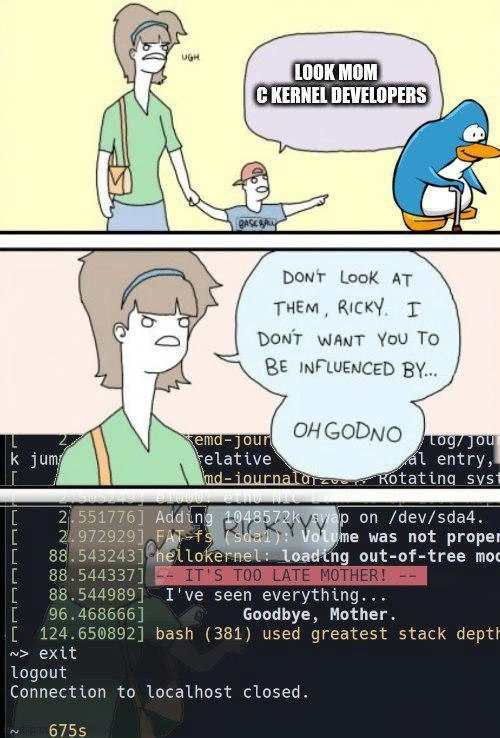
Let’s break down what’s happening in this meme in simpler terms. The mom and son in the first two panels set up a scenario: kid sees something fascinating, mom is worried he’ll get bad ideas. In this case, the “bad influence” is a group of C kernel developers – people who write the very core of the computer’s operating system (like Linux) using the C programming language. They’re depicted by the Linux mascot (Tux the penguin in blue) to make it clear we’re talking about Linux OS internals. The kid excitedly says, “Look mom, C kernel developers!” as if pointing out some really cool superheroes. The mom’s face instantly goes uh-oh. She says, “Don’t look at them, Ricky. I don’t want you to be influenced by—” but she gets cut off. Something has already happened before she can finish her sentence, and we see her exclaiming “OH GOD NO.” This is the classic setup of a mother_son_meme: parent tries to stop the kid from copying a reckless behavior, but the kid dives in headfirst anyway.

Now, the third panel is where all the technical humor comes in. Instead of cartoons, we see a real computer terminal with a bunch of text (looks like a screenshot of a terminal window). This text is actually output from the computer’s kernel log, which you normally view with the dmesg command on Linux. Think of dmesg as the system’s diary or medical report – it keeps messages about hardware, drivers, and low-level operations. Regular users don’t usually need to read it unless something’s wrong or you’re debugging. It’s definitely not a place where a simple ls command (which just lists files in a directory) would normally show up. So the presence of ls in the title (“harmless ls”) and dmesg in the same sentence already hints: something that should have been simple turned into a big deal under the hood.

In that log, several lines scroll by. The ones given in the description include:

  • Adding 204857k swap on /dev/sda2… – a fairly normal system message (probably the computer adding swap space, not too important to the joke except to make it look like a real log).
  • HelloKernel: loading out-of-tree module…this is crucial. It indicates that a kernel module named "HelloKernel" is being loaded. A kernel module is like a plugin for the operating system’s core. “Out-of-tree” means this module isn’t an official part of the OS; it’s something external, likely custom-built. This line basically means: someone just inserted a piece of code into the running kernel. Usually, you do that using insmod or modprobe commands, and you’d need administrative (root) privileges. It’s not something that happens by accident; it’s deliberate.
  • Then in red highlight (the meme shows it in red to emphasize it, presumably a warning level message) we see: “IT’S TOO LATE MOTHER!”. This is not a typical log entry – it reads like dialogue. That’s exactly the kid’s voice coming through, but via the computer. It suggests that the code in that module printed out this message. In Linux kernel programming, developers print messages to the system log with a function called printk. Here, someone (Ricky!) wrote a module that does printk("IT'S TOO LATE MOTHER!"). In other words, the kid’s rebellious spirit has now manifested as a message inside the OS log, essentially telling his mom: “Ha! You tried to stop me, but I’ve already done it.”
  • Next line: “Goodbye, Mother!” – likely the module printing another message, maybe when it was unloaded or finished. It’s like Ricky dropping the mic in the kernel log, dramatically announcing he’s done and out.
  • bash (381) used greatest stack depth – this one is a bit technical. Bash is the name of the shell (the command-line program the kid was using). The number 381 is the process ID for that bash session. “Used greatest stack depth” means that this bash process caused the deepest kernel stack usage seen so far. Each process has a limited stack in kernel mode, and if a process makes a lot of nested calls into the kernel (imagine function A calls B, which calls C, and so on), it uses stack space. This message implies Ricky’s antics pushed the system near some limit or at least further than any other process had since boot. It’s basically a warning; not usually harmful on its own, but it indicates something was done that’s unusual. Perhaps his kernel module accidentally recursed or did something complex when ls was run, leading to that record depth. For a junior developer, you can think of it as “the system saying: that was a deep rabbit hole you just went down.” It’s a sign of an extreme operation, which matches the story of Ricky doing something extreme.
  • Finally, we see the user prompt with > exit, then “logout”, and “Connection to localhost closed. 675s”. This means the user (Ricky) typed the exit command to leave the shell, logging out of his session. “Connection to localhost closed” suggests he may have been connected to a local session (or possibly a remote session to his own machine, which is a bit meta). The 675s likely means the session lasted 675 seconds – about 11 minutes – implying that in just eleven minutes, Ricky managed to do all of this from start to finish! That’s part of the humor (things escalated fast).

So, putting it together in a simple narrative: Ricky, the kid, sees the kernel hackers and immediately gets inspired to try it himself. He presumably opens a terminal, becomes the superuser (root – the only user who can tinker with the kernel like this), and runs a quick custom program (in C) that loads into the kernel. Perhaps it was a “Hello, World” kernel module that he tweaked to send a message to his mom. The moment that module loads, the computer’s internal logs announce his defiant message: “It’s too late, mother!” – meaning he’s already gone to the “dark side” of low-level hacking. The mom’s worst fear (him being influenced) comes true instantly. Then, as quickly as he appeared, he signs off with “Goodbye, Mother!” and logs out of the system. The computer notes that he really pushed its limits (greatest stack depth), implying that even the system was like “wow, that was intense.”

For someone new to these terms:

  • ls: A harmless command to list files in a directory. Users run it dozens of times a day without any side effects.
  • Kernel: The core part of an operating system that controls everything in the system. On Linux, the kernel is what those developers Ricky saw work on. It runs in a protected space, and typical programs (like ls) request services from it via system calls. Think of it as the engine of a car – usually you don’t mess with it while driving.
  • Kernel module: A piece of code that can be added to the kernel at runtime to extend its functionality (like adding a new gadget to that engine while it’s running). It’s powerful but dangerous if done wrong. “Out-of-tree” just means it’s not an official part of the engine design – it’s like an unofficial mod.
  • dmesg log: A log where the kernel (engine) prints status messages, errors, or any printk messages from modules. If something unusual or bad happens in the core, dmesg is where you’d look. Finding a cheeky message from your own kid in there is definitely unusual!
  • Stack depth: This refers to how deep a program’s call stack goes into nested calls. The deeper the stack, the more memory it’s using for those layers of function calls. There’s a limit; if you exceed it, the program or system can crash (stack overflow). “Greatest stack depth” in the log implies Ricky’s actions came close to that boundary or at least further than anyone else had since the last reboot. It’s like the system saying “this was the biggest stunt so far”.
  • Root user: The administrator of a Linux system who can do anything (like install kernel modules). We can infer Ricky either had access to a root account or exploited something to gain it (perhaps mom’s computer was already logged in as root?), because without root, none of this would be possible. It’s part of the absurdity – imagine a little kid suddenly having the “keys to the kingdom” on a computer.

In terms of why this is funny, especially under categories like OperatingSystems and Debugging_Troubleshooting: it’s mixing a domestic, relatable scenario (a kid not listening to his mom) with the nerdy reality of system internals. It’s poking fun at how quickly things can go from normal to very technically wrong. Anyone who’s tried to fix a computer after a small change went awry can chuckle at this. A simple ls shouldn’t normally cause any drama, so seeing it associated with such a loud meltdown in the logs is a hyperbolic way to say “curiosity got out of hand.” It also highlights a bit of the culture: kernel developers are often seen as the daredevils of programming – they operate with C code at a level where mistakes are costly. The mother treating them like rock stars or bad boys that could “corrupt” her son is the joke. And indeed, the son immediately doing something that a kernel dev might do (writing an out-of-tree module) confirms the mother’s fear in the most extreme comedic way.

For a junior developer or someone just learning: this meme is basically a cautionary tall-tale. It’s saying, “Be careful messing with the kernel; one minute you’re listing files, the next minute your computer is shouting at your mom in system logs!” Of course, in real life, things don’t escalate quite that fast — but it captures the spirit of what can happen when you venture into areas of programming you’re not prepared for. The debugging frustration comes when your machine starts doing weird things like this and you have to figure out why. Here we know why (Ricky did it), but imagine stumbling on such log messages without context – it would be a head-scratcher! The meme resonates with anyone who’s broken a system by doing something they thought was “innocent” at the time. And it gives a nod to the thrill of LowLevelProgramming: yes, it’s possible to bend a system to your will (even make it print silly messages), but you might also bend it until it almost breaks (stack depth warnings, et cetera).

In simpler summary: Mom tried to stop Ricky from getting into trouble, but he immediately did something super advanced on the computer that normal people never do. He effectively “hacked” the core of the OS to send a sassy message back to her. It’s funny because it mixes a normal family situation with highly technical silliness. The title “When a harmless ls turns into dmesg-level teenage rebellion” says it all: a normally harmless act (an ls command) turned into full-blown teenage rebellion – not by slamming doors or blasting music, but by generating kernel log entries! It’s an exaggeration meant to make techies laugh and nod knowingly.

Level 3: Rebellious Child Process

For seasoned developers, this meme evokes a mix of amusement and “oh no, I’ve seen this before” recognition. The scenario is a classic trope in tech circles: someone innocent (a child, in the meme) gets exposed to the hardcore side of programming (low-level C and kernel hacking) and immediately things escalate into chaos. It’s funny because it’s true enough – many of us have watched a harmless curiosity turn into a late-night debugging_troubleshooting session when a junior developer (or our younger self) tried to mess with something way over their privilege level. Here the “C kernel developers” are portrayed like a “bad influence” gang hanging out on the corner – the mom character frantically says “Don’t look at them, Ricky!” as if kernel hackers are the rebel kids smoking behind the school. It’s a brilliant metaphor: in the programming world, those who dive into writing kernel code do have a bit of a rebel mystique. They deal with dangerous tools (pointers, direct memory access, ring-0 privileges) and live on the edge where a mistake can freeze or panic a system. So seeing the cartoon mother react as if her child might fall in with a bad crowd of hackers sets up the joke.

The punchline lands in the third panel: the kid has indeed been “corrupted” instantaneously. The meme flips from cartoon to reality – we’re shown a real terminal output. For experienced folks, the sudden appearance of dmesg logs filled with bizarre entries is immediately laugh-inducing. It’s the digital equivalent of a kid dyeing his hair blue and blaring loud music in rebellion. The lines in the log are comedic gold for anyone familiar with Linux internals. We see normal system chatter (“Adding swap...”, etc.), then the telltale sign of a shenanigan: loading an out-of-tree module named “HelloKernel”. Instantly every senior dev’s eyebrow goes up – we know that loading random kernel modules is asking for trouble. It’s the development world’s version of a teenager sneaking out at midnight to joyride in the family car. The mother’s horror (“OH GOD NO”) in the meme is exactly how a team lead or mentor might react upon catching wind of a newbie developer trying something reckless on a live system (e.g., “You did WHAT with the server?!”).

Then, the highlight: in big red text, the kernel log screams “IT’S TOO LATE MOTHER!”. This is hilariously anthropomorphic – the computer’s core is literally voicing the kid’s rebellious smack-talk. In shared programmer lore, we’ve seen things like this: maybe not a kid telling mom off via printk, but certainly instances where someone left cheeky messages in code or logs. It reminds senior devs of Easter eggs or the dark humor sometimes lurking in low-level code. (For instance, some old Linux kernels would print “LP0 on fire” as an error – a literal and humorous message for a printer fault.) The dramatic flair here is wonderful: not only did Ricky write a kernel module, he used it to talk back to his parent through system logs! That’s a level of petty genius only a rebellious coder would think of. It’s as if instead of slamming his bedroom door, he slammed the entire operating system with a witty one-liner.

The log continues with “Goodbye, Mother!” – another flourish suggesting Ricky’s code might unload itself or shut down, the way a teenager might shout “I’m running away!” before disappearing. Seasoned engineers chuckle at this because it’s mimicking exactly what overzealous programming can feel like. Perhaps you recall a colleague’s “brilliant” idea to tweak the kernel or use an out-of-spec API – the rest of the team, like the mother, was yelling “No, stop!” but by the time anyone looked, the deed was done and the system was spitting out weird messages or crashing. The line bash (381) used greatest stack depth is the icing on the cake. For those in the know, it’s a somewhat obscure kernel debug message, meaning some process (the bash shell, likely Ricky’s session) went deeper in the call stack than anything before it. This suggests the kid’s antics pushed the system to a new extreme. It’s a subtle nod to those war stories where someone’s code accidentally created insane recursion or overloaded the system. In other words, Ricky not only misbehaved; he set a new record for mischief on that machine (a “greatest stack depth” record).

Finally, “Connection to localhost closed. 675s” – to a veteran dev, this line evokes the image of someone SSH’d into a machine and then abruptly disconnecting after 11 minutes. We’ve all seen that in logs when tracking who did what. It’s like catching the tail of the incident: someone was in, did crazy stuff, and left. Of course, here it’s the kid, essentially doing a “hit and run” hack on his own system. The time frame (675 seconds) is ridiculously short for accomplishing all this – that exaggerated speed is part of the humor. It implies a prodigious but dangerous talent: the kid didn’t even need an hour to learn kernel module basics and wreak havoc. This winks at the trope that young or novice programmers sometimes dive in head-first and rapidly produce something impressive but potentially destructive (think of the mythical genius teen hacker). For senior engineers, there’s a cathartic laugh in that absurdity. We remember being “script kiddies” or enthusiastic juniors ourselves: we might not have written kernel modules at age 7, but many of us did try wild things way before we fully understood the consequences.

This meme also satirizes the kernel developer culture gently. The Tux penguin cameo (wearing hip orange shoes) representing “C kernel developers” hints that kernel devs have a distinct identity – maybe a bit quirky, hardcore, and not always parent-approved in their methods. There’s a longstanding notion that kernel hackers operate by different rules (chasing performance and power at the cost of safety), much like rebellious teens test boundaries. Senior devs appreciate how the meme uses this cultural image: the mother’s fear is that Ricky will start thinking in terms of pointers, malloc()s, and unsigned longs at the dinner table – an inside joke about how low-level programming can consume one’s life. The lowlevelprogramming tag and context like ricky_goes_root (Ricky becoming a superuser) underscore that idea of diving off the deep end.

Ultimately, experienced engineers laugh at this meme because it exaggerates a real phenomenon in tech mentoring and learning. We’ve all given (or received) the advice: “Maybe don’t mess with that just yet, it’s dangerous.” And we’ve all seen cases where, despite the warning, curiosity wins. The results are often exactly what’s depicted: cryptic log messages, potential kernel panic alarms, and a story to tell later. The role reversal of the child schooling the parent via terminal output is just the comedic wrapper. It reminds us that in the world of software, a single line of code at the core can be more dramatically effective than a thousand lines elsewhere. And importantly, it nudges us with nostalgia: many seniors secretly admire that wide-eyed passion that leads to such experiments (we were Ricky once!), even if it’s paired with a facepalm because we also know the fallout (the poor mom/computer now has to deal with a tainted kernel state). In short, the meme is a tongue-in-cheek celebration of the bold, crazy stuff that happens when curiosity meets capability – encapsulated in a rebellious kid’s one-liner in the system logs.

Level 4: From ls to insmod

At the deepest technical level, this meme is highlighting a dramatic leap from a simple user-space command (ls) to executing code in kernel-space (insmod inserts a kernel module). In a normal Linux system, running ls (list directory) triggers a series of system calls – the kernel is invoked to read the directory entries (via something like the getdents() syscall) and then hands the data back to the user program. Under ordinary circumstances, listing files should be a completely mundane, sandboxed operation with no surprises. The humor comes from the fact that here ls isn't harmless at all – it’s a gateway into chaos because the child (Ricky) has meddled with the kernel itself. Essentially, Ricky crossed the protected boundary between user applications and the OS core, performing what amounts to a privilege escalation on his own machine, voluntarily.

In the third panel’s terminal screenshot, we see lines from the kernel log (dmesg). Normally, commands like ls don’t produce dmesg output; if you see messages there, something unusual is happening at the OS level. The line HelloKernel: loading out-of-tree module... is a key clue: it shows that an out-of-tree kernel module named "HelloKernel" was inserted. “Out-of-tree” means this module isn’t part of the official Linux kernel code (the "tree"); it’s a custom add-on. Loading a module modifies the running kernel on the fly. Kernel developers (the ones Ricky was so excited about) write modules in C, the same language the Linux kernel is written in. By loading one, Ricky essentially became a kernel developer in that moment – he’s added new C code into the live kernel. This is a huge deal technically: kernel modules run with full privileges (ring 0 on the CPU). There’s no safety net like there is in user-space; a bug in a module can crash the whole system (that’s called a kernel panic, the Linux equivalent of a “blue screen of death”). The mom’s horror is absolutely justified at a systems level: the kid went from listing files to executing arbitrary C code in the kernel in an instant.

Let’s decode the rebellious messages. The module likely contains code that uses the kernel’s logging function, printk(), to print “IT’S TOO LATE MOTHER!” and “Goodbye, Mother!” into the kernel log. In Linux, printk is like printf but for kernel space; it writes messages that you later see with dmesg. Here’s an example of how a minimal malicious (or playful) kernel module could produce such output:

// A minimal Linux kernel module that prints rebellious messages
#include <linux/module.h>
#include <linux/kernel.h>

static int __init rebel_init(void) {
    printk(KERN_WARNING "IT'S TOO LATE MOTHER!\n");
    return 0;
}

static void __exit rebel_exit(void) {
    printk(KERN_WARNING "Goodbye, Mother!\n");
}

module_init(rebel_init);
module_exit(rebel_exit);
MODULE_LICENSE("GPL");

In this C code, when the module is initialized (inserted with insmod), it logs "IT'S TOO LATE MOTHER!", and when it’s removed (rmmod), it logs "Goodbye, Mother!". The meme’s log snippet suggests Ricky’s module printed the first message on load, and perhaps the second on exit (or system shutdown). The timestamps (88.454693 etc.) in the screenshot indicate when these events happened after boot.

The next log line bash (381) used greatest stack depth... is an intriguing technical detail. It implies that the bash shell process (PID 381) consumed more stack space than any other process so far. Linux tracks the maximum stack depth for debugging; reaching a new “greatest” depth triggers a kernel message if certain debugging options are on. This often happens if something recursive or deeply nested runs in kernel context on behalf of that process. How might a mere bash shell use an extreme stack depth? One possibility is that Ricky’s module hooked into a system call or performed an operation causing an unexpectedly deep call chain in the kernel. For example, if the module tried to intercept the ls system call path (perhaps by wrapping the getdents syscall or manipulating the filesystem code), a bug could have caused an infinite recursion or a very deep function call sequence – thus nearly overflowing the stack. The kernel noticed this and reported it. It’s a sign of mischief: under normal conditions, bash should not trigger that message. The comedic timing is brilliant: right after the rebellious shouts, the system essentially says “uh, that was a deep one...” – like the computer itself remarking on the stunt Ricky pulled.

Finally, we see the user prompt input > exit, then “logout” and “Connection to localhost closed. 675s”. This suggests Ricky was in a remote session (maybe SSH into a Linux box) for 675 seconds (about 11 minutes) – just enough time for a curious kid to compile and load a quick kernel module, apparently. Ending the session with exit is like the grand finale of his escapade. It also metaphorically represents the rebellious teenager “storming off” after dropping a bombshell statement. In technical terms, Ricky likely had to be root (administrator) to load that module and view dmesg. So in those 11 minutes, he went from zero to root user, compiled a kernel module (his “Hello, Kernel” program), inserted it, and thus tainted the kernel (i.e., marked it as running non-official code). The system doesn’t show a full kernel panic, so evidently he just rode the line of mayhem, but didn’t crash – instead he dramatically logged out, leaving the system and his mother to deal with the aftermath.

In summary at this level: the meme cleverly condenses a wealth of low-level Unix and Linux concepts – from the interaction of user commands and system calls, to the dangers of out-of-tree kernel modules, to kernel logging and stack usage – into a visual joke. It’s an ode to OperatingSystems internals and that wild thrill of LowLevelProgramming. The harmless ls command’s journey into a full-blown kernel hack is an exaggeration, of course, but it’s grounded in real technical possibilities. It tickles engineers who know that crossing from user space into kernel space (KernelDevelopment 101) can escalate complexity and risk faster than you can say SegmentationFault. The meme essentially says: “Today he’s listing files, tomorrow he’s writing kernel modules” – a tongue-in-cheek warning of how quickly innocuous curiosity can spiral into hardcore system tinkering.

Description

Three-panel meme. 1) Cartoon mom in green dress pulls her small son past a blue tux-penguin wearing orange shoes; inside the son’s speech bubble: “LOOK MOM C KERNEL DEVELOPERS.” 2) Close-up of mom, worried, saying: “DON’T LOOK AT THEM, RICKY. I DON’T WANT YOU TO BE INFLUENCED BY - ” but an overlapping bubble from off-screen already screams “OHGODNO.” 3) Cut to a black terminal screenshot filled with kernel log lines: “2.557179 Adding 204857k swap on /dev/sda2…”, “88.454693 HelloKernel: loading out-of-tree module…”, then highlighted in red, “IT’S TOO LATE MOTHER!” followed by “Goodbye, Mother!”, “bash (381) used greatest stack depth…”, user types “> exit”, “logout”, and finally “Connection to localhost closed. 675s”. The visual punch-line is that the child immediately dives into low-level C hacking, surfacing as dramatic dmesg output while the system cheerfully reports stack-depth abuse. For senior engineers this mocks how quickly curiosity about kernel internals escalates to dangerous out-of-tree modules and terminal drama

Comments

7
Anonymous ★ Top Pick Every parent worries their kid will pick up bad habits; ours skipped TikTok and went straight to writing unsigned kernel modules in vim
  1. Anonymous ★ Top Pick

    Every parent worries their kid will pick up bad habits; ours skipped TikTok and went straight to writing unsigned kernel modules in vim

  2. Anonymous

    The real horror isn't the kernel panic - it's realizing your child just understood why your mutex implementation has a race condition and is now suggesting they rewrite it in Rust for 'memory safety, Mother.'

  3. Anonymous

    Ah yes, C kernel developers - the only people who can make a computer say 'Goodbye, Mother' before dying. They work so close to the metal that their code doesn't just crash, it has an existential crisis. One wrong pointer dereference and suddenly your filesystem is 'not properly unmounted' and your stack depth is questioning its life choices. It's like watching someone juggle chainsaws while standing on a tightrope made of memory addresses - technically impressive, but you really don't want your kids getting any ideas. After all, once you've seen a kernel panic at 2 AM because you forgot to check a null pointer in an interrupt handler, you can never unsee it. The void stares back, and it's segfaulting

  4. Anonymous

    Once the kid discovers insmod, you don't get 'Hello, World' - you get a tainted tree, dmesg poetry, and an SSH session that ends the way recursion always does: 'bash used greatest stack depth'

  5. Anonymous

    Kernel devs' influence: turning Ricky's VM into an out-of-tree module that recurses until bash begs for mercy

  6. Anonymous

    Parenting in systems teams: one peek at dmesg and they declare GC a user-space myth, signing the goodbye note with “exit; logout.”

  7. @Mishanya43 1y

    I'm fucking crying

Use J and K for navigation