Skip to content
DevMeme
5468 of 7435
Love In The AI Burn-Rate Era
Startup Post #5992, on May 12, 2024 in TG

Love In The AI Burn-Rate Era

Why is this Startup meme funny?

Level 1: Expensive Lemonade Stand

This is like working long hours so someone you love can run a lemonade stand that loses money every day because the lemons are too expensive. The funny part is that the dream sounds exciting, but someone still has to pay for all the lemons.

Level 2: Burning Money To Learn

A startup is a young company trying to find a repeatable business model. Burn rate means how much money it loses each month while it is building, testing, hiring, or trying to grow. If a startup loses $30k a month, it must find funding, revenue, or cost reductions before the money runs out.

An AI startup can be expensive because AI products often depend on paid model APIs, cloud servers, GPUs, data storage, and repeated experiments. Even a simple chatbot-style product can cost money every time users send prompts, documents are processed, or background jobs run.

For newer developers, this is a reminder that technical success and business success are different. A demo can work beautifully and still lose money on every user. Good engineering includes asking what each request costs, what can be cached, what can be batched, and whether the expensive model is actually needed.

Level 3: Romance As Runway

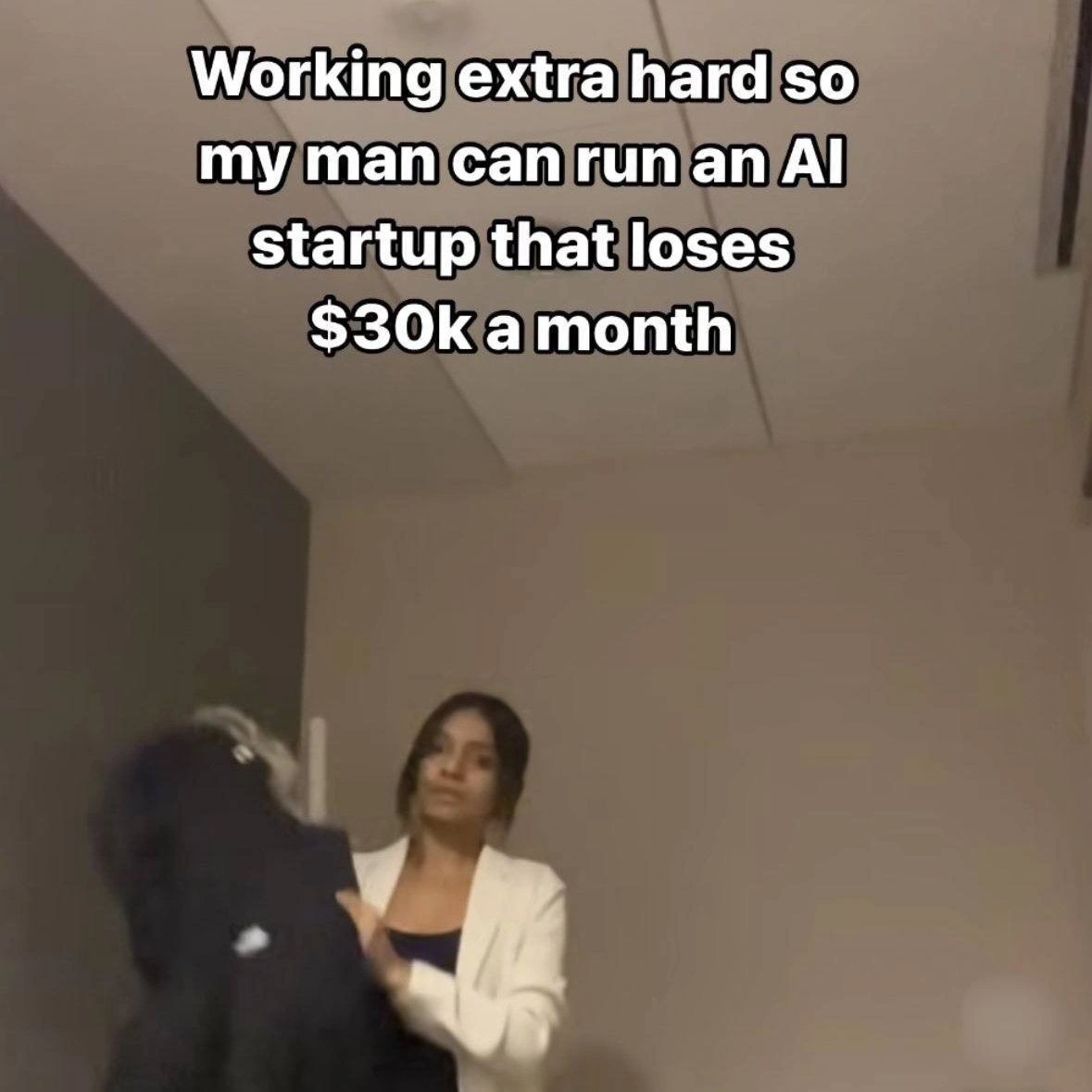
The meme's entire premise is in the visible caption:

Working extra hard so my man can run an AI startup that loses $30k a month

The joke works because it translates startup burn rate into relationship dynamics. Instead of venture capital, angel checks, or revenue financing the company, the implied funding source is one exhausted partner working "extra hard" while the founder's AI startup turns cash into invoices. It is romantic comedy for the negative-margin era.

For developers and founders, the number matters because AI startup costs can become real very quickly. A normal software startup may spend on hosting, payroll, analytics, observability, and SaaS tools. An AI startup can add model API usage, GPU instances, vector databases, batch jobs, fine-tuning experiments, data labeling, evaluation pipelines, and a demo that becomes more expensive every time someone actually uses it. The joke is not that all AI startups lose money. The joke is that it is very easy to build a product whose unit economics start as a dare.

The phrase "run an AI startup" also points at the hype-cycle tension. In a hot market, "AI" can attract attention before the business model is clear. Teams may prototype quickly, wrap existing models, chase demos, and assume scale will fix margins later. Sometimes that works. Sometimes the product is an elegant machine for converting someone's paycheck into cloud credits while the founder says "we are pre-revenue" with the confidence of a man protected from the billing dashboard.

The blurry office-like scene adds to the feeling of tired practicality. This is not a glossy founder keynote. It looks like someone in work clothes holding things together in an unglamorous hallway while the caption narrates the financial absurdity. That contrast is why the meme lands: the startup dream is framed as heroic, but the operational reality is rent, invoices, labor, and a partner quietly becoming the runway.

Description

The meme shows a blurry indoor scene, likely an office or hallway, with a woman in a white blazer standing behind a dark, partially obscured figure in the foreground. Large white outlined text at the top reads, "Working extra hard so my man can run an AI startup that loses $30k a month." The joke is about the romance-era version of startup financing: one partner subsidizing the other partner's AI company while it burns cash without obvious revenue. For engineers and founders, it hits the current AI startup economy where API bills, GPU costs, cloud spend, and hype-driven experimentation can turn a side project into a monthly negative-margin machine.

Comments

4
Anonymous ★ Top Pick Nothing tests product-market fit like discovering the only paying customer is your partner's paycheck.
  1. Anonymous ★ Top Pick

    Nothing tests product-market fit like discovering the only paying customer is your partner's paycheck.

  2. @man13hma 2y

    30к not that much

    1. @Bitals 2y

      So when do you start donating $30k a month to charities?

      1. @man13hma 2y

        When I’ll be a head of a bedroom ai startup funded by my hardworking wife. I’m not heading this direction though

Use J and K for navigation