Skip to content
DevMeme
5467 of 7435
The Ultimate Senior Dev Career Pivot: From Principal Architect at Microsoft to Goose Farmer
Career HR Post #5991, on May 10, 2024 in TG

The Ultimate Senior Dev Career Pivot: From Principal Architect at Microsoft to Goose Farmer

Why is this Career HR meme funny?

Level 1: Computers to Geese

Imagine someone who worked with computers for a very, very long time – so long that they got incredibly tired and stressed out. They had a big important job at a company (like Microsoft, which is a famous company that makes things like Windows and Xbox). Every day, they sat in an office or at their computer, dealing with lots of hard problems and meetings. It’s as if they were solving puzzles and doing homework non-stop for 22 years! Eventually, this person felt so worn out that they decided, “I need a big change in my life.”

So what did they do? Instead of working with computers anymore, they went to work with geese on a farm. Geese are those big, loud birds that honk – kind of like big ducks. Now this might sound funny and surprising. It’s like if your school’s principal or a very senior teacher suddenly said, “I’ve had enough of school, I’m going to go take care of animals.” You’d probably giggle because it’s so unexpected. One day they’re in a suit or nice clothes, and the next day they’re in muddy boots on a farm, feeding birds.

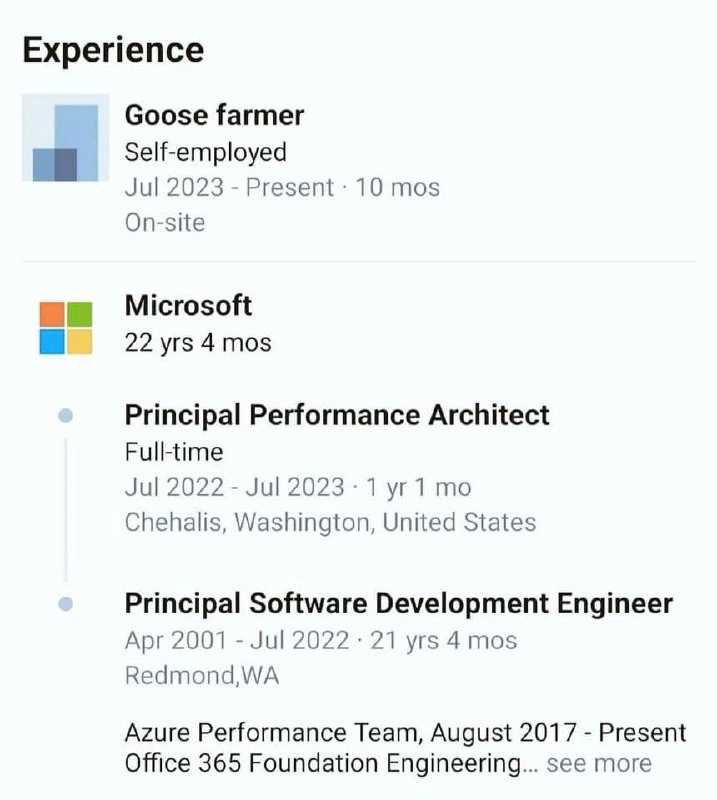
The reason this is humorous is because the two jobs are so different. Working at a place like Microsoft is like being in a bustling city or a busy office – lots of emails, phone calls, and brain work. Being a goose farmer is like living in the countryside, doing physical work like feeding animals, cleaning their pen, and collecting eggs. It’s much simpler in some ways, though it’s still hard work, just a different kind. It’s a bit like trading a high-tech robot for a bunch of honking birds. The picture (from LinkedIn, which is a website where adults show their job history) shows both jobs back-to-back: first the super high-tech job, then “Goose farmer” listed right above it. Seeing that side by side is kind of like seeing a story where a superhero retires and becomes a farmer – it makes you smile because it’s so abrupt and contrasts so much.

Why would our computer friend do this? Probably because they were really tired and stressed in their old job. Think of it like this: if you played a really hard video game for hours every day without rest, you might eventually want to go outside and just play with your friends or pet an animal instead. Grown-up jobs can be similar – if someone works too hard for too long, they might stop enjoying it, even if it’s a cool or important job. So, this person decided to do something totally different that might make them happier or give them peace. Taking care of geese on a farm is a quieter, more peaceful kind of life compared to big meetings and computer code. They’re their own boss now (self-employed means they work for themselves), and they get to be outside with animals, which some people find relaxing despite the hard work.

In simple terms, the meme is funny because it’s showing an extreme career change in a very official way. It’s as if someone wrote on their serious work résumé: “I used to build big fancy computer systems, and now I gather goose eggs.” It makes us laugh, and maybe also feel a bit good, because it’s nice to think that if you’re really stressed at work, you could one day choose a totally different path that makes you happier – even if it’s something as quirky as raising geese.

Level 2: Burnout to Barnyard

In this meme’s LinkedIn experience section screenshot, we see a former Microsoft Principal Engineer who has made a drastic career pivot – leaving a prestigious tech job to become a “Goose farmer.” For a junior developer or anyone newer to the tech world, let’s break down why this is noteworthy and humorous.

First, understand the roles listed. Principal Software Development Engineer at Microsoft is a very senior position. It usually means the person has decades of experience, leads important projects, and is an expert in their field. In the screenshot, this individual spent 21+ years (April 2001 – July 2022) in that role at Microsoft’s Redmond, WA headquarters. That’s essentially a lifetime in tech – likely working on everything from early Windows or Office products up through modern cloud services. They climbed the technical ladder to one of the highest non-managerial ranks (Principal), which is a big deal in CorporateCulture. Then they served as a Principal Performance Architect for a year in Chehalis, WA (July 2022 – July 2023). An architect in this context isn’t the building kind – it’s a software architect focusing on performance. This person probably specialized in making Microsoft’s services (possibly Azure and Office 365, as hinted by the text) run faster and handle more users. They would have been responsible for high-level design decisions to improve speed, efficiency, and scalability of large systems. In summary, this person was a top-tier tech expert with Microsoft for over two decades, tackling complex software challenges.

Now look at the entry above Microsoft: “Goose farmer – Self-employed – Jul 2023 – Present (10 mos) – On-site.” This means that starting around July 2023, after leaving Microsoft, the person listed themselves on LinkedIn as a goose farmer. Self-employed indicates they aren’t working for a company; they started their own farm or personal business. And “On-site” literally means the work is done in person at a specific location (naturally, a farm isn’t remote!). It’s such a sudden and surprising change that it catches your eye. On LinkedIn, people usually list professional positions like software engineer, manager, consultant, etc. Seeing “Goose farmer” in the same style and format makes it comically official, as if it’s just another normal career move. The meme is playing up that absurd formality – treating raising geese as your new “job title” following a job at one of the world’s biggest tech companies.

So why would someone do this, and what’s funny about it? This appears to be a commentary on burnout and the allure of a simpler life away from tech. Burnout is a term for the extreme tiredness, stress, and loss of motivation that can occur after you’ve been working too hard for too long. In the software industry, burnout is common, especially for those in high-pressure roles for many years. Long hours, on-call duty (where you must respond to problems at any time), constant learning of new technologies, and corporate bureaucracy can wear people down. After 22 years, it’s very plausible this Principal Engineer felt exhausted or unfulfilled, despite the prestige and pay.

The meme humorously imagines that instead of taking another tech job or a promotion, he made a U-turn in life: going from writing code and designing cloud systems to tending animals on a farm. A career pivot this drastic is rare, but not unheard of. Sometimes people refer to this type of change as “leaving big tech to go do something wholesome”. There’s even a tongue-in-cheek notion in tech circles of “going off to start a farm” or similar, when corporate life becomes too much. In reality, a few ex-tech folks do buy farms, start breweries, open bakeries, or pursue passion projects after saving up money or burning out. It’s seen as reclaiming work-life balance and doing something tangible. Here it’s specifically goose farming, which is an oddly specific and thus funny example (why not chickens or cows? The peculiarity of geese makes it extra humorous!).

Let’s clarify some terms and context from the screenshot:

  • LinkedIn is a professional networking site where people list their work experience. The Experience section is basically an online résumé/CV. Having “Goose farmer” listed there, right above “Microsoft – 22 yrs 4 mos,” creates a comedic juxtaposition. It visually tells a story of “I did this very serious tech job for a long time, and now I’m doing something completely different.”
  • Microsoft (22 yrs 4 mos): This indicates the person worked at Microsoft for over 22 years continuously. That’s a very long tenure at one company, especially in tech where many people switch jobs every few years. It suggests he joined around 2001 and left in 2023, witnessing huge changes in technology and the company itself. Microsoft’s culture in the early 2000s vs 2020s changed a lot (from the Windows XP era to cloud services like Azure). Staying that long could mean he really loved the work, or he was very tied to the company by things like loyalty or financial rewards (Microsoft, like other big tech firms, gives stock grants that vest over years – often called “golden handcuffs” because they encourage you to stay).
  • Principal Performance Architect (Jul 2022 – Jul 2023, Chehalis, WA): Chehalis is a smaller city in Washington state, quite a bit south of Seattle/Redmond. Not a typical tech hub – it’s actually a more rural area. This detail might imply he was working remotely or had moved away from the main campus. As a Performance Architect, he probably worked on improving the speed and reliability of Microsoft’s cloud (Azure) or services like Office 365. That’s a highly specialized role requiring deep knowledge of systems, networking, possibly even hardware considerations. It’s likely he dealt with complex issues like how to make Outlook or Teams run faster for millions of users, or how to reduce cloud server costs by optimizing code. Heavy stuff!
  • Principal Software Development Engineer (Apr 2001 – Jul 2022, Redmond, WA): Redmond is Microsoft’s headquarters. Being a Principal SDE means he was a veteran developer, possibly a tech lead or an architect on various projects over the years. 21 years in that role suggests he might have worked on many versions of Windows, Office, or later on cloud and enterprise software. Principal engineers often mentor others, review designs, and make big technical decisions. It’s not a 9-to-5 coding job; it comes with a lot of meetings, design docs, code reviews, and guiding teams.
  • The line under Microsoft mentioning “Azure Performance Team, August 2017 – Present Office 365 Foundation Engineering… see more” likely is the beginning of a description of his responsibilities. It indicates he was involved in foundational engineering for Office 365 and Azure’s performance. This shows he was really at the core of Microsoft’s cloud and services – a high-impact area. Azure, for context, is Microsoft’s huge cloud computing platform (like how Amazon has AWS). If you’ve ever saved files to OneDrive or joined a Teams meeting, Azure’s behind the scenes. This guy was ensuring all that runs smoothly.
  • On-site: On LinkedIn, you can specify if a job is on-site, remote, or hybrid. “On-site” for Goose farmer is kind of obvious (farms are in-person), but seeing it listed formally is amusing. It contrasts with the increasingly remote-friendly tech roles – while tech workers debate remote vs office, a farmer job by nature can’t be remote. It’s a small comedic detail reinforcing how different the two careers are.

So, putting it all together: The meme shows a highly accomplished senior engineer switching to a humble farming occupation. This highlights themes of CareerHumor and CareerReflection. The humor comes from the surprise and the degree of change. It’s like seeing a starship captain decide to captain a fishing boat instead – you do a double-take. Why would someone go from a cutting-edge tech career to a farm? The implied answer is burnout or a search for a more meaningful, low-stress life. Big tech jobs can be exhilarating but also mentally draining. After years of cranking out software or dealing with corporate bureaucracy, some people daydream about doing something tangible and earthy, like farming, woodworking, or running a small business where the problems are straightforward.

In tech, there’s even a bit of a running joke: “I’ll quit and become a goat farmer” (or insert any peaceful job) when things get too crazy at work. This meme picks “goose farmer,” which makes it even more humorous because geese are known to be quirky animals (they hiss and chase people – they have attitude). Dealing with geese might be challenging in its own way, but to an office-weary engineer, even getting chased by a goose might feel less frustrating than, say, dealing with the 100th email thread about project deadlines or a never-ending debugging session.

For a junior developer looking at this, it’s also a bit of a cautionary tale wrapped in comedy. It shows that even high achievers can hit a wall. It’s okay – even normal – to reconsider what you want out of your career if you’re unhappy. The meme exaggerates it for effect: not everyone will or should literally go farm geese. But it represents the very real thought, “I need a complete break from this”. The CorporateCulture at big companies sometimes grinds people down with constant pressure to deliver and stay competitive. And the higher you go (like Principal level), the more responsibility and stress you often carry. So the joke is, after all that, this person said “forget it” and opted for a pastoral, self-directed life.

To someone new in their career, the idea might seem far-fetched (why give up a top job at Microsoft?!). But from a seasoned perspective, you realize that titles and salaries don’t guarantee happiness. The meme is essentially an ironic commentary: Working in tech is great… until it isn’t, and then a quiet farm starts sounding like heaven. It’s a mix of funny and thought-provoking. Plus, seeing “Goose farmer” on a LinkedIn profile in the same format as fancy corporate jobs is just plain comedic imagery – it’s formalizing something informal, which is classic humor.

In summary, this meme uses a single LinkedIn profile snapshot to tell a story of leaving_big_tech for a radically different life. It highlights concepts of burnout (being so overworked and tired that you want out), and a career pivot (a big change in career direction). It resonates as CareerHumor because many folks in the industry have jokingly imagined doing the same. And it subtly pokes at Microsoft’s and Big Tech’s culture – even a Principal Engineer might prefer peace and quiet over corporate glory eventually. The meme is both a laugh and a little lesson: value your well-being, because even the best careers can wear you down to the point you’d rather hang out with geese than with computers.

Level 3: Azure to Pasture

After 22 years in Big Tech, this veteran Microsoft engineer appears to have literally gone out to pasture. The LinkedIn screenshot sets up a darkly comic contrast: a lengthy tenure as a Principal software wizard on the Azure cloud and Office 365 teams, immediately followed by a new self-assigned title: Goose farmer (Self‑employed). It’s the ultimate career pivot punchline for those in the know. On one line, he’s a Principal Performance Architect wrangling globally distributed systems; on the next, he’s wrangling actual geese on a farm. The humor here is as sharp as a goose’s honk at dawn – a seasoned techie trading high-profile architecture reviews and on-call rotations for barn chores and free-range foul (er, fowl). It lampoons the unspoken truth of CorporateCulture: even a top-tier SeniorEngineerLife at Microsoft can burn someone out so completely that shoveling manure and herding waterfowl starts to sound like sweet relief.

This CareerHumor strikes a chord with anyone who’s endured decades in the industry. A Principal Software Development Engineer at Microsoft is no small feat – it’s a role at the top of the technical ladder, typically held by those who have survived countless product cycles, late-night outages, feature-death marches, and reorgs. Such veterans carry battle scars from debugging memory leaks at 3 AM and firefighting production incidents that would send juniors running. They’ve sat through endless architecture review boards and Blue Badge meetings where “leveraging synergies” and OKR drill-downs replace actual coding. Our protagonist spent two decades optimizing enterprise software performance, squeezing out latency in the Azure Performance Team and building Office 365 from the ground up. And now? He’s optimizing grain feed schedules and building actual goose nests. The sheer absurdity is gold: after designing systems to handle millions of Outlook users, he’s decided that managing a gaggle of geese is the more scalable lifestyle.

Why is this so relatable (and hilarious) to senior devs? Because many have daydreamed about this exact escape. It’s a CareerReflection fantasy known to every burnt-out tech lead: “What if I just quit and ran a farm/brewery/coffee shop instead?” – trading stand-ups for farm stand and conference calls for calls of the wild. High-level architects often joke that dealing with microservice orchestration is like herding cats, but actual herd animals might be easier to manage than office politics. Here, the meme dials it to eleven: herding geese, those notoriously ornery creatures, might still involve less squawking than aligning six cross-functional teams on a feature rollout. By listing “Goose farmer” on LinkedIn, this engineer is basically saying “I’d rather risk getting pecked by angry birds than endure one more corporate all-hands meeting.” It satirizes the extreme burnout and disillusionment that can hit even the most passionate technologists after decades under the relentless pressure of Big Tech. The CorporateCulture of constant innovation can ironically wear people down to the point they seek solace in literally anything else – even manual labor in a field.

Notice the little details: “On-site” is cheekily noted next to the Goose farmer role. In tech, “On-site” usually means you work in the office (as opposed to remote); here it’s a wry nod that yes, goose farming is very much not a work-from-home gig – unless your home is a farm. It’s a subtle jab at how our industry obsessed over remote vs. hybrid work, while this guy noped out to a job that’s 100% physically present (you can’t patch a goose or deploy feed via VPN). And that blank profile avatar and non-branded title? It contrasts with the fancy Microsoft logo and Full-time Principal titles below – visually underscoring how he’s left the land of Corporate VP titles and fancy org charts for a one-man venture where none of that prestige matters. The multicolored Microsoft logo that once lent him status is replaced by an empty default icon; he’s throwing away the clout and perhaps the “golden handcuffs” (the stock bonuses and benefits that keep you tied to Big Tech). Maybe after 22 years, his stock grants fully vested – turning him financially secure (a golden egg or two in the bank) – and he took the money and ran... straight to a farm. It’s the classic tale of finding freedom after grinding through the tech rat race for ages.

There’s also an ironic literalism at play. In tech, we often talk about “wild goose chases” when tracking down elusive bugs or waiting on endless management approvals. Well, this meme’s hero decided to chase actual wild geese instead of the metaphorical ones. And you know what? Chasing real geese might be less futile than chasing corporate KPIs that keep shifting every reorg. The text “Azure Performance Team, August 2017 – Present... see more” in the screenshot hints he was a top performer, the guy in charge of making Azure services lightning fast. Think about the stress: if Teams calls were lagging or Outlook web was slow, folks like him got paged. Now, if a goose is slow, who cares? No pager, no severity-1 incident at midnight because a goose didn’t lay an egg on schedule. The Microsoft entry spanning 22 yrs 4 mos is a monument to loyalty (or maybe inertia), but tucked under it is likely a laundry list of high-profile accomplishments – “Foundation Engineering Lead”, “Performance Architect for critical cloud infrastructure”, etc. It’s the kind of résumé that normally commands reverence in the tech world. And atop it now sits Goose farmer, Self‑employed. The meme brilliantly subverts our expectations: someone with such serious credentials doing something so mundane and unrelated. It’s a reminder (served with a side of sarcasm) that after a certain point, many developers don’t care about prestige or Microsoft titles – they just want peace.

To drive the point home, let’s compare the two “jobs” this person held, from the perspective of a jaded engineer:

Life as a Principal Engineer (Big Tech) Life as a Goose Farmer (Post-Tech)
On-call for 2 AM server outages, pagers buzzing On-call at dawn when the geese start honking
Chasing elusive memory leaks and performance bugs Chasing actual geese that wandered off the coop
Back-to-back Scrum meetings and sprint demos Morning feeding rounds and cleaning the barn
Writing design docs & fighting over architecture in review boards Building a wooden goose shelter with your own hands
Coordinating across 5 teams and office politics Coordinating grain deliveries, no office politics (geese don’t do PowerPoints)
Stress from Azure incidents impacting millions Stress from a fox sneaking into the henhouse (at least that one’s tangible)
Golden handcuffs of stock vesting keep you in the grind Collecting actual golden-ish goose eggs (and no HR approval needed)

Every row in that table is a wink to those who’ve been in the trenches. On the left, the abstract digital stressors of a high-end software career; on the right, the concrete, earthy tasks of farming. The meme cleverly suggests that the latter might actually be less crazymaking. After all, geese can be ornery, but they don’t file bug reports at 4 PM on a Friday. And a rogue goose on the loose is a lot easier to catch than a catastrophic bug in production that takes a 12-person war room to diagnose. It’s a cynical veteran’s way of saying: “After all the complexity and corporate absurdity, even scooping goose poop sounds like paradise.”

Ultimately, this LinkedIn gag highlights a real industry trend wrapped in humor: burnout and the appeal of leaving_big_tech. It’s a satirical take on what happens when a SeniorEngineerLife reaches a breaking point. Instead of scaling more services, our hero scaled down his life. The goose_farmer entry is both a joke and a kind of techie folk hero moment – the image of a principal engineer dropping the keyboard and picking up a pitchfork resonates because it’s an exaggeration of feelings many have had. This meme is funny, yes, but it also nails a truth: sometimes the only way to win the tech career game is to stop playing and go tend your geese.

Description

A screenshot of a work experience section from a professional networking profile, likely LinkedIn. The profile shows two main entries. The most recent job is 'Goose farmer', listed as self-employed and on-site since July 2023. Immediately below this is a 22-year, 4-month tenure at Microsoft, which includes roles like 'Principal Performance Architect' and 'Principal Software Development Engineer' on foundational teams like the Azure Performance Team and Office 365 Foundation Engineering, ending in July 2023. The headers and text are black on a white background, with standard corporate logos for Microsoft and a generic icon for the 'Goose farmer' role. The technical humor stems from the extreme and abrupt career change. A highly distinguished engineer, holding a 'Principal' title (a top-tier individual contributor role) after more than two decades at a major tech corporation, has left it all behind for the rural, low-tech life of goose farming. This is the quintessential daydream for many senior tech professionals who are burnt out by the high-stress, abstract nature of their work. The meme is relatable because it represents the ultimate escape from corporate bureaucracy, performance reviews, and complex distributed systems to a life of tangible, straightforward problems
Comments

13
Anonymous ★ Top Pick He's now a Principal Performance Architect for a different kind of flock, optimizing for egg latency and honk throughput
  1. Anonymous ★ Top Pick

    He's now a Principal Performance Architect for a different kind of flock, optimizing for egg latency and honk throughput

  2. Anonymous

    Left Azure after 22 years to farm geese - finally a distributed system where Raft, leader election, and aggressive health-check honking are the exact same operation

  3. Anonymous

    After 22 years of optimizing Azure's performance, they finally found a distributed system that actually delivers: geese naturally load balance across the pond without a single Kubernetes cluster

  4. Anonymous

    After optimizing Azure's performance for 22 years, they finally achieved O(1) complexity in their career by eliminating all dependencies, refactoring their life to a single-threaded goose farming operation, and deploying to on-premises infrastructure. Sometimes the best architectural decision is to deprecate the entire stack and start fresh with a completely different runtime environment - preferably one that honks

  5. Anonymous

    After 22 years optimizing Azure perf, they migrated to the ultimate on-prem cluster: geese - sharded by season with eventual consistency and excellent honk throughput

  6. Anonymous

    From Principal Performance Architect to goose farmer: same distributed systems, just better observability - liveness probes that honk, RAFT leader election every migration, and zero Jira

  7. Anonymous

    Pro tip from a 22-year MSFT vet: Goose farming means zero tech debt, infinite scalability, and no Jira tickets

  8. @mpolovnev 2y

    hm.... Is butchering geese a hard skill or a soft skill?

    1. @proglll 2y

      both 1) you need to work with hands and land? 2) you have to sell the farm products

  9. @marogatari 2y

    I really want to have a farm, for that real bullshit is way better than my bullshit code.

  10. @yevhen_k 2y

    just reminded me good old meme(?) comics(?)

  11. @dsmagikswsa 2y

    Remind me the meme 'How to be the gardener?'

    1. @RiedleroD 2y

      by equipping gunboats and a low-damage rocket launcher of course

Use J and K for navigation