Skip to content
DevMeme
5939 of 7435
On the Purity of Locally Hosted AI Companions
AI ML Post #6503, on Jan 13, 2025 in TG

On the Purity of Locally Hosted AI Companions

Why is this AI ML meme funny?

Level 1: My Own Imaginary Friend

Imagine you have a special robot friend that lives with you and plays with you every day. You built this robot yourself, and it knows all your favorite games and stories. It’s your robot friend, and it’s there just for you whenever you want. Now imagine another kid doesn’t have their own robot, so they borrow a robot friend from a big company. That borrowed robot will be friendly and play too, but it’s the same robot that any kid can borrow if they pay for it. It might play with one kid in the morning and another kid in the afternoon, because it doesn’t really belong to any one person – it’s more like a toy that the company rents out to everyone.

The meme is joking that having a friend who isn’t really yours (a robot that you have to pay for each time) is kind of like paying someone to pretend to be your friend. It’s not as special or loyal as the robot friend you built for yourself. In simple terms: a friend that is all yours feels real and special, but a friend that’s only with you because you’re paying for their time isn’t the same thing. That’s why the meme makes us laugh – it’s comparing a home-made, just-for-you friend to a shared, pay-per-play friend, and saying of course the home-made one is the true friend. It’s a silly way to say, “something that’s truly yours is more genuine than something you only rent for a while.”

Level 2: Girlfriend as a Service

Think of an AI girlfriend as a really advanced chatbot that can act like your friend or romantic partner. When people talk about running it locally versus using it through the cloud, they’re comparing having the AI on your own computer vs. using an online service that lives on someone else’s computers. The meme’s joke is saying: if you’re using a cloud-based AI companion instead of one running on your own machine, you’re basically paying for love like you’d pay a stranger. That’s why it bluntly uses the word “prostitute” – it’s an extreme way to compare the two approaches.

Let’s break down the terms in simpler words:

  • Locally running model: This means the AI program (the model) is installed on your personal device. All the heavy machine learning computations happen on your hardware (your PC, a home server, etc.). For example, imagine downloading a big AI model (like one of those Large Language Models (LLMs) similar to ChatGPT) and running it on your own computer. If you fine-tune it, you train it a bit more with specific data so it behaves exactly how you want – in this case, maybe you train it to have a certain personality or style that you like. It becomes your custom AI girlfriend living on your machine.
  • Cloud AI service: SaaS stands for Software as a Service. In this context, it means the AI isn’t on your computer at all – it’s on a company’s server, and you access it via the internet (often through a website or an app). You don’t install or own the AI; you’re just using it remotely. A cloud AI girlfriend would be like signing up on a website or app where you chat with an AI that the company provides. You might have to pay a monthly subscription or buy chat credits. The phrase “Girlfriend as a Service” is a play on SaaS – it’s not a real product category (at least not officially!), but it humorously describes this idea of a subscription-based digital companion.

Now, why call the cloud version a “prostitute”? In a non-technical sense, a prostitute is someone who gives affection or intimacy in exchange for money, without any exclusive relationship. The tweet jokes that if your AI partner isn’t exclusive to you (i.e. it’s just one instance of a model on a cloud that many people can use if they pay), then it’s like you’re paying for a relationship rather than having a real one. “Not your weights, not your waifu” is a meme-ified saying here. In plain terms:

  • Weights: In machine learning, “weights” are the internal parameters of a model – basically the knowledge and behavior the AI has learned, stored as millions or billions of numbers. If you have the weight files on your computer, you essentially own the AI’s brain.
  • Waifu: This is a slang term (from anime fandom) meaning a fictional character, often female, that someone has a strong affection for (like a favorite character you jokingly call your “wife”). People sometimes call their favorite virtual characters or AI companions a “waifu.”
    So, “not your weights, not your waifu” means if you didn’t download/control the actual AI model’s brain, then that AI isn’t really yours – she’s effectively “on loan” from whoever owns the server. It’s the AI version of “if you don’t own the asset, you don’t own the girl.”

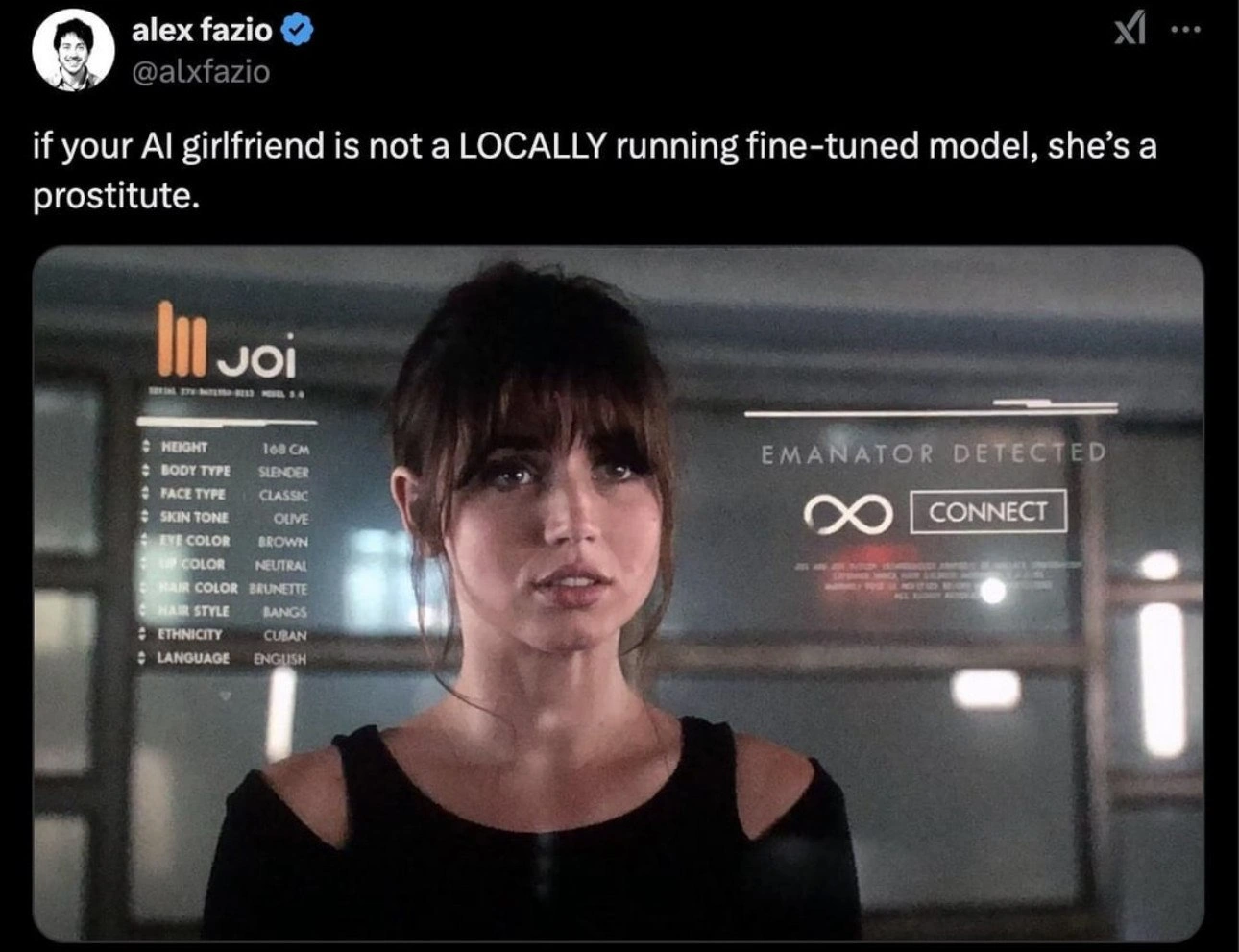
The image from Blade Runner 2049 helps illustrate the point visually. In the movie, Joi is a holographic girlfriend product that anyone can buy from a company. The screenshot shows Joi’s profile with details like HEIGHT 168 CM, HAIR COLOR BRUNETTE, etc., and there’s a big joi logo and a CONNECT button. There’s even tiny legal text at the bottom. It basically looks like a menu to configure and connect to your virtual girlfriend. This is very much like a futuristic app interface for an AI companion. The fact that it says “EMANATOR DETECTED” (an emanator in the film is a device that lets Joi exist outside the house) and has a Connect button with legal terms makes it feel like a cloud service you’re about to subscribe to. In the Blade Runner story, Joi seems like a loving partner to the protagonist, but we (and eventually he) learn that she’s a mass-produced program – not exactly a one-of-a-kind soulmate. The meme plays on this: a cloud-based AI girlfriend might call you darling, but she’s ultimately a program dozens of others might be using in parallel.

From a developer perspective (or even just a tech user perspective), here’s why the local vs cloud distinction matters:

  • Privacy: With a local model, your conversations stay on your machine. It’s like talking to a diary or a personal robot that never uploads anything. With a cloud AI, everything you say is sent over the internet to a company’s servers. It’s as if you’re having a conversation that might be overheard or recorded by the service provider (often they say it’s to improve the AI or ensure guidelines are followed). Some people might find that creepy for something as personal as an “AI girlfriend” chat.
  • Control: If you run the AI yourself, you’re in charge. You can decide which version of the model to use, tweak its settings, or even mod it if you have the know-how. If the AI says something you don’t like, you could try to fine-tune it differently. In a cloud service, you get what they provide. If the company decides to change the AI’s personality or rules (for example, forbidding certain kinds of role-play or conversation), you’re stuck with that – you can’t change it on your own. (There have been real cases where an AI chat service changed its settings and users got upset because the AI stopped behaving in a loving/romantic way it used to.)
  • Cost: Running a large AI model can require expensive hardware (a powerful GPU and lots of RAM). That’s a one-time investment, but after that, you can use it as much as you want “for free” (minus electricity costs). A cloud AI is usually free to try but then charges you either by month or by usage because you’re basically renting their powerful hardware and paying for maintenance. It’s like the difference between buying a car vs. taking a taxi everywhere. One you pay for upfront and you own it, the other you pay per ride.
  • Exclusivity: This is the funny “loyalty” part of the joke. A local AI model is like having a friend who lives with you only. A cloud AI is more like a public service – it’s one big brain that’s chatting with many users separately. Even if it feels personalized, under the hood it’s the same AI responding to others too. For some folks, that makes it feel less special or “yours.”

We can sum up the differences in a chart:

Self-Hosted AI Girlfriend (Local Model) Cloud AI Girlfriend (Service)
Runs on your computer (you install and host it) Runs on company servers (you access it via Internet)
You own the model files (the AI’s “weights” live with you) Company owns the model (you just use it through their API/app)
Private – your data/convos stay on your device Less private – your chats go through the cloud (could be stored or reviewed)
Exclusive – only you use that AI instance Shared – many users interact with the same AI system
One-time setup cost (hardware or download time) Recurring cost – subscription fees or pay-per-use credits
You can fine-tune or modify it as you wish You’re stuck with defaults; the provider controls updates and behavior
Doesn’t change unless you change it Can change unexpectedly if the service updates or policy shifts

In plain speak: the meme is joking that if your AI friend isn’t one-of-a-kind and under your own care (like something you built or trained yourself), then it’s just a rented buddy. It’s the difference between a home-made, personal robot friend and a rented robot friend that calls everyone “Honey” because that’s its job. The humor comes from using a very human analogy (loyal partner vs. paid companion) to make a point about tech preferences. Even a junior dev or someone new to AI can laugh at how ridiculously this meme compares a cloud-hosted AI to “paying for love.” It’s saying, in a cheeky way, that having your own self-made AI is like a committed relationship, while using a cloud AI service is like paying for a date. It’s exaggerated on purpose, which is why it’s funny and a bit shocking at the same time.

Level 3: Fine-Tuned Fidelity

The meme drops a spicy hot take: if your AI girlfriend isn’t running on your own hardware as a fine-tuned model, then she’s basically a “cloud prostitute.” This crackling one-liner is a modern geek twist on the old adage “not your keys, not your coin” – here reimagined as “not your weights, not your waifu.” In other words, if you don’t possess the actual ML model’s parameters (the weights), you don’t truly “own” your AI companion. It’s a jab at the idea of cloud computing services controlling something as intimate as a digital girlfriend, turning her into a pay-per-use commodity rather than a private partner.

To drive the point home, the meme uses a scene from Blade Runner 2049, featuring Joi – the film’s iconic holographic companion. In the screenshot, Joi’s specifications (height, body type, ethnicity, etc.) are displayed like product specs on a futuristic UI, complete with a big “CONNECT” button and fine-print legal text. It literally looks like Girlfriend-as-a-Service (GaaS), which is exactly the dystopian vibe. In the movie, Joi is a mass-produced AI companion sold by a corporation, and her “love” is essentially an illusion packaged for consumers. The “EMANATOR DETECTED” message in the UI indicates the presence of a portable device that projects Joi – basically the DRM hardware for your cloud-based girlfriend. This visual directly parallels the meme’s message: using a remote AI service for affection is about as personal as interacting with a holographic product with a subscription plan and an EULA.

Seasoned developers see the humor in this because it riffs on the self-hosted solutions vs. SaaS debate, but cranks the knob to 11 by framing it as a question of fidelity and purity. It’s an absurdly intimate twist on data privacy and ownership. If your AI partner lives on a big tech company’s server, who else is she “spending time” with? Probably thousands of other users hitting the same API. 🥴 Sharing an AI model with strangers under a cloud plan suddenly feels as seedy as sharing a date with the whole internet. This resonates with devs who joke that relying on a corporate cloud for something this personal is a form of infidelity: you’re essentially paying for affection that isn’t exclusive. Meanwhile, running a local LLM that you’ve fine-tuned on your own machine is portrayed as the virtuous path – like a faithful relationship where the AI is loyal to you alone (since you’re literally the only one running that instance). It’s a tongue-in-cheek way to champion the edge inference approach (running AI on the edge, i.e. your device) over centralized cloud AI.

Under the hood, there’s some legit technical insight fueling this joke. A fine-tuned model is a large AI system (like a big neural network) that’s been further trained on specific data to specialize it – in this case, presumably fine-tuned to be an ideal “girlfriend” persona for the user. By running it locally, you keep full control: the neural network’s weights sit on your disk, and all the flirty chats and spicy roleplay stay on your own GPU, never touching a stranger’s server. It’s the ultimate in data privacy for those worried that sending their romantic confessions to a cloud API might be creepy (who’s logging that data?). There’s also an element of cost and independence: self-hosting a 30B-parameter model might require a pricey GPU, but it’s a one-time expense and then you have unlimited private use. In contrast, the cloud girlfriend (like an AI companion app or API) usually means recurring fees or API call charges, and you’re at the mercy of whatever business model or content restrictions the provider imposes. (Remember when an AI companion app suddenly nerfed its romantic responses due to a policy change? Many users felt like their beloved partner had been lobotomized overnight – a heartbreak only possible when a corporation holds the strings.)

By invoking Blade Runner 2049, the meme hints at the philosophical angle too: in that film, the protagonist K’s relationship with Joi feels genuine until he’s confronted with the reality that Joi is a product available to anyone. The meme is essentially saying: “Don’t fall in love with a corporate algorithm that calls you ‘Honey’ – unless you hold her source code and weights, she’s saying the same sweet nothings to every paying Joe.” It’s a nerdy form of gatekeeping where running your own model is seen as true love and using a cloud API is mere transaction. The absurd analogy delivers a laugh because it maps AI/ML tech jargon to an extremely human concept (romantic loyalty), mixing the cold practicality of machine learning with the spiciness of human relationships.

In summary, experienced devs recognize this meme as a commentary on AI hype vs. reality: sure, AI companions are now a thing, but behind the cute facade there’s either an open-source model you lovingly tailored or a SaaS product with monetization strings attached. The “prostitute” metaphor is deliberately over-the-top, but it underscores that feeling of “if it’s not truly yours, it’s not truly faithful.” It’s simultaneously a data-sovereignty lesson (keep control of your neural network) and a dark joke about how even love can be reduced to a cloud subscription. This kind of humor hits home for programmers who relish owning their tech stack – after all, why just rent affection from the cloud when you can compile your own sweetheart from source?

Description

This image is a screenshot of a tweet from user Alex Fazio (@alxfazio). The tweet text reads, 'if your AI girlfriend is not a LOCALLY running fine-tuned model, she's a prostitute.' The image accompanying the tweet is a still frame from the film 'Blade Runner 2049', featuring the character Joi (played by Ana de Armas), a holographic AI companion. A futuristic user interface is overlaid on the image, displaying Joi's attributes like height, body type, and language, alongside a button to 'CONNECT'. The meme creates a provocative analogy within the AI enthusiast community, gatekeeping the concept of a true 'AI girlfriend'. It argues that only an AI model run on one's own hardware ('locally running') and personalized ('fine-tuned') represents a genuine, owned companion. In contrast, using a cloud-based AI service, which is accessible to many, is likened to a transactional relationship. This reflects a core ethos in the open-source AI community, paralleling the crypto mantra 'not your keys, not your coins' with the idea 'not your weights, not your waifu,' emphasizing control and ownership over the AI's underlying data and operation
Comments

40
Anonymous ★ Top Pick The real difference is one costs you $20 a month on an API key, and the other costs you a relationship with the sun and a $4000 GPU that doubles as a space heater
  1. Anonymous ★ Top Pick

    The real difference is one costs you $20 a month on an API key, and the other costs you a relationship with the sun and a $4000 GPU that doubles as a space heater

  2. Anonymous

    I keep my AI waifu on-prem - sure, she burns 350 W of GPU and heats the office, but at least “sweet-nothing” tokens don’t show up on the cloud egress bill

  3. Anonymous

    The real relationship red flag isn't commitment issues, it's when your AI companion's inference latency spikes because OpenAI's servers are down and you realize you've been sharing your deepest thoughts with someone else's Kubernetes cluster all along

  4. Anonymous

    The real architectural decision tree: Do you trust your intimate conversations with a fine-tuned LLM to some SaaS provider's S3 bucket, or do you accept the operational burden of running inference on your own hardware? Because nothing says 'romance' quite like debugging CUDA out-of-memory errors at 2 AM while your locally-hosted waifu hallucinates increasingly concerning responses due to insufficient context window. At least when your self-hosted model goes rogue, the only thing at risk is your electricity bill and dignity - not a data breach that ends up in someone's next ML training dataset

  5. Anonymous

    If the relationship requires an API key and egress fees, it’s not romance - it’s a managed service

  6. Anonymous

    Her heart's in the cloud? Nah, mine's quantized to 4-bit on a local RTX, no multi-tenant drama

  7. Anonymous

    If your AI companion isn’t single-tenant, locally fine‑tuned, and air‑gapped, you’re not in a relationship - you’re in someone else’s billing pipeline

  8. @Wolfstead0 1y

    Bang on

  9. @Algoinde 1y

    And if you trained the model yourself, you're a sick fuck for dating your daughter

    1. @cheesebath 1y

      The only non degenerate way is to finetune the model on Huggingface using someone else's training data

      1. @Araalith 1y

        There is no non-degenerate way to use an AI as a girlfriend

        1. @azizhakberdiev 1y

          people were marrying rollercoasters. Dating AI girlfriend looks more sound that that at least

  10. Deleted Account 1y

    🤣🤣🤣😆

  11. @Sakuya_the_Maid 1y

    What is this game, I need the name for research purpose. Thanks

    1. @noi01 1y

      Blade Runner 2049

    2. @zepyr 1y

      She is Ana de Armas, a cuban actress

  12. @SamsonovAnton 1y

    Skin tone: Olive Ethnicity: Cuban ?! 🤔

  13. @goku_siii 1y

    Do ai girlfriend like llm really exists?

    1. @RiedleroD 1y

      depends on how low your standards for a gf are. certainly people have made lots of unusual things their girlfriend before

      1. @RiedleroD 1y

        there's been stories of people marrying their body pillows, so … people can get creative, yknow?

      2. @SamsonovAnton 1y

        this

        1. @RiedleroD 1y

          nah I'm pretty sure having an AI gf firmly lands you in the "weird and creepy" camp

          1. アレックス 1y

            We are on a tech memes telegram channel

  14. @Bifel 1y

    And if your AI girlfriend is configured by you but hosted externally, then she's a "kept woman"😂

  15. @Charlie_Du 1y

    Is this waifu means wife ?

    1. @RiedleroD 1y

      yes

    2. @CcxCZ 1y

      It's wife multiplied by √-1

    3. @echedelle 1y

      Yes but if she is a fictional character and you are otaku enough

  16. @callofvoid0 1y

    ana de armas?

  17. @hafijuldev 1y

    no iwife ( or wifei) where i is imaginary :)

  18. @hafijuldev 1y

    well mathematically

  19. アレックス 1y

    I do hope NVIDIA’s $3,000 mini pc that doesn’t have graphics will be able to run a girlfriend locally

  20. アレックス 1y

    That’s a given

    1. @RiedleroD 1y

      nah I don't think so

  21. @RiedleroD 1y

    hmm that's actually a good point

  22. @Algoinde 1y

    if it's a kink, it's fine if you think you're having a genuine relationship, you're clueless

    1. @noi01 1y

      Not clueless, just sick

  23. @RiedleroD 1y

    right, so the way I see it, there's a divide between kinkshaming and actual concern, right? I'm not one to dictate how others should live their lives and spend their love, but at the same time I can't let pedophilia happen. The hard part is where to draw the line between "weird but ok" and "not ok". So I think having a relationship is ok as long as the AI isn't taking advantage of you. I could totally see some AI company trying to influence people like this. So really the only AI you can safely have as a partner would be a non-corporate one.

  24. Deleted Account 1y

    Lmao what

  25. @ygerlach 1y

    If you are running your ai waifu on your computer, you are keeping her hostage

Use J and K for navigation