The Genetic Algorithm of Royal Inbreeding vs. AI Model Collapse
Why is this AI ML meme funny?
Level 1: A Game of Telephone
Imagine you and your friends are playing the telephone game. You whisper a sentence to the next person, they whisper it to another, and by the time it reaches the last person, the sentence is completely mixed up and silly. That’s what’s happening to the AI in this joke. Think of a super-smart computer that learns by reading what it wrote itself. If it keeps doing that, its story gets more and more jumbled, just like the message in the telephone game. The picture of the old painting with the blurry face in the meme shows the same idea: every time the image is copied, it loses a bit of detail, until the face looks all smudged and funny. We laugh at this meme because it’s saying even a high-tech computer can end up totally confused if it only ever learns from itself. It’s a simple reminder that whether it’s a secret passed along in a game or a computer learning from its own stories, if you keep recycling the same material over and over, it’s going to turn into nonsense eventually — and that idea is both funny and a little eye-opening.
Level 2: The Self-Training Trap
This meme points out a big mistake to avoid in AI and machine learning, but it does so with a joke. It’s saying that if a language model keeps learning from its own made-up text, things can go downhill. An LLM (Large Language Model) is basically a very advanced program that learned to generate text by training on huge amounts of human-written content. Normally, an LLM gets smarter by studying real examples of language (like lots of books, articles, and websites written by people).
Now, “being fed its own output” means that instead of using fresh real-world text to continue training, someone takes the text that the AI itself produced and uses that as new training data. In other words, the model ends up in a feedback loop, essentially self-training on its own earlier answers. This might sound like a quick way to get tons of training data (after all, the model can spit out pages of text on its own), but it’s actually a trap. The trouble is: if the model had any mistakes or odd quirks in its generated text, feeding those outputs back in will teach the model to make those same mistakes more often. It’s similar to making a copy of a copy of a copy — each generation, the quality drops a little more.
In machine learning terms, one risk here is overfitting. Overfitting means the model becomes too specialized to the data it has seen, to the point that it loses flexibility and doesn’t generalize well to new input. Instead of grasping the wide range of how humans write, it starts imitating its own narrow style. Another issue is distribution drift. “Distribution” in this context just means the overall mix and patterns in the text data. Drift happens when that mix changes over time. By using a lot of synthetic data (text that the AI generated itself instead of real human examples), the training data’s characteristics shift. They drift away from how real people write and towards the AI’s more limited way of writing. The model gradually forgets some of the diverse language patterns it originally learned and focuses more on the repetitive or biased patterns from its own outputs.
Over time, this self-training loop can make the model’s output get worse. At first, the changes might be hard to notice – maybe the phrasing becomes a bit more repetitive or some answers have small inaccuracies. But if the loop continues, those little errors can snowball. The AI’s answers might start to sound more awkward, less accurate, or oddly the same every time, because it has been “learning” from flawed material. In extreme cases, the model might even fail at things it used to do well, because it essentially poisoned its own training data with too much bad input. This collapse in quality is what people jokingly refer to as model collapse – the model’s skills falling apart because it was trained on tainted data.
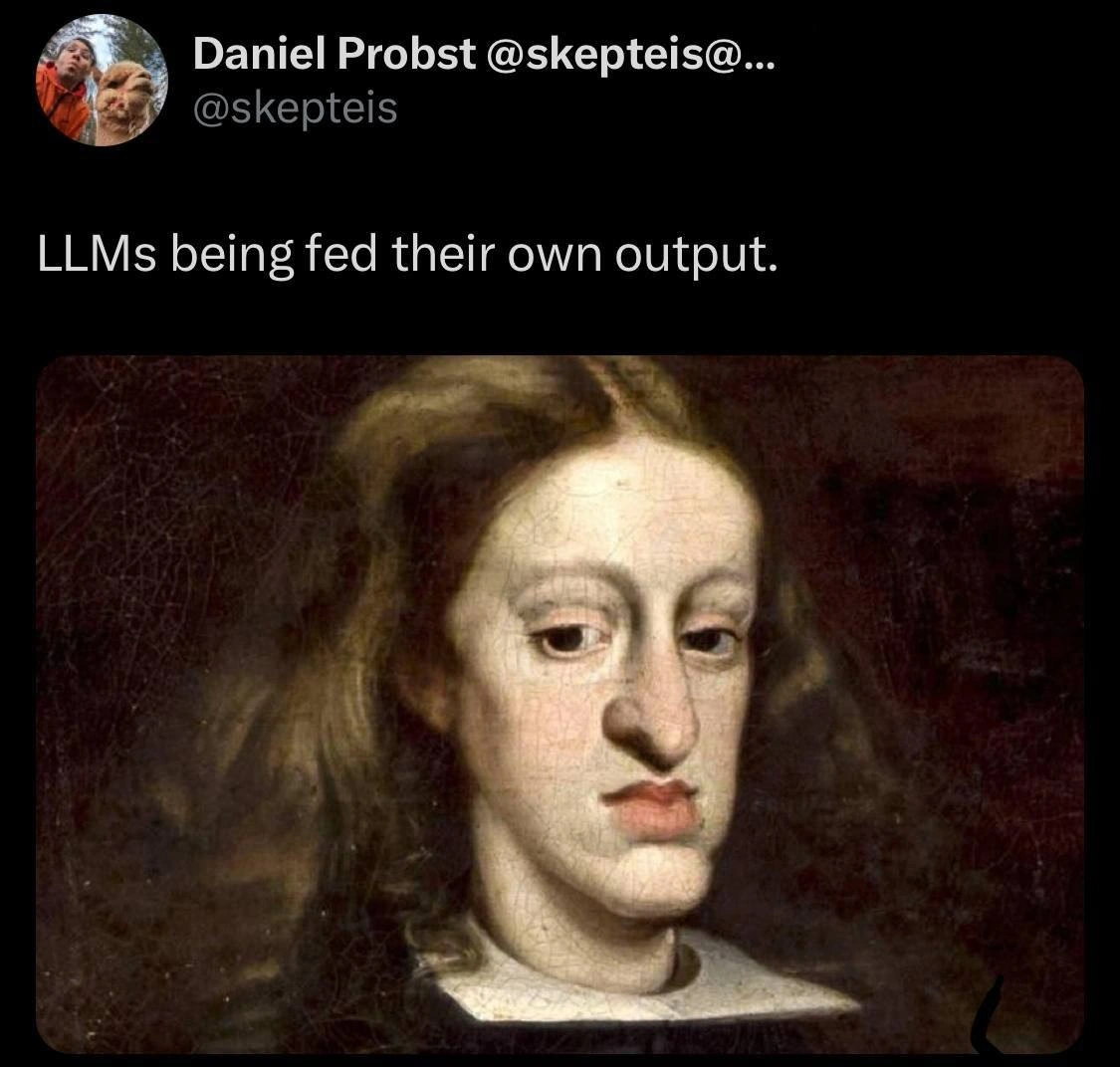
The meme’s image gives a visual twist on this idea. It shows an old portrait painting, but the person’s face is very blurred and distorted. That’s a metaphor: imagine you took a clear picture and made a photocopy, then copied that copy, and so on. Eventually, the picture becomes a smeared blur with hardly any recognizable features. In the meme, the original sharp portrait stands for a model trained on good, real data, and the blurry face stands for what happens after the model has been trained on its own imperfect output too many times. It’s a funny exaggeration of a real lesson: using an AI’s own writings to teach it more can lead to a loop where the quality spirals down. Even if it’s convenient to generate new training data with AI, any beginner in machine learning learns that you have to be careful — otherwise you end up in this self-training trap, and your model starts speaking gibberish instead of giving good answers.
Level 3: Eating Its Own Tail
"LLMs being fed their own output."
At a senior engineer’s glance, the meme hits on the garbage in, garbage out principle — except here it’s garbage cycling around on loop. The tweet text above sets up the joke plainly. You immediately picture an AI caught in a strange feedback loop, retraining on text that it itself spat out previously. The attached image drives it home: a classical oil portrait where the person’s face has become a smeared mess. It’s as if the painting was copied, re-copied, and distorted so many times that the poor guy’s features melted away. This visual is a spot-on metaphor for an AI model devouring its own tail. Every time the model regurgitates text and then trains on that regurgitation, the “portrait” of its knowledge loses a bit more definition. Seasoned devs recognize this as a recipe for model collapse — basically the AI equivalent of a photocopy-of-a-photocopy turning into a blur.
What makes this scenario funny (and a bit scary) to experienced folks is the kernel of truth in it. We’ve all heard the AI hype about models that can supposedly improve themselves endlessly by generating more training data. But in reality, that’s like inbreeding in a royal family: without fresh outsiders (in this case, real human-written data) the gene pool narrows. Small flaws get magnified with each generation. An LLM training on its past outputs is basically engaging in digital inbreeding. Tiny grammar quirks or factual hiccups present in its initial output get reinforced and start to compound. Before you know it, the model’s prose becomes a caricature of itself — overly formulaic, maybe riddled with weird errors, or just lacking the depth and variety it used to have. It’s an echo chamber effect: the AI is stuck listening to itself, and the nuance of genuine human language slowly fades out of the conversation.
The industry has already seen hints of this kind of feedback-loop failure. Think about Q&A forums like Stack Overflow. Early on, moderators noticed a flood of AI-generated answers (thanks to GPT-style models) that sounded confident but were often incorrect or bland. If those answers weren’t purged, they’d end up in the site’s data dump, which future models might train on. That’s literally LLMs learning from LLMs. A senior dev can’t help but chuckle imagining the downward spiral: Model A answers a question incorrectly, Model B trains on that answer and answers even more incorrectly, and so on — a shallow knowledge lagoon gradually evaporating into nonsense. The meme exaggerates it with that distorted face, but it highlights a real concern. It wryly captures why so many of us insist on fresh, high-quality training data. Relying too much on AI-regurgitated content is just asking for an “AI that’s forgotten what a real face looks like,” metaphorically speaking. In other words, you become what you eat — and if the AI only eats its own cooking, the menu gets worse over time.
Level 4: Ouroboros Overfitting
From an advanced ML standpoint, this meme warns of an Ouroboros-like trap where a Large Language Model (LLM) enters a self-training pitfall by consuming its own outputs during training. Each time an LLM is fine-tuned on synthetic data that it generated itself, subtle errors and biases in that output get reinforced. Over successive self-training cycles, the model’s learned representation of language starts to deviate from the true distribution of human-written text. This is essentially a data distribution drift problem: the training data’s statistics shift away from reality toward the model’s internally warped version of natural language. Researchers refer to the extreme outcome of this drift as model collapse, where the AI’s capabilities deteriorate because it’s overfitting to a poorer-quality, self-referential dataset.
In information-theoretic terms, think of each training iteration as applying a lossy compression on the model’s knowledge. The LLM’s outputs typically have lower entropy and less diversity than the original training corpus. So when those outputs are fed back in, the model’s internal representation loses a bit of richness and nuance. Over many generations, it’s like repeatedly photocopying an image—each copy retains fewer details. The KL divergence (a measure of difference) between the model’s new training distribution and the original human language distribution grows larger with each loop, meaning the AI is gradually forgetting what real writing looks like. Eventually, the process can converge to a degenerate state: the LLM might become stuck producing bland or nonsensical text because it has effectively poisoned its training data with its own mistakes. This kind of synthetic-data feedback loop has been analyzed in the ML community, showing how a seemingly innocuous practice—reusing AI-generated text as training material—can lead to an asymptotic spiral of degraded performance.
Description
A screenshot of a tweet from user Daniel Probst (@skepteis). The tweet text reads, 'LLMs being fed their own output.' Below this text is the famous oil portrait of Charles II of Spain. The painting depicts a young man with distinct facial features, including a prominent jaw and nose, which are historically attributed to the effects of extensive inbreeding within the Habsburg dynasty. The meme draws a clever and dark parallel between the genetic degradation resulting from generations of inbreeding in a royal family and the concept of AI 'model collapse' or 'model inbreeding.' This technical issue occurs when Large Language Models (LLMs) are trained on data that includes their own synthetic output, leading to a recursive feedback loop that amplifies errors, reduces diversity, and degrades the quality of future generations of the model, much like how a limited gene pool can lead to congenital problems
Comments
7Comment deleted
The first generation of the model is a king. The tenth generation, trained on its own output, can barely hold a coherent thought and thinks its primary function is to secure the Spanish succession. We call it Habsburg-GPT
Feeding an LLM its own output is the data-pipeline equivalent of nth-gen JPEG compression - after a few epochs the artifacts start confidently explaining why they’re industry best practice
Just like the Habsburgs discovered that marrying your cousin repeatedly leads to Charles II of Spain, we're learning that training GPT-5 on GPT-4's Medium articles leads to models that confidently explain why all code should be written in a revolutionary new framework that's definitely not just React with extra steps and hallucinated syntax
Ah yes, the inevitable heat death of LLMs: train on your own outputs long enough and you'll converge to a model that's essentially a very expensive random word generator with a PhD in confidently hallucinating citations. It's like code review where you only review your own PRs - technically possible, but the resulting entropy violates several laws of thermodynamics and good engineering practice. We're basically watching AI speedrun the Habsburg jaw problem, except instead of genetic defects, we get models that think every answer should start with 'As an AI language model' and end with plausible-sounding nonsense
Training on your own outputs is a positive‑feedback loop with gain > 1 - congrats, your KL divergence is now the burn rate
Feeding an LLM its own output: model collapse in slow motion - entropy tends to zero, confidence to one, and product brands it a self-sustaining content flywheel
Recursive self-improvement? More like recursive self-delusion - turning diverse corpora into a funhouse mirror of nonsense