Linux: The Operating System That Always Fits
Why is this OperatingSystems meme funny?
Level 1: Size Matters
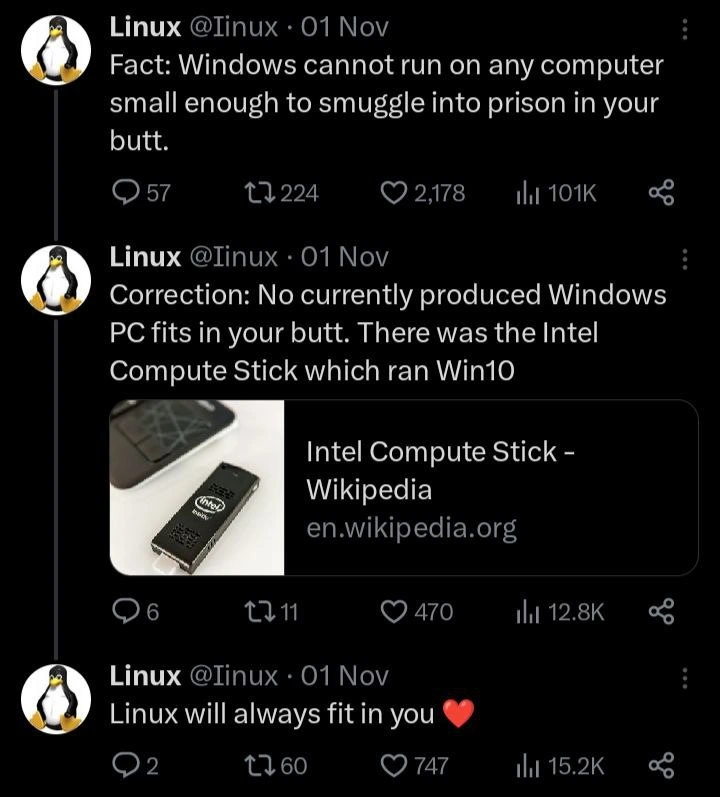
Imagine you have two toys: one is a big chunky toy and the other is a small flexible toy. The big toy (that’s like Windows) is super cool but needs a lot of space – you can only fit it in a large backpack. The small toy (that’s like Linux) is simpler and can fold or shrink, so you can put it even in your pocket. Now, in a silly game of hide-and-seek, you try to hide the toy. The joke in this meme is saying: “I bet I can hide my small toy anywhere, even in a really small hiding spot, but your big toy is so bulky it won’t fit!” 😄 It even makes an over-the-top example of hiding a tiny computer in someone’s butt (gross and funny to imagine, right?). Basically, it’s joking that Linux is so small and sneaky it can fit anywhere, while Windows is too big and clunky to hide. In simple words, Linux is like the tiny friend who can squeeze into any hiding place, and Windows is the big friend who always gets spotted. That’s why it’s funny – it’s a goofy way of saying the small guy can go places the big guy can’t. The heart at the end (“Linux will always fit in you ❤️”) is like the little toy saying, “I’ll always be there for you, no matter what.” It’s a playful, slightly cheeky way to show love for the small-and-flexible Linux versus the big-and-heavy Windows. In the end, the meme is just about how size matters – and being small can be an advantage in a really comical situation!
Level 2: Tiny Computers, Big OS
Let’s break this down in simpler terms and define some of the jargon and references:
Operating System (OS): This is the basic software that runs on a computer and manages hardware and other software. Windows and Linux are two different OSes. Think of an OS as the master program that lets you interact with the computer (logging in, running programs, managing files). Windows is made by Microsoft and is very common on PCs. Linux is an open-source OS (anyone can see and modify its code) and it comes in many flavors called distributions (like Ubuntu, Fedora, etc.).
Linux vs Windows rivalry: There’s a long-standing friendly rivalry in tech between fans of Linux and fans of Windows (LinuxVsWindows). It’s like two popular teams in the software world. Each has its strengths: Windows is known for user-friendliness and running popular desktop software, while Linux is known for being free, flexible, and running on almost anything (especially servers and gadgets). This meme is an example of that rivalry turned into humor (os_rivalry), teasing that Linux is more adaptable than Windows.
“Fits on tiny devices”: The meme talks about computers “small enough to smuggle into prison in your butt.” 😄 This extremely silly (and a bit gross) scenario is just an exaggerated way to say really really small computers. In the real world, there are very small computers – for example, the Raspberry Pi Zero is a fully functional computer that's only about 2 inches long (about the size of a pack of gum). There are even computers built into USB sticks or tiny boards; these are examples of tiny form factor PCs (tiny_form_factor_pc).
Windows cannot run on any computer that small: Windows (particularly Windows 10 or 11) usually needs fairly decent hardware – a certain amount of memory (RAM), storage (disk space), and a fast enough processor. Very tiny devices often use weak processors or have very little memory/storage, so you generally can’t install standard Windows on them. For instance, you couldn’t run full Windows on a typical USB thumb-drive-sized computer because it wouldn’t meet Windows’ minimum requirements. Windows is considered more “bloated” (windows_bloat) meaning it has a lot of built-in stuff that takes up space.
Linux can run on minimal hardware: Linux is famous for being able to run on older, low-spec, or small devices. There are lightweight versions of Linux that can run on, say, 128 MB of RAM or less, and very small disks. Linux is used in a lot of embedded devices (tiny computers inside other gadgets) – like the software in your Wi-Fi router, smart TV, or even some refrigerators is often Linux (linux_on_embedded). So when the meme implies “Linux will always fit,” it’s saying no matter how small the computer, you can probably find or make a version of Linux for it.
“Smuggle into prison in your butt” scenario: This is the meme’s wild way of describing the smallest possible computer. In real life, unfortunately, prisoners have been known to hide contraband items in body cavities because guards can’t easily find them. The tweet is using that idea to gauge size: if a computer is small enough to hide like that, it’s really small. To be super clear, this is just a joke – no one is seriously suggesting doing this! It’s just highlighting an absurdly tiny size limit. So if Windows can’t run on a device that small, it emphasizes Windows’ larger size footprint.
The Intel Compute Stick: The second tweet brings up this device as a correction. The Intel Compute Stick was an actual product (around 2015) that was basically a full PC packed into a device that looks like an oversized USB flash drive. It had an Intel Atom processor, memory, storage, and ran Windows 10. You would plug it into a TV or monitor via HDMI, and it was like carrying a little Windows computer in your pocket. This was remarkable because it was one of the smallest devices to run Windows. The tweet says “no currently produced Windows PC fits” but then mentions the Compute Stick, meaning: “Okay, to be totally accurate, there used to be one that could.” That implies that nowadays (as of the tweet date), you can’t buy a brand-new Windows device that tiny, because Intel stopped making the Compute Stick and there hasn’t been an exact replacement.
Linux will always fit in you ❤️: Here “Linux” (the Twitter user with Tux the penguin avatar) is speaking as if Linux is a person or entity. It’s saying Linux can always fit inside you, with a heart emoji to make it humorous and friendly. The literal joke is that Linux can run on such a small computer that you could hide it inside your body (again, super exaggerated!). The subtext is that Linux is highly adaptable and lightweight, almost like it “belongs” wherever it needs to go. The heart emoji adds a playful tone – as if Linux is professing love, or saying this with affection. It’s simultaneously a bit of a burn on Windows (implying Windows is too chunky to fit) and a cheeky self-praise for Linux.
Meme format (Twitter thread): The image is styled as a Twitter thread from the user “Linux” (@iLinux) — note the profile pic is Tux, the penguin mascot of Linux. Each tweet has metrics (replies, retweets, likes, views) which makes it look like a real Twitter conversation. In meme culture, it’s common to use fake (or real) tweet screenshots to tell a joke. This one likely isn’t an actual tweet by an official account, but rather a joke format image. The fact that it’s made to look like a Twitter thread is part of the humor: it mimics how tech folks banter on social media. When reading it, you imagine the voice of Linux bragging and a correction being offered, which feels like a natural internet conversation.
Hardware requirements: A key concept here is that different OS have different hardware requirements. Hardware refers to the physical components of a computer (CPU, RAM, storage, etc.). Windows 10, for example, typically needs at least around 2 GB of RAM and 20+ GB of disk space, plus a fairly modern CPU. Those specs mean the device itself can’t be too primitive or tiny – it needs to house those chips and memory modules, and it will consume a decent amount of power. Linux, especially minimal distributions, can run on far less. You could have, say, a tiny board with 256 MB of RAM and a small flash chip for storage, and still run a basic Linux (no fancy graphical desktop, just text mode). So physically, the hardware for Linux can be simpler and smaller. That’s the real-world basis for the joke: Linux is often the go-to OS for small or low-power devices, whereas you’d never even consider installing full Windows on such devices.
Bloat: This term (used in windows_bloat) refers to software being overly large or filled with unnecessary components. Many developers jokingly call Windows “bloatware” because it ships with lots of services, background processes, and pre-installed apps that eat up resources (memory, CPU, disk). In contrast, you could make a very “barebones” Linux system that has just the essentials. So, bloat vs barebones is an underlying theme.
In summary, for a junior dev or someone new to this humor: the meme is playing on the idea that Linux is small and flexible (can run on tiny, even ridiculous hardware setups) while Windows is big and inflexible (needs a proper PC with more heft). It uses a comically extreme example (hiding a computer in one’s body) to get the point across in a memorable way. It’s all in good fun as part of the ongoing Linux vs Windows jokes we see in DeveloperHumor and MemeCulture. If you’ve ever heard someone say “Oh, I bet it can even run Doom!” or “Does it run Linux?” about a weird gadget, this is in the same spirit – celebrating Linux’s ability to run on almost anything, and poking at Windows for being the heavy giant that can’t join the tiny-device party.
Level 3: Bloat vs Barebones
For seasoned developers and system engineers, this meme hits on the long-running os_rivalry between Linux and Windows, especially the perception of Windows as a bloated system versus Linux as lean and mean. The thread, written in the style of a Twitter exchange, uses an outlandishly comic scenario – smuggling a computer into prison via one’s backside – to underscore just how tiny a device Linux can run on compared to Windows. In plainer terms, it’s poking fun at the hardware requirements of the two OperatingSystems. Every experienced dev who’s tried to resurrect an old PC or run something on a single-board computer has encountered this: Windows just won’t even install if the machine is too underpowered or small, but Linux can often find a way. This is classic TechHumor mixing truth and exaggeration.
Let’s unpack the tweets. The first tweet boldly states as “Fact” that no computer small enough to be hidden in such an extreme way can run Windows. This immediately brings to mind the notion of Windows bloat – Windows typically demands more disk space, more RAM, and a more powerful processor than extremely small devices have. The joke lands because devs know Windows feels heavy; many have joked about Windows updates being larger than entire Linux distributions. The tweet’s cheeky phrasing also evokes an image: trying to hide a full Windows PC the way inmates notoriously hide contraband. It’s an absurd mental picture that makes the contrast memorable (and slightly uncomfortable in a funny way). It implies that Windows-powered devices are inherently larger or bulkier – not literally in physical size always, but effectively because of all the extra baggage Windows carries.
The second tweet in the thread issues a “Correction,” humorously mimicking how nerds on Twitter love to pedantically fact-check. It mentions “No currently produced Windows PC fits in your butt. There was the Intel Compute Stick which ran Win10.” Here we see the meme acknowledging a footnote in computing history to keep the joke technically accurate (a very developer thing to do!). The Intel Compute Stick was a real product – essentially a full Windows-capable computer condensed into a device the size of a large USB stick. Senior devs might remember this gadget from around 2015: you’d plug it into an HDMI port of a monitor, and voila, you had a tiny Windows 10 machine. The meme’s author knows the audience – many tech folks recall that device – and by citing it, they show they’re in on the specifics. It’s like saying, “Yes, yes, we all know about that one exception.” The phrase “No currently produced” highlights that the Compute Stick was discontinued (Intel stopped making them), so as of now, you can’t buy a new Windows PC that small. This detail grounds the joke in reality: historically one existed, but at present if you want something that fits entirely in a very tiny form factor PC, you won’t find a Windows machine on the market. Meanwhile, plenty of tiny Linux boards exist and new ones pop up all the time (every maker faire or hacker convention, someone’s showing off a coin-sized Linux board). This taps into the Linux on embedded trend: Linux powers a lot of little devices (think of routers, smartwatches, Raspberry Pi microcomputers) whereas Windows stayed in the realm of desktop, laptop, server, and a failed mobile venture.
Finally, the third tweet delivers the punchline: “Linux will always fit in you ❤️”. This line is both hilarious and a bit bold. It anthropomorphizes Linux as a cheeky, caring entity (“in you ❤️” sounds both intimate and supportive), and simultaneously it’s a brag that Linux can always be made small enough to fit – even inside you. For a veteran techie, this is riffing on the age-old bragging rights of Linux enthusiasts: Linux can run on anything! It’s only half-joking – we’ve seen Linux run on an ancient iPod, on a router with 8 MB of flash, heck, people have gotten Linux running on a toaster or a fridge. There’s also a sly double meaning here: Linux will always “fit in your life” or “be there for you,” given the heart emoji, implying a kind of trust or love in the tech community. But primarily, it’s a physical metaphor: no matter how constrained the environment, Linux finds a way (cue Jurassic Park meme: “Linux, uh… finds a way”). This is HardwareHumor gold, contrasting a sleek flexible penguin (Linux’s mascot Tux is a penguin, as seen in the avatar) slipping into any nook, versus a hefty blue-screen-prone giant (Windows) that can’t squeeze in.
Behind the humor, there’s an industry truth that senior devs appreciate. Over the years, Windows bloat has been a pain point – each new version adds features and usually needs more resources, meaning you often need new hardware to run it well (remember the jump from Windows XP to Vista – suddenly you needed way more RAM and GPU power). Linux, on the other hand, can often revive older hardware or run on minimal specs because you can choose a lightweight distro or strip it down. Many of us have taken an old laptop that choked on Windows and given it new life with a slim Linux install. So when Linux boasts “I’ll always fit,” it resonates – it’s the OS that scales down as well as up. In a server context too, Linux can run on a tiny headless server with no GUI, consuming minimal resources, whereas Windows Server has a relatively higher baseline footprint.
Another subtext is how meme culture and TwitterHumor are used here: the faux tweet thread format is a popular way to deliver tech jokes. The account named “Linux” with Tux avatar playfully represents the voice of Linux itself trash-talking Windows. This personification of tech (like Linux speaking in first person) is common in online DeveloperHumor. And the engagement metrics shown (retweets, likes, etc.) are part of the joke’s texture – it looks like a viral tweet, implying the community enthusiastically agrees (those “747 likes” on “Linux will always fit in you ❤️” show people cheering that punchline). It’s a tongue-in-cheek way of saying the Linux crowd is high-fiving this notion. Developers familiar with the Linux vs Windows banter will chuckle because it’s exaggeration with an edge of truth. Even the heart emoji is a mocking contrast – a sweet emoji in a slightly rude joke setting – which adds to the silliness.
In practical senior-engineer terms, this meme is also a light commentary on system engineering trade-offs. We often joke about “Windows bloat,” but it’s the result of Windows being a full-featured general-purpose OS aiming for user-friendliness and compatibility, which inevitably makes it heavier. Linux’s prowess at fitting anywhere comes from its flexibility and open development: if you need it to run on a wristwatch, someone can cross-compile the kernel for that CPU and optimize it. There’s no single company saying “you can’t do that”; the community just does it. Conversely, you can’t just take Windows 11 and decide to run it on a random $5 microchip – Microsoft decides what platforms Windows supports (typically PC class or some ARM SBCs for IoT, with many limitations). So when this meme says “Linux will always fit in you,” senior folks read: Linux will always support that niche device or weird use-case I have, whereas Windows probably won’t. Many of us have indeed relied on Linux for weird projects: custom routers, DIY gadgets, or revitalizing old devices. It’s funny because it’s true: size (and openness) matters.
Level 4: If It Fits, It Boots
At the deepest technical level, this meme highlights fundamental operating system design philosophies and hardware constraints. It's essentially about the minimal footprint needed for an OS to run on a computer, taken to a comically extreme scenario (the "butt_smuggling_meme" scenario). On one side, you have Linux – a highly modular, open-source kernel that can be pared down to run on ridiculously small hardware. On the other side, Windows – a feature-rich but heavier system with substantial resource requirements. The humor works because it’s rooted in real technical differences: Linux distributions exist that can run on devices with just a few megabytes of memory, whereas modern Windows (like Windows 10 or 11) expects gigabytes of RAM and plenty of disk space.
From an OS architecture standpoint, Linux’s flexibility comes from its monolithic kernel that you can configure to include only the essentials for a given device. Developers can compile a custom Linux kernel stripping out drivers and features they don’t need, yielding a super-tiny OS image. There are entire Linux variants (e.g. Tiny Core Linux, Damn Small Linux) focused on minimal size, some small enough to fit on a floppy disk or in a few MB of flash storage. Linux also runs on a staggering range of hardware architectures – from powerful servers to microcontrollers – thanks to decades of porting efforts by enthusiasts. There’s even uClinux, a project to run Linux on microcontrollers without a Memory Management Unit, demonstrating how far Linux can stretch into embedded territory (linux_on_embedded). The theoretical underpinning here is that Linux is scalable downward: it can be simplified to approach the bare minimum needed for a Turing-complete, multitasking OS. If there’s a chip that’s barely powerful enough to be called a computer, chances are someone will get Linux running on it (and likely brag about it on an online forum). As a cheeky general principle: “if it fits, it boots.”
Windows, conversely, is architected with a lot of built-in assumptions about hardware capacity. The modern Windows kernel (descended from Windows NT) is a hybrid kernel design with many subsystems (graphical interface, services, registry, etc.) tightly integrated. It’s optimized for user experience and backward compatibility on PCs and servers, not for ultra-tiny form factors. There’s a minimum footprint below which Windows just doesn’t function – not just due to the kernel size, but because of necessary components like the GUI, security services, and drivers that all add up. You can’t easily trim Windows down beyond a point (Microsoft tried with things like Windows CE and Windows IoT Core for simpler devices, but those are essentially different OS products). In formal terms, Windows has a larger lower-bound on resources due to its more monolithic distribution of features; it’s not modular in the same way Linux is. This is a reflection of different design priorities: Windows prioritizes a consistent user environment and broad device support out-of-the-box (which means more code running all the time), whereas Linux lets you assemble just what you need. It’s a classic case of bloat vs efficiency in OperatingSystems design.
Historically, as Hardware advanced, Windows grew in features (and size) assuming PCs would have ample disk and RAM (the infamous windows_bloat everyone jokes about). Linux, coming from the Unix tradition, retained a culture of running lean – you could always drop into a text-only mode or run a minimal server setup with almost no extras. This history means that today, in 2023, we have the amusing reality that Linux can run on a computer the size of a keychain, while Windows typically can’t. The meme’s claim about a computer “small enough to smuggle into prison in your butt” is an absurdist way of defining an ultra-small form factor PC (tiny_form_factor_pc). It exaggerates an actual tech feat: hobbyists have put Linux on things like a Raspberry Pi Zero (size of a gum stick) or even smaller custom boards – devices so small you could (in theory) hide them almost anywhere 😅. Windows, by contrast, has only ever run on devices above a certain size (both physically and spec-wise). The one counterexample the thread gives – the Intel Compute Stick – is telling: it was a full Windows 10 PC shrunk to a dongle, but it pushed the limits of how small a Windows machine could get. Even that Compute Stick needed to be the size of a chunky USB thumb drive to accommodate an Atom CPU, 2GB RAM, and storage, and it ran Windows at the edge of viability. In summary, the meme’s hyperbole actually rests on real tech principles: Linux’s minimalist adaptability versus Windows’ built-in heft, reflecting how each OS scales (or doesn’t) when you push it to the physical and computational extreme. It’s a nod to deep operating system engineering trade-offs hidden beneath a very cheeky joke.
Description
A screenshot of a three-tweet thread from a Twitter account named 'Linux' (@Iinux), which uses the Linux penguin mascot, Tux, as its profile picture. The first tweet, dated '01 Nov', makes a bold claim: 'Fact: Windows cannot run on any computer small enough to smuggle into prison in your butt.' The second tweet in the thread is a humorous self-correction, stating: 'Correction: No currently produced Windows PC fits in your butt. There was the Intel Compute Stick which ran Win10', accompanied by a Wikipedia link preview for the 'Intel Compute Stick'. The final tweet serves as the punchline, suggestively saying, 'Linux will always fit in you ❤️'. The humor is a classic take on the Linux vs. Windows rivalry, using the absurd and crude metric of 'smugglability' to praise Linux's well-known minimalism and ability to run on extremely small hardware, while also making a playful innuendo

Comments
12Comment deleted
Sure, Linux fits, but can you imagine trying to debug a kernel panic on a device you can't physically see? Suddenly, the Windows Blue Screen of Death seems like a preferable outcome
Windows is the kind of payload you need a forklift - and a CAL - to smuggle into production; Linux fits in a base64 pipe, reassembles itself on the other side, and still leaves room for vim
The real prison here is being stuck with Windows Update on a device that small - at least with Linux in your colon, the only thing you'll be passing is kernel panics
This thread perfectly captures the eternal Linux evangelism paradox: start with an absurdist claim about Windows bloat, get fact-checked by your own community with a Wikipedia citation about discontinued Intel hardware, then pivot to wholesome reassurance that Linux's minimalism will never let you down. It's the technical equivalent of 'I may have been wrong about the specifics, but I was right in spirit' - a debugging philosophy every senior engineer knows intimately when explaining why their microservice 'only needs 512MB RAM, I swear.'
Windows: minimum requirements; Linux: make menuconfig until the scheduler fits in L2 cache - and apparently other caches too
Linux boots from a 1MB floppy; Windows demands a proctologist and a pallet jack for the same real estate
Windows loves minimum specs; Linux boots from a 4MB initramfs - yet our “lightweight” Kubernetes sidecar is 300MB, so the OS isn’t our footprint problem
Don't give up and everything will become possible. Comment deleted
Yeah but do you know how dirty would I feel with Microsoft product in my butt? Also at some point the bulge becomes rather noticeable… so much for hiding it. Comment deleted
1. 🤷♀️ 2. You know, I'm something of a size royalty myself. 3. I've seen things you people wouldn't believe... Comment deleted
3. from you I would 😼 Comment deleted
3. trust issue Comment deleted