Skip to content
DevMeme
6475 of 7435
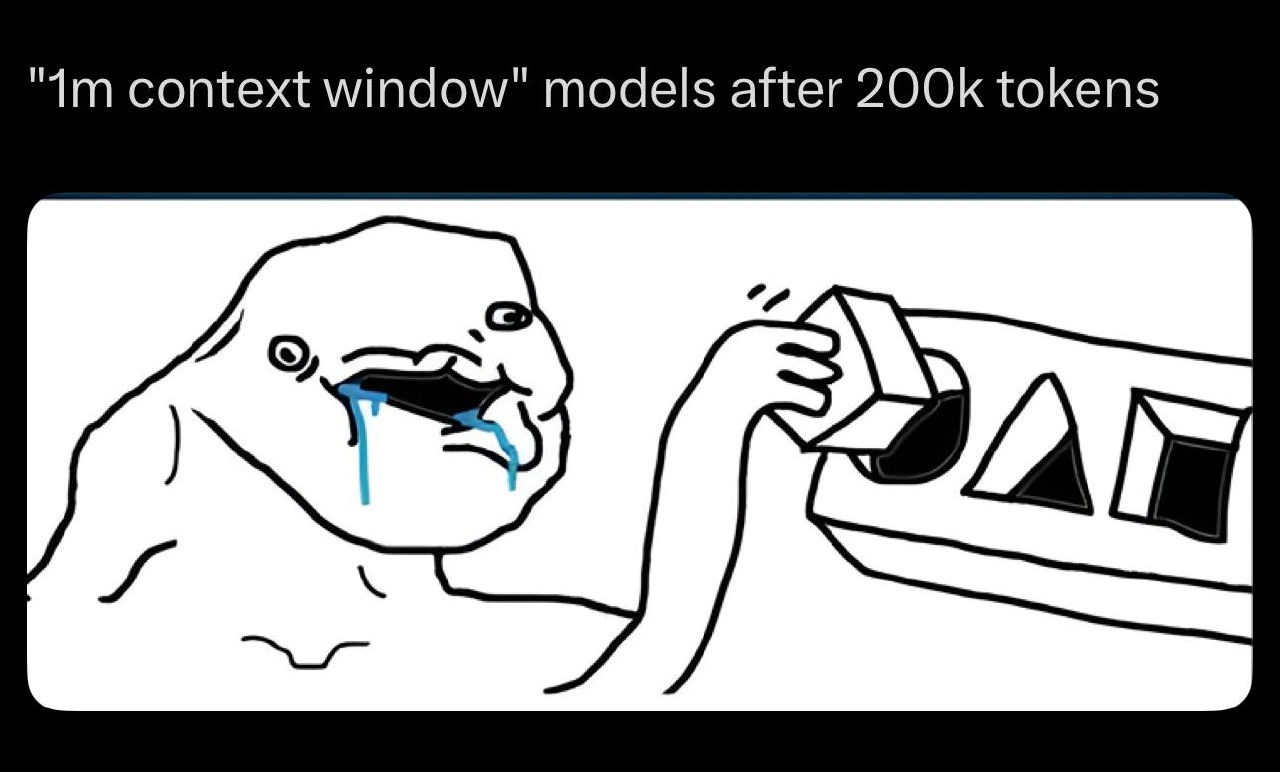
LLMs With 1M Context Window Struggling Desperately After 200K Tokens
AI ML Post #7100, on Sep 4, 2025 in TG

LLMs With 1M Context Window Struggling Desperately After 200K Tokens

Why is this AI ML meme funny?

Level 1: Square Peg, Round Hole

Imagine a really smart robot that claims it can read a whole library of books without forgetting anything. Sounds awesome, right? But now picture actually giving this robot an entire shelf of books, one after the other, without a break. At some point, the robot gets so overfilled with words and information that it starts acting really silly. By the time it’s on, say, the 200th book, you ask it a simple question about the first book and it just babbles nonsense, as if it completely lost track of everything. This meme is joking about that kind of situation. It shows a drawing of a goofy, drooling person trying to force a square block into a round hole in a toddler’s toy. The caption says that’s the super-smart AI after reading too much (200k tokens worth of text). In other words, the meme is comparing the overwhelmed AI to a little kid who can’t even do a basic shape puzzle. It’s funny because you’d expect this advanced AI (with a “1 million token memory”) to handle lots of information easily, yet here it is, basically going baby mode and making a ridiculously obvious mistake. The emotional core of the joke is the contrast: something that should be brilliant turning into a total dummy when overloaded. It’s like watching a genius-level student completely blank out and start doodling like a kindergartner during an exam – unexpected and comically absurd. So, in the simplest terms, the meme says: even a super smart computer can get overwhelmed and act like a confused toddler if you give it way too much to think about, and that silly truth makes us laugh.

Level 2: Context Window 101

Let’s unpack this meme in simpler technical terms. First, what’s a context window? In large language models, the context window is essentially the model’s memory span for a given prompt. It’s how many tokens (pieces of text) the model can pay attention to at once when generating an answer. Tokens are the basic units of text the model reads – they can be whole words or parts of words. For example, the sentence “The cat sat on the mat” might break down into tokens like “The”, “ cat”, “ sat”, “ on”, “ the”, “ mat”. Early GPT models had a context window of only a couple thousand tokens (roughly a few pages of text). That meant if you gave them input longer than that, they’d have to ignore the rest or forget the beginning. Over time, newer models started offering bigger and bigger context windows – 8k, 32k, even 100k tokens – allowing them to handle much longer inputs without losing track. Now, 1m context window (one million tokens) is an extremely large context size that some experimental models by 2025 are claiming to support. To give a sense of scale, 1 million tokens could be around 750,000 words or more – that’s like the length of several novels combined or almost all of Wikipedia articles about a specific topic, all stuffed into the model at once! It’s an enormous amount of text to deal with in one go.

Now, the meme says these "1m context window" models turn into toddler mode after ~200k tokens. 200k tokens is still huge – think of it as maybe 150,000+ words, which could be two decent-sized novels back-to-back. The joke here is that even though the model is advertised to handle up to a million tokens of context, by the time you feed it about 20% of that capacity, it starts acting silly or nonsensical. The picture that accompanies the caption illustrates this vividly. It shows a Wojak character (Wojak is a meme cartoon figure used to represent various human archetypes – in this case, a dim-witted or mentally regressed person) who is drooling and struggling with a child’s shape sorter toy. He’s trying to push a square block into a circular hole, which obviously doesn’t work. The Wojak has this blank, dopey expression with blue drool leaking out, indicating he’s not all there mentally. Essentially, the image is saying: here’s your fancy million-token model after it’s been fed way too much text – it’s as cognitively capable as a drooling toddler trying to do a simple puzzle.

So why would a state-of-the-art AI model behave like that? There are a couple of key reasons, simplified: memory overload and attention issues. Large Language Models use a mechanism called attention to figure out which parts of the input are relevant when generating each part of the output. Imagine reading a long book and trying to connect something on page 500 back to something from page 1. It’s hard, right? Your attention to the beginning has faded. Similarly, if an AI has to consider hundreds of thousands of tokens, the early tokens might not get enough attention by the time it’s deep into the text. The model might effectively forget or confuse details from the start. We call this attention decay informally – the influence of earlier content decays as the input grows longer and longer. Even though, in theory, the model can look at everything, in practice it starts focusing only on the most recent parts or just jumbles things up because there’s too much to juggle.

The other issue is raw performance and capacity. Handling 200k tokens or more in one go is extremely taxing for the model computationally. With every additional token, the model’s workload increases dramatically (roughly by the square of the number of tokens, due to how the calculations scale). So by the time you’ve fed it hundreds of thousands of tokens, it’s like a person trying to read 500 books at once – it’s bound to get overwhelmed. When a model gets overwhelmed, it doesn’t literally “get tired” like a human, but you start to see errors: it might start repeating itself, producing irrelevant answers, or mixing up concepts that it would normally keep straight. In essence, the model’s output quality goes down because it’s out of its depth. This is analogous to how a very tired or overloaded person might start making really silly mistakes.

Now, connect this back to the meme: The “toddler logic” phrase is highlighting that the model’s reasoning level has dropped. The drooling shape-sorting toddler image is a metaphor for regression – going backwards in development. An AI that usually might answer complex questions correctly is now making a mistake so basic (square vs circle, doesn’t fit!) that a young child might make it. It’s a humorous exaggeration, of course; the model’s not literally an infant, but it can feel that way to the user. If you’ve ever seen an AI suddenly output something unbelievably stupid or random, you know the feeling – you almost want to ask, “Are you okay there, buddy?” The meme captures that exact sentiment visually.

In simpler everyday terms, think of it like this: an extremely long conversation with the AI might start out fine, but if you keep it going and going, eventually the AI’s responses could start to seem as nonsensical as if you were talking to someone half-asleep or a little kid who lost track of the story. This is why the meme resonates: it’s taking a very technical issue (limitations of an AI’s context length) and illustrating it in a way that anyone can understand – with a picture of a confused person putting a square peg in a round hole. It’s a universal symbol for “this does NOT fit, and someone’s not understanding the basics.” For developers and AI enthusiasts, it immediately brings to mind the underlying cause (the model couldn’t handle the super long input), but you don’t need to know any of that to chuckle at the image itself. You just see “supposedly smart thing do something dumb,” which is a classic formula in tech humor.

In summary, the meme is explaining that just because an AI is advertised with a HUGE memory (context window) doesn’t mean it can actually use all of it effectively. After a certain point, it might lose coherence. The long_context_window promise turns into an attention_decay reality. It’s a cautionary joke about not taking those big numbers at face value. In the world of AI, like many other fields, there’s often a gap between theoretical maximum specs and the practical usable limits. And nothing drives that point home better than picturing the fancy AI as a drooling Wojak who can’t match a cube to a square hole. It’s a fun, slightly absurd way to remind us that more is not always better – sometimes more is just more... and very confusing for the poor AI.

Level 3: Million-Token Mirage

For seasoned ML engineers, this meme hits close to home and triggers a wry grin. It lampoons the ongoing AI hype vs reality saga surrounding ever-larger LLM context lengths. The setup is the boast: “1m context window” models — a reference to recent claims by AI companies that their latest Large Language Model can ingest truly colossal amounts of text in one go. The punchline is the visual: after about 200k tokens of input (which is already mind-bogglingly large), the supposedly cutting-edge model is portrayed as a drooling simpleton forcing the wrong shape into a hole. In plainer terms, the meme is saying: you can claim your model has a million-token memory, but by the time it’s partway there, it’s basically lost the plot. The phrase Million-Token Mirage captures this perfectly: like a desert mirage, the promise of effectively unlimited context fades into illusion when approached. What looked like a glittering oasis of memory and understanding turns out to be a puddle of confusion. Experienced folks in AI_ML instantly recognize this pattern, because they’ve seen countless examples of grand claims in AI systems that crumble in real-world use. It’s a prime example of AIHumor derived from AILimitations we all know too well.

Why is it so funny (and a little painful)? Because it’s true. Imagine an engineer eagerly testing a new LLM that advertises a 1,000,000 token capacity. This engineer might load up an entire novel series or a huge codebase into a single prompt. At first, things look okay: the model handles questions about the beginning of the text, maybe summarizes the first hundreds of pages, seems to be coping. But as the input keeps flowing, cracks appear. The responses get slower, sure (everyone expects that), but they also get decidedly weirder. By the time you hit something like 150k or 200k tokens of input, the model’s output starts to feel off. Perhaps it begins repeating earlier sentences verbatim, or it mixes up characters and events that were far apart. It might produce irrelevant blurbs that have nothing to do with the earlier context, as if it randomly forgot what the user was asking for. In some internal slack channels or forums, you’ll hear jokes like, “I gave the 1M-token model our entire wiki to summarize, and halfway through it went babbling like a toddler.” This meme takes that scenario and visualizes it literally: the sophisticated AI agent has metaphorically drooled on itself and is shoving ideas where they don’t belong. It’s LLMHumor born from the shared experience of watching an advanced system faceplant when pushed to extremes.

This speaks to a broader pattern in tech: the marketing arms race to have the biggest numbers vs. the engineering reality of trade-offs. Context window size has become a selling point – much like camera megapixels or CPU clock speed in past tech hype cycles. If one company offers 100k tokens, another might tout 1M tokens to seem more advanced. But insiders know that raw numbers can hide caveats. It’s like a car manufacturer claiming a car can get 200 miles per gallon under special conditions – technically true, but in normal driving you’ll never see that. Here, the fine print might read: “1M token context (warning: model may behave like a confused child well before reaching this limit).” Those of us who build and deploy these models anticipate the long context letdown. We treat the advertised maximum with skepticism, knowing that effective usable context will be much lower. So when we see the meme’s big goofy Wojak struggling with a baby toy, we immediately get the subtext: the model’s supposedly huge brain has effectively turned to mush. It’s a friendly poke at the dissonance between million_token_claims and actual useful performance.

The shape-sorting toy in the image is a brilliant choice of metaphor that senior devs appreciate. In software terms, it’s like an algorithm expecting sorted input and suddenly getting chaos – things end up in the wrong place. The LLM is expected to “sort out” relevant information from a massive input (like matching shapes to the right holes), but after a certain point it starts mismatching context (like a square fact going into a round reasoning hole). We’ve all dealt with systems that behave well under normal load but turn into Byzantine messes under stress. Think of a database that performs fine with thousands of records but thrashes with millions, or a search index that timeouts with too many keywords. That’s what’s happening here: the overloaded model is thrashing. The drool is a nice touch – it suggests not just failure, but a reversion to a primitive state. It’s as if all the fancy layers and learned weights in the neural network have short-circuited, leaving behind only a dumb, base behavior. In human terms, it’s a student who studied advanced calculus but, after going 48 hours without sleep, can’t even do 2+2 correctly. We laugh because that extreme regression is both absurd and relatable (who hasn’t had a brain-fart under heavy strain?).

Another aspect that industry veterans grin at is the unspoken whiff of “we told you so” towards AI hype. There’s a cycle: new model comes out claiming bigger, better, breaks all the limits. Skeptics ask, “Alright, but what about memory usage? What about quality at the tail end of that context?” Often the answer is hand-wavy. Lo and behold, when people actually test it, the model falters beyond a fraction of its advertised capability. This meme is essentially the engineering peanut gallery saying, “Yes, of course it falls apart, what did you expect?” It’s a gentle roast of both the model and the marketing. The Performance engineers who keep these systems running know that pushing any system to 100% capacity usually reveals cracks. This includes fancy AI models. We find it amusing that no matter how advanced the tech, you can always find a scenario (like ultra-long inputs) where it behaves in a hilariously unsophisticated way. It humanizes the AI in a sense – even the super smart model has a breaking point where it just goes derp.

Finally, there’s an element of camaraderie in this humor. ML practitioners and AI researchers share war stories of crazy prompts that caused models to fail. It could be something like: “I kept feeding it chapters and it started outputting the Navy Seal copypasta out of nowhere at token 180k!” or “It began to repeat the last sentence over and over, like a stuck record.” These are both frustrating and funny moments. The meme captures the essence of all those anecdotes in one scene. It’s saying: Remember that time our fancy AI turned into a gibbering mess? Here it is, depicted as a drooling Wojak jamming a cube into a round hole. We laugh, perhaps a bit ruefully, because we’ve been there. We’ve witnessed an overfitting model or an overstretched system act in baffling ways. The humor comes with a nod of understanding – an inside joke among those who know that more tokens, more data, more of anything doesn’t always mean better results. Sometimes it just means a bigger, dumber failure mode. And hey, at least we can meme about it.

Level 4: Attention Span Overflow

At the cutting edge of AI_ML, scaling up context has exposed fundamental limits. A Transformer model with a purported 1,000,000-token context window runs into brutal math: the self-attention mechanism has $O(n^2)$ complexity. That means the compute and memory needed grow quadratically with the number of tokens n. For $n = 1{,}000{,}000$, the attention engine would theoretically need to juggle $10^{12}$ pairwise token interactions – an almost absurd number. In concrete terms, a full attention matrix at that scale has trillions of values, far more than any GPU array we can realistically process or store. This is the dreaded quadratic memory blow-up. No matter how much you optimize, a million-token input is slamming into physical limits of memory bandwidth and processing time. So, when companies boast about million_token_claims, it's often more of a theoretical upper bound than something you can actually push to the max in practice. The meme’s drooling, dull-eyed figure is essentially the model hitting this wall – the point where the lofty $O(n^2)$ theory turns into a performance nightmare and the system starts to fall apart.

To cope, long-context DeepLearningModels often use tricks to approximate full attention. Techniques like sparse attention (only attending to some tokens) or chunking the input into blocks can bring down complexity. For instance, a model might split a 1M-token input into 10 chunks of 100k tokens, process each chunk, and then try to stitch together some compressed summary for the next stages. These tricks avoid creating a single giant $10^{12}$-sized attention matrix. But such shortcuts come at a cost: the model isn’t truly “seeing” all tokens with full resolution. It’s skipping or condensing information. The farther back in context you go (earlier tokens), the more compressed or fuzzy their influence becomes on the model’s current decision. In other words, the model suffers from attention decay – older tokens either get down-weighted or merged into an imperfect summary. By the time you reach hundreds of thousands of tokens in, the earliest parts of the prompt may as well be a hazy memory. The shape of their information no longer cleanly matches any slot in the model’s attention head, much like a confused brute forcing a cube into a round hole.

Another subtle issue is extrapolation beyond training distribution. Neural networks aren’t magical; they can’t instantly generalize to scenarios wildly outside what they saw during training. During training, an LLM might have seen sequences up to, say, 8k or 100k tokens (with special long-text datasets). But it’s very unlikely it saw anything close to 1,000k tokens in one contiguous chunk – that would be impractically long to feed in during training runs. So when you suddenly present a sequence 10x or 100x longer than it’s used to, you get a context_length_extrapolation_failure. Even though the architecture allows a million tokens, the model doesn’t know how to handle position number 500,000 or 900,000 with any finesse, because it never learned to. Think of positional encodings: many transformers use sinusoidal or rotary position embeddings which, mathematically, can represent very large positions. But representing is not the same as understanding. If the model never had to pay attention to token #500k during training, its weights won’t have learned any pattern like “when you’re extremely far into the sequence, do X”. Instead, weird things happen: the positional embeddings might start to alias (the sinusoidal patterns can repeat or interfere at large indices), or the model might overly rely on recent context and effectively ignore the distant tokens. The result? After a certain point, the model’s outputs degrade — coherence drops, errors spike. Its behavior reverts to something more primitive and random, almost as if its intelligence has regressed. It’s operating outside its comfort zone, so you get babbling nonsense or repetitive gibberish. The meme’s shape_sorter_wojak visual nails this: the advanced pattern-matching machinery of the AI has essentially broken down to toddler level cognition beyond ~200k tokens.

From a theoretical viewpoint, this isn’t surprising. Imagine trying to maintain meaningful interactions across a million tokens — that’s like a human trying to memorize and cross-reference a million-word novel without forgetting details. Even if we had infinite compute, the model’s capacity (the fixed number of neurons and layers) puts a ceiling on how much complexity it can juggle. When forced to attend to everything, it might end up attending to nothing particularly well. In fact, some research suggests that as context length grows, models need to learn to focus or filter information, not blindly take it all in. This is why we see architectures introducing hierarchical attention or recurrence: they process text in segments and carry forward a distilled state. A million-token context model might internally be doing something like “summarize every 50k tokens and forget the rest.” And once you’re summarizing, you’re inevitably losing detail. It’s a necessary evil to avoid the O(n^2) explosion, but it means the model’s effective comprehension beyond that summary point is limited. In essence, those early tokens (say token #1, #2, ... #1000) after being summarized are no longer sharp “cubes” or “triangles” — they’ve been ground into a kind of mushy shape that the model hopes will fit somewhere. No wonder a literal shape-sorting puzzle appears in the meme: the model is left matching very coarse, mismatched representations of early information into later contexts.

All these factors combined explain why long_context_window models might boast huge numbers yet stumble in practice. The meme’s humor is rooted in this deep technical irony: we can build a system that theoretically stretches attention to extreme lengths, but the AILimitations become glaring as soon as we try to use the full extent. It’s a classic case of AIHypeVsReality. The million-token context is like a shiny sports car engine put into a go-kart – it sounds impressive, but if you actually rev it to the max, things get messy. Here, “messy” means the DeepLearningModels in question start outputting absurd, infantile responses. The lofty promise of effectively infinite memory collapses into an algorithmic mirage. At the end of the day, physics, math, and the model’s finite training experience assert themselves: past a certain point, you can’t push more tokens through the same pipe without losing a lot in translation. The Wojak drooling on a toddler toy is the perfect absurdist illustration of the inevitable collapse that happens when theory meets reality in the realm of extreme LLM context lengths.

Description

A meme with black background and white text: '"1m context window" models after 200k tokens'. Below is the classic 'brainlet trying to plug in' meme showing a poorly-drawn drooling character (the 'brainlet' meme) struggling to insert a plug into a socket, representing the degraded cognitive ability of large language models that advertise 1 million token context windows but become effectively useless well before reaching that limit. The drool emphasizes the model's impaired state when dealing with long contexts

Comments

9
Anonymous ★ Top Pick LLM context windows are like RAM specs on budget laptops -- technically it's 1M tokens, but after 200K it's basically swapping to 'I forgot what you asked' disk
  1. Anonymous ★ Top Pick

    LLM context windows are like RAM specs on budget laptops -- technically it's 1M tokens, but after 200K it's basically swapping to 'I forgot what you asked' disk

  2. Anonymous

    A 1M token context window is just a bigger haystack to lose the needle in. By 200k tokens, the model has forgotten the needle, the haystack, and the concept of 'sharp'

  3. Anonymous

    Apparently the new "infinite" context algorithm is just the toddler heuristic: keep ramming the square token into the round receptive field until the GPU budget times out

  4. Anonymous

    It's like watching your distributed system's performance metrics after the marketing team promised 'infinite scalability' - technically possible if you ignore the part where it becomes a very expensive random number generator after hitting 20% of the theoretical limit

  5. Anonymous

    Ah yes, the classic '1 million token context window' - marketing's favorite number that conveniently omits the asterisk explaining that after 200k tokens, your model develops the attention span of a goldfish scrolling Twitter. It's like claiming your database can handle petabytes of data while quietly hoping nobody notices the query planner having an existential crisis after the first terabyte. Senior engineers know: theoretical limits are just the beginning of the conversation about what actually works in production

  6. Anonymous

    Million‑token context is CAP for attention: length, coherence, or cost - pick two; past 200k, RoPE knots itself and the KV cache loses your requirements doc in the middle

  7. Anonymous

    “1M context” apparently means that by 200k tokens the KV cache has become a swap file, RoPE’s phase drift is doing drunk trigonometry, and the model starts performing schema migrations by inserting cubes into round tables

  8. Anonymous

    200k context tokens: enough to ingest your monorepo, not enough to peg a triangle

  9. @sk8destroy 10mo

    Actually even after 100k

Use J and K for navigation