Skip to content
DevMeme
6474 of 7435
Google CEO Brags About AI-Generated Code While Google Services Have Massive Outage
Google Post #7098, on Sep 4, 2025 in TG

Google CEO Brags About AI-Generated Code While Google Services Have Massive Outage

Why is this Google meme funny?

Level 1: Robot Did My Homework

Imagine you’re working on a big school project with a tight deadline. You discover a cool robot helper that can do some of the work for you. Excited by this, you let the robot handle about a quarter of your project while you do the rest. On presentation day, you proudly tell everyone, “Guess what, a robot helped me finish my project faster!” That’s like Google bragging about AI writing 25% of their code. But then, when it’s time to show your project, uh-oh – the part the robot did is completely messed up. It’s as if the robot wrote a bunch of wrong answers or maybe made a huge silly mistake that you didn’t catch. Suddenly, your project isn’t working at all, right in front of the whole class. This is super embarrassing, and you might even get a bad grade because of that big blunder.

So, in simple terms, the meme is joking that Google let a “robot” (an AI) write a bunch of its “homework” (code), and then one day, everything broke (like a project failing spectacularly). Google was basically showing off – “Look how cool, a robot writes our code!” – but then that morning they had to face a huge problem: their services went down, and everyone noticed (just like all your classmates would see your project fail). It’s funny in the way it’s funny when someone brags about a shortcut they took and immediately the shortcut backfires in an obvious way. It’s a bit of an “oops” or instant karma moment.

You know that feeling when you maybe don’t study quite enough for a test because you found answers online, and then the test has totally different questions and you panic? It’s similar energy here. Google leaned on a quick helper (AI) for coding, but maybe that helper wasn’t as careful or smart about it as a real expert would be. And when the mistake came out, it was a big public fiasco – like the equivalent of a teacher holding up your incorrect homework in front of the class. The meme gets a laugh because Google is super powerful and usually reliable, so seeing them in a moment of “the robot messed up, and now everything’s on fire” is unexpected and ironic.

In essence: don’t count your chickens before they hatch. Or rather, don’t boast about your robot buddy before you’ve double-checked its work, or you might end up with a big red F (or in Google’s case, a big red outage graph)!

Level 2: AI Code, Real Outage

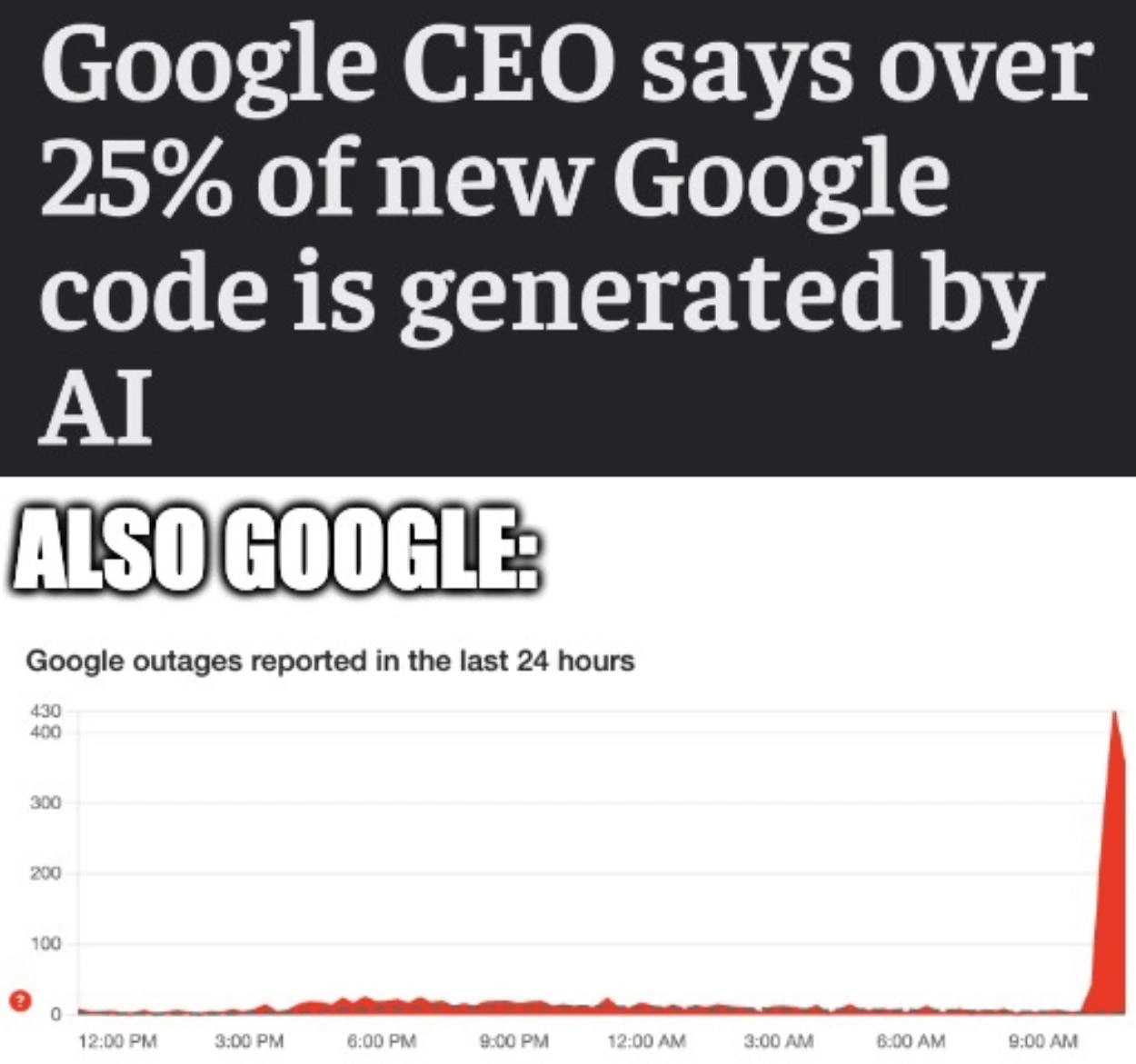
Let’s break down what’s happening in this meme in simpler terms. The top half looks like a news headline on a dark background. It says: “Google CEO says over 25% of new Google code is generated by AI.” This means Google’s chief executive is proudly stating that a quarter (25 out of every 100 lines, roughly) of the code their developers add is written not by humans, but by artificial intelligence. In practice, this likely refers to Google using advanced AI tools or assistants (kind of like super-smart autocorrects or code suggestion systems, e.g., maybe their version of GitHub Copilot) to help write code. That’s a big claim! It suggests Google is heavily leaning on machine-generated code to speed up development. Imagine a robot or a computer program that can write parts of the software for you – sounds futuristic and efficient, right? That’s the vibe of the top panel: a big tech company bragging about embracing the future of coding. It’s essentially saying, “We’re so advanced, even our code is written by AIs now! Humans, take a back seat (for about 25% of the ride).”

Now, the bottom half is where the joke comes in. It starts with large bold text saying “ALSO GOOGLE:” to set up a contrast, followed by a graph labeled “Google outages reported in the last 24 hours.” This graph looks mostly flat at a very low number of reports for most of the day, which implies everything was fine and Google services were running smoothly. But then, near the right side around the 9:00 AM mark, the graph shoots way, way up into a big red spike. That spike indicates a huge number of outage reports in a short time – basically, a ton of people suddenly started reporting “Google is not working for me.” Downdetector is mentioned, which is a website that collects user reports to tell if an online service might be down. If you’ve ever wondered “Is it just my internet or is YouTube down for everyone?”, Downdetector is where people go to check. When you see a spike on Downdetector for Google, it means a lot of people simultaneously had trouble reaching Google’s services (be it Google Search, Gmail, YouTube, etc). The bigger and taller that spike, the more widespread and severe the outage. And this spike is huge – basically a wall of red – implying a major incident (a big production outage, in tech terms).

So, putting the two panels together: the meme implies that while Google is gloating about using AI to write code, that very practice might be causing big problems – namely, a massive outage. It doesn’t explicitly say “the AI caused the outage,” but by juxtaposing those images, it’s strongly hinting at that storyline. It’s like saying, “Google says: We use AI to code! Also Google: Oops, everything’s on fire (down) right now.” This is a common joke structure in tech memes, highlighting hypocrisy or cause-and-effect in a tongue-in-cheek way.

Now, let’s unpack some terms that popped up, like error budgets and SRE, and why people find this scenario funny (in a kind of dark humor way). Site Reliability Engineering (SRE) is a discipline Google more or less invented to keep their services running smoothly. SRE teams are like specialized IT firefighters who also work to prevent fires. They set SLOs (Service Level Objectives) – basically targets for uptime like “this service should be available 99.9% of the time.” An error budget comes from that: if you aim for 99.9% uptime, that means you’re allowed 0.1% downtime. Think of an error budget as the allowance for mistakes or downtime. For example, over a month, 0.1% downtime is about 43 minutes max. If you “spend” more than 43 minutes being down, you’ve exhausted your budget – kind of like overspending your monthly data plan on your phone. When the meme says “error budgets evaporate,” it means Google’s services experienced so much downtime from this outage that they used up all the allowable downtime for a long while (maybe a whole quarter’s worth in one go!). In SRE land, if your error budget is gone, that’s serious. It typically means you should stop adding new features and focus on reliability, because you’ve been too unstable recently.

For a junior developer or someone new to these concepts: basically, Google has a system to balance new code vs. stability. New code (especially big changes) can introduce bugs and make things unstable. So they measure how often things break (downtime/errors). If things break too much (error budget exceeded), they say “no more new code until we fix our reliability.” It’s like if you got too many bad grades in school, you might take a pause from joining new clubs or activities and focus on studying to get your grades back up. Here, an error_budget_breach means the service’s “grade” fell below acceptable, so they need to buckle down.

Now, why would AI-generated code lead to outages specifically? Think of AI code generation like an auto-complete for code on steroids. It can save time, but it doesn’t truly understand the code’s purpose – it’s guessing based on patterns. If developers rely on it heavily (25% is a big chunk), there’s a chance it writes something that’s logically incorrect or risky, especially if humans don’t double-check it thoroughly. For example, the AI might omit a critical error check or use a wrong variable, and if a developer doesn’t catch that during review, that bug goes into the product. Many bugs might be minor, but some can be catastrophic – like causing a widely used service to crash or malfunction. At Google scale, even a small bug can have huge impact because everything is connected (Google has lots of internal services talking to each other, like a giant ecosystem of software). One wrong piece can create a domino effect.

The meme hints that by rushing into AI-written code, Google may have sacrificed some quality or caution, causing a big failure. It’s highlighting the trade-off between velocity and reliability. Velocity means how fast you can develop and deploy stuff. Reliability means how stable and error-free that stuff is when running. There’s always a balance: push too fast (especially with unproven tools or code), and you risk stability; focus only on stability, and you might not innovate or move as quickly. Google’s error budget concept is literally a tool to manage this balance: it says “okay, move fast until you see too many errors, then dial it back.” The meme suggests Google went a bit too fast with AI (lots of new code quickly), and boom – dial it way back because a huge error happened.

On the observability_monitoring side: Observability means how well you can understand what’s happening inside your system from the outside – through logs, metrics, traces, and dashboards. Monitoring is actively tracking those metrics and raising alarms if something looks wrong. In big systems, you set up monitors (like “alert me if user errors go above X per minute” or “page me if CPU usage goes crazy”). But guess what? Often, the first indicator of trouble for internet services is actually people complaining online. Downdetector is essentially an external monitoring tool that measures complaints. It’s not as precise as internal dashboards, but it’s very telling for user impact. In the meme, the downdetector_spike is a glaring indication that monitoring (external and no doubt internal too) is screaming “Red Alert! Users are having issues en masse.” If you were on the on-call rotation that day (meaning you’re the designated person to respond to emergencies), that spike is your nightmare scenario. OnCall_ProductionIssues are exactly that – when you’re on call, you’re responsible for fixing production issues. So an oncall_nightmare could be being woken up at 3 AM by pager, or in this depicted case, getting slammed at 9 AM when everyone is starting their day, because something broke big time.

The phrase "blameless_postmortem_fodder" in the context tags is basically saying: this incident (AI causing an outage) is the kind of story that would show up in a postmortem. A blameless postmortem is a meeting/document after an incident where the team analyzes what happened, why it happened, what can be learned, and how to prevent it, all without blaming any one person. The idea is to fix the system, not punish people. And believe me, if AI-generated code took down Google, that postmortem would be epic. It’d cover how the code got in, what went wrong with process or testing, and would likely result in new rules like “always have a human thoroughly review AI code” or “improve the AI model to understand these patterns” or “add more safeguards in deployment.” It’s even a bit meta: they might feed this incident back as training data to the AI (so it doesn’t suggest the same bad code again)!

Overall, to a newer developer or someone less familiar: this meme is a humorous caution. It’s saying, AI in coding is cool, but be careful – it can backfire spectacularly. Google’s name is attached to make it spicy because if even mighty Google can stumble with AI code, anyone can. The concept of an “error budget evaporating” is just a colorful way to describe “we messed up so much, we used all our allowance for mistakes.” And that graph – it’s basically the world noticing that mess-up in real time. For you, the takeaway is: AI is powerful but not magic. In software, more speed (or automated help) can mean more frequent mistakes if you’re not careful. That’s why we have testing, code reviews, monitoring, and yes, on-call engineers ready to jump in when something sneaks past all those defenses. The meme is funny because it compresses all these ideas into a simple two-panel irony: boast about AI making coding easier, and then deal with the fallout when that ease possibly leads to a giant glitch. It’s a wink-wink to anyone who’s seen grand plans meet harsh reality.

Level 3: Error Budget Bankruptcy

The humor of this meme hits seasoned engineers and SREs right in the gut, because it’s basically a picture of our worst-case production outage fears coming true at scale. In the top panel we have a triumphant corporate headline: “Google CEO says over 25% of new Google code is generated by AI.” This is a classic example of AI hype – leadership proudly announcing how AI/ML is making the dev process super-efficient, presumably expecting Wall Street and the press to applaud how forward-thinking and productive Google’s engineering has become. It’s the sort of shiny statistic you’d hear at a keynote or quarterly earnings call: “Look at us, embracing the future! Robots write a quarter of our code now.” The subtext: higher velocity, lower costs, maybe even a subtle hint that Google’s developers are augmented (or dare we say partially replaced) by AIGeneratedContent. To industry veterans, that line sets off a little alarm bell – “25% of our code is written by a tool that can sometimes be an unpredictable code parrot… okay, bold move, let’s see how that plays out.”

Then comes the bottom panel with the bold “ALSO GOOGLE:” – and we see a Downdetector graph showing a massive spike in Google outages reported. Downdetector, for context, is this public website where users report if they can’t access a service, and it aggregates those reports to indicate if a major platform might be having issues. So a flat line near zero means all clear, and a giant red spike means widespread outage – users everywhere are screaming. The graph in the meme is practically off the charts at ~9 AM. The juxtaposition is brilliant: it’s saying, “Google brags about AI-written code... and in the next breath, something at Google breaks spectacularly.” It’s implied causation through comedy: hey, maybe that 25% AI code has something to do with this huge outage. Whether or not that’s “true” literally, the meme hammers on the AIHypeVsReality theme. The reality being: if you let AI ship a quarter of your codebase, you might just end up setting your on-call team’s pager on fire.

This resonates so strongly with those of us who have been on the receiving end of a 3 AM OncallNightmares scenario or a mid-morning SEV-1 incident. The phrase "error budgets evaporate" in the title nails it: Google SREs allocate an error budget (tied to SLOs as described above) which is essentially the tolerance for failures in a given period. It’s an allowance for how much things can break before we say “whoa, slow down on new releases.” When that budget evaporates, it means reliability has been thrown out the window by recent issues. In plain terms, too many things broke too quickly. And nothing breaks error budgets faster than a massive outage of a critical service. We’re talking something like Gmail, YouTube, Google Cloud, or (heaven forbid) Google Search going down hard. If an incident like that happens, especially if it’s traced back to a bad code push, that’s when the SREs slam the brakes on all new deployments. It’s all-hands-on-deck to stabilize, and feature launches are put on hold. The meme doesn’t show it, but trust me, behind that Downdetector spike there’s a frenzy: frantic messages in incident chat rooms, dashboards all lit up red, a virtual war room spun up on a Google Meet, and bleary-eyed engineers furiously trying to rollback whatever change was just pushed. The site reliability engineering practices kick in: automated failovers, switching traffic off the broken service, maybe even engaging some circuit breakers to contain the blast radius. Somewhere an incident commander is saying: “Alright folks, priority #1: restore service. Priority #2: who pushed what change at 8:45 AM?” In an organization that big, an outage of that magnitude (hundreds of outage reports and likely millions affected) gets top priority attention.

The meme’s two-panel contrast effectively screams “headline_vs_production_reality.” We have the marketing/leadership narrative on top versus the gritty reality on the bottom. This is dark humor that any engineer who’s lived through a release-day fiasco will chuckle (or maybe cringe) at. Why? Because we’ve all seen some version of this story: New Technology X is hailed as a game-changer, then New Technology X inadvertently takes down production because it wasn’t as bulletproof as advertised. Here, Technology X is AI code generation: maybe internal tools similar to GitHub Copilot or Google’s own ML code assist integrated into developer workflows. The smart commentary is on AIHype: just because a machine can churn out code doesn’t mean it’s good code. Experienced devs know that more code ≠ better code. In fact, more code (especially if written without deep context) often means more bugs. So the seasoned architect or SRE reading that headline might arch an eyebrow and think, “25% of code? How much of that is being thoroughly code reviewed and tested? Are we sure this isn’t going to introduce a ton of automated_code_quality_risk?” The meme answers with a punchline: apparently, a ton of risk indeed – just look at that graph.

Another angle to this is the internal culture at Google, specifically around SRE. Google’s SRE invented the whole blameless_postmortem approach. That means when something blows up, they don’t line up one engineer to fire; they dissect the incident to find systemic causes and ways to improve. A scenario where an ai_generated_code change caused a major outage would be prime blameless postmortem material. It’s literally postmortem_fodder that SREs and devs would chew on for weeks: “How did this slip through? Did we rely too much on AI without sufficient checks? Was there a testing gap? Did product pressure to ship features override caution?” etc. The meme caption even notes “a scenario every seasoned SRE and architect has war-gamed” – meaning, we’ve imagined this exact possibility in pre-mortems and risk assessments. SREs often do scenario planning: “What’s the worst that could happen if we let AI write code? Could it take down prod? Nah… or maybe?” And here we have it drawn in meme form: the nightmare realized. It’s both funny and horrifying, like an inside joke that also hurts because it could very well happen (or maybe it already has behind closed doors!).

Let’s talk about the Google context too. Google is known for engineering excellence; they have some of the most stringent code review and testing processes on the planet. So if even Google is saying “Yeah, a quarter of our new code is AI-written,” it suggests AI coding has gotten really integrated into the workflow (or that might be a bit of PR fluff – hard to know). But then to pair that with an outage graph implies a kind of hubris meets nemesis storyline. It’s reminiscent of Icarus flying too close to the sun: Google flexed about AI-coded wings, and then those wings melted and down came the service reliability. It jabs at that Silicon Valley tendency to jump on the latest trend (AI everything!) while possibly underestimating the genAI_tradeoffs. One trade-off here is code quality and safety. AI might produce code faster, but is it handling corner cases? Does it truly grok the reliability_vs_velocity balance? Unlikely – it’s just optimizing for whatever it was trained on (maybe mostly open-source code with varying quality). If the AI learned from a corpus where error handling or thread synchronization is often overlooked, it might propagate those patterns into Google’s codebase – ouch. And when you operate at Google’s scale, even a small inefficiency or error gets amplified. The meme’s outage spike is a visual metaphor for that amplification.

From a developer perspective, this meme is also a wink at all the times management has chased shiny automation or tools and turned the dial to 11, only for engineers to scramble when reality doesn’t match the rosy expectations. We’ve heard the promises: “AI will reduce bugs!” or “This new CI/CD pipeline will make deploys safe by default!” or “Our codegen tool writes flawless code, trust it.” But any senior dev can recount war stories where over-reliance on a tool (be it an ORM, a codegen, an IDE auto-refactor gone wrong, you name it) led to some spectacular failure. This meme is basically that feeling writ large, with Google and AI as the players. It’s Schadenfreude for sure – seeing a mighty company possibly hoisted by its own petard – but it’s also cautionary. The lesson lurking behind the laughter: don’t put blind faith in automation. Keep those code reviews aggressive, test like crazy, monitor like your job depends on it (because it does), and always have a rollback plan. As an SRE might say wryly, “Hope for the best, plan for the worst.” Here, the “worst” showed up at 9 AM sharp.

And let’s not ignore the OnCall_ProductionIssues emotional element here. That Downdetector spike tells me some poor engineer’s phone started buzzing uncontrollably. If this was a widespread Google outage, imagine the stress: you’re the on-call engineer and suddenly Twitter and Downdetector show Google in the red. Every service team at Google knows the drill: pages to the on-call, instant mobilization. It might even trigger a company-wide incident if it’s something like Google Auth or another shared platform piece failing. Those situations are where war stories are born. Later, over coffee (once the adrenaline crashes), that on-call might joke with colleagues, “Remember that time the AI pushed a bad config and we basically hit the Downdetector top charts? Good times, good times…”. It’s funny after it’s fixed – during, it’s panic. The meme gets that dark humor exactly right. Only those who have been through a ProductionIncident or three can truly laugh and wince at the same time, seeing that graph and knowing the human scramble hiding behind it.

So, to sum up this level: The meme skewers the contrast between AI hype and operational reality. It speaks to engineers familiar with site reliability practices, who know about things like error budgets, monitoring dashboards, and postmortems. We see the tags like AIHypeVsReality and sre_oncall_pain practically playing out in the images. The top is the hype: big promises of efficiency and innovation (AI writing code!). The bottom is the pain: all that innovation doesn’t mean squat if your service is down and users are furious. Google’s reputation for uptime is part of their brand – seeing a giant outage is both rare and jaw-dropping, which amplifies the humor here. It’s hyperbolic, sure (reality is more nuanced; not every AI commit will instantly cause a meltdown), but exaggeration is the soul of meme humor. And this exaggeration is grounded in genuine concerns floating around developer circles right now: “What are the unintended consequences of letting AI into our codebase?” The meme’s answer: potentially, a lot of unintended consequences – just look at that wall of red outage reports!

Level 4: SLO-bliteration by AI

At the cutting edge of software engineering, using Large Language Models (LLMs) to write code blurs the line between human logic and machine-learned pattern matching. These models (like GPT-based Codex or Google's own code-gen AI) produce code by statistically predicting what "looks right" based on huge training corpora. But here's the rub: statistical correctness is not formal correctness. In theoretical computer science, we know that certain properties of programs (like whether it will crash or behave safely) are undecidable in the general case (thanks, Halting Problem and friends). Traditional approaches to ensure code reliability involve intensive testing, static analysis, or even formal verification to prove properties about code. An LLM-driven code generator doesn't inherently perform those rigorous checks – it can't mathematically prove the code it writes will meet all invariants or handle every edge case. Essentially, the AI is a very sophisticated auto-complete for code, without a true understanding of the code’s intent or the full context of a massive system. This means the AI might produce code that passes unit tests (or whatever limited checks it's given) but still contains a landmine of a bug. It’s a bit like having a super intelligent intern who learned coding from reading every Stack Overflow post: prolific, AIGeneratedContent in spades, but not guaranteed to foresee the subtle concurrency bug or memory leak that will bite at scale.

Now, scale is exactly where Google operates. Consider that even a tiny bug in a low-level service or a common library at Google can have globally distributed impact. We're talking microservices fan-out and cascading failures worthy of a PhD thesis in distributed systems. A small mistake (say, an AI hallucinating a slightly incorrect API usage or failing to check a nil pointer) might only cause a 0.01% error rate under normal load. But 0.01% of a billion users is 100,000 unhappy users – and that might be per minute. In distributed systems theory, we often worry about the blast radius of a failure: with one wrong line of code in a core service, you can get a chain reaction where dependent services start failing, timeouts pile up, and caches thrash. The graph shown (the Downdetector spike) is practically a textbook example of a cascading failure manifesting as a sudden wall of red. One moment everything is quiet; the next, it's a step function straight to outage city. This hints at something that failed fast and hard around ~9 AM, likely an automated push or update that the AI helped craft. Perhaps a configuration deployment or a common library update went out network-wide and caused a thundering herd of errors. The AI didn't “intend” this of course – it’s just executing its training – but it has effectively introduced a systemic anomaly that only emerges under production conditions. This is the kind of emergent bug that chaos engineers and SREs have nightmares about, where a subtle flaw blows up when real-world traffic hits it in just the wrong way.

Now let's talk about that ominous phrase: error budgets evaporate. In Google’s Site Reliability Engineering (SRE) doctrine, an error budget is a quantitatively defined allowance for failure. Formally, if your Service Level Objective (SLO) is say 99.9% uptime per quarter, that implicitly grants about 0.1% of downtime as the “budget” for errors or maintenance. In a 90-day quarter, 0.1% downtime is roughly:

$$ 0.001 \times 90 \text{ days} \approx 2.16 \text{ hours} $$

That’s about 2 hours 9 minutes of total allowed downtime in a quarter for that service. One colossal outage can burn through that budget in one shot. The meme’s red spike suggests a major Google service outage likely lasting on the order of tens of minutes to an hour (or more). If a core product was down even for 30 minutes globally, that's a budget breach of catastrophic proportions – poof, the entire quarterly error budget could be gone in one morning. This is what we mean by “error budget evaporated”: all the reliability slack, the wiggle room for mistakes that the SREs had carefully allocated, just got instantly obliterated by this one event. From a pure math standpoint, the probability of hitting a 0.1% downtime all at once is something you try to make vanishingly small with redundant systems and careful rollouts – yet here we are, with the worst-case scenario realized. The reliability metrics just went off a cliff.

There’s also a deeper reliability vs. velocity principle on display. Google’s SRE philosophy intentionally uses error budgets to balance the push for new features (velocity) against the need for stability (reliability). In theory, if you consume your error budget, you’re supposed to halt or throttle deployments to recover reliability (i.e., stop pushing new code and focus on fixes, tests, and robustness until you’re back within SLO). The darkly funny implication in this meme is that by proudly letting an AI pump out 25% of new code – presumably to boost engineering velocity – Google might have tripped a giant circuit breaker on deployments because the AI’s contributions helped nuke the SLOs. It’s an almost physics-like conservation law: conservation of complexity. Move fast and break things? Sure, but the breaking catches up. You can’t cheat the fundamental complexity of large systems with just faster coding. Somewhere, somehow, all those shortcuts and uncertainties will materialize as downtime. If anything, the meme hints at a lesson straight out of academic reliability theory or even Chaos Engineering research: introducing a new source of code (especially one that’s not human-standard in reasoning) into a complex system adds entropy, and without sufficient dampening (extensive testing, validation, sandbox runs), that entropy eventually finds a path to manifest as a failure. The spike is entropy made visible.

Ironically, Google of all companies knows this all too well – they pioneered the blameless postmortem and quantitative risk management culture in SRE. So you can imagine the cognitive dissonance: one part of Google is touting a shiny AI/ML achievement (“look how efficient we are now, 25% of code auto-generated!”), while another part (the on-call SREs and system architects) is grappling with the very real OnCall_ProductionIssues that result. Internally, there's probably a frantic dive into logs, metrics, and traces (thank goodness for modern observability stacks that Google also pioneered). Monitoring systems from Stackdriver/Cloud Monitoring or internal tools are likely flashing red more vividly than this public Downdetector graph. But externally, that flatline-then-spike chart is worth a thousand words – it’s basically the “facepalm” heard around the world for any engineer: a clear signal that something went horribly wrong after a period of calm. And the fact that it’s juxtaposed right below the AI-code boast is a chef’s kiss of irony.

In summary, on a theoretical level, this meme encapsulates a collision of trend and truth. The trend: increasingly relying on AI-generated code to accelerate development. The truth: software engineering has fundamental chaos properties where unvetted changes can induce system-wide failures, and no amount of hype can bypass the laws of complexity. We’re seeing the equivalent of a failed experiment in real-time: the system reached a critical point and the safeguards (tests, reviews, design checks) evidently didn’t catch an AI-introduced bug. The result aligns with fundamental principles – automation bias and unchecked probabilistic code-gen can erode the safety margins that engineers try so hard to maintain. This is the kind of scenario that makes the academically inclined folks reference papers on fault tolerance, formal methods, or SRE case studies titled something like “Outage of 2025: The Perils of Over-Reliance on GenAI in the SDLC.”

Description

A two-part meme. Top half has white text on dark background: 'Google CEO says over 25% of new Google code is generated by AI'. Bottom half shows bold red text 'ALSO GOOGLE:' followed by a Downdetector-style chart titled 'Google outages reported in the last 24 hours' showing a massive spike to over 430 reports, with the chart going from near-zero to a dramatic spike at around 9:00 AM. The juxtaposition implies correlation between AI-generated code and service outages, questioning the quality of AI-generated production code

Comments

17
Anonymous ★ Top Pick Correlation isn't causation, but when the CEO brags about 25% AI code and you see a 430-spike on Downdetector, your p-value starts looking suspiciously significant
  1. Anonymous ★ Top Pick

    Correlation isn't causation, but when the CEO brags about 25% AI code and you see a 430-spike on Downdetector, your p-value starts looking suspiciously significant

  2. Anonymous

    The good news is we're letting an AI write 25% of our code. The bad news is it just discovered race conditions and thinks they're a performance feature

  3. Anonymous

    Congrats AI, you hit 25 % of the commits and 2500 % of the SLO burn rate before the coffee finished brewing

  4. Anonymous

    Ah yes, the classic deployment strategy: let AI write 25% of your code, then spend 75% of your time debugging why prod went down at 9 AM when everyone's coffee-fueled and checking their Gmail. Nothing says 'innovation' quite like correlating your CEO's AI evangelism timeline with your SRE team's cortisol levels

  5. Anonymous

    Ah yes, the classic 'correlation implies causation' fallacy - except when your AI-generated code passes all unit tests but somehow triggers a cascading failure at 9 AM sharp. It's like watching a junior dev's first production deploy, but at 25% of your entire codebase. The real question isn't whether the AI wrote bad code; it's whether it also generated the postmortem explaining why 'works on my machine' doesn't scale to planetary infrastructure. At least when humans cause outages, we have the decency to do it gradually throughout the day

  6. Anonymous

    If 25% of commits are LLM-generated, make 75% of releases canaries with instant rollback - your error budget just learned probability the hard way

  7. Anonymous

    25% AI code at Google: Scaling hallucinations from dev to a 400-outage prod firehose

  8. Anonymous

    When your DORA change-failure-rate starts tracking the model’s loss curve, maybe don’t auto-merge AI PRs without canaries and a fast rollback

  9. @Icrarkie 10mo

    More AI Code for AI God 😁

    1. @chupasaurus 10mo

      Vibes for the throne of vibes😘

  10. @drbogar 10mo

    My new job title will be 'vibe code debugger'. We've got AI to take the good parts of coding and leave the bad parts for us! 😄

    1. @Icrarkie 10mo

      Junior Vibe Code Debugger > Senior Vibe Coder

      1. @Johnny_bit 10mo

        Hopefuly the pay is worth it...

        1. @Icrarkie 10mo

          We just need to wait for the time when all the AI code starts causing global problems, and then the specialists who can subdue it all will grow in value.

  11. @RiedleroD 10mo

    so that's why everything is going to shit even more than usual. good to know ig

  12. @grinya_a 10mo

    In principle, it won't affect anything. No one reads the reports anyway

  13. @GarySKS 10mo

    I am curious now what a graph over the years looks like

Use J and K for navigation