When LLM token fees click: microtransactions have finally reached developers
Why is this AI ML meme funny?
Level 1: Coins for Questions
Imagine you have a gumball machine that gives you a candy each time you put in a coin. Each candy is cheap – just a single coin – so it doesn’t seem like you’re spending much. But if you keep turning the knob for more candy, coin after coin, eventually you might use up all the coins in your piggy bank without noticing. This meme is saying something similar is happening to programmers with AI: every time a developer asks a big computer brain (an AI) a question, it’s like they have to put a tiny coin in a machine. One question, one little coin.
At first, paying per question sounds okay because each coin isn’t worth much. But those questions (just like candies) can add up quickly if you’re not careful! It’s a funny comparison because usually when we think of buying things one small piece at a time (microtransactions), we think of video games or candy machines or maybe those rides in front of a grocery store you put quarters into. We don’t usually think about writing code or using a computer helper as something that costs money every single time. Developers – the people who make and maintain the apps and games – aren’t used to feeling like they’re at an arcade machine inserting coins to continue.
So the joke here is basically: “Haha, now even programmers have to experience what it’s like to pay little by little for something they use a lot.” They put on their “glasses” and suddenly realize token fees for the AI are just like in-app purchases or game microtransactions. It’s a bit like if every time you asked your voice assistant (like Siri or Alexa) a question, a few cents quietly disappeared from your allowance. You’d probably start saying, “Whoa, hold on, do I really need to ask this?” That mix of surprise and concern – and the realization of the pattern – is what makes the meme funny. It’s showing the moment a developer understands that their fancy AI-powered tool comes with a sneaky little coin slot.
Level 2: Insert Coin, Get Answer
Let’s break this down in simpler terms and explain the pieces. LLM stands for Large Language Model, which is a type of AI system (like OpenAI’s GPT series) that can understand and generate text. When you interact with an LLM (for example, by sending it a prompt like “Explain what a binary tree is”), the service charges you based on the number of tokens used. A token is basically a chunk of text – it could be a word or just part of a word. So the longer your prompt or the AI’s answer, the more tokens, and thus the more you pay. This pricing scheme is often called pay_per_token. If you’ve seen cloud services charging per API call or per gigabyte of data, it’s similar, but now it’s per word fragment.
Now, what are microtransactions? In the context of video games or mobile apps, microtransactions are those tiny payments (maybe 50 cents, a dollar, five dollars) you make inside a game to get extra stuff: a cool sword for your character, an extra life, a new skin, or access to the next level. Instead of paying a big price upfront for the whole game, you pay in these small increments as you go, which can add up to even more. It’s a business model that many game studios use to make money gradually from players. If you’ve ever heard someone joke about a “microtransaction economy,” it means an economy where the user is continuously prompted to spend a bit more money for incremental benefits.
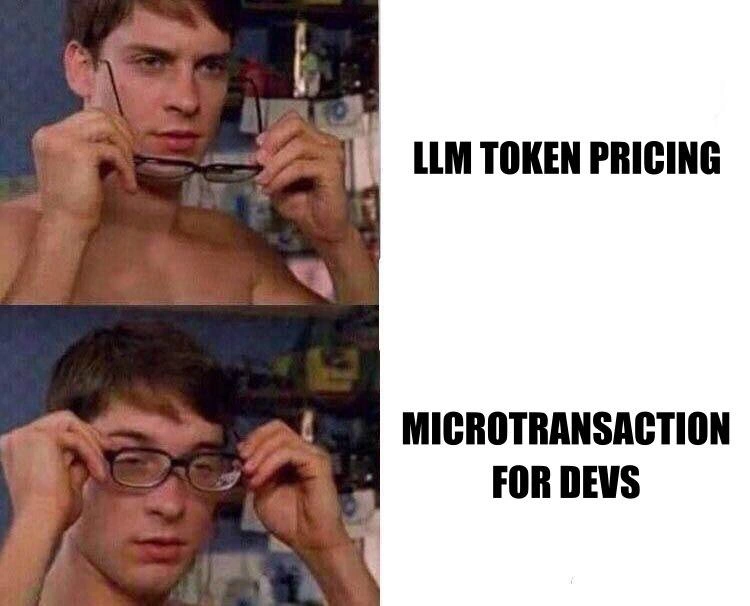
In this meme’s joke, the developer has realized that LLM token pricing is basically microtransactions for developers. Every time a dev uses an AI API to get some work done – say auto-generating code, answering a question, or processing data – they’re effectively making a tiny purchase. The meme uses the classic Spider-Man with glasses image to illustrate a moment of realization. On the left side, Peter Parker is squinting at something he sees unclearly; the text he’s looking at reads “LLM TOKEN PRICING.” This represents a developer initially just seeing the pricing model as a technical detail. In the next frame, he puts on his glasses (now he can see clearly) and the text comes into sharp focus as “MICROTRANSACTION FOR DEVS.” That’s the moment it “clicks”! He now understands that what he’s dealing with is akin to the microtransactions he’s maybe encountered elsewhere, but this time in his developer tools.
Why is this funny (especially for someone early in their career or just learning about these things)? It’s a mix of surprise and irony:
- Surprise: If you’re a new developer, you might think, “Using an AI service is straightforward, maybe I just pay a monthly fee or it’s free.” But surprise! You actually pay by usage, down to very small units (tokens). It’s like discovering that every time you ask the AI a question, a tiny charge applies. Many didn’t expect that programming would involve thinking about budgeting inference calls, yet here we are.
- Irony: Developers often build or use microtransaction systems in consumer apps, but now that same concept is being applied to the tools developers use. It’s ironic and a bit humorous that devs themselves have to experience the “nickel-and-dime” feeling. Essentially, the dev is the new gamer who has to be mindful of not overspending. There’s even a tag for this feeling: developer_wallet_drain – the image of a dev’s wallet being slowly emptied by many tiny AI transactions.
In more concrete terms, imagine you’re writing a program that uses an AI to help users. Perhaps it’s an app where users type questions and the AI answers. If your app gets popular, you might have thousands of questions per day. With token pricing, each question-answer pair might cost, say, $0.001 or $0.0005 in tokens. That sounds super cheap, right? But multiply by 100,000 or a million – suddenly you have a significant bill. New developers might not anticipate how quickly those pennies turn into hundreds of dollars. Just like a gamer might not realize how those $0.99 purchases add up until their credit card statement arrives.
The meme’s categories AI_ML and DeveloperExperience_DX hint at exactly this intersection: it’s about an AI/ML feature (LLM usage) affecting the developer’s experience of building and maintaining software. A junior dev reading this might go, “Oh, I need to keep an eye on costs when I use AI APIs. It’s not free magic.” It’s a lighthearted warning. In fact, developers now sometimes have to optimize prompts for cost. That could mean:
- Using fewer words in prompts (because shorter prompt = fewer tokens = cheaper). You start thinking, “Do I really need a flowery detailed request, or can I ask in a concise way?”
- Limiting the AI’s response length (maybe asking for a summary instead of a detailed essay) to save money.
- Batch processing or caching results so you don’t call the AI for the same thing twice.
All of this is analogous to how a mobile app user might budget their microtransactions: “Maybe I won’t buy that extra skin today” vs “Maybe I won’t call the AI for this trivial thing right now.” It introduces a new consideration in development: balancing cost optimization with functionality. And yes, there are even tools and dashboards now for tracking LLM usage, just like a gamer might track spending or have parental locks on purchases.
To put it simply, the meme is a humorous way to teach that “There ain’t no such thing as a free lunch” in AI services. If you use a lot of an AI’s brainpower, you pay for it – often in tiny little increments measured in tokens. And once you see the similarity to game microtransactions, you can’t unsee it. That’s why Spider-Man needed the glasses 🤓: the blurry concept of token pricing suddenly became clear as the familiar pattern of in-app purchases.
Level 3: Pay-to-Prompt Paradigm
At the highest level, this meme highlights a paradigm shift in AI/ML tooling economics that seasoned developers are starting to recognize. In modern AI development, using a Large Language Model (LLM) often involves a pay-per-token pricing model – essentially, you’re charged for every piece of text (token) the model processes. Initially, that pricing might look innocuous: a fraction of a cent per token. But when you integrate an LLM into a real product or workflow, those fractions can scale aggressively, much like microtransactions in games.
Why is this funny (or painfully true) to experienced devs? It’s the sudden clarity that we’ve seen this business model before. The meme’s two-panel Spider-Man format (Peter Parker squinting, then putting on glasses to see clearly) perfectly captures the “aha” moment: LLM token pricing coming into focus as “microtransaction for devs.” In other words, the realization that every AI prompt is like a tiny in-app purchase. This is an inside joke for developers who remember when gaming and mobile apps embraced microtransaction economies—charging users a few cents for every extra life or shiny skin. Now, that same nickel-and-dime approach has crept into developer life: each code completion or AI-generated answer silently chips away at your budget.
From a senior developer’s perspective, this resonates as a commentary on Developer Experience (DX) and AI industry trends. Just as gamers rolled their eyes at pay-to-win schemes, developers are now warily eyeing pay-to-prompt schemes. The humor is a bit dark: it suggests that even writing code or querying an AI has become a coin-operated activity. After surviving cloud-computing bills and AWS “pay for every lambda invocation” surprises, today’s battle-scarred engineers see history repeating. The industry has moved from upfront software licenses (pay once, use unlimited) to cloud usage-based billing, and now to per-keystroke billing with AI. It’s a continuum of granularity: first we paid per server, then per container, then per function call, and now per token of text. Each step gets more granular – and potentially more painful to track financially.
One could argue this is a rational consequence of how LLM inference works. Large Language Models consume substantial GPU resources; charging per token is a fair usage-based model. But the meme wryly implies something beyond the tech: it’s pointing at the gameified monetization of coding tools. Microtransaction economy tactics (small repeated charges) are psychologically known to lead to higher aggregate spending than one-time purchases – it’s why game studios and now API providers love them. Senior devs reading this might recall management asking “Why is our OpenAI API bill so high?” and having to explain that countless 0.002¢ tokens cumulatively cost thousands of dollars. It’s the same vibe as a credit card statement full of $0.99 game purchases.
This is also a commentary on the new developer pain points in AI integration. Incorporating an LLM into your app means you’ve got cost optimization and budgeting as part of your engineering concerns. You start doing weird things like:
- Limiting the length of user prompts or AI responses to save tokens (like a gamer conserving coins).
- Caching AI results aggressively so you don’t call the API for repeated queries.
- Monitoring usage with the zeal of a DevOps engineer watching cloud spend, maybe even writing a script to alert when token use exceeds some limit.
In short, the meme lands with experienced developers because it connects to real-world patterns: you think you’re adding an awesome AI feature, and suddenly you feel like you’ve opened a mini app store inside your codebase – one where each function call might require swiping the corporate credit card. It’s a funny-and-sad reflection on the state of AI industry trends: powerful language models are here, but using them at scale can feel like being a gamer who can’t progress without feeding in more quarters. The convergence of AI/ML innovation with a microtransaction-style pricing model is the punchline; it’s a modern developer’s “welcome to the future, it costs $0.0005 per token” moment of clarity.
💡 **Senior Dev Easter Egg – Viewing the Source Code of Costs**
To illustrate how these costs accumulate, consider some pseudo-code:
# Pseudo-code for using an LLM with token-based billing
prompt = "Can you generate unit tests for this function?"
response = LLM_API.generate(prompt)
tokens_consumed = count_tokens(prompt) + count_tokens(response)
cost = tokens_consumed * PRICE_PER_TOKEN # e.g., $0.0005 per token
print(f"💸 Tokens used: {tokens_consumed}, Cost incurred: ${cost:.4f}")
This snippet counts how many tokens were in the prompt plus the AI’s response and calculates the cost. The printout might reveal: "💸 Tokens used: 2000, Cost incurred: $1.00". That’s one expensive pair of unit tests! Senior devs will chuckle (or wince) at the thought of instrumenting their code to report how many dollars each AI call burns – it’s reminiscent of coin-operated machines tallying how much you’ve spent.
Description
Classic two-panel Spider-Man glasses meme. Left column shows a shirtless Peter Parker in a cluttered bedroom: in the top frame he squints while holding his glasses; in the bottom frame he has put the glasses on. The right column is plain white with bold black text: upper frame reads “LLM TOKEN PRICING”, lower frame reads “MICROTRANSACTION FOR DEVS”. The gag lands when clarity returns - pay-per-token looks suspiciously like the nickel-and-dime model game studios use. For engineers budgeting inference calls, the realisation that every prompt is an in-app purchase satirises the new cost calculus of production LLM integrations
Comments
12Comment deleted
We went from counting bytes on the wire to counting tokens in the prompt - congratulations, your architectural decision diagram now has its own coin-op slot
Remember when we laughed at gamers paying $0.99 for a skin? Now we're optimizing prompt lengths to save fractions of cents per API call, implementing token caching strategies, and explaining to finance why our AI assistant just cost us $47 because someone asked it to summarize War and Peace with detailed analysis
The moment you realize your 'quick prototype' with GPT-4 has racked up more in token costs than your entire AWS bill, and you're now frantically implementing prompt caching, context compression, and considering if that intern's regex solution wasn't so bad after all. At least with gaming microtransactions, you knew you were getting a cosmetic horse armor - with LLM tokens, you're paying per thought and the bill arrives after you've already shipped to production
FinOps update: each RPC gets a token budget - exceed it and the model pops a $0.03 “Continue Thought” pack
Prompt engineering: where every extra token in your system prompt triggers a scope creep on your cloud bill
Token billing turned Big-O into Big-$ - every recursive agent loop is amortized over the CFO’s blood pressure
These are macrotransactions Comment deleted
Huh, it depends Comment deleted
But now on Claude Max x20 and kinda enjoying it Comment deleted
They made us pay for words Comment deleted
owah, don't be tired bro, you and all memmbers protected from group by ad bot attackers Comment deleted
Uuuhauhuahuah Comment deleted