Can JTAG hearts sync with DOM souls? Embedded girl meets webdev boy
Why is this EmbeddedSystems meme funny?
Level 1: Opposites Attract
Think of two people who both like technology, but in totally different ways. One person works with gadgets and machines – kind of like how you might build a robot or play with an electronics kit. They deal with actual hardware, wires, and very low-level computer code that makes devices do things. The other person works with the internet and websites – like designing a really cool interactive webpage or a game you can play in a browser. This is a bit like one friend who loves tinkering with toys and circuits, and another friend who loves creating digital art or stories on a computer. They both are creative and smart, but the stuff they play with is super different.
Now, the meme asks if these two people can be in a relationship, which is a funny way of wondering if they can understand each other and get along when their day-to-day work is so unlike. It’s using an exaggerated question to make us smile, as if their worlds are so far apart that it’d be a miracle for them to connect. Imagine one lives in the land of hardware (where you fix things with screwdrivers and code that makes LEDs light up) and the other lives in the land of websites (where you make buttons click and pages look beautiful). It sounds like they’re from different planets, right? That’s the joke – it’s like asking “Can a dolphin and a bird be friends?” They both live in different environments (water vs air), so you’d laugh and think, hmm that’d be tricky!
But if you think about it in simple human terms, both of these people are actually doing the same general kind of thing: problem-solving and creating with technology. They just use different tools. One might use a soldering iron and code that talks to hardware, the other uses a laptop and code that talks to web browsers. The meme is funny because it exaggerates how hard it would be for them to relate – like they have nothing in common. It’s humor, so it’s purposely being dramatic. In real life, of course an embedded dev and a web dev can be friends or date; they’d just have to be curious about each other’s work. They might even find it cool to learn about that other side of tech! The core of the joke is the surprise and silliness of picturing two total opposites together and wondering, “Could that actually work?” It makes us laugh because usually when people say “opposites attract,” they mean things like a shy person and an outgoing person dating. Here, it’s two kinds of nerdy people who are “opposites” in the nerd world.
So, the simple idea: it’s funny to imagine two very different tech lovers trying to share a life. One speaks the language of machines, the other speaks the language of the web. It’s as if one person talks in binary (010101) and the other talks in colorful pictures and text. The meme winks at us and says, “Do you think that can work out?” We laugh because it’s a bit absurd, but also kind of sweet. After all, even very different people can get along if they try. Opposites do attract – and maybe they can teach each other about their cool different worlds along the way.
Level 2: Toolchain Culture Shock
Let’s break down what this meme is saying in simpler terms. We have two characters: an embedded software developer (the “embedded dev girl”) and a web developer (the “webdev boy”). These titles refer to the type of programming they do. The meme wonders if it’s really possible for them to be in a relationship – essentially if they can understand each other’s work and world. It’s a playful way of pointing out how different their daily jobs are. This falls into a common tech joke about embedded_vs_webdev: the idea that working on tiny computers inside gadgets is drastically different from building websites or web apps, almost like two separate cultures.
Embedded development means writing software for devices that aren’t general-purpose computers. Think of the software that runs inside a microwave oven, a fitness tracker, or a car’s engine control unit. An embedded developer often writes in low-level languages like C or C++ and works closely with hardware. They might use things like microcontrollers (essentially very small computers on a single chip) which have limited memory and processing power. Because of this, embedded devs have to be careful with every byte of memory and every millisecond of timing. For instance, if you’re coding for a digital watch, you might only have 32 KB of RAM total – that’s tiny! Embedded devs commonly use tools like JTAG probes, which are physical devices that plug into a circuit board to help debug the code running on the chip. With JTAG, they can pause the program at a certain line, inspect processor registers (the chip’s internal variables), or flash new code onto the device. It’s a very hands-on kind of programming, often involving hardware kits, wires, and specialized software to communicate with the device. They also use protocols like SPI or UART to communicate between chips (for example, to send data from a sensor to the main processor). Debugging in embedded land might involve reading hex dumps (a bunch of hexadecimal numbers representing memory) or watching an LED blink in a certain pattern as a clue. It’s pretty far removed from the kind of programming most people see on their laptop.
Now, web development is almost the opposite end of the programming spectrum. A web developer builds websites or web applications – everything from the front-end pages that you see in your browser (with buttons, text, images, styles) to some of the back-end logic that runs on servers (handling databases, user accounts, etc.). In the context of this meme, we’re focusing on the front-end web dev (since it mentions DOM and such). Web devs use languages like JavaScript alongside HTML and CSS. JavaScript code manipulates the DOM, which stands for Document Object Model – basically the structure of the webpage. You can imagine the DOM as a tree of elements (like <div> containers, paragraphs <p>, buttons, etc.) that the browser creates from the HTML. Web developers can use JavaScript to change this DOM on the fly – for example, to show a popup, to update text, or to animate something – which is how interactive websites are built. They rely on a huge ecosystem of libraries and frameworks. You might have heard of React (a popular JavaScript library for building user interfaces) – the meme mentions a “React SPA,” which means a Single Page Application written in React. That’s a web app that loads a single HTML page and dynamically updates it as the user interacts, rather than constantly loading new pages. Web devs use package managers like npm (Node Package Manager) to pull in open-source libraries (sort of like getting pre-made code helpers so they don’t reinvent the wheel). And instead of an LED blinking to debug, a web dev will probably use console.log() statements to print messages in the browser’s console, or they’ll use the browser’s developer tools to inspect elements, check network requests, and debug JavaScript step by step (much like how embedded folks step through C code in a hardware debugger, but here it’s all in software within the browser).
Because these two fields are so far apart, it can be a shock if you only know one and suddenly see the other. That’s the toolchain culture shock the subtitle refers to. A toolchain is just the set of tools and processes you use to develop software. For embedded devs, the toolchain might include a cross-compiler (to compile code for a specific microcontroller architecture), a hardware programmer device to load the code onto the chip, maybe an IDE or even just a command-line and a text editor, plus things like logic analyzers or multimeters for hardware testing. For web devs, the toolchain often includes a code editor or IDE specialized for web (with plugins for HTML/CSS/JS), a local web server for testing (often by running something like npm start that serves the app), browser dev tools, and a deployment pipeline to put the site on a live server or cloud service.
Imagine a fresh graduate who’s only done web programming trying to work with an Arduino microcontroller blinking an LED – suddenly they have to think about memory addresses, and why their program doesn’t run if they forget a semicolon in C (which can cause a compile error rather than a quick fix in an interpreter). Conversely, someone coming from writing firmware might find modern JavaScript baffling – “Wait, you’re telling me undefined is not a function is a common error? And what’s with all these { } curly braces in HTML-looking code – oh, that’s JSX in React, got it.” They might also be surprised at how heavy web apps can be (megabytes of JavaScript) compared to their ultra-lightweight firmware that’s maybe a few dozen kilobytes. Both would definitely experience a learning curve stepping into each other’s shoes.
The meme’s question itself – “Is it really possible for an embedded dev and a web dev to be in a relationship?” – is phrased like a dramatic, almost hopeless query. It humorously suggests that the gap is so large that it might be as tricky as, say, a long-distance relationship or one between people with no common language. It’s playing on the idea of developer tribalism: sometimes, developers form tight-knit groups around the technology they work with, and they playfully (or sometimes seriously) assume other groups don’t quite get it. If you’ve ever browsed tech forums or Reddit, you’ll see jokes like “Front-end vs Back-end vs DevOps” where each group has stereotypes. Here it’s Embedded vs Web. Embedded devs are often seen as dealing with “hard” real engineering (since it involves hardware and low-level code), whereas web devs are seen as dealing with rapidly changing, higher-level stuff (sometimes derided as “just making pretty pages” even though it’s quite complex in its own way). These stereotypes aren’t really fair, but they persist as running jokes.
The meme specifically brings up JTAG hearts and DOM souls, which is a poetic way to reference each side’s core “thing.” If you know Marvel or sci-fi, it’s like saying one person’s heart beats with technology and the other’s with the spirit of the web. But practically: an embedded dev’s heart (their passion) is in things like JTAG and hardware debugging, and a web dev’s soul is in understanding the DOM and making it dance. The question is asking if those two can sync up – like getting two very different systems to communicate. In engineering, when two systems sync, they often need a common protocol or clock. For instance, two devices might sync via a shared clock signal so their data transfers line up. By analogy, for our two devs to sync, they’d need to find a common language or interest. It’s not literally about tech now, it’s more about understanding each other’s perspective. If one starts talking about their day – “I kept hitting a race condition in my interrupt service routine” – the other might respond, “Umm… I styled a modal popup with CSS and fought a React state bug.” Initially, they might draw blanks at each other. But if they’re patient, they could explain the translation: a “race condition” is when two parts of a program try to do things at the same time and mess each other up, whereas a “state bug” in React is like when your UI shows the wrong data because the internal data got out of sync – hey, those are kind of similar types of problems (consistency issues)! So actually, even though the surface tools differ, they both do debug tricky issues, just in different domains.
For someone newer to software, the takeaway is: embedded development and web development are two very distinct areas in tech. The meme gets its humor from exaggerating how incompatible they seem. It’s like asking “Can a cowboy date a mermaid?” – two cool individuals, but you wonder how their worlds could ever mix! In real life, people from different tech fields can absolutely connect (and do all the time), but they’ll have some funny moments trying to explain their work to each other. This meme is a lighthearted nod to those differences, wrapped in the format of a question about a romantic relationship for comedic effect.
Level 3: JTAG Meets DOM
At the senior developer level, this meme highlights the comical chasm between two very different DevCommunities: EmbeddedSystems engineers and WebDev professionals. The caption asks if an embedded dev girl and a webdev boy can be in a relationship – a tongue-in-cheek way of questioning if two wildly different tech worlds can find common ground. The humor lands because these roles operate on opposite ends of the tech spectrum. It’s poking fun at a bit of DeveloperTribalism in our industry, where each camp has its own tools, jargon, and culture that outsiders find bewildering. Seasoned developers immediately recognize the ideological_stack_divide being satirized here.
In one corner, you have the embedded developer – the kind of engineer who debugs with oscilloscopes and JTAG probes, writing firmware in C/C++ that runs on tiny microcontrollers. They deal with hardware registers, bitwise operations, and timing diagrams. Their idea of a wild bug is when an IRQ (interrupt request) misfires or an off-by-one error causes a memory corruption on a device with 32 KB of RAM. In the other corner, the web developer lives in a world of browsers and high-level frameworks, juggling HTML/CSS and JavaScript. They debug by popping open Chrome’s DevTools, and their typical fires are maybe a misbehaving npm package or a CSS flexbox that isn’t flexing in Firefox. The meme exaggerates this contrast for comedic effect: can these two fundamentally different species of developer peacefully coexist, let alone date? 😄
TechCulture is full of these playful rivalries. The embedded folks sometimes joke that web devs are just “pixel pushers” who copy Stack Overflow snippets to center a <div>. Meanwhile, web developers tease that embedded devs are archaic, writing in ancient C and spending hours to blink an LED like it’s a big achievement. It’s a classic case of DeveloperTribalism: each side thinks the other has it easier or less “real.” The meme’s caption literally censors the words girl and boy and overwrites them with embedded dev and webdev, implying that the real question is about the relationship between their tech stacks, not their genders. It’s mocking the idea that combining these worlds is almost like an inter-species romance in tech terms.
Consider the tools: an embedded engineer might use a hardware debugger and stare at raw hex dumps to troubleshoot, while a web developer uses hot-reloading development servers and inspector tools on the DOM. The meme’s title phrase “Can JTAG hearts sync with DOM souls?” playfully anthropomorphizes their core tools – as if the embedded dev’s heart beats in JTAG signals and the web dev’s soul lives in the DOM structure of a page. JTAG (Joint Test Action Group) is a low-level interface that lets you halt a microcontroller, inspect CPU registers, and step through instructions on the bare metal. In contrast, the DOM (Document Object Model) is a high-level representation of a webpage’s UI elements that JavaScript can manipulate. These two things never directly interact in real life; they’re as far apart in the tech stack as you can get. So the notion of them “syncing” is inherently funny – it’s a metaphor for these two people trying to connect their vastly different professional lives.
The meme even alludes to a scenario “like integrating SPI drivers with a React SPA.” That line is gold for experienced devs. SPI (Serial Peripheral Interface) drivers live in the embedded world – they control how a microchip talks to peripheral devices (sensors, displays, etc.) at the electrical signal level. A React SPA (Single Page Application built with React) lives firmly in web dev land – it’s all about interactive components in the browser, routing via URLs, and state management with Redux, far removed from any physical hardware. Integrating an SPI driver with a React app is an absurd mash-up, the kind of franken-project you’d never actually do. It highlights how mismatched the toolchains are: imagine trying to #include <spi_driver.h> in your JavaScript code, or using npm install inside a microcontroller’s firmware – totally impossible. This absurdity is the point of the joke. It exaggerates the toolchain_incompatibility to underline the cultural gap.
Yet, anyone who’s been around the industry knows that cross-stack encounters aren’t just hypothetical. Think IoT (Internet of Things): the embedded dev writes firmware for a smart device (say, an Arduino controlling a sensor) and the web dev writes the dashboard that visualizes the sensor data in real time. They have to collaborate, and when they do, it can feel like diplomats from two countries trying to understand each other’s language. The embedded dev might talk in terms of UART baud rates and memory addresses, while the web dev speaks about HTTPS requests and JSON formatting. They need a sort of “protocol translator” – both socially and technically – to work together. A senior engineer reading this meme chuckles because it rings true: we’ve seen meetings where an embedded engineer asks “Can’t we just multi-thread that real-time task?” and the web dev blinks, thinking in terms of event loops and async-await, not realizing the microcontroller has no OS threads. And vice versa, the web engineer might say “Just use latest JavaScript on that device” and the embedded folks facepalm because their chip only runs C at 120MHz with 128KB flash – JavaScript isn’t even on the menu.
To illustrate how contrasting these worlds are, let’s put some of their characteristics side by side:
| Embedded Dev World | Web Dev World |
|---|---|
| Code in C/C++ (maybe even some assembly) | Code in JavaScript/TypeScript, HTML, CSS |
| Runs on a microcontroller with 256KB RAM | Runs in a browser (or server) with GBs of RAM |
| Uses a JTAG/SWD hardware debugger and serial logs | Uses Chrome/Firefox DevTools and console logs |
| Deploys by flashing firmware via UART or USB | Deploys by pushing to a web server or CDN |
| Concerned with bits, registers, and interrupts | Concerned with user interfaces and APIs |
| Typical bug: segfault or timing issue | Typical bug: “undefined is not a function” |
| Optimizes for memory and CPU cycles | Optimizes for responsiveness and compatibility |
Looking at this, it’s no wonder an embedded dev and a web dev can feel like they’re on different planets. One is dealing with electrons and UART serial data, the other is orchestrating pixels and DOM nodes. The shared term “developer” belies how vastly different their daily life is. A veteran engineer reading the meme recognizes all these little contrasts and likely recalls a time they saw (or experienced) this disconnect first-hand. Maybe they’ve witnessed a hardware engineer blankly stare at React code, or a front-end guru get flustered by the phrase “memory leak in the ISR.” The meme’s question (“Is it really possible...?”) is phrased like an age-old romantic dilemma, which just adds to the humor. It’s as if the caption is wistfully pondering a star-crossed love: can these two worlds ever truly understand each other?
And yet, the punchline is also an eye-roll and a laugh of recognition, because in reality, these pairings do exist and can thrive. If anything, a senior dev knows that diversity in tech backgrounds can lead to some of the most innovative collaborations (and also some hilarious miscommunications). The meme cleverly exaggerates the differences to play on a RelatableDeveloperExperience: most of us have felt at some point that another programmer’s job was mystifying. It’s funny because it’s true – the embedded dev and the web dev might struggle to talk shop without a lot of explanation. The shared experience here is that feeling of “Wow, I wouldn’t even know where to start with what you do!” that happens when two devs from different domains chat. Ultimately, the seasoned perspective is: yes, the tech stacks are worlds apart, and that’s exactly why this meme gets a knowing chuckle. It captures a real TechCulture phenomenon in a single, cheeky question.
Embedded Dev: “Psh, all you do is tweak some CSS and hit refresh.”
Web Dev: “Yeah? Well, all you do is blink an LED and call it rocket science.”
Despite the ribbing, both know that under the hood they’re solving complex problems—just of very different flavors. The meme embraces this contrast, and any senior developer can appreciate the absurd yet affectionate sentiment: it’s challenging for a JTAG heart to sync with a DOM soul, but it’s a lot of fun when it happens.
Description
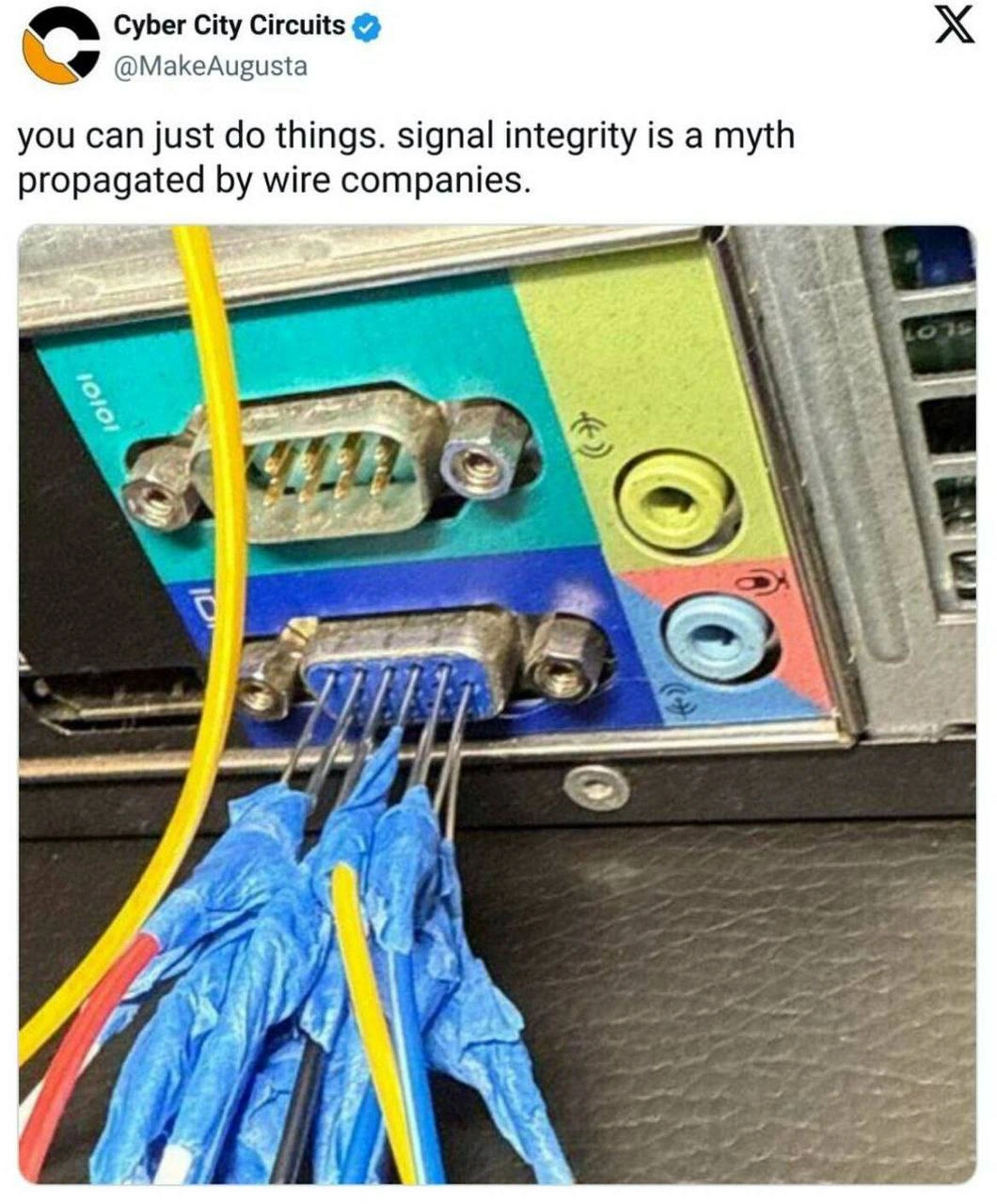
Meme-style image: a seated man in a plaid shirt and cowboy hat (face blurred) leans forward, elbow on knee, holding his hat in a contemplative pose. Large white caption with bold black outline reads: “Is it really possible for a girl and a boy to be in a relationship?” The original words “girl” and “boy” are partially covered by black censor-style rectangles that insert tech roles, resulting in the full visible text: “Is it really possible for a embedded dev girl and a webdev boy to be in a relationship?” The humor plays on the perceived culture gulf between low-level firmware engineers who debug with JTAG probes and timing diagrams and browser-centric web developers who live in npm and CSS, questioning whether two wildly different toolchains (and mindsets) can peacefully merge - much like integrating SPI drivers with a React SPA
Comments
31Comment deleted
Sure, it can work - as long as she’s OK with his love language being JSON and he’s cool waiting 45 minutes for her cross-compile to finish before date night
She's debugging race conditions in microseconds while he's debating whether to use 17 JavaScript frameworks or 18 - but at least they both know the pain of undefined behavior, just at vastly different abstraction layers
The real question isn't whether they can be in a relationship - it's whether the embedded dev can tolerate the web dev's 500MB node_modules folder when they're used to fitting their entire application in 64KB of flash memory. One optimizes for microseconds and milliwatts; the other imports three frameworks to center a div. It's a love story written in incompatible type systems, where 'undefined is not a function' meets 'segmentation fault (core dumped)' and somehow they still have to share the same Git repository
Her interrupts are precise and deterministic; his promises async and forever pending - race condition in romance
It works if they agree on one definition of “real time”: her ISR budget is 10ms, his SLO is “before first contentful paint,” and both lint each other’s expectations
They’ll be compatible once they version the relationship API: she demands a 5ms worst‑case latency with no dynamic allocation, he ships weekly breaking changes behind feature flags - so far the emotional firmware bricks right after npm install
Embedded girls are a fantasy, not real, fake news Comment deleted
Ironically, I worked with one of them while I was in college. Comment deleted
Lies Comment deleted
I'm friends with one Comment deleted
average rust programmer Comment deleted
no 😔 Comment deleted
Nahhh Comment deleted
gilr 😳 Comment deleted
🥺🥺🥺 Comment deleted
🥺 Comment deleted
Based Comment deleted
It’s me I’m the embedded dev girl Comment deleted
i'm also embedded dev because the bed is so comfy to code in Comment deleted
I mean, there are people with humiliation kink… Comment deleted
I am a web dev and I hate myself for it Comment deleted
Why it may not always be great but its not that bad Comment deleted
it's the first kind of engineers AI will replace Comment deleted
Ah not to worried about that yet It would require clients to accurately describe what they want Comment deleted
ah yes ok that works too Comment deleted
bro is advertising him self a lot to scam people of group but he don't know we are smarter then him😈🔪 Comment deleted
Can I use this? Comment deleted
yep why not? Comment deleted
If you are a trusted member yeah Comment deleted
Does it works with the bot itself? Comment deleted
🚬 Comment deleted