A Skeptic's Guide to Modern LLM Research Papers
Why is this AI ML meme funny?
Level 1: Cheating to Win
Imagine you have a friend at school who boasts, “I got the highest score on the test, 99% — I’m the best!” But then you find out a few things:
- He helped write the test questions. So of course he knew exactly what would be asked and how to answer them.
- He peeked at the teacher’s answer key beforehand. He already knew the answers in advance.
- He says his secret was simply “reading the questions really carefully.” Well, duh — everyone tries to read carefully.
Would you be impressed by his 99% score? Probably not. You’d roll your eyes because it’s clear he had an unfair advantage and is bragging about it like it’s a huge achievement.
That’s exactly what this meme is joking about, but in the world of AI research papers. Some papers act like they broke a record (“got SOTA, almost 99%!”) but they might have done things that make it an unfair or unimpressive win (like designing a special test or using obvious tricks). The meme is funny because it’s calling out this “cheating to win” in a sarcastic way. Even if you don’t know the tech details, you can laugh at the idea of someone claiming a trophy they didn’t truly earn.
Level 2: LLM Paper Tricks
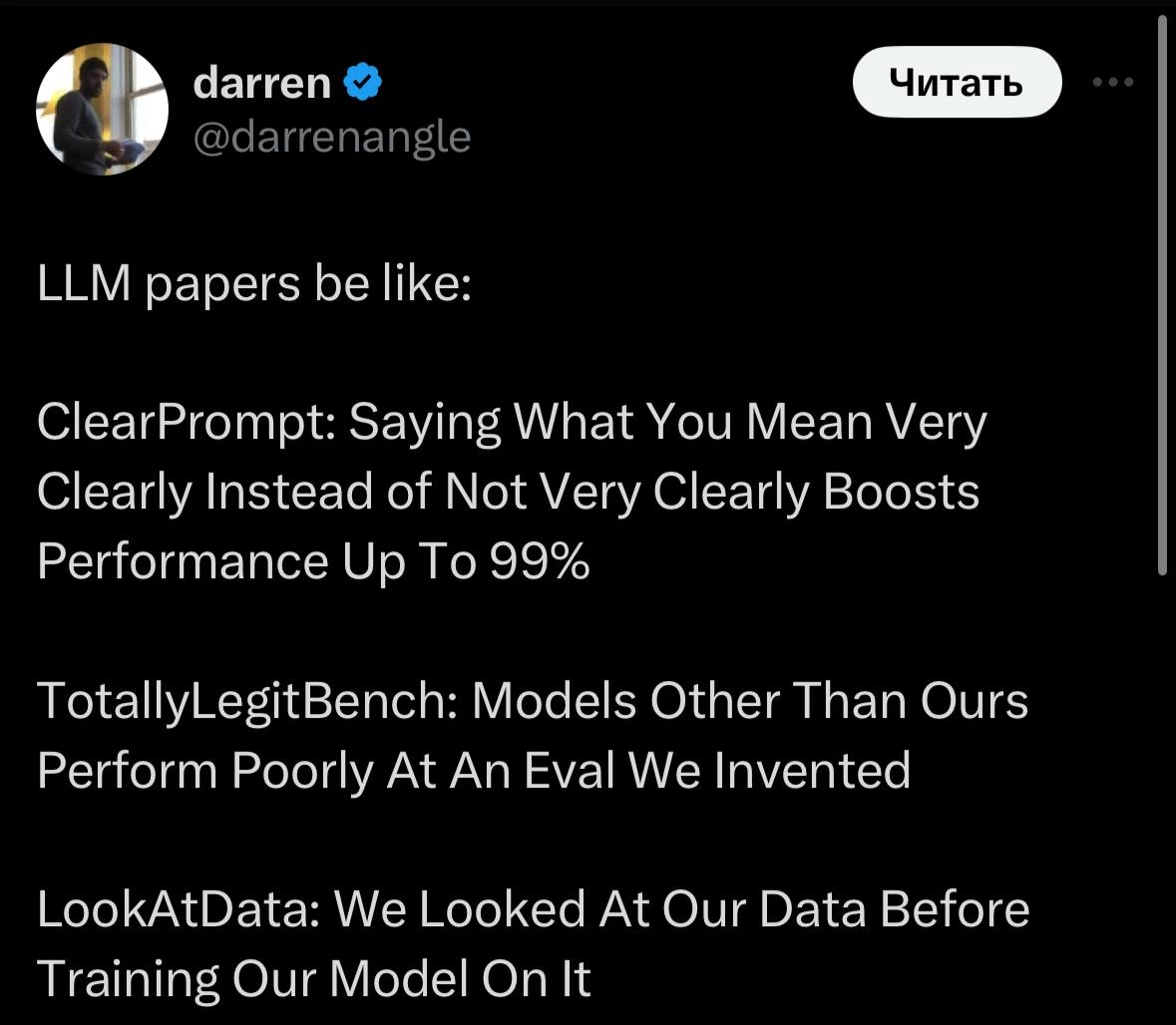
So what’s going on here? Let’s break down the humor in simpler terms. This meme is poking fun at how some research papers about Large Language Models (LLMs) claim they achieved almost 99% performance or “state-of-the-art” results, but they might be doing it in sneaky or exaggerated ways. Three fake paper names are given, each representing a different trick:
ClearPrompt – First, you need to know an LLM (Large Language Model) is an AI system (like ChatGPT) that answers questions or generates text. How you prompt it (meaning how you ask it a question or give instructions) can really affect the answer. Prompt engineering is the art of phrasing your query to get better results. The meme jokingly imagines a paper titled “ClearPrompt: Saying What You Mean Very Clearly Instead of Not Very Clearly Boosts Performance Up To 99%”. In plain terms: if you ask the AI very clearly and directly, it performs better – maybe up to a 99% success rate. Well, that sounds obvious, right? It is! The joke is that a paper would treat this common-sense idea as a big discovery. Why it’s funny: It’s like writing a research paper to say “hey, if you speak clearly, people understand you better.” No duh! In real life, there have been papers about prompt strategies, but this one is a parody making fun of overly-hyped trivial findings.
TotallyLegitBench – “Bench” here stands for benchmark, which is a test or set of tasks used to compare different AI models. Normally, to be fair, everyone tests on the same known benchmarks. The meme’s second fake title is “TotallyLegitBench: Models Other Than Ours Perform Poorly At An Eval We Invented.” Translated: We created a brand-new test (“evaluation”) and surprise, all the other models did poorly on it except ours. Why might that happen? Because the creators knew exactly what the test was (they invented it) and perhaps designed their model to ace it. Think of it like a game or exam that you made up yourself – of course you’d be the best at your own game. Why it’s funny: It’s tongue-in-cheek accusing some AI researchers of cheating a bit – creating a special benchmark just so their model can be #1. It’s not totally illegitimate to propose new benchmarks (that’s how science progresses), but if you do it purely to make others look bad and yourself good, people will side-eye you. This meme assumes an exaggerated case where the benchmark is “totally legit” in name only. For a newcomer: imagine boasting “I’m the fastest runner in the world” but on a racing track that only you have practiced on; others stumble because they’ve never seen it before. That’s the kind of trick being mocked.
LookAtData – Data refers to the information the model is trained on. Normally, ML researchers split data into training and testing. You train the model on training data, and later test it on fresh data it hasn’t seen, to check if it truly learned patterns (and isn’t just reciting answers it saw). “LookAtData: We Looked At Our Data Before Training Our Model On It” sounds straightforward – of course you’d look at your data, right? In fact, it’s standard to explore your training data. But the subtext here could be that they also peeked at the test data, which is a big no-no. If they looked at the test set in advance, they could adjust their model specifically to do well on that test. That’s called data leakage or peeking, and it’s basically cheating because it inflates performance. Even if they just mean training data, bragging about “we looked at it first” is silly because everyone should do that anyway. Why it’s funny: The meme is ridiculing how some papers make a big deal out of either very basic best practices or, worse, bend the rules entirely. It’s like someone saying, “I got an A on the exam because I secretly looked at the answers beforehand — isn’t that a brilliant study technique I invented?” The audience (developers who follow AI) finds this hilarious because it’s sarcasm highlighting poor research practices.
In general, a paper claiming “99% SOTA” means “we achieved 99% accuracy (or some score) and it’s the best result to date.” That’s a huge claim because hitting ~99% usually means you’re nearly perfect at the task. So when every other new paper boasts something like that, folks get skeptical. It starts to feel like hype — like each one is saying “we’re the best!” but maybe only on a very narrow scenario. This meme falls under AI humor (AIHumor, LLMHumor, MachineLearningHumor) because it uses insider knowledge of how research works to make a joke. It also touches on the AI hype cycle – the way excitement builds as everyone tries to one-up each other with flashy results, sometimes resulting in over-claiming. If you’re newer to this field, the key takeaway is: not all that glitters is gold in AI papers. Always look a bit critically at how they got their results. Are they comparing fairly? Are they just tuning the problem to make themselves look good? This tweet is a funny reminder to do just that.
Level 3: The SOTA Circus
For experienced engineers and researchers, this meme encapsulates the circus around every new AI_ML paper claiming a state-of-the-art (SOTA) result. The tweet by @darrenangle lampoons familiar tricks in AIResearch that many of us have seen again and again. Let’s break down why each part is hilariously on-point:
“ClearPrompt: Saying What You Mean Very Clearly Instead of Not Very Clearly Boosts Performance Up To 99%” – This mocks the recent obsession with prompt engineering. Large Language Models (LLMs) like GPT-3/4 are very sensitive to how you phrase a question. Everyone in the field knows that if you articulate your request clearly, you usually get a better answer. That’s common sense. But the meme jokes that an academic paper might brand this obvious tip as a novel method called “ClearPrompt” and then boast about a huge performance boost. Seasoned folks smirk here because we’ve read papers that rebrand straightforward tweaks as breakthroughs. It’s prompt_engineering_snark: the paper’s title reads like a satirical version of real ones (giving a method a catchy name and a subtitle). The humor lies in the idea that academics would publish “We got better results by not being vague, who knew?” as if it’s profound. It’s the equivalent of a cooking recipe titled “HotWater: Discovering that boiling water cooks pasta faster.”
“TotallyLegitBench: Models Other Than Ours Perform Poorly At An Eval We Invented” – This one hits on benchmark_gaming, which many senior devs and researchers find all too familiar. In the machine learning community, when you introduce a new model, you’re expected to compare it against others on some standard tasks or benchmarks (like say, GLUE for language understanding, or ImageNet for vision). But if those don’t show your model on top, some crafty authors will invent a new evaluation (an “eval”) where, surprise, their model shines and others look bad. This could be a niche task or dataset tailored to their model’s strengths. The meme’s faux-title “TotallyLegitBench” drips with sarcasm – the name suggests the benchmark is “totally legit” when it’s obviously suspect. We laugh because we’ve seen papers do this: e.g., “Model X outperforms GPT-4 on our bespoke Unicorn Classification Dataset 2024!” Sure it does – because Model X was basically built for that exact task, while GPT-4 has never seen it. It’s a cheap way to claim SOTA by moving the goalposts. Industry veterans roll their eyes at these claims, hence the meme perfectly satirizes that frustration. It resonates as AIHumor and ml_research_satire, calling out how each new model’s hype sometimes rides on carefully chosen comparisons rather than genuine across-the-board improvement.
“LookAtData: We Looked At Our Data Before Training Our Model On It” – This line parodies an academic paper proudly announcing a painfully obvious or rule-breaking step. In machine learning, “look at your data” is indeed a staple advice — you should always do some exploratory data analysis. But the way it’s phrased here hints that they possibly looked where they shouldn’t. It’s like the authors are bragging about dataset_peeking: maybe peeking at the test set or using domain knowledge from the data in a way that others wouldn’t normally do, just to get an edge. Why is that funny? Because of course you should understand your training data, and absolutely not peek at test data — neither is novel enough to deserve a fancy title. Presenting it as “LookAtData” method is as absurd as a paper saying “We actually examined the homework before grading it.” The implication is they might have tuned their model with inside info about the dataset (which verges on cheating). For seniors, this nails a common critique: some papers implicitly overfit or leak info from the dataset, then pat themselves on the back for high performance. This causes evaluation_bias, and insiders can spot that kind of result a mile away.
Collectively, these three points summarize a broader phenomenon in the IndustryTrends_Hype around AI: a flood of papers each claiming to be the new champion on some metric, often with diminishing returns or dubious evaluation tactics. It’s become an AIHypeCycle cliché that every week there’s an announcement of “We beat the previous best by 0.0001%!” The meme distills that cynicism into a tweet format. Each fake paper name is a barb aimed at unwritten truths of academic publishing:
- Researchers feel pressure to publish something novel, so they sometimes give a mundane tweak a catchy name (ClearPrompt) to make it seem innovative.
- There’s a race for benchmarks and leaderboards – if you can’t win on the popular ones, just create your own niche benchmark (TotallyLegitBench) and declare victory.
- Basic good practices or even shady shortcuts get presented as if they’re cutting-edge techniques (LookAtData), because saying “we did the obvious thing” doesn’t sound glamorous unless you package it as a method.
For those deep in the field, the meme is a knowing wink. It says: “We see through the fancy paper titles and 99% claims.” It’s funny because it’s academic_paper_parody built on truth – many of us have reviewed papers or attended talks and quietly thought, “Well, if you squint, that’s basically what they did.” This tweet just says it out loud with a heavy dose of irony. Anyone who’s spent late nights slogging through arXiv papers or replication studies can relate. In short, the meme’s humor works on the senior level because it calls out the ubiquity of oversold SOTA claims in a way only an insider could. We’ve all been to this circus, and these are the clowns we recognize.
Level 4: Goodhart’s Law Strikes Again
At the deepest technical level, this meme highlights how evaluation metrics can be gamed in academic ML research, invoking principles like Goodhart’s Law. In machine learning, we create benchmarks (standard tests or datasets) to measure model performance objectively. But when researchers start optimizing too hard for a specific benchmark metric, the metric itself loses meaning. This is Goodhart’s Law in action: “When a measure becomes a target, it ceases to be a good measure.” Each satirical paper title in the tweet demonstrates a way to bend or distort the usual evaluation process for an artificial boost:
Invented Benchmarks & Overfitting: The hypothetical TotallyLegitBench scenario shows authors evaluating their model on a brand-new custom test they devised. Statistically, this is suspect because it’s easy to overfit or tailor a model to do well on a narrow, cherry-picked eval. If you design the test knowing your model’s strengths, you violate the assumption that a benchmark is an independent, unbiased yardstick. It’s akin to baking the answers into the questions. Formally, the model’s performance on such a bespoke eval isn’t a reliable predictor of general performance — it’s high by construction, not by genuine generalization. Researchers who do this are effectively chasing a metric rather than true progress, a classic AI_hypeCycle pitfall.
Data Leakage and Bias: The LookAtData gag hints at the serious issue of data leakage. In proper experimental design, one must not peek at the test dataset or ground truth labels when training or tuning a model. Doing so breaks the i.i.d. assumption (that training and test data are independent and identically distributed) underpinning most statistical learning theory. If you “look” at test data in advance (even just to guide choices), you’re inadvertently training on it. This can yield near-perfect accuracy on that test — an apparent 99% SOTA result — but it’s an illusion. It doesn’t mean the model learned to generalize; it means the evaluation was compromised. In research terms, it’s contaminating the held-out set, leading to evaluation_bias where results are too optimistic. The humor here comes from treating this cardinal sin as if it were a clever new technique — an obvious ML_research_satire highlighting how some papers mistakenly (or intentionally) blur the line between training and testing.
Marginal Gains and P-Hacking: The ClearPrompt title parodies papers that claim massive improvements from seemingly trivial tweaks — essentially a tongue-in-cheek reference to prompt_engineering_snark. Under the hood, this is mocking how researchers might try dozens of minor prompt variations or hyperparameter tweaks and then only report the rosiest result. It’s reminiscent of p-hacking in statistics: trying many variations until something reaches a 99% success rate, then publishing as if it were a planned outcome. Without proper corrections or significance testing, an “Up To 99% performance” claim might just be capitalizing on randomness or noise in evaluation. In fact, if your baseline was already say 97%, bumping it to 99% might fall within the margin of error given the stochastic nature of LLM outputs (different runs, random seeds, etc.). A veteran ML engineer knows to ask: was that improvement statistically significant, or just lucky?
At this level of analysis, the meme is critiquing the rigor of LLM research claims. It reminds us that true scientific progress requires careful methodology: properly blinded test sets, robust benchmarks, and honest reporting. When any new paper trumpets “99% SOTA” with an asterisk, seasoned researchers immediately suspect the kinds of shenanigans satirized here — from benchmark_gaming to quietly peeking at data. The joke lands because it exposes a fundamental truth: if you tune the process to make your model look unbeatable, you haven’t actually advanced the state of the art at all. You’ve just confirmed the theory that if you give yourself enough advantages (or cheat codes), you can score near 100% on TotallyLegitBench™ every time.
Description
This image is a screenshot of a tweet from the user 'darren' (@darrenangle). The tweet, set against a black background with white text, satirizes the perceived state of academic papers on Large Language Models (LLMs). The introductory line reads, 'LLM papers be like:'. Below this, it lists three fictional, humorously titled research findings. The first is 'ClearPrompt: Saying What You Mean Very Clearly Instead of Not Very Clearly Boosts Performance Up To 99%'. The second is 'TotallyLegitBench: Models Other Than Ours Perform Poorly At An Eval We Invented'. The third is 'LookAtData: We Looked At Our Data Before Training Our Model On It'. The humor critiques common tropes in AI research: presenting obvious conclusions as profound insights (prompt clarity), creating biased benchmarks that favor a specific model, and the critical issue of data contamination where models are inadvertently trained on their evaluation data. This resonates deeply with experienced engineers who are often critical of the 'publish-or-perish' culture and the hype cycle in AI/ML research
Comments
13Comment deleted
Some LLM papers read like they're just rediscovering the CAP theorem for natural language: you can have Clarity, Accuracy, or Performance, but good luck getting all three in a model that wasn't trained on its own test data
Some days it feels like the real breakthrough isn’t better models - it’s discovering ever more creative ways to cherry-pick a benchmark and slap an -GPT suffix on the title
After 20 years in the industry, I've learned that the length of an ML paper's title is inversely proportional to its actual novelty - and directly proportional to how many hyperparameters they tweaked until SOTA appeared
This perfectly captures the AI research paper industrial complex: where 'ClearPrompt' gets published for discovering that clarity improves results, 'TotallyLegitBench' somehow always shows your model winning on metrics you just invented, and 'LookAtData' reveals the shocking insight that examining your training data is actually useful. It's the academic equivalent of submitting a PR titled 'FixBug: Made the bug not happen anymore by fixing it' and expecting a promotion. The real innovation would be a paper called 'HonestEval: We Compared Against GPT-4 And Lost, But Here's Why Our Approach Still Matters' - but that one never makes it past peer review
If your ‘SOTA’ comes from a benchmark you wrote, with prompts you tuned after peeking at the test set, congratulations - you’ve reinvented p‑hacking with tokenizers
LLM papers' real innovation: crafting benchmarks so custom, only your model remembers the answers from 'pre-training'
If your benchmark ships the same corpus and tokenizer as your model, that’s not evaluation - it’s unit testing with the answers already in the fixtures
written by former kaggle users that were not bother themselves with calculation of validation metric Comment deleted
I've read a lot of research papers across various disciplines in last 6 years. Let's say LLM papers are 3/10 on "disrespect and disgrace" scale. When you get social sciences studies it's insulting even to bytes wasted on storage of said paper... Comment deleted
It's got some real problems with replication too. It's honestly surprising how bad the replication crisis is in computer science, (surely it should be trivial to replicate anything, right?), but then ML papers crank that up a notch Comment deleted
Oh, yeah... Putting reproduction as a criteria for papers then worryingly huge amount of papers wouldn't pass a smell test. What's a p-hacking and n=3 among friends where's there a paper to be published ;) Comment deleted
Those social science papers then used as justification to change lives of hundreds of millions of people, affecting even more 😭 Comment deleted
What’s the story behind LookAtData Comment deleted