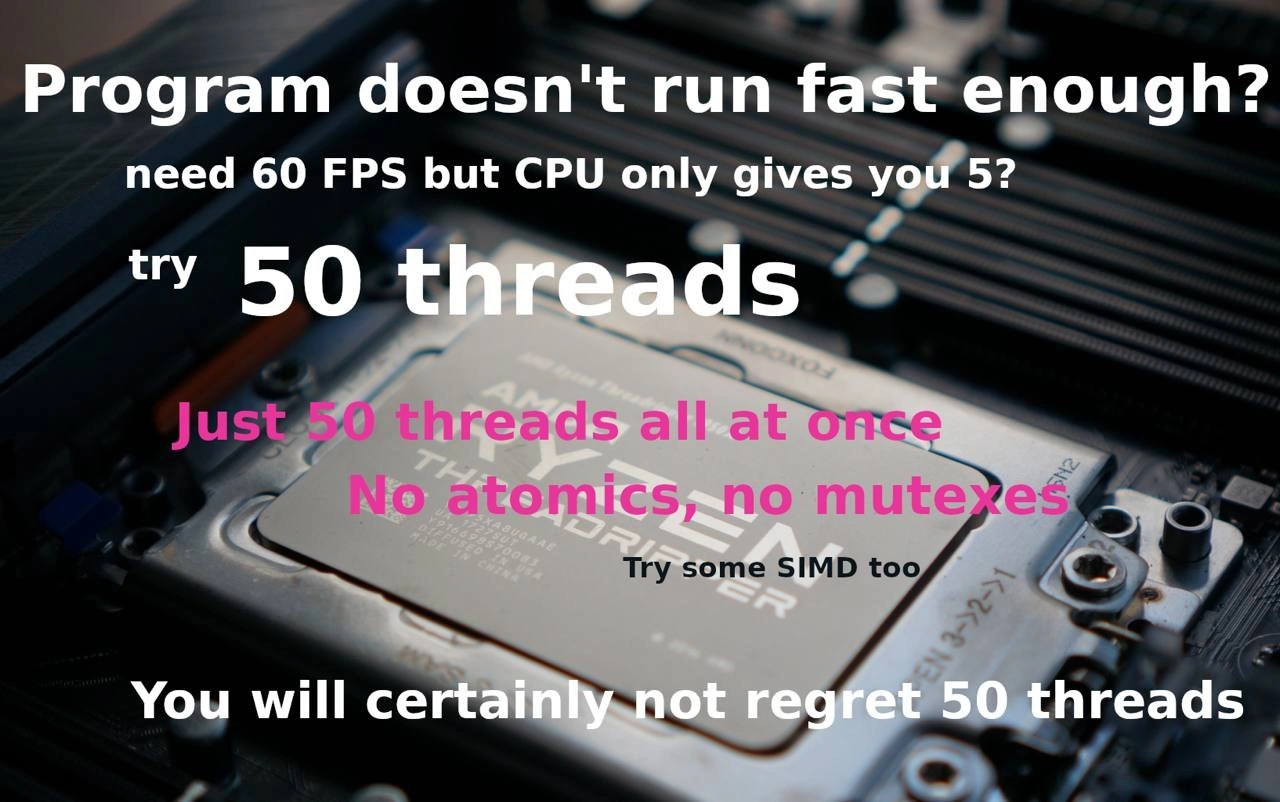
Terrible Performance Advice: Just Add More Threads
Why is this Performance meme funny?
Level 1: Too Many Cooks
Imagine you have a small kitchen, and you're trying to cook a big meal that’s taking a long time. You think, "Hmm, one cook is only making 5 dishes an hour, but I need 60 dishes an hour. I know – I'll bring in 50 cooks to all work at the same time!" 🍲🍜 Now suddenly 50 people crowd into the kitchen, all trying to use the same stove and countertop without any plan. There are no rules – nobody is waiting their turn (no one says, "you chop while I boil" – they all just do whatever). What do you think happens?
Instead of 50 times faster, the kitchen turns into pure chaos. People bump into each other, spill ingredients, redo each other’s steps, and fight over the one oven. One person adds salt at the same time another adds sugar, and now the dish tastes awful. Maybe a couple of pots get knocked off the stove in the mayhem. In the end, you don’t get 50 times more food – you might actually get less because so much got messed up or wasted in the confusion. And the food that does come out might be wrong or burnt because of the lack of coordination.
This is exactly what the meme is joking about. The original problem was like the meal taking too long with one cook (the program only running at 5 FPS). The "solution" in the joke is like shoving 50 cooks into the kitchen all at once (50 threads) with no coordination tools (no one in charge, no schedule – which in computing terms means no mutexes or atomics to organize the threads). Just as common sense tells you 50 cooks without a plan will make a mess, experienced folks know 50 unmanaged threads will do the same to a program. The meme says "You will certainly not regret 50 threads" but really means the opposite – it’s tongue-in-cheek. In our kitchen analogy, it's as if someone promises "Sure, you won't regret inviting 50 people to chop carrots simultaneously," while we can all see that’s a recipe for disaster. The humor comes from this obvious mismatch: more is not always better, especially when it's too many cooks in the kitchen spoiling the broth. In simple terms, the meme is a funny warning: if you try to speed things up in a crazy way without thinking it through, you’re going to end up with a big mess and maybe even worse results than when you started.
Level 2: Thread Overkill
Let’s break down what this meme is talking about in more straightforward terms. It’s joking about using too many threads to solve a performance problem and ignoring all the normal safety and sanity checks. Here are the key concepts and terms from the meme:
Frames Per Second (FPS): This is a measure of how many images (frames) a program can generate or display in one second. It’s commonly used in games and video. If something runs at 60 FPS, it looks very smooth to a human. At 5 FPS, it would appear extremely choppy and slow. In the meme, the program “needs 60 FPS but CPU only gives you 5” – meaning the program is running very slowly (only 5 frames a second, far from the desired 60). So, there’s a performance problem to solve here.
Threads: A thread is like a smaller unit of a process – it’s a sequence of instructions that can run independently. If you have multiple threads, they can run concurrently, meaning at the "same time" from the program’s perspective. Modern CPUs have multiple cores, and each core can run one (or more) thread(s) simultaneously. For example, if you have a CPU with 8 cores, you could run 8 threads truly at the same time (one on each core). Some CPUs, like the AMD Threadripper shown in the image, have an especially high number of cores (Threadripper CPUs can have 16, 32, or even more cores, enabling a lot of threads to run in parallel). The meme’s suggestion “try 50 threads” means they want to split the work into 50 parallel pieces. The hope is that if one thread was doing the work and got 5 FPS, maybe 50 threads could somehow work together to reach 60 FPS or more. It’s an attempt at parallel computing – doing many things at the same time to go faster.
No Atomics, No Mutexes: These are terms related to thread safety. When multiple threads work on shared data or resources, you have to be careful to coordinate them; otherwise, they might step on each other’s toes.
- A mutex (short for "mutual exclusion") is basically a lock. It’s a mechanism that allows only one thread at a time to access a particular piece of code or data. It’s like having a key to a room: if one thread has the key (lock), others have to wait their turn until the key is released.
- An atomic operation is a low-level concept meaning an operation that is indivisible – it either happens completely or not at all, with no in-between states visible to other threads. For example, adding 1 to a counter can be made atomic so that if two threads try to do it at once, one will effectively do it after the other, rather than intermixing and messing up the result. Atomics are often used as building blocks for thread-safe communication without using bigger locks.
- When the meme says “No atomics, no mutexes,” it implies the person is not planning to use any of these safety mechanisms. In other words, thread safety is being ignored. Every experienced developer knows this is dangerous: without some form of synchronization, threads can interfere with each other and cause incorrect results or crashes. This interference is what we call a race condition – the program’s outcome depends on the unpredictable timing of threads (like two threads “racing” to update the same data).
Race Conditions: This term means that two or more threads are accessing shared data at the same time and at least one thread is modifying it, without proper coordination. The “race” part comes from the fact that the result will depend on who wins the race – which thread finishes first or gets to a certain point first. A classic simple example: say you have a shared variable
Xthat starts at 0. Thread A doesX = X + 5and Thread B doesX = X + 3. If these run one after the other, you’ll always end up withXbeing 8. But if they run in a race without any lock, the operations might intermix. Both threads might read the original X at the same time (0), then each adds their number, and both write back, one after the other. If A writes last, X becomes 5, if B writes last, X becomes 3. In either case, the result is wrong (it should have been 8). And it could randomly be 5 or 3 depending on timing! That’s a race condition. The meme’s scenario of “50 threads all at once” without locks is basically a giant invite for race conditions everywhere. Thread safety ignored means lots of these could happen.Profiling: This is the act of measuring a program to find out where the time is being spent. A profiler is a tool that helps you see which functions or parts of code are slow or how much CPU time each part takes. The meme’s tagline “Because who needs profiling when you have 50 unsynchronized threads?” is sarcastic. It implies that the person skipped the crucial step of finding the real problem (through profiling) and jumped straight into a complex solution (using 50 threads). In reality, good performance tuning starts with profiling – otherwise you might optimize the wrong thing. Here, maybe the program is slow not because it isn’t using enough CPU threads, but because of a slow algorithm or heavy calculation that even 50 threads can’t fix (or maybe the bottleneck is something threads won’t help with, like waiting on disk or network).
Performance Trade-offs: This means that often you can’t get a benefit (like speed) without some kind of cost elsewhere. Using threads is a trade-off: you might get things done faster if you have multiple CPU cores, but you also introduce overhead (like the need for synchronization, the CPU having to manage many threads, etc.). The meme jokes about going for speed (FPS) at any cost, but a savvy developer knows there’s always a balance. For instance, if you add threads, you might have to spend CPU time coordinating them or might use more memory. If you use no coordination (no locks), you risk correctness. If you do add locks for correctness, you might reduce the speed again because threads might often be waiting for each other. These are the performance trade-offs that were completely ignored in the “just use 50 threads” advice.
Cache Thrashing: To explain this, know that a CPU cache is like a small fridge in your kitchen that keeps items you need often, so you don't run to the supermarket (main memory) every time. If too many people (threads) are using the kitchen and constantly replacing items in the fridge with what they need, nobody gets to keep their items there for long – everyone is thrashing that poor fridge, and they keep running to the supermarket. In computing terms, when threads keep invalidating each other’s cached data, the CPU has to go out to main memory more often, which is much slower. Cache thrashing is what happens when there’s a lot of contention on shared data, causing constant cache evictions and reloads. The meme implies this scenario by mentioning 50 threads (a lot of threads) and heavy-handed techniques like SIMD – likely they would be all over the same data, causing this effect. It’s a subtle point, but important in real low-level performance: if you’re not careful, adding threads can actually make memory access patterns less efficient.
SIMD (Single Instruction, Multiple Data): This is a form of parallelism at the data level rather than thread level. Modern CPUs have special instructions that can perform the same operation on multiple pieces of data at once. For example, rather than adding one number at a time, a SIMD instruction might add 4 numbers that are packed together in one go. This is like doing a tiny 4-step loop in one CPU tick. SIMD can greatly speed up things like processing pixels, mathematical arrays, or any operation that repeats on lots of data. The meme’s phrase “Try some SIMD too” is basically layering on another suggestion: "Hey, not only use 50 threads, but also rewrite your code to use these special vector instructions." It’s a bit like telling someone who’s struggling to drive a car, “Oh, just install a jet engine as well.” 😅 It’s humorous because SIMD is a specialized optimization – useful, but not a magic wand, and certainly not something you just casually throw in without expertise. It also hints at how people give over-engineering advice: “Use threads! Use SIMD! Use whatever buzzword technology!” whether or not it fits the problem.
AMD Ryzen Threadripper: This is the specific CPU shown in the background image. It’s a product line from AMD known for having a huge number of cores and threads, much more than a typical consumer desktop CPU. For example, a Threadripper might have 32 cores / 64 threads, which is why the meme suggests “50 threads” – it’s actually feasible on such a chip to run 50 threads in parallel (on a smaller 4-core CPU, 50 threads would be way over the top). The choice of this CPU in the image emphasizes the context: this is about heavy parallel processing and someone trying to use the massive hardware resources naively. If one core gives 5 FPS, maybe they think a Threadripper with dozens of cores could multiply that many times by using all threads at once.
In summary, the meme is highlighting a case of thread overkill. Instead of doing careful performance optimization (like finding out why the program only gets 5 FPS and addressing that), someone suggests an almost comically brute-force solution: run everything in 50 threads simultaneously and also throw in some fancy CPU instructions (SIMD). And they explicitly say they won’t use any thread safety measures (no locks, no atomics), which every experienced developer knows is a recipe for disaster. The humor comes from the certainty that this advice will backfire. It's making fun of the idea that you can solve a complex performance problem with sheer force and ignorance of proper technique. Concurrency models and proper synchronization exist for a reason – ignore them at your peril. So to a junior developer, the lesson here is: performance issues need careful analysis and often subtle fixes, not just maximum parallelism. More threads can make things faster only if done right; if done wrong, you just end up with a big, unpredictable mess (and often still a slow program!). And yes, sometimes over-engineering like this is more harmful than helpful. Always profile and understand the problem first, rather than blindly applying “solutions” you’ve heard about.
Level 3: Multithreaded Mayhem
For seasoned developers, this meme hits home as a piece of dark humor. It’s riffing on a well-known anti-pattern in performance optimization: the knee-jerk attempt to speed up a slow program by spawning a ton of threads without understanding the root cause of the slowness or the complexities of concurrency. The image literally shows an AMD Threadripper CPU (a beast with many cores) and teases: “Program doesn’t run fast enough? need 60 FPS but CPU only gives you 5? try 50 threads.” This sounds like someone’s dubious advice on an online forum or a junior dev’s “brilliant” idea after glancing at the CPU specs. Experienced engineers immediately smirk because they know this fifty threads solution is more likely to create a multithreaded mayhem than to solve anything.
Why is it funny? Because it’s over-engineering to the extreme, and we’ve seen it. Instead of profiling the code to find the real bottleneck (maybe an inefficient algorithm or a slow I/O call), the suggestion is to just throw brute-force parallelism at it – “who needs profiling when you have 50 unsynchronized threads?” The meme explicitly says no atomics, no mutexes, which is basically announcing "we're going to ignore thread safety altogether." This is an absurd recipe for race conditions. Seasoned devs have been bitten by those enough times to know that no_mutex_no_problem actually means huge problem. We can practically hear the sarcastic voice: "Just spawn 50 threads all at once, don't bother coordinating them. What could possibly go wrong?"
When you run 50 threads without proper synchronization, you get nondeterministic behavior. For instance, imagine each thread is trying to update the same counter or process pieces of shared data. Without locks or atomic operations, those threads will race each other. One thread might overwrite the results of another, or read data while another thread is in the middle of modifying it. The final outcome becomes unpredictable, varying from run to run. This is the classic definition of a race condition. A senior engineer reading “Just 50 threads all at once. No atomics, no mutexes” is likely chuckling because they've debugged that exact nightmare – maybe the final score in a game sometimes comes out wrong, or a transaction count goes negative, or the program outright crashes, and it turns out some thread wrote to memory at the wrong time. There’s a shared PTSD in the dev community about chasing down these heisenbugs that disappear when you add print statements (because adding a print slightly changes timing and the bug goes into hiding). So the line “You will certainly not regret 50 threads” drips with irony. We all know you certainly will regret the day you decided to go thread-crazy without a plan.
There’s also the matter of performance trade-offs. Sure, in theory, more threads could use more of the CPU’s cores and do more work in parallel. But with 50 threads, unless you have a monster CPU, you’ll have more threads than cores. For example, even a high-end Threadripper might have 32 cores (64 threads with SMT, but let’s stick to cores for clarity). If you run 50 CPU-bound threads, many of them will be time-slicing on the same core. The operating system has to rapidly switch between threads – this is called context switching – which is not free. Context switching introduces overhead because the CPU must save one thread’s state and load another’s. If threads are doing tiny tasks or constantly interacting, you can end up spending a significant chunk of time just switching rather than doing actual work. It’s like trying to do 50 things at once with only 32 hands – you keep dropping what one hand is doing to use another, and end up accomplishing less than if you had just focused properly. This is part of the mayhem: more threads can lead to diminishing returns and even slowdowns once you saturate the CPU’s ability to manage them.
Another performance pitfall is cache thrashing. Seasoned folks know that modern CPUs rely heavily on caches (small, fast memory) to speed up repetitive data access. When threads are working on shared or nearby data, they can invalidate each other’s cache lines constantly. For example, if Thread A and Thread B are updating variables that happen to sit near each other in memory (even different array elements that share a cache line), the cache system will keep bouncing that memory cache line back and forth between the two cores. This is called false sharing, a particularly sneaky cause of slowdowns. The meme’s scenario of “50 threads, no coordination” practically guarantees a cache coherence traffic jam. Senior devs might recall real-world incidents: e.g., someone parallelized a loop across threads, but all threads updated a single progress counter – oops, that became the bottleneck as all cores fought over one memory location. The result? The more threads they added, the slower the whole thing got! It’s both tragic and comic – exactly the kind of war story that makes this meme resonate.
Then there’s the SIMD suggestion in bright pink: “Try some SIMD too.” This is the meme doubling down on the kind of one-size-fits-all performance advice we often joke about. SIMD, which allows a CPU instruction to process multiple pieces of data in one go (like adding 8 numbers at once), can indeed boost performance for the right kind of math-heavy operations. But it’s not something you just sprinkle on top like sugar. Senior developers know that utilizing SIMD effectively often requires refactoring data structures (to be contiguous in memory, aligned to 16 or 32 bytes, etc.) and using intrinsics or special libraries. It’s a performance optimization tool with its own learning curve. The meme throws it in as if to say, “oh yeah, and while you’re rewriting everything in the most over-engineered way possible, go ahead and use SIMD everywhere too!” It’s poking fun at how beginners or superficial commenters will toss around terms like threads and SIMD because they’ve heard they’re good for speed, without grasping the complexity involved. An experienced dev chuckles because they recognize the pattern: highly ambitious plan, zero regard for complexity. It rarely ends well.
To illustrate just how crazy the "50 unsynchronized threads" idea is, consider a tiny code snippet that a naive programmer might write:
int counter = 0; // shared counter, no atomic, no mutex
// Launch 50 threads that each increment the counter
for (int i = 0; i < 50; ++i) {
std::thread([&]() {
// Each thread increments the counter 1000 times
for(int j = 0; j < 1000; ++j) {
counter++; // Race condition: threads interfering here
}
}).detach();
}
// (In a real program, you'd join threads or wait for them to finish)
// The expected result is counter = 50000, but due to race conditions
// the actual result will likely be less, and non-deterministic.
A senior engineer looks at this and immediately cringes. The counter++ operations will collide. Without an atomic or a mutex protecting counter, many increments get lost when threads interleave their reads and writes. In practice, you might run this toy program twice and get results like 47283, then 49810 – basically never the full 50000. This demonstrates the type of bug that the meme is hinting at in a very real way. Now imagine this happening not just to a counter, but to important game state or data in a complex program. It's a debugging nightmare.
So, why do we find this meme funny? Because it’s true to life and absurd at the same time. The bold claim “You will certainly not regret 50 threads” is a wink to every veteran: we know you will regret it, because we have, at least once in our careers. It captures the disconnect between how junior devs (or well-meaning but naive advice-givers) think performance works and how it actually works in the real world. The seasoned perspective recognizes all the red flags: no profiling, blind use of threads, no consideration for concurrency pitfalls, and buzzwordy solutions like SIMD slapped on top. The humor is in that contrast — it’s like suggesting fixing a slow car by strapping on 50 rocket boosters all at once without checking if the wheels can handle it. We laugh, and maybe grimace a bit, because we’ve seen that kind of over-engineering lead to spectacular failures. In short, this meme is a sarcastic reminder that in software, more (threads) is not always better, especially when done recklessly. It’s the quintessential “this is fine” moment before a multi-threaded dumpster fire. And every experienced dev understands that implicitly.
Level 4: Parallelization Paradox
At the most low-level programming and theoretical view, this meme highlights a fundamental truth of parallel computing: more threads do not automatically mean more speed, and in fact can introduce new bottlenecks and chaos. There's a well-known principle in performance theory called Amdahl's Law. It tells us that if a fraction of a task can't be parallelized (must run in a single thread), adding more threads yields diminishing returns. In formula form:
$$ \text{Speedup with N threads} = \frac{1}{(1 - P) + \frac{P}{N}} $$
Where P is the portion of the work that can run in parallel. If P is less than 1, no amount of threads can exceed a certain speedup limit. For example, if 10% of the work is inherently sequential (P = 0.90 parallel), then even N = 50 threads gives at most a ~8.5× speedup (because $(1 - 0.90) + 0.90/50 \approx 0.118$; the reciprocal is ~8.47). That means a program originally running at 5 FPS might, in a perfect world, reach around 42 FPS with 50 threads – still short of 60 FPS. And that's an optimistic scenario ignoring real-world overheads. This is the parallelization paradox: beyond a point, throwing more threads at a problem yields little benefit, or even slows things down due to overhead.
Why overhead? Modern CPUs like the AMD Threadripper (pictured in the meme) indeed have many CPU cores, but they share resources like memory bandwidth and caches. When you spawn 50 threads, you introduce competition for these resources. Each core has a cache (fast local memory), and when multiple threads (on multiple cores) modify shared data, the cache coherence protocol kicks in. This protocol (often MESI or its variants) makes sure all cores agree on the values in memory, but it does so by sending signals to invalidate or update caches. With 50 unsynchronized threads hammering away, you can get cache thrashing: cores spend more time passing cache lines around and waiting on memory than doing actual useful work. In other words, the CPU is working hard – but on managing chaos rather than computing your frames. The result can be that 50-thread program achieving even less than the single-thread performance due to constant contention. The hardware is effectively saying: “If you all try to grab the same resource at once, everyone waits.”
Another deep issue is memory ordering and the absence of proper synchronization (“No atomics, no mutexes” as the meme proudly proclaims). At the processor instruction level, operations can be reordered and buffered for efficiency. Atomic operations and memory fences act like traffic lights, ensuring that memory updates from one thread become visible to others in a predictable way. If you ignore these and let 50 threads write to shared data willy-nilly, you break the rules of the game. In computer science terms, you enter the realm of data races and undefined behavior. This means there is literally no guarantee what the program will do – compilers and CPUs are allowed to make optimizations based on the assumption that you wouldn’t do this unsafe stuff. Without a mutex or atomic to synchronize, one thread might keep a value in a register and never update main memory (so other threads see stale data), or two threads might interleave operations on a data structure in a way that corrupts it. There's a morbid joke among systems programmers that undefined behavior can even make “nasal demons fly out of your nose” – an absurd way to say anything can happen. With 50 unsynchronized threads, you are essentially inviting those demons into your program. 😈
From an academic perspective, this scenario is a textbook example of why concurrency models and careful design are critical. Decades of research have produced models like message-passing, lock-free algorithms with atomic primitives, and structured parallel patterns to manage complexity. Simply cranking up thread count is a brute-force approach that ignores these advances. In fact, hardware itself often can’t utilize 50 threads effectively on one task unless the task is perfectly partitioned and communication-free (which is rare). CPUs have features like SIMD (Single Instruction, Multiple Data) to speed up data-parallel loops, but even SIMD execution relies on data being laid out and aligned properly, and it runs into its own memory bandwidth limits. Meanwhile, if those 50 threads are all hitting the same memory subsystem, you're also limited by the memory wall – the fact that memory speeds haven’t kept up with CPU speeds. On an architecture like Threadripper with multiple chiplets (clusters of cores), an ill-designed 50-thread program might inadvertently cause a lot of NUMA (Non-Uniform Memory Access) traffic, where a thread on one chiplet frequently accesses data located on another chiplet’s memory. This incurs extra latency, further eating away at performance.
In short, at the deepest level, the meme humorously illustrates how naïve performance optimization collides with hard theoretical and hardware limits. It’s poking fun at the idea that you can just ignore correctness and complexity (no mutex, no atomic) and expect the silicon to miraculously give you a 10× or 50× boost. The truth is, performance trade-offs and laws of computing make that a pipe dream. Seasoned engineers (and computer scientists) appreciate this joke because it caricatures a common misunderstanding: parallelism is not a magic turbo boost – it's a resource to be carefully harnessed, lest the Parallelization Paradox bite you with slower speeds and phantom bugs.
Description
This meme features white and pink text overlaid on a close-up, angled photograph of an AMD Ryzen Threadripper CPU installed in a motherboard socket. The text provides intentionally bad advice for performance optimization. The top lines in white text read, 'Program doesn't run fast enough? need 60 FPS but CPU only gives you 5? try 50 threads'. Below this, in a smaller, playful pink font, it says, 'Just 50 threads all at once', 'No atomics, no mutexes'. A smaller white text adds, 'Try some SIMD too'. The final, ominous line at the bottom reads, 'You will certainly not regret 50 threads'. The humor comes from the sarcastic suggestion to solve a performance problem by throwing an excessive number of threads at it without any synchronization primitives like mutexes or atomics. For an experienced developer, this is a recipe for disaster, guaranteed to create race conditions, data corruption, and unpredictable behavior, making the program even buggier and likely slower. It satirizes the naive belief that more threads automatically equal more speed, a common misconception for those new to concurrent programming

Comments
17Comment deleted
Ah, the 'thread-and-pray' strategy. It's a great way to transform a deterministic performance bottleneck into a non-deterministic Heisenberg-level debugging nightmare
Sure, spin up 50 threads; modern CPUs love turning your game loop into a live-action cache-coherence benchmark
Ah yes, the classic 'thread-per-pixel' rendering architecture - because nothing says 'senior engineer' like turning a simple frame rate issue into a distributed systems PhD thesis complete with Heisenbug collection and a CPU that sounds like a jet engine taking off
Ah yes, the classic 'throw more threads at it' approach - because nothing says 'I understand concurrency' quite like spawning 50 unsynchronized threads to fight over shared state like it's Black Friday at a data structure store. With no atomics or mutexes, you've essentially created a race condition simulator that'll make your CPU scheduler weep and your cache coherency protocol file for early retirement. The real kicker? You'll burn more CPU cycles on context switches than actual work, turning your 5 FPS into a cinematic 2 FPS slideshow. But hey, at least your thread count looks impressive in the profiler - right next to the 'time spent in kernel mode' metric that's now approaching 95%
50 threads sans atomics: Ignoring Amdahl's law since it only applies to people who read papers
Spawning 50 threads to hit 60 FPS is like telling Amdahl you’ll outvote him - then watching the scheduler turn your cache into a distributed denial‑of‑service
Spawning 50 threads without atomics or mutexes is just benchmarking the scheduler; Amdahl’s Law writes the RCA while your cache lines sue for false sharing
reject gpu, run 50 parallel threads on your cpu Comment deleted
those are rookie numbers, my gpu has 2304 stream processors Comment deleted
that sounds like more fuckery job to be done Comment deleted
Well they're secretly not all independent ofc Comment deleted
i want a nondeterministic Turing machine Comment deleted
we got autism at home Comment deleted
Bus locks go brrrrrr Comment deleted
llvmpipe is slow as fuck Comment deleted
no, use GPU Comment deleted
Which app did you use Comment deleted