
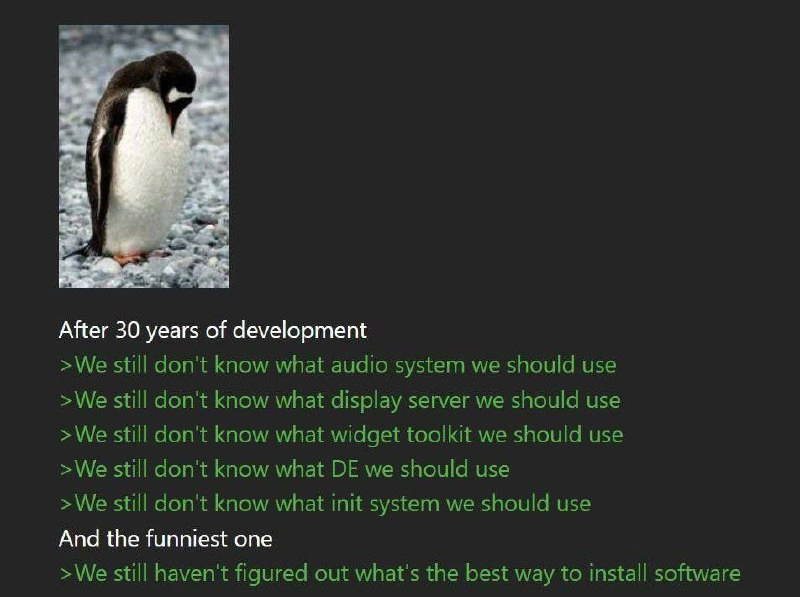
Linux Still Cannot Pick One Stack
Description
A dark-background meme shows a small penguin photo in the upper left, evoking the Linux mascot. Beneath it, white and green terminal-like text reads: "After 30 years of development", followed by ">We still don't know what audio system we should use", ">We still don't know what display server we should use", ">We still don't know what widget toolkit we should use", ">We still don't know what DE we should use", ">We still don't know what init system we should use", "And the funniest one", and ">We still haven't figured out what's the best way to install software". The humor targets the Linux desktop ecosystem's endless fragmentation across audio, display, UI toolkit, desktop environment, init, and package distribution choices. For experienced developers, the joke is less about missing features and more about the social and architectural cost of every layer having several passionately defended alternatives.

Comments
68Comment deleted
Linux has a thousand package managers because consensus is clearly a proprietary feature.
Wanting one way to do a thing is how you get regulation. Do you want regulation? Comment deleted
Yes, we do Comment deleted
Even os Comment deleted
Being a developer is like constantly making terrible choices Comment deleted
Basically Comment deleted
The penalty of choice. If you want to regulate, you will have less choice. But the cost will be freedom. You'd have to live with what authority will provide. Ubuntu tried it with snap. Now everyone hates snap. Comment deleted
There is the only way — just use windows🤷♂️ Comment deleted
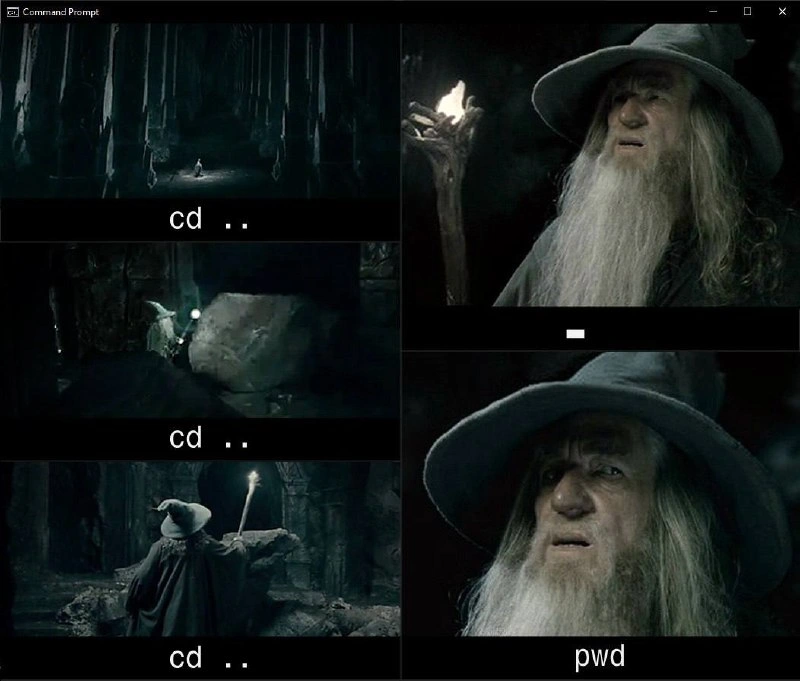
yeah! I love downloading random exe files! Installshield is my best pal! Wizards just work™! 🙃 Comment deleted
we have to implement witches to be politically correct 🙃 Comment deleted
I think the female version of a wizard would be a sorceress. A witch is more… chaotic, I feel. Comment deleted
"installation was not successful. You are cursed. Have a nice day." Comment deleted
then what would be the female version of sorcerer? Comment deleted
…still sorceress Comment deleted
you got the point, bro!😁 Comment deleted
Yeah, how you wanna install app today? By MSI? By EXE? Via MS Store? Using Winget? Using appx? Through Windows Update (It doesn't even care if you are installing something right now, for example, if you are installing a GeForce driver, and Windows Update decided to do the same, nothing stops it from doing it)? Comment deleted
would you like some trojans with that? Comment deleted
how about some pseudo fork-bomb that you can't jail to keep your system stable? Comment deleted
that's a built-in feature, no need to download Comment deleted
I meant you can use jail (on bsd)/cgroup(linux) to isolate a process tree and prevent them from spawning children too much... windows has nothing like that... Comment deleted
appaling tbh, they conquered all the viruses with Defender and still can't isolate processes Comment deleted
omfg, the last time i used windows was about 15 years ago. So many things has been chaged😁 Comment deleted
real, *my last win system was xp 💀 Comment deleted
Don't you an VK's linux-based services admin? Comment deleted
yes i am😁 Comment deleted
1. ALSA Comment deleted
everything was created just to make alsa play nice, be it jack or pulseaudio or pipewire... Comment deleted
PA devours resources like it's coded in Python. I saw a netbook's CPU spike to 40% load just because of PA. Comment deleted
I'm pretty sure jack is older than alsa Comment deleted
jack is newer.... alsa began in 1998, jack in 2002 Comment deleted
huh, alsa is older than I thought Comment deleted
I like 'em Comment deleted
didn't expect to see a Dark Souls weapon together with a cheesy instagram emoji Comment deleted
the best ones are recursive backronyms though Comment deleted
not sure who invented these jolly pancakes tbh, ios emoji then Comment deleted
After 30 years of development, we still don't know what {userspace subsystem} we should use. That's because Linux is the kernel, not a userland! 🤓 Comment deleted
Meanwhile Android: "Calculator app needs System Administrator privilege". 🤡 Comment deleted
Linux way: Run the package manager which always demand full root privileges. And this package manager WILL run configuration scripts with root privileges. The package will be installed into: /usr/bin /usr/lib /usr/local /usr/local/bin /usr/share /home/username/.something /opt /etc /var /var/lib /var/lib/snapd But wait, there's more. You'll get a bonus round of dependencies scattered like graffiti all over your system. And if you're diving into private repositories? Oh boy... Comment deleted
actually, most package managers don't run configuration scripts with root privileges at all. that's what fakeroot is for. some packages require hooks with root permission, but that's like… updating grub when it updates. recompiling dkms when a new kernel update rolls around. stuff like that. and why would you- oh, you're talking about ubuntu, aren't you? lol Comment deleted
Ubuntu is just the worst. Comment deleted
Want to talk about installing packages in Gentoo? You know, emerge - the Python-based package manager that calculates dependencies for minutes and then shows you a huge list of packages with dozens of unresolvable conflicts. And every keyword, use, or mask fix you apply (manually, of course) will bring you even more conflicts in a future. Comment deleted
if you use gentoo, that's also your own fault Comment deleted
You know, the default Linux response to any issue is always: "Don't use XXX distro, switch to YYY instead." The amusing part? XXX and YYY are always changing. And yet, no single distro comes close to achieving even half the efficiency and user-friendliness of Windows. Comment deleted
efficiency? don't make me laugh and it's not user-friendly at all, people have just learned how to use it Comment deleted
not to mention the literal ads inside loads of system UI Comment deleted
Over the past 30(!) years, people still haven't learned to use: - The basic GNOME, as well as XFCE, LXDE, and other "lightweight" environments, which lack even simple features like drag-and-drop from the menu to the desktop. - The sluggish KDE. And yes, are those famous tearing issues resolved yet, or do they still require a complex ritual of system setting tweaks? - The remarkably glitchy KDE Plasma. "Plasmoids" have been known to crash the entire desktop environment, sometimes triggering kernel panics - a truly innovative user experience. - The naively designed Unity. It seems like its creators might have drawn 'inspiration' from Flash games. Why this lack of progress? Oh, right, it must be some corporate conspiracy, of course... Comment deleted
what da hell are u talking about, D&D has been a feature for years sluggish? sluggish???? as a windows user????? don't make be laugh, again tearing is due to the ancient X11 protocol, it's being phased out in favour of wayland rn. Not everyone has switched over yet, but it'll generally resolve a lot of displaying problems and finally elevate that part of the linux experience above windows. eventually. give it another 5 years to stabilize. Coincidentally, X11 recently got a huge set of patches that should eliminate tearing. Seems like some people can't make up their minds 🤷♂️ still better than whatever the fuck windows does with fullscreen resolution changes, lol I don't use plasma, but I've literally never heard of this, so I'm pretty sure you're exaggerating a lot here …unity? oh, the DE. Yes, that one's shit. Good thing you can choose your DE on linux if you don't like it, unlike on windows. there's no lack of progress, you're just choosing to look away. AND because whenever the linux ecosystem does something good, windows often gets it too, because we open-source things for the general benefit of humanity instead of a greedy corporation. Comment deleted
oh yeah, note: X11 is literally 36 years old. And it's still been working relatively ok up until now. That's how good linux-adjacent software is. Comment deleted
Ah, the classic "just wait 5 more years" line. I've been hearing that since the 90s. And of course, it's always X11 to blame. Enter the sacred Wayland, promised to fix everything (despite being around for 15 years already). On Plasmoids, once I tried to display time and weather, only to find they lack isolation (the 'S' in Linux clearly stands for Security). One faulty Plasmoid later, I faced segmentation faults at every restart but display manager didn't give me the option to have a console... What else can I recall from my own experiences? Oh, there's Pulse Audio that was discussed before. Gnash, which I sincerely hope gone for good. Then there's Dolphin that freezes on a network or device issues - reminds me of Windows 98's Explorer. And the nightmare of using dual displays with different resolutions is an experience I'm still trying to forget. Comment deleted
well yes, that's how progress works. You have to wait for it. They're always working on something lol. Wayland has been around for ages because they've mostly been designing it up until now. It's been viable for devs for like 2 years, and only now is getting viable for the average linux user. pulse is crap, yea. Pipewire works flawlessly though. It's had its 1.0 release recently. dolphin (fm, not emu) is crap too. Use something sensible like idk pcmanfm or nautilus ig the display resolution thing is also fixed by wayland. And yes, I mean: already fixed. Not "is going to be fixed". Like with tearing, it just works. No more weirdness on wayland. Comment deleted
Eventually, the resolution and tearing issues will be resolved, bringing Linux up to the level of Windows XP. This isn't just about progress - it's about why Linux is consistently a mile behind, addressing problems Windows solved a decade ago. Do you remember Wi-Fi in Linux a decade ago? Using one required lengthy how-tos and lists of compatible chipsets. It's a classic example of Linux's delayed response to user needs. By the way, speaking of security, the only distro (I'm not sure it can be called so) that might qualify as truly secure is Qubes OS. It's a unique case in the Linux world, focusing intensely on security. But the price of the security is... everything else. Comment deleted
I will remind you that windows is leaking memory like programmer's first C project, and that it's normal and accepted that it - crashes often if you don't reboot at least once every few days - forces updates onto you - forces ads onto you - spies on you - costs a lot of money (yes, even if it's bundled, it just adds to the price of the device) and I think 5 hard dealbreakers is enough not to use a system Comment deleted
- XP was stable enough to run for months without a reboot, a level of stability Plasma still struggles with. - In the past decade, I've only experienced two crashes on Windows, both due to hardware failures, not the OS, while using it every day. - Disabling forced updates in Windows is straightforward. - The "forced ads" are essentially a default news feed widget that also can be easily disabled. - There hasn't been any proven incident of spying for PII or other sensitive data by Windows. It's a corporate product that follows regulations, unlike some open-source software. - After purchasing Windows 7 I got subsequent upgrades for free. A one-time expense of $100 over a decade. Comment deleted
ok, these arguments are getting dumb - Xp yes, 10 no. I don't care for a 15yo OS's stability - great! I've experienced many many more despite mainly using linux - is it now? very user friendly, yes? Except the method changes all the time and sometimes it doesn't work at all - oh great I can disable the ads… individually, for each single one, if I'm lucky. Also the ones in the start menu come back after certain updates. - proven shmoven, it's obvious - just because microsoft doesn't admit it doesn't make it not real - except you can't really buy any good laptops without windows bundled. Mine came with windows. Comment deleted
I never reboot due to memory issues with Vista, W7, W8, W10, W11. W8 had interface issues, but it was stable. Your point about changing methods in Windows is hypocritical. Linux software often changes unexpectedly and requires frequent config edits. Adjusting one Windows feature every few years is hardly a hassle. I've always had a clean start menu, even now. It's about trust in Microsoft by many companies. If any found Microsoft misusing PII or sensitive data, it would be a big deal. I've worked with Microsoft's Cyber Defense team. They process real-time data from millions of machines globally, including those on Linux, to detect and mitigate new threats. Both Linux and Windows users tend to grant root access easily. About bundles - welcome to the real world, where people prefer laptops ready to work. Vendors often bundle laptops with OEM Windows, catering to this demand. However, there are vendors that offer a choice of OS. It's like going to buy a car and being frustrated that all cars come with radios. I never use the radio, yet I still have to pay for it. Comment deleted
- seems like you're the luckiest person known to man, because I don't know a single person using windows who thinks it's a good idea not to reboot it - linux does change, but that's ok because it doesn't contain adware. Also because it's not meant for beginners. It doesn't require frequent config edits though, as evidenced by my emulation PC that's been running on the same config for several years - if you call W10's start menu clean, you're a clown. genuinely, I cannot take that claim seriously. - all I'm hearing is windows needs to spy on users to find security vulns, and yet they still have glaring issues - well I'm not most people, and I'd apprechiate the *option* not to buy an arbitrary piece of software with my hardware. And the fee for a radio is a) laughable in comparison and b) in the case of ORF/GIS payments doesn't go towards an evil company that wants nothing more than a monopoly Comment deleted
come buy car from here most of the things including radio,Hat(I don't know what you call the outer axial casing of tyres) even the bow/astern and side shields are optional and you have to pay seperately for them Comment deleted
security… windows can literally be hacked by opening a .doc file… Comment deleted
and I don't care how linux was 10 years ago (in your perception), I care how it is right now, and it's fucking glorious Comment deleted
/usr/bin is for executables - in theory, /usr/local/bin and /bin/ should link to the same folder. Depends on distro though. /usr/lib is for libraries /usr/local is a parent folder for "other stuff" - usually, packages choose a subfolder, like /usr/local/share/fonts/ - but normally, this isn't being written to. /usr/share/ is "other stuff that is shared between programs" - same as /usr/local, mostly, except this is actually written to. /home/username isn't normally written to, since the file tree inside the package is not dynamically created. You'd need to make a hook that copies files into userland. /opt is for "optional executables" - whatever that means. Usually only shitty bloated mega-proprietary programs do anything with that - e.g. maya, astah, android studio… the tor browser for some reason aparrently. /etc is for system-wide config files. it's that simple /var is weird and I don't want to talk about it if you install snaps, that's your own fault Comment deleted
pacman best package manager 💪 Comment deleted
well, yes. I mean it does have downsides, but it's better than apt I think. Can't say much about other package managers though Comment deleted
So, Windows is the worst operating system ever, except for all the others. Comment deleted
I know what the menu looks like. And even this is only after disabling the godawful grid Comment deleted
Linux user criticizing Windows for needing trivial basic configuration seems ironic. Comment deleted
fair point. counterpoint: it still looks like absolute shit Comment deleted
Anyway, duty calls for this corporate minion. I've exhausted my corporate quota for propaganda and agitation today. Time start working - have to do my bit to tighten Microsoft's monopoly grip. So, have a good night (if you have this feature on Linux, ofc). Comment deleted
ok have a nice day. like, genuinely. I'm sorry I've been so negative, I hope it didn't bother you too much Comment deleted