Skip to content
DevMeme
230 of 7435
The Unholy Trinity of Web Browsers
WebDev Post #282, on Mar 30, 2019 in TG

The Unholy Trinity of Web Browsers

Why is this WebDev meme funny?

Level 1: Monster Under the Bed

Imagine your parent or teacher tells you, “Don’t worry, there’s no such thing as a monster that’s part dragon, part spider, and part ghost. It isn’t real and it can’t hurt you.” That might make you feel better at first. But then you suddenly imagine that exact monster – a huge, scary creature mixed from all the scariest things you know! 😨 Now you’re terrified, right?

For a web developer, that mixed-up monster is like a browser made from all the different browsers combined. Each browser (like Chrome, Firefox, Explorer) is a bit like a different teacher with their own set of rules. One says, “You must do it this way,” and another says, “No, do it that way.” It’s already hard to make all of them happy when they’re separate. So if you smush them all together into one super browser, it’s like a teacher with multiple personalities constantly changing the rules on you – totally confusing and scary! The meme’s joke is basically saying: “The therapist says that crazy mixed-up browser isn’t real, so it can’t scare me... but just the thought of it is scary!” It’s funny because it shows how developers feel deep down: supporting all those different browsers can be a real nightmare, almost like dealing with a monster that we hope isn’t hiding under our bed.

Level 2: It Worked in Chrome

For a newer developer or someone early in their career, let’s break down why this “Mozilla Chrome Explorer” concept is funny (and scary) in plainer terms. First, recognize the names in that phrase:

  • Mozilla Firefox (“Mozilla” is actually the organization, the browser itself is Firefox – the orange fox wrapped around a globe logo).
  • Google Chrome (the popular browser with the four-color circle logo).
  • Internet Explorer (often called IE, the older Microsoft browser represented by the blue ‘e’ with a gold ring, which many devs love to hate due to its quirks).

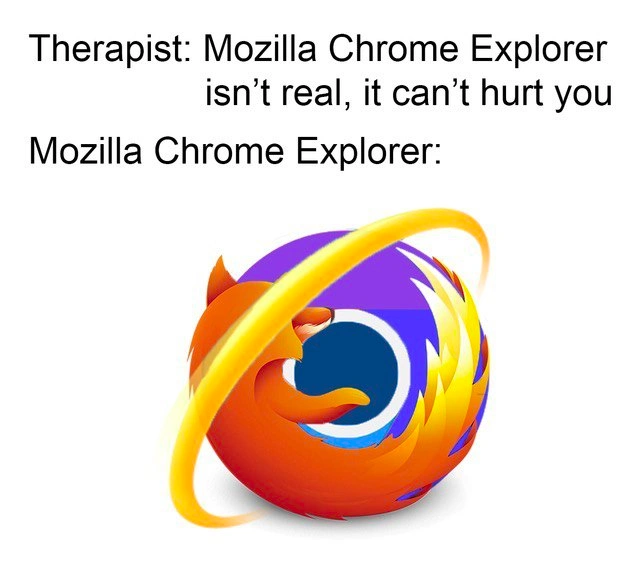
The meme imagines combining all three into one browser – hence the picture of a single logo that merges Firefox’s fox, Chrome’s center, and IE’s swooping ring. This mashup is intentionally ridiculous. It’s like saying, “What if one web browser had to be Firefox, Chrome, and IE all at once?”

Why would that be a nightmare? Because web developers constantly deal with BrowserCompatibility issues – that means making sure a website works the same (or at least decently) across different browsers. Each browser has its own engine under the hood, which is the part that reads HTML/CSS/JS and displays the page. For example:

  • Firefox’s engine (called Gecko) might handle a new CSS feature slightly differently than Chrome’s.
  • Chrome’s engine (called Blink) is very fast and gets new updates frequently; sometimes it supports cool new stuff before others do.
  • Internet Explorer’s engine (older one was Trident) is… well, old. IE (especially versions like IE 10, IE 9, or dreaded IE 6) often does not support modern features that Firefox and Chrome do, or it does weird things (like requiring its own syntax or having bugs).

If you’re a front-end developer, you might have experienced this: you build a webpage and it looks great in Chrome (a common browser you likely use to test first). Then your colleague checks it in Firefox and something is slightly off – maybe a fancy grid layout isn’t quite right. Worst of all, your client opens it in Internet Explorer on their work computer and sees a completely broken page or an error. 🙈 This is the classic “works on my machine” scenario, except it’s “It works in Chrome, why is it broken in IE?” Each browser has quirks – little differences in how they interpret your code. For instance, Internet Explorer historically had issues with modern CSS like flexbox or grid, and needed polyfills or alternate solutions. Firefox might need a prefix (like writing -moz-border-radius instead of just border-radius in very old versions) to support a new style property, and Chrome might use -webkit-border-radius for the same in its early days. As a concrete example, here’s how developers used to write CSS to ensure border-radius (rounded corners) worked across browsers a decade ago:

.my-button {
  -moz-border-radius: 5px;    /* Firefox older versions */
  -webkit-border-radius: 5px; /* Chrome/Safari older versions */
  border-radius: 5px;         /* standard property for modern browsers */
}

All that just to get a simple rounded corner everywhere! And if you had the misfortune of supporting IE8 or IE7, well, they didn’t support border-radius at all – you might see square corners in IE unless you used some special tricks. This shows why dealing with multiple browsers can be painful.

Now, the meme’s Therapist format comes from a popular joke setup: “Therapist: [X] isn’t real, it can’t hurt you. [X]: [shows something terrifying].” In our case, the therapist is telling the developer that “Mozilla Chrome Explorer” isn’t real and can’t hurt them – trying to soothe their irrational fear. The punchline is the image of Mozilla Chrome Explorer itself, suggesting that, in the developer’s mind, this monster is very real. It’s basically saying, “Even though no single browser monster like this exists, the fear of it hurts us anyway.” For a front-end dev, the idea of one browser combining Firefox, Chrome, and IE is scary because it conjures up all the worst compatibility problems rolled into one.

In simpler terms: Cross-browser compatibility is a big deal in web development. You can’t assume that just because it works on Chrome (which many of us use during development), it will work the same on Firefox or IE. So developers often have to test on multiple browsers, write fallbacks, or add fixes specific to one browser. It’s a running joke that Internet Explorer (especially older versions) was the bane of web developers – people would say “IE is the new Hell” or “Thanks, I’ll have to write an IE hack for this.” Many teams even had a policy: “No deploying on Friday, because if it breaks on IE, you’ll be working over the weekend!” So the “unholy nightmare” of one combined browser exaggerates that headache: it’s like facing all the browser bugs at once. The meme exaggerates this in a humorous way, essentially poking fun at how paranoid or traumatized web developers can feel after battling those issues. (Sometimes we half-joke that after fighting with cross-browser bugs, we need a therapy session! 🥴)

So, if you’re a junior dev or just learning web dev, the takeaway is: browsers are not all the same. You have to account for differences. And the meme is a fun, slightly dark joke that imagines a scenario we’re all glad is fiction. Mozilla Chrome Explorer is like a nickname for the ultimate web developer nightmare – a reminder that we’re happy these browsers stay separate, because dealing with each one’s quirks individually is bad enough!

Level 3: Compatibility Chimera

At the highest technical level, this meme mashes up three distinct browser engines into one terrifying chimera, highlighting the insanity of cross-browser compatibility. Each of the logos in the image represents a major web browser and, by extension, its underlying rendering engine and all its quirks: the fiery fox (Mozilla’s Firefox with its Gecko engine), the colorful orb (Google’s Chrome with its Blink engine), and the infamous yellow swoosh (Microsoft’s Internet Explorer with its old Trident engine). Seasoned web developers immediately recognize these as the heraldry of the Great Browser Wars – an era when these browsers competed fiercely, each introducing unique features (and bugs) that would haunt our CSS and JavaScript for years. The meme jokes that all three have merged into a single abomination, “Mozilla Chrome Explorer,” which on a technical level would be an impossible Frankenstein. It’s the browser equivalent of mixing incompatible DNA: each engine implements web standards slightly differently (or not at all), so a composite would inherit the worst of all worlds – think Chrome’s memory hunger, Firefox’s eccentric edge-cases, and IE’s blatant disregard for modern standards, all in one package. 😱

For experienced devs, the humor cuts deep because it satirizes the nightmarish debugging sessions caused by inconsistent behavior across browsers. We’ve all written code that works perfectly in Chrome, only to find Internet Explorer choking on it and Firefox rendering something subtly off-kilter. This “unholy compatibility nightmare” imagines having to support all those contradictions at once. It’s like a senior engineer’s war story: “One time, I fixed a layout in Chrome and broke it in IE; then fixed it in IE and broke it in Firefox”. Combining the browsers into a single entity would mean every fix simultaneously breaks something else – the ultimate compatibility hell.

Behind the humor is a commentary on web standards (or the lack thereof). In theory, we have organizations like the W3C and WHATWG that define HTML, CSS, and ECMAScript standards so that browsers behave uniformly. In practice, each browser historically had its own interpretation or proprietary extensions:

  • Internet Explorer was notorious for its own path: older versions lacked basic features like <canvas> or modern CSS selectors, and introduced oddities like outerText and attachEvent that only IE understood. It often ran in “Quirks Mode” for old websites, where even the CSS box model behaved differently, defying the standard.
  • Firefox (Mozilla) championed web standards but still had unique quirks. Its Gecko engine might handle certain HTML or CSS edge cases differently from others, and it introduced XUL for add-ons—powerful, but not relevant outside Firefox. Early on, you might need -moz- prefixes for experimental CSS features (like -moz-border-radius) which only Firefox recognized.
  • Chrome (Google), with the Blink engine (forked from WebKit), tended to push new features fast, sometimes ahead of standardization. It required its own -webkit- CSS prefixes for a while, and some features (like an early version of `) only worked properly in Chrome. Chrome’s dominance led many developers to optimize for it first, occasionally neglecting the others.

Now imagine a “Mozilla Chrome Explorer” browser that somehow combines all three engines. A veteran dev might joke that we already have something close: the dreaded “compatibility mode” in old IE, or the days when Edge (pre-Chromium EdgeHTML) pretended to be Chrome or Firefox to pass naive browser sniffing checks. In fact, a fun bit of tech history is that most browsers’ user-agent strings include the word “Mozilla” (a legacy of Netscape Navigator) just to appease old scripts. For example, one of Chrome’s user agent strings begins with Mozilla/5.0 and even mentions Gecko and Safari – a real-life identity crisis! This was a hack to trick websites that only allowed certain browsers, illustrating how messy the browser compatibility situation became. The meme’s monster logo feels like the embodiment of that hacky reality: browsers wearing each other’s skins to get by.

Ultimately, experienced developers see this meme and laugh nervously – it’s a hyperbolic reminder of countless hours spent taming three-headed browser bugs. It captures the shared PTSD of debugging a CSS layout that Chrome renders perfectly, Firefox shifts by 5px, and IE completely breaks (likely showing a yellow error icon or a cryptic message about “unknown runtime error”). The “Therapist: ... it isn’t real, it can’t hurt you” line is dripping with dark sarcasm: we wish this nightmare merge wasn’t real. But in a sense, it is real in our daily work – every time we code, we’re haunted by the necessity to please multiple “browser personalities.” The therapist’s reassurance falls flat because any dev who’s been around knows that browsers in combination have hurt us plenty. We’ve lost sleep supporting old versions of IE while staying compatible with modern Chrome and Firefox. The joke lands because it exaggerates a very real FrontendPainPoint: even as we chase the dream of “write once, run everywhere”, the browsers’ differences turn that dream into a bit of a joke.

As a senior web engineer might bitterly chuckle: the only thing scarier than debugging Internet Explorer 11 is debugging IE11, Chrome, and Firefox combined. The meme gives that fear a face (or three faces!), and we laugh because otherwise we’d cry. In summary, “Mozilla Chrome Explorer” is the ultimate boss in the game of Web Development – a creature we pray never actually materializes, because keeping just regular browsers happy is hard enough!

Description

A two-part meme using the 'Therapist: X isn't real, it can't hurt you' format. The first line of text says, 'Therapist: Mozilla Chrome Explorer isn't real, it can't hurt you'. The second line reads, 'Mozilla Chrome Explorer:'. Below the text is a composite logo horrifically merging three iconic web browsers. The base is the Google Chrome circular logo, which is being enveloped by the orange Mozilla Firefox fox, and the entire thing is orbited by the golden ring from the Internet Explorer logo. This meme visually represents a cursed, monstrous combination of competing technologies. For developers, this image is the stuff of nightmares. It symbolizes the ultimate challenge in cross-browser compatibility, combining the infamous legacy of Internet Explorer's non-standard rendering engine (Trident), Google Chrome's notorious memory consumption, and Mozilla Firefox's distinct Gecko engine. The humor comes from the shared trauma of trying to make websites work consistently across these vastly different ecosystems, a task that has caused immense frustration throughout the history of web development
Comments

8
Anonymous ★ Top Pick This browser's main feature is that it renders CSS based on your quarterly performance review, uses 90% of your RAM to display ads for its own certification program, and its only developer tool is a button that posts 'it works on my machine' to the bug ticket
  1. Anonymous ★ Top Pick

    This browser's main feature is that it renders CSS based on your quarterly performance review, uses 90% of your RAM to display ads for its own certification program, and its only developer tool is a button that posts 'it works on my machine' to the bug ticket

  2. Anonymous

    Mozilla Chrome Explorer: consolidating Gecko’s memory leaks, Blink’s API churn, and Trident’s box-model interpretation so your cross-browser test matrix can fail in one glorious place

  3. Anonymous

    After 15 years of writing polyfills and vendor prefixes, you realize the real browser compatibility issue was the friends we alienated along the way by insisting they update from IE11

  4. Anonymous

    Joke's on the therapist - with everything converging on Chromium, 'Mozilla Chrome Explorer' is less a nightmare and more a roadmap

  5. Anonymous

    This meme perfectly captures the fever dream of every frontend developer who's spent too long debugging CSS quirks across browsers - a chimera combining Mozilla's idealism, Chrome's dominance, and IE's legacy trauma. It's the browser equivalent of 'git push --force production': theoretically possible, universally feared, and guaranteed to haunt your dreams. Senior engineers know the real horror isn't the fictional 'Mozilla Chrome Explorer,' but remembering when we actually had to support all three simultaneously with vendor prefixes, polyfills, and conditional comments while maintaining our sanity

  6. Anonymous

    Meet the only browser whose UA string triggers every if (isChrome || isFirefox || isIE) branch - Hyrum's Law wrapped in a rendering engine

  7. Anonymous

    The real horror: it appears in prod user agents, demanding Trident polyfills in a Gecko-Blink hybrid

  8. Anonymous

    This is the browser that renders with Gecko, calls Blink-only APIs, and runs under Trident’s Enterprise Mode - a single tab that reproduces every bug you’ve ever closed

Use J and K for navigation