Hidden Acrostic in C Code Criticizes Rust for Linux Kernel
Why is this Languages meme funny?
Level 1: Schoolyard Secret
Imagine you’re in a classroom where a new game or rule has been introduced, and one of the kids absolutely hates it. Instead of openly complaining to the teacher (maybe they’re afraid to, or they know it won’t change anything), this kid decides to be sneaky and pass a secret note. But the note can’t be obvious – it has to be hidden. So the kid writes a normal-looking story or list of things, and if you read the first letter of each line downwards, it spells out “I DON’T LIKE THIS”. It looks like an innocent piece of writing, but there’s a hidden message for anyone who knows how to read it. This meme is just like that, but in the world of computer code. The programmer felt like the new thing (the Rust language) was a bad idea, so they basically passed a secret note in class. They chose the first letters of each code line to spell “RUST SUCKS,” which is like saying “I really don’t like this” in a covert way. It’s funny in a childish way – kind of like finding out someone wrote a hidden “Teacher stinks” message in a homework assignment. It shows that even serious adults (and very smart computer engineers) sometimes express their dislikes with a bit of sneaky, playful rebellion.
Level 2: Language Rivalry 101
Now let’s break this down in simpler terms. The meme centers on a bit of Linux kernel code and a feud between two programming languages: C and Rust. First, know that the Linux kernel is the core part of the Linux operating system – it’s like the master program that talks directly to the computer’s hardware and manages everything (your CPU, memory, devices, etc.). For a long time (since Linux began in 1991), the kernel has been written in C, which is a powerful low-level programming language. C is loved in kernel development because it’s super efficient and gives programmers fine-grained control over memory and hardware. But with great power comes great responsibility: C doesn’t prevent you from making mistakes with memory. For example, if you mis-manage a piece of memory in C (like forgetting to check a boundary or free something twice), you can crash the system or open up security holes. These are not just theoretical – such mistakes in C have led to many real bugs and even hacks over the years.
Enter Rust, a newer programming language (first released in 2015, so a young upstart compared to C which dates back to the early 1970s). Rust was designed specifically to make systems programming safer by catching those mistakes at compile time. Rust has this thing called a borrow checker and an ownership model which basically acts like a strict teacher: it won’t let the programmer do certain risky things (like have two pieces of code messing with the same data at once unsafely, or use memory after it’s supposed to be gone). If you try something sketchy in Rust, your code just won’t compile – it forces you to fix the issue before the program can run. This is great for safety: it’s much harder to have a lot of the common bugs that plague C programs. Because of that, the Linux community decided, “Hey, maybe we can start writing new parts of the kernel in Rust, to make those parts more secure and robust.” This was a pretty historic decision – Linux adding a second language is a big deal! However, not everyone in the community was happy about it. Some veteran developers feel Rust is unwieldy, or that its rules make simple things more complicated. Others simply don’t like change or don’t want to learn a new language. It’s a classic case of “if it ain’t broke, don’t fix it” versus “modernize or fall behind”. That tension is what we call a language war in the developer world – basically arguments (sometimes good-natured, sometimes heated) over which programming language is better for a job. Hence the tag LanguageWars.
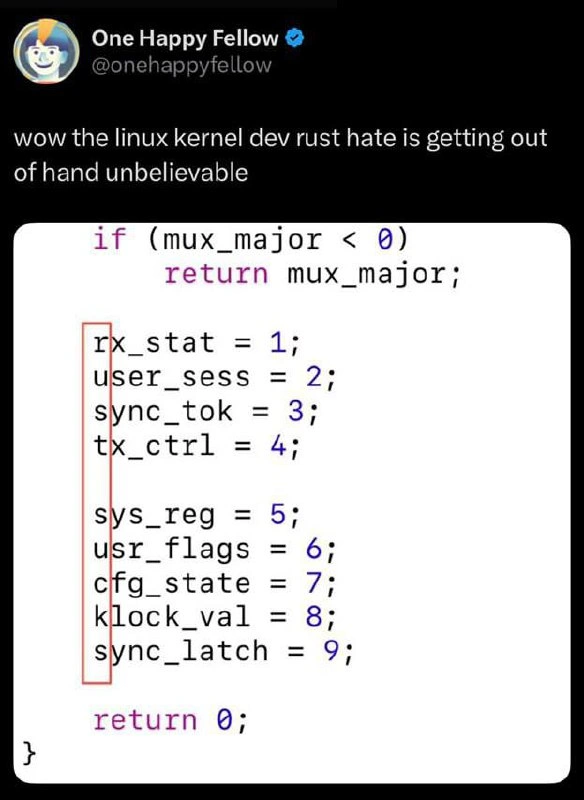
Now, the code snippet in the meme is showing an interesting form of protest or humor from the C side of that war. It’s written in C, and it looks like part of a kernel function. There are several lines assigning numbers to variables: rx_stat = 1; user_sess = 2; and so on. Nothing unusual there – it resembles setting up some constants or flags (like maybe giving IDs to different status registers or states). But the trick is in the variable names. Notice the first letter of each variable, in order: r, u, s, t, then again s, u, c, k, s. If you line those up, they spell “RUSTSUCKS”. That’s not a coincidence; it’s what’s called an acrostic. An acrostic is a hidden message where the first letter of each line (or word, or paragraph) forms a new word or phrase. It’s like a puzzle or secret code embedded in the text. Here the developer crafted the variable names (rx_stat, user_sess, etc.) such that their initials convey “Rust Sucks.” It’s a sly way to slip an opinion into code that on the surface doesn’t say anything overtly rude. In programming culture, an intentional hidden joke or message like this is often referred to as an Easter egg. Just like Easter eggs in video games or movies (like a secret feature or reference hidden for fans to find), in code an Easter egg might be a funny comment, a secret command, or, as in this case, a stealth message formed by the code itself.
Why is this funny to developers? Well, it’s a mix of surprise and relatability. It’s surprising because you don’t expect a kernel developer – typically folks dealing with very serious, mission-critical code – to take the time to plant a joke, especially one that’s essentially a jab at something. It’s like finding graffiti inside a space shuttle’s engine room. And it’s relatable because many developers have strong preferences (sometimes overly strong) about programming languages. The phrase “$X sucks” (with X being some language or technology) is an almost cliché joke in our field. We’ve all encountered memes or rants like “JavaScript sucks” or “Python sucks” or conversely “ is the best, everything else is trash!” – often exaggerated for comedic or dramatic effect. Here it’s Rust that’s being knocked, presumably by a C loyalist. The meme is highlighting how the “hate” or criticism of Rust in the Linux kernel world might be going a bit overboard – to the point of sneaking a diss into the code itself. The tweet text even says “rust hate is getting out of hand unbelievable,” indicating the author finds it crazy someone would go to this length.
For someone newer to programming, it’s worth noting that introducing Rust into Linux is actually a collaborative effort – many kernel devs are on board with it, and it’s not an all-or-nothing thing. Parts of the kernel remain in C (the vast majority as of 2025), and Rust is being used gradually for certain drivers or new subsystems where its safety can help most. The meme’s scenario is a humorous exaggeration reflecting the grumbling minority who dislike this change. Linux tag and OperatingSystems category here point to the context: this is happening in an OS development project. LowLevelProgramming is also relevant – both C and Rust are used for low-level tasks like managing memory and interacting with hardware. Low-level devs take performance and control very seriously, so language choice is a big deal to them. That’s why this has become a hot debate. And DeveloperHumor – well, that’s the spirit of the meme. It’s an inside joke for coders: you kind of have to know about the Rust-vs-C discussion and have an eye for code structure to catch the humor. Once you see the red vertical line highlighting the first column of those variable names, the secret is out and it’s hard not to smirk at how childish yet clever it is.
In summary, at this level we can understand the meme as follows: There’s a push to use Rust (a safer programming language) in the Linux kernel (historically all C code). Some kernel developers are not happy about this. The meme imagines (or reports) that a disgruntled C programmer hid a message saying “Rust sucks” in the code by using the first letters of some C variable names. It’s a form of kernel_dev_trolling – a prank or protest hidden inside the very thing under debate. For a junior developer or someone outside this context, it’s a peek into programmer culture: we often express frustrations or loyalties through code jokes. It also shows a bit of the political side of coding – yes, even in programming, there are “politics” or differing opinions on tools, and people can get really passionate (sometimes too much) about it. But at the end of the day, most see this kind of thing and laugh it off as a silly gag. After all, if the worst battlefield for this c_vs_rust_politics is a few cleverly named variables, that’s a lot better than real project sabotage! It’s a reminder that engineers, even kernel hackers, have a sense of humor – though sometimes a very nerdy and sarcastic one.
Level 3: Trolling in Plain Sight
Stepping back to a seasoned developer’s perspective, this meme is a prime example of the language wars playing out in a very cheeky way. The Linux kernel community is famous (or infamous) for its strong opinions and blunt communication style – this is the tribe that has survived endless flame wars on mailing lists and has a no-nonsense attitude to code. So when Rust, a shiny newer language, started making inroads into the kernel (which has been almost exclusively C since 1991), it was bound to ruffle some feathers. KernelDevelopment is a rather conservative domain; it’s low-level, close to the hardware, and any change can have far-reaching consequences for system stability. Many senior kernel devs have poured decades into mastering C’s quirks and building the kernel’s immense codebase with it. Along comes Rust promising safer code and fewer bugs – objectively a noble goal – but also implicitly saying, “Hey, the way you’ve been doing things might be flawed. Use this tool to save yourself from yourselves.” It’s no surprise that some veterans aren’t immediately charmed by that implication! This meme’s code snippet embodies that backlash: it’s essentially a sour little easter egg of dissent.
What’s happening in that code snippet? On the surface, it’s totally normal C code: a function doing some checks (if (mux_major < 0) return mux_major; looks like it’s handling an error case from perhaps initializing a multiplexer device, for instance), then assigning various values (rx_stat = 1; user_sess = 2; ...) and finally returning 0 to indicate success. Those variable names – rx_stat, user_sess, sync_tok, etc. – seem plausible enough in a kernel context (they read like shorthand for “receive status”, “user session”, “sync token”, and so on). An innocent code reviewer might skim this and just think it’s initializing some status codes or IDs sequentially. But a more attentive (or frankly, more cynical) eye notices the pattern: the first letter of each identifier down the left side forms an acrostic. It spells out “RUSTSUCKS” in all caps, one letter per line. This is not an accident; it’s an old-school trolling technique. It’s the digital equivalent of a developer doodling a hidden message in the margin of a specification document – except here it’s right in the source code.
For veteran developers, this kind of Easter egg in code elicits both a chuckle and a knowing sigh. It’s funny because it’s so petty and audacious at the same time. We’ve seen playful elements in code before – from humorous comments and commit messages to the occasional light-hearted naming of functions (panic() functions that print “Kernel panic, yeehaw!” or quirky version codenames). But sneaking in an acrostic that insults a technology is next-level trolling. It reminds many of us of the days when battles between technologies or ideologies were fought via hidden messages and inside jokes. In the 90s and 2000s, there were fierce debates like vi vs Emacs, tabs vs spaces, or Windows vs Linux, and you’d occasionally find quips in documentation or source about the “other side”. The Rust vs C feud is a modern incarnation of that phenomenon (“LanguageWars” as the tags put it). The meme suggests kernel devs have taken this feud so far that one actually encoded “Rust sucks” directly into a piece of kernel code. It’s an absurd escalation: normally you’d expect ranty emails or heated forums posts, but here we have a compile-able, ship-able insult.
Why is this so relatable (and slightly alarming) to experienced devs? Because it hits on the reality of project politics and culture. Large long-lived projects like the Linux kernel aren’t just technical entities; they’re communities with values and pride. Introducing Rust has both technical merit and symbolic weight – it’s like suggesting a fundamental change in the project’s identity. Some long-time C contributors may feel threatened or annoyed, seeing Rust as a fad or as implying their C code is “unsafe crap”. So the humor comes from recognition: we’ve all met that one developer who absolutely hates some new technology and isn’t shy about saying “$TechX sucks!”. This meme just imagines (or reflects) that attitude taken to a stealthy extreme: instead of loudly blogging about it, this hypothetical (or real?) kernel coder hard-codes their grievance into the product. It’s a form of protest that the in-crowd will notice eventually – a wink to fellow C loyalists and a slight poke in the eye to Rust proponents if they ever spot it. It’s also a risky move: if discovered in an official code review or (heaven forbid) in released kernel code, it could cause quite a stir. Maintainers generally do not like hidden messages that could spark drama or reflect unprofessionally on the project. Imagine the Linux kernel actually shipping with a “RUST SUCKS” message hidden in it – not great optics for a collaborative project trying to attract Rust developers! It could even be seen as a form of sabotage or at least a breach of decorum.
Thus, seasoned engineers see layers of irony here. On one hand, it’s classic developer humor – the puerile kind of joke you might expect from someone who’s very opinionated and has a mischievous streak. On the other hand, it underscores the very real friction in the community. The meme’s caption (“rust hate is getting out of hand unbelievable”) plays on the fact that some folks think this anti-Rust sentiment has gone too far – implying they’d believe a kernel dev might actually do this. In truth, whether or not a real instance of this acrostic occurred (it could be purely fictional for laughs), it’s entirely believable to those of us in the field. We’ve witnessed flame wars on the Linux Kernel Mailing List that make you question humanity’s capacity for civil debate. Seeing a feud leak into the code itself? It’s shocking yet hilariously in-character for a cranky genius programmer stereotype. As a senior dev, you laugh at the creativity (hey, it takes some effort to choose variables that line up like that!) and also cringe thinking, “Someone’s gonna have a word with this guy in the next code review.” In essence, this level of the joke resonates because it’s so tech-culture specific: only in programming do you find Easter eggs that are literally spelling out an insult about a programming language, buried in the source for other initiates to find. It’s both a satire of the ongoing c_vs_rust_politics and a reminder that even brilliant kernel hackers can be as petty as anyone when their turf is threatened.
Level 4: Taming Undefined Behavior
At the deepest technical level, this meme highlights a clash of systems programming paradigms in the Linux kernel – essentially a showdown between the old guard of C and the new promises of Rust. The hidden “RUST SUCKS” message is a symptom of a broader tension: memory safety and what we sacrifice or gain to achieve it. In C (the Linux kernel’s native tongue for 30+ years), undefined behavior lurks around every corner. C gives you raw power over memory, but if you make a mistake – say, use a pointer after freeing it or overflow an array – the behavior is not defined by the language. Anything can happen: crashes, security vulnerabilities, even seeming to work fine until it spectacularly doesn’t. Catching these issues is theoretically undecidable in the general case (thanks to the halting problem and the complexity of pointer aliasing), meaning no compiler or tool can guarantee to find all your bugs without limiting what you can do. C essentially says, “You’re on your own, hope you know what you’re doing,” which is both its scary freedom and its revered efficiency.
Rust, on the other hand, was born from decades of programming language research to tame this chaos. Rust’s compiler employs an advanced borrow checker and strict ownership rules – concepts rooted in type theory and formal verification – to ensure memory safety and data race freedom at compile time. It’s as if Rust set out to systematically eliminate an entire class of bugs (buffer overflows, use-after-free, double frees, iterator invalidation, data races in threads) by refusing to compile code that isn’t provably safe according to its rules. Under the hood, Rust’s type system acts like a built-in theorem prover for memory and thread safety: it won’t let two threads mutate the same data without synchronization, it ensures no pointer outlives the data it points to (via its lifetime annotations), and it requires explicit opt-in to do anything potentially dangerous (unsafe blocks). This is huge from a theoretical standpoint – it’s enforcing at compile-time what operating system developers historically had to get right by careful discipline and endless testing. In a way, Rust is bringing a taste of formal methods and mathematical guarantees to mainstream systems programming, without (ideally) sacrificing runtime performance. This aligns with the concept of zero-cost abstractions: Rust’s safety checks mostly happen at compile time, meaning a well-written Rust program can run as fast as a C program, but with extra guardrails that C lacks.
However, these guardrails come with a cognitive and practical cost. Rust’s strict rules make certain low-level tasks more complex – you might need to restructure code to satisfy the borrow checker or wrap unsafe hardware access in carefully audited code blocks. There’s an inherent trade-off here that advanced developers recognize: absolute freedom versus enforced safety. It’s almost like a law of nature in computer science: you can have strong safety guarantees or maximum flexibility, but not both in equal measure (a bit like a “no free lunch” theorem for systems programming). The Linux kernel community is now grappling with this trade-off. They know that memory corruption bugs in C have led to countless security vulnerabilities and stability issues over the years (think of infamous exploits from buffer overruns in device drivers). Rust offers a principled way to dramatically reduce those, essentially by designing the bugs out of the code. But adopting Rust means embracing a more rigid model of thinking about memory and lifetimes, and introducing a second language ecosystem into the kernel build process. That involves new compiler tooling (the Rust compiler alongside gcc/clang), new design patterns, and the need for existing maintainers to learn Rust’s idioms. It’s a paradigmatic shift – not just adding some library, but changing how one writes kernel code at a fundamental level.
Deep down, this hidden acrostic “RUST SUCKS” is a reaction to that shift. It’s a kind of low-level rebellion against the oxidation of the Linux kernel (indeed, the initiative to add Rust code is often playfully nicknamed “oxidizing the kernel”). The phrase encodes a sentiment that some veteran C developers hold: that Rust’s guarantees and complexity are an unnecessary academic intrusion into a domain that they feel C already handles (or that they can handle with enough experience and code review). From a purely technical lens, we can interpret the joke as a jab at Rust’s very raison d’être: “We don’t need your fancy borrow checker; we’ve been managing fine (and fast) with pointers and nail-biting ever since Linux was born.” It’s almost a caricature of the purist stance that values deterministic, minimal abstraction (C’s approach) over Rust’s stricter, more abstract enforcement of correctness. To an expert eye, this humorous sabotage in code underscores a classic engineering debate: can we mathematically guarantee more safety in low-level systems without losing the simplicity and control that C gave us? Rust’s existence proves it’s possible in theory – but the grumbling hidden in this code suggests not everyone is convinced it’s worth the hassle in practice. The battle between tradition and innovation here isn’t just a personality clash; it reflects legitimate technical concerns on both sides. And ironically, by smuggling a protest in the code itself, the prankster coder is acknowledging one truth of low-level development: at the machine level, code is law, and even opinions can be encoded literally in the language of the computer.
Description
The image is a screenshot of a tweet from the user 'One Happy Fellow'. The tweet text reads, 'wow the linux kernel dev rust hate is getting out of hand unbelievable'. Below this text is a snippet of C-like code with syntax highlighting inside a dark-themed container. The code shows nine sequential variable assignments, each on a new line: 'rx_stat = 1;', 'user_sess = 2;', 'sync_tok = 3;', 'tx_ctrl = 4;', 'sys_reg = 5;', 'usr_flags = 6;', 'cfg_state = 7;', 'klock_val = 8;', and 'sync_latch = 9;'. A thin red rectangular outline highlights these nine lines of code, drawing the viewer's attention to them. The humor is a clever acrostic hidden in the variable names. The first letter of each variable sequentially spells out the phrase 'RUST SUCKS'. This is presented as a subtle jab from a C programmer against the adoption of the Rust language in the traditionally C-based Linux kernel. The joke satirizes the 'language wars' and the resistance to change within established developer communities, playing on the real-world debates surrounding Rust's integration into systems programming projects
Comments
18Comment deleted
This is the most passive-aggressive code review feedback I've ever seen. The merge conflict is cultural, not technical
When you can’t convince Linus on LKML, just let the first letters of your structs do the talking - grep-proof advocacy at its finest
The real kernel panic isn't a null pointer dereference - it's watching maintainers who've spent decades perfecting undefined behavior workarounds suddenly confronted with a language that won't let them play fast and loose with memory. Nothing says 'job security' quite like being the only one who knows which race conditions are features
When your kernel dev writes code that screams 'I dare you to refactor this with your fancy type-safe enums,' you know the Rust evangelism has hit a nerve. Nothing says 'I've been writing C since before you were born' quite like deliberately assigning 1 through 9 to variables that absolutely should be an enum, just to prove that decades of muscle memory and pointer arithmetic can coexist with complete disregard for maintainability. It's the systems programming equivalent of 'get off my lawn,' except the lawn is 30 million lines of battle-tested kernel code and the kids are wielding borrow checkers
Kernel C code skips minor 7 like it's cursed - proving even superstitious devs could use Rust's borrow checker to enforce sane numbering
Waiting for checkpatch.pl to add --reject-acrostics; until then, tribalism is the only undefined behavior the kernel still tolerates
Guarding against mux_major < 0 is fine, but the real undefined behavior is encoding ‘RUST SUCKS’ down the left margin - checkpatch lints style, not maturity underflow
Daily routine of reading thousands upon thousands of lines of code to find something to get offended by Comment deleted
"one happy fellow" Comment deleted
縦読み? lol Comment deleted
Lol Comment deleted
@grok is this true? Comment deleted
@true is this gork Comment deleted
🌚 Comment deleted
what a waste of money Comment deleted
Those are really expenssive ones lol Comment deleted
That channel is total lol Comment deleted
very useful code Comment deleted