The Standup Yes Has Footnotes
Why is this Management PMs meme funny?
Level 1: Tiny Answer, Big Problem
It is like a kid saying "yes" when asked if they cleaned their room, then admitting they found a broken toy and are now trying to fix it instead. The first answer sounds simple, but the full story explains why the job is still not really done.
Level 2: Standup Footnotes
A daily standup is a short team meeting, common in Scrum and other Agile workflows, where people say what they worked on, what they plan to do, and whether anything is blocking them. A bug is behavior in software that does not match what users or developers expected. Debugging is the process of finding and fixing the cause.
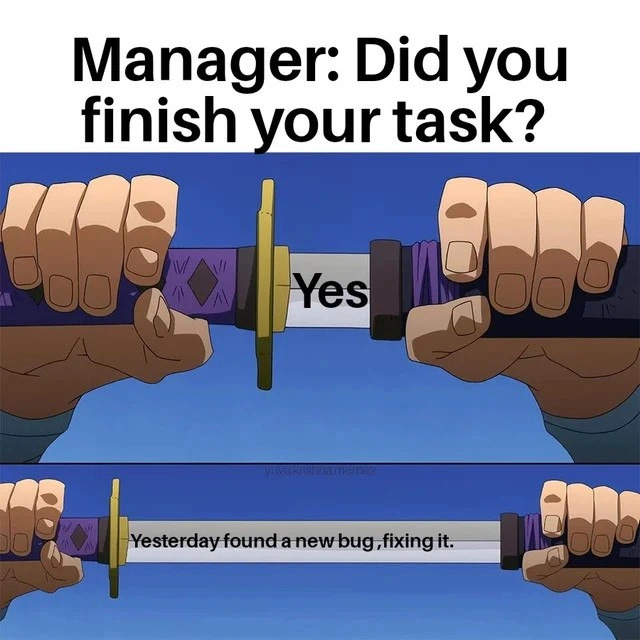
In the image, the top panel makes it look like the answer is simply Yes. The lower panel reveals the rest: Yesterday found a new bug, fixing it. That extra text changes the meaning. The task may have moved forward, but a new problem appeared, so the work is not cleanly complete.
For junior developers, this is a familiar moment: you think you finished the feature, then testing uncovers a bug. Now you must decide how to explain it without sounding like you are making excuses. The meme captures how hard it can be to summarize messy technical work for a meeting that wants a neat update.
Level 3: Boolean Status Abuse
The meme asks:
Manager: Did you finish your task?
The first sword reveal shows only:
Yes
Then the longer blade reveals the real answer:
Yesterday found a new bug, fixing it.
That is the entire daily standup communication gap in one image. The developer's answer begins like a clean boolean: true. Pull the sword farther out, and it becomes a status object with caveats, fresh defects, unresolved scope, and probably a comment thread nobody wants to reopen. The joke is that the visible Yes is technically adjacent to optimism, but the hidden continuation means the task is not really "finished" in the manager's sense.
Experienced developers recognize the trap. A task can be done at the level of "I wrote the code," not done at the level of "QA found something," done except for "one small edge case," not done because "the fix exposed a deeper bug," and somehow still presentable in standup as progress. This is not necessarily dishonesty; it is the compression problem of Agile ceremonies. Daily meetings ask for a short answer, while debugging produces branching narratives.
The sword format works because it visualizes partial disclosure. The manager sees the handle-side word Yes, the part that fits the meeting. The full blade contains the uncomfortable implementation detail: a new software bug changed the task from completion into investigation. In real teams, this is where estimates go to become folklore. A one-day fix becomes an archaeology dig through assumptions, flaky tests, unclear acceptance criteria, and a reproduction path that only works on one person's machine after lunch.
The deeper satire is organizational. Manager expectations often want status to be discrete: finished or not finished, blocked or not blocked, green or red. Debugging is probabilistic and recursive: every fix is also a test of the mental model. The meme is funny because the developer is trying to satisfy a binary question with a non-binary reality, which is how you get sprint boards that look tidy right until someone asks what "almost done" means.
Description
The image uses an anime sword-reveal meme format. Large top text asks, "Manager: Did you finish your task?" and the close-up of the sword shows only the word "Yes." In the lower panel, when the sword is pulled farther out, the full text reads "Yesterday found a new bug, fixing it." The meme captures the evasive daily standup status update where a task is technically progressing, but completion has been displaced by fresh debugging work.
Comments
3Comment deleted
In standup, "yes" is often just a boolean cast over a much messier exception object.
Pls use english not stickers Comment deleted
de ja vu Comment deleted