Errors: The Unwanted Best Friend of Every Developer
Why is this Bugs meme funny?
Level 1: Your Shadow Friend
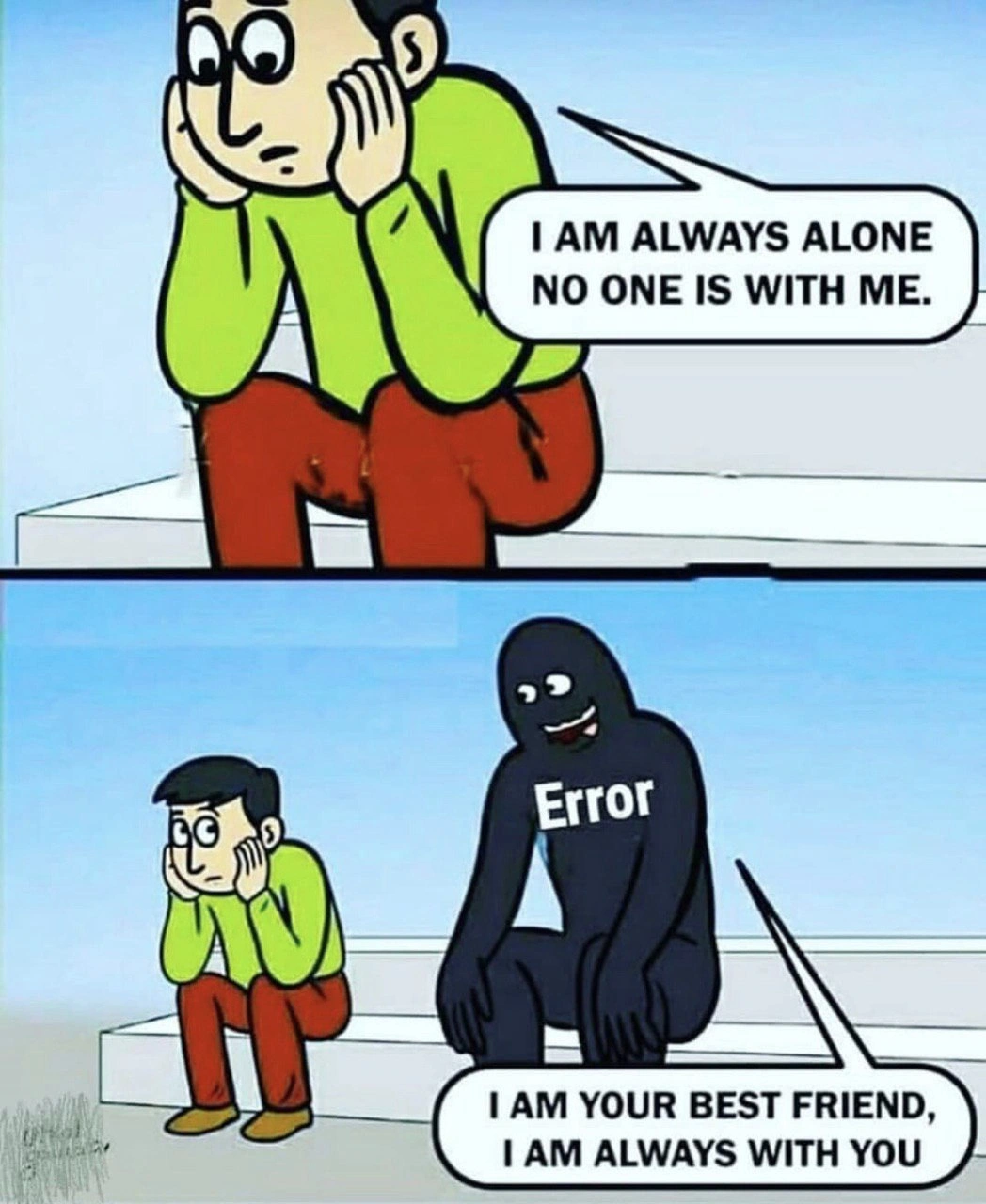
Imagine a kid sitting alone on a playground feeling sad because he thinks he has no friends to play with. He says, “I am always alone, no one is with me.” But then he notices his own shadow on the ground next to him. The shadow sits up, gives a big goofy grin, and says, “I am your best friend, I am always with you!” Suddenly, the kid realizes he was never truly alone – his shadow was by his side the whole time. This meme is just like that, but for a computer programmer. The programmer feels lonely working by himself, but the big dark figure labeled "Error" is like his shadow friend, always there even when he wishes it wasn’t. It’s a funny way of saying that whenever someone writes code, the little mistakes (errors) in the code are always there keeping them company.
Think of it like building with LEGO blocks. Suppose you’re trying to build a big tower, and you feel like you’re doing it all alone. Then, crash! – the tower falls down because one block was in the wrong spot. That crashing tower is like an “error.” It’s frustrating, but it’s also as if the falling tower is telling you, “Hey, something wasn’t right, let’s try that again differently.” In the meme, the error is drawn as a friendly-looking shadow creature who says it will never leave the programmer. It’s kind of like an imaginary friend, except instead of helping you, it’s pointing out problems. The humor comes from the idea that just when the programmer thinks nobody is with him, he actually does have a constant companion... it’s just not the kind of friend you’d hope for! It’s the error in his code. So, the lonely programmer in the green sweater isn’t really alone after all – he always has his errors to keep him busy. It might sound negative, but there’s a silver lining: that “friend” (the error) is how he knows what to fix. It’s like the shadow friend saying, “I’ll stick with you until you make things right.” In simple terms, the meme is joking that a programmer’s true BFF (best friend forever) is the error messages that pop up whenever something goes wrong! They might annoy you, but at least you know you’re never alone – your shadowy error buddy is always by your side, guiding you (in its own mischievous way) to become better.
Level 2: The Bug Buddy System
This meme’s joke is pretty straightforward for anyone who has started writing code. In the cartoon, the programmer feels lonely and says, “I am always alone, no one is with me.” In the next panel, a goofy dark shadow figure labeled Error sits next to him and says, “I am your best friend, I am always with you.” It’s a tongue-in-cheek way of saying that whenever you’re programming, errors and bugs are constantly by your side. Even if you feel like you’re coding all alone, as soon as you run your program, an error message is likely to pop up and keep you company (whether you like it or not!). The depressed-looking developer in the green sweater represents any coder who’s felt isolated wrestling with a tough problem. The punchline is that he isn’t actually alone at all – his ever-loyal companion, the error in his code, is right there with him. It’s like the computer is telling him, “Cheer up, you’ll always have me (the bug) to hang out with!”
Let’s break down the technical terms in this context. In programming, a bug is basically a mistake or flaw in the code that causes it to behave in an unexpected or wrong way. For example, maybe you tried to use a variable that wasn’t initialized, or you put a loop in your program that never ends. When the computer hits a bug like that, it often throws an error. An error message is the computer’s way of saying “Uh oh, something went wrong!” It might look like red text in a console or a popup alert in an app that tells you what the problem is. For instance, if you forget to close a quote or parenthesis, you might see an error like SyntaxError: missing parenthesis pointing to the exact line of code. Or if your program tries to use something null or undefined, it could raise a NullPointerException at line 42. These messages can be intimidating or annoying at first, but they’re actually really helpful clues. They usually tell you where and sometimes what the issue is, so you know what to fix. The process of finding the bug causing the error and fixing it is called debugging (or troubleshooting). When you debug, you might read the error message, go to the code it points to, and try to understand why the bug happened. Then you change the code and run it again to see if the error went away. Debugging is like being a detective for your own code – following the trail of clues (error logs, stack traces, etc.) to catch the culprit bug.
For a new developer, seeing errors crop up constantly can be frustrating and even a little demoralizing. You might write what you think is a perfect piece of code, hit “run,” and immediately get a big red error in your face. That experience can cause some serious coding frustration. You might think, “Am I the only one who makes so many mistakes?” But trust us, constant errors are a normal part of coding for everyone. That feeling when you’re testing your first project late at night and error after error keeps showing up? Every programmer from beginner to expert has been there (many, many times). In fact, an experienced coder expects to see errors and bugs – it doesn’t mean you’re bad at coding, it just means you’re doing something non-trivial. The key is learning how to handle that moment. Over time, you start to see error messages less as personal attacks and more like a form of feedback from the computer. It’s almost like the computer is talking to you, saying “Hey, something’s not right, go check this part!” Seasoned developers often joke about developing a sort of friendship with their debugger or their log files. A common learning technique is rubber duck debugging – explaining your code out loud to a rubber duck (or any inanimate object) as if it were a friend, which often helps you spot the mistake. In this comic, though, it’s as if the error itself is your rubber duck or buddy, sitting beside you and cheerfully reminding you it’s not going anywhere until you fix the problem. It’s a funny exaggeration of how errors can feel almost alive when you’re knee-deep in debugging.
The takeaway for a junior developer is that you’re never really coding alone. Sure, you might be the only person at your keyboard, but you’ve always got your faithful (if annoying) companion: the latest error message! The programmer in the meme looks despairing because he feels alone, but the black shadow with "Error" on its chest is basically saying, “Don’t worry, I’ve got your back. I’ll be here to point out every mistake.” It’s a comical reassurance that encountering bugs is just part of the journey. Every error you bump into is an opportunity to learn something and make your code better. For example, that error that says “Array index out of bounds” teaches you that you tried to access something outside the range of a list. The next time, you’ll be more careful with your indices. In a strange way, errors teach you by immediate feedback. It doesn’t feel great in the moment (it can be quite debugging frustration to have your program crash), but each resolved bug is a little victory and a lesson learned. So the meme uses humor to convey a bit of wisdom: don’t be too upset when you run into errors, because every developer – even the pros – has this “friend.” Bugs and errors are the loyal sidekicks to every coder’s adventure. They might not be the friends you want, but they’re the friends that push you to improve. In short, writing code is a bit like having an imaginary buddy who constantly says “Oops, you messed up here, fix it!” – annoying, yes, but ultimately helpful. The sooner you accept that ever-present companion, the more smoothly your coding journey will go.
Level 3: Hello Error, My Old Friend
For seasoned developers, an error message is like that old friend who shows up uninvited but reliably every time. The meme shows a lonely programmer lamenting, "I am always alone, no one is with me," when suddenly his code’s Error appears like a comforting (if unwelcome) buddy saying, "I am your best friend, I am always with you." It's darkly humorous because it's painfully true: no matter how solitary coding feels, you're never truly alone – some bug is bound to pop up and keep you company. In production on-call life, at 3 AM when an outage wakes you, you might be physically alone in the dark, but the moment you check the logs an error is there to greet you with that same grin from the comic, as if saying "Hello, it's me again."
In a senior developer's reality, this translates to countless late-night debugging sessions where the only dialogue is between you and a glowing screen full of error messages. You fix one bug, only to find a new one lurking behind it – debugging often feels like a hydra: slay one head (bug) and two more pop up. It’s practically a rite of passage in the developer experience (DX). There's even a morbid industry joke (sung to the tune of "99 Bottles of Beer"):
"99 little bugs in the code,
take one down, patch it around,
127 little bugs in the code..."
This captures how fixing one issue can inadvertently introduce others. The shadowy figure labeled "Error" in the comic perfectly personifies this phenomenon of persistent, multiplying bugs – an ever-present companion that appears whenever you think you’ve finally got the system all to yourself. The meme uses a dark, grinning shadow friend to literally embody the abstract nuisance of errors always lurking beside us. (It’s a popular meme format to give an unwanted problem a friendly face, and here our unwanted buddy is the infamous software error.) Every seasoned engineer recognizes that feeling: you triumphantly deploy a new feature, only to be joined immediately by a familiar Error message politely insisting it’s still here to keep you company.
So why is this scenario so universal in developer humor? Because modern software is incredibly complex, and bugs in software are practically guaranteed. Any non-trivial codebase has countless interacting parts – libraries, APIs, user inputs, hardware quirks – each offering opportunities for something to go wrong. Even when we follow best practices religiously (writing tests, doing code reviews, using linters and static analysis), a new deployment or an odd user input inevitably summons an error we didn’t anticipate. It's basically Murphy’s Law of coding: if something can break, it eventually will. In fact, the term "debugging" itself comes from early engineers literally removing a moth from a malfunctioning computer in 1947 – a sign that bugs (whether actual insects or coding errors) have been part of programming from the very beginning. The software industry has long accepted that we must manage bugs rather than dream we can eliminate them entirely. We add robust error handling via try-catch blocks, log every anomaly, and set up alerts and monitoring – essentially treating Error as a known roommate rather than a surprise guest. We know our code will throw exceptions, so we write guard clauses and fallback logic to handle them. The developer in the meme might feel alone, but this proactive mindset is an admission that Error is always right beside us, waiting for any slip-up.
Even the most advanced teams and projects aren’t safe from mistakes. NASA once lost an entire Mars orbiter because one piece of software used metric units while another used imperial – a "simple" unit conversion oversight that led to a $327 million crash. If rocket scientists can slip up, what hope do the rest of us have? 😅 It illustrates a core developer pain point: no matter how experienced or careful you are, there's always a new debugging frustration waiting around the corner. The meme nails this with the black shadow figure: it’s funny because every engineer has faced that despairing moment of “Why am I stuck here alone with all these errors?” and then realized, ironically, that those Error messages are their company. When the coder in the comic says "no one is with me," every developer knows that feeling of isolated struggle – and we laugh (with a groan) because we also know the punchline: try to code for more than a few minutes, and an error will invariably pop up saying it’s “always with you.” In a strange way, there’s comfort in that shared misery. You might be alone in a room, but thousands of other developers at that very moment are also getting friendly visits from their own errors and exceptions. It’s a brotherhood of bug-fighting. 🔥
A battle-hardened coder will even plan for this constant companionship. We write unit tests and integration tests to catch bugs early. We practice pair programming or do code reviews so that someone else can help spot mistakes before our eternal friend, the error, does. But even with all that process, surprises still happen. Sometimes companies push features out the door too fast, racking up technical debt that basically invites errors to stick around as permanent guests. Every quick-and-dirty fix or skipped test today is like rolling out the red carpet for tomorrow’s bugs. The result? The same error (or its slightly mutated cousin) reappears sprint after sprint, release after release, like it's saying, "Miss me? I’m back!" Fixing things properly often takes more time and care than tight deadlines allow, so we end up living with certain bugs longer than we should. This leads to war stories and gallows humor: ask any senior dev about their most stubborn bug, and you’ll hear about an "invisible friend" that shadowed them for days or weeks before finally being vanquished. The meme’s smiling Error character perfectly captures that mix of coding frustration and resignation – sometimes you have to laugh so you don’t cry, knowing that quashing one bug doesn't mean you won’t meet its brethren soon.
Beyond the technical battles, there's a human aspect to constantly dealing with errors. It can wear you down over time. Many developers quietly wonder if they're doing something wrong because they keep encountering problems – a touch of imposter syndrome or developer anxiety. But the inevitability of mistakes is exactly why this meme strikes a chord; it reminds us that struggling with errors isn’t a personal failing, it's just part of the job. The difference between a junior and a senior developer isn’t that the senior writes flawless code – it's that they’ve made peace with the endless cycle of finding and fixing flaws. Seasoned devs develop a kind of zen (or dark humor) about it: when our old pal Error shows up, we sigh, roll up our sleeves, and start debugging like it’s just another day at the office. In a weird way, you come to respect that constant companion: every error is a clue, a chance to learn something new or improve the system. Every bug fixed makes the software a little better and the developer a little wiser. The meme takes this reality and gives it a witty twist – turning the abstract concept of "always having bugs to fix" into a literal cartoon best friend who never leaves your side. It’s both comforting and a bit sinister: comforting because hey, you’re not truly alone in your coding woes (we’re all in this together, and even your errors are reliably by your side), and sinister because, well, this "best friend" is definitely not the friend you asked for! In the end, the meme gets a knowing chuckle from developers because it’s a love-hate truth: errors are the one companion you can count on in software development – for better or worse.
Description
A two-panel comic strip with a simple art style. In the first panel, a cartoon man in a green shirt and red pants sits dejectedly on some steps, resting his head in his hands. A speech bubble from him reads, 'I AM ALWAYS ALONE NO ONE IS WITH ME.' In the second panel, the man is in the same pose, but now a large, shadowy, vaguely humanoid creature with a sinister grin sits beside him. The creature has the word 'Error' written in white on its chest. In a speech bubble, the creature says, 'I AM YOUR BEST FRIEND, I AM ALWAYS WITH YOU'. The meme personifies software errors as a constant, unwelcome companion in a developer's life. It humorously captures the relentless nature of bugs and the feeling that no matter what you do, errors will always be there, a universal experience that resonates with anyone who has ever written code
Comments
7Comment deleted
My code's social life is more active than mine; it's always hanging out with its best friends: `NullPointerException`, `Undefined is not a function`, and `Segmentation fault`
The only part of our stack that actually hits five-nines availability is 500 Internal Server Error - he never misses a deploy, a stand-up, or a 3 a.m. page
After 20 years in this industry, I've learned that errors aren't bugs - they're just the compiler's way of telling you it understood exactly what you wrote, not what you meant to write
After 20 years in this industry, I've learned that 'Error' isn't just a companion - it's a code reviewer that never takes PTO, never misses a standup, and has an uncanny ability to appear right before production deployments. At least it's more consistent than our CI/CD pipeline
Funny how the happy path is aspirational, but the error path has five nines and a PagerDuty subscription - always by your side
Errors: the one microservice that achieves 100% uptime, no matter how many times you redeploy
After three rewrites and two cloud migrations, the only component with five-nines uptime is our error stream