Skip to content
DevMeme
2368 of 7435
The Ultimate 'Make' Command: From Political Slogans to Compiling Code
CLI Post #2634, on Jan 20, 2021 in TG

The Ultimate 'Make' Command: From Political Slogans to Compiling Code

Why is this CLI meme funny?

Level 1: Only Hear "Make"

Imagine you have a friend who loves building with LEGO blocks. Now say a teacher loudly proclaims, “We need to make the classroom great again by cleaning up!” Your friend hears the big sentence, but their brain latches onto one word – “make”. Suddenly they get excited and start grabbing their LEGO bricks, thinking the teacher wants them to build something! They completely ignore the “classroom” and “clean up” parts, because the word “make” is all they can focus on. This meme is funny in the same way. It shows a famous saying “Make America great again,” but a programmer only sees the word “make” and thinks about their favorite computer command. It’s like a one-track mind: when you really love or are used to something, you hear it everywhere. So the joke is that programmers are so wrapped up in coding and commands that even a serious slogan turns into a silly computer joke for them. It’s as if someone said a long sentence, and the programmer just heard their favorite toy’s name. That mismatch – taking something big and important and looking at it in a tiny, geeky way – is what makes it lighthearted and fun.

Level 2: Build Tool Basics

For those newer to programming, let’s break down why the word make is so significant here. In everyday English, “make” just means to create or build something. In the programming world, make is also the name of a classic build tool. A build tool is a program that automates the process of turning your source code (the human-written text files that make up a program) into an executable application (the thing you can run). Instead of manually invoking the compiler for each file, linking libraries, etc., developers use make to handle all that for them with one command.

make specifically reads instructions from a file typically called a Makefile. The Makefile contains a list of rules or recipes for how to compile the program. For example, it might say “to build the program, first compile main.cpp into main.o, then compile util.cpp into util.o, then link those together into the final program.” Each of those steps might themselves depend on other files. make figures out the right order to do things and only rebuilds parts that need updating. It’s essentially build automation – you run one command and it takes care of making (building) everything. This is a cornerstone of traditional software development, especially in C and C++ projects on Linux/Unix systems.

Now, about the Linux penguin in the meme: that cute penguin is named Tux, the mascot of Linux. Its appearance in the final panel signals that we’re dealing with a Linux/Unix context (where make is commonly used). On Linux and other Unix-like operating systems, command names are almost always lowercase. The meme emphasizes this by showing the word “make” in all lowercase for the last step. This ties into case sensitivity: on these systems, uppercase and lowercase letters are considered different characters. So a program named make is not the same as Make or MAKE – those would be seen as completely different names by the computer. A newbie might not realize that at first and wonder why typing “Make” doesn’t work, but they quickly learn that commands like ls, cd, gcc, and make must be entered exactly in the right case. It’s an early lesson in the command-line world: “Close” only counts in horseshoes, not in shell commands.”

Let’s connect this to the meme text. The original phrase “Make America great again” is recognizable as a political slogan, but here each word “falls off” until only “make” remains – and crucially, it’s shown with Tux to indicate it’s now the shell command. The joke is playing on the double meaning of “make.” To a non-programmer, even just “Make” or “make” might imply “create something” in a general sense. But to a developer, make immediately brings to mind the act of compiling software. If you’ve ever followed instructions to build an open-source project from source code, you might recall steps like:

  1. Configure the project (often by running a script or cmake or ./configure).
  2. Run make to compile the code.
  3. Run make install to install it.

That second step, make, is doing a lot behind the scenes – it’s crunching through the Makefile’s directives to compile the project. The first time a new developer runs make and sees a wall of compiler output text scroll by, it’s a bit of a magical moment. You type one short word, and your computer starts whirring, doing a bunch of work for you. After using it repeatedly, the association between the word “make” and building something complicated with a single command becomes very strong.

So, when a developer hears or sees the word “make” out in the non-coding world (like in a slogan or phrase), a lightbulb in their head goes off: “Hey, I know make – I use that to build my programs!” It’s a little chuckle to ourselves, thinking “if only they meant that kind of make.” In developer communities, people often joke about everyday words that collide with tech terminology. It’s a form of terminal humor. For instance, someone might quip, “I tried to grep my homework for answers” (mixing a Unix command grep with the act of searching through homework, as a joke). In the same vein, seeing “make” in a political slogan triggers this meme-worthy idea: what if we treat the slogan like a series of command-line instructions?

The case-sensitive commands aspect is another subtle nod. In the meme, the shift from “Make” with a capital M to “make” with lowercase shows that we’ve moved from normal language to exact computer command. Beginners learn quickly that when working in a Unix shell or a programming context, you have to match the exact case of things. This can be an adjustment if you come from a Windows background (where file and folder names are often case-insensitive). So “Make” -> “make” in the meme isn’t a typo; it’s highlighting that detail-oriented developer mindset. One letter’s case can change everything for a computer, so we notice such differences.

Lastly, let’s talk about why this evolution in the meme is funny from a developer’s perspective. It’s showing an over-the-top literalism that is common in programming jokes. The original phrase is about making a country “great again” – a very broad, non-literal goal. But programmers are literal creatures: we think in terms of concrete tasks and commands. The meme humorously reduces a grand idea to a build command, suggesting maybe if we just run make, we could improve things. Of course, reality doesn’t work that way, but the contrast between the seriousness of the slogan and the mundanity of a command-line build is what makes us laugh. It’s like seeing everything as a nail because you have a hammer: if your hammer is make, then every problem looks like it might be solved by compiling something. For a junior dev, it’s a glimpse into the inside jokes of programming culture – the kind of joke you start to appreciate after you’ve spent enough time waiting for code to compile or troubleshooting a broken Makefile.

In summary, the meme takes a famous line and turns it into a programmer’s joke by gradually morphing a political slogan into a command-line statement. It uses historical figures for comedic effect (each older figure saying a shorter phrase, as if we’re rewinding time and distilling down to the essence). And that essence, in the end, is just the command make. Understanding it helps to know: Linux/Unix command-line conventions (like case sensitivity and common tools), what make does in software development, and the general tendency of devs to inject tech references into anything. Once you know those, you’ll see why a developer might smirk and say, “I can’t hear ‘make X great again’ without thinking of a Makefile.” It’s a nerdy pun, bridging the world of code and the world outside.

Level 3: Terminal Vision

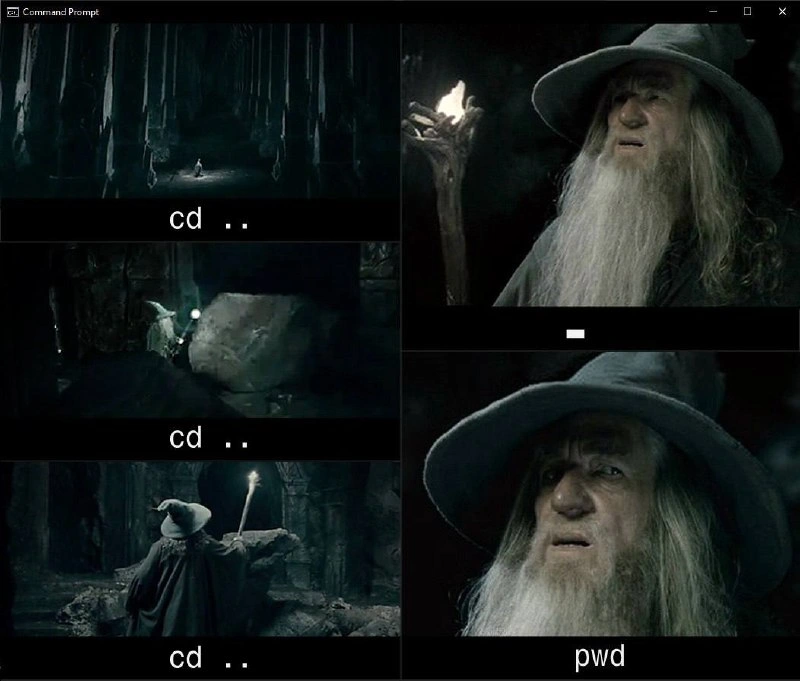
In this meme, a well-known political slogan is stripped down to a single Unix command – a transformation only a developer’s mind would conjure. The panels progress through time: a modern politician demands “Make America great again.” A 19th-century statesman echoes “Make America great.” An 18th-century founder asserts “Make America.” A classical deity simply intones “Make.” Finally, the Linux mascot Tux appears with the lowercase command make. Each step peels away a word (and a century) until we’re left with the bare-bones build command that developers know and love. It’s a geeky punchline: from campaign trail to command line, all roads lead to make.

Seasoned programmers find this hilarious because it captures that peculiar developer tunnel vision: we see everyday words and immediately think of tech tools. The word “Make” isn’t just a verb to us – it’s the name of the ubiquitous build tool GNU Make. By the time the meme reaches the final line, it has entered the realm of the terminal, where the capital “M” has vanished. This case sensitivity detail is key. In Unix-like systems, Make and make are totally different tokens – one might refer to nothing at all, while the other is the command that launches a build. The meme winkingly acknowledges case-sensitive CLI culture: only the lowercase make will do. (How many of us have seen a newbie type a command with a capital letter and wonder why bash scolds them with a “command not found”? 😅) Here, the capital “Make” spoken by a godly figure wouldn’t execute on any Linux shell – the universe only compiles when it’s lowercase.

Beyond the letter-case gag, there’s a deep vein of developer humor in conflating lofty political rhetoric with our everyday build process. “Make America great again” was a grand slogan, repeated ad nauseam in the real world – and by January 20, 2021 (when this meme was posted, not coincidentally Inauguration Day), many were ready to retire it. Programmers, however, gave it a second life by parsing it like a Makefile command. The joke imagines, “If only rebuilding a nation were as straightforward as running a build script.” The humor lands because make is all about automation and repeatability – you run make again and again to compile software reliably. Hearing “again” in the slogan tickles the part of a coder’s brain that deals with iterative builds and CI pipelines. It’s as if the meme asks: What if “Make America great again” were literally a command you could execute? Experienced devs know that feeling when you wish you could just script something complex into existence. We can’t help but smirk at the absurd mental image of a Makefile for national greatness, complete with targets like “america” and “great”.

In fact, if a terminal literalist tried to run the slogan as a command, make would treat each word as a build target. It might look like this:

$ make america great again
make: *** No rule to make target 'america'.  Stop.

That error message – “No rule to make target 'america'” – is exactly what seasoned developers expect. We’ve all seen make gripe when we fat-finger a target name that doesn’t exist in the Makefile. The meme plays on that insider knowledge. It’s implicitly understood that there is no predefined recipe to build “america”, let alone make it “great” or “again.” The punchline is that reality isn’t so conveniently automatable, but wouldn’t it be nice (and darkly funny) if it were?

There’s also an historical layer to this joke that veteran engineers might appreciate. The progression from modern President to Lincoln to Washington to a biblical creator evokes a regression to origin, and what do we find at the primordial beginning? Not “light” or “logos,” but the good old Unix make command. 😄 It’s a playful nod to the age and foundational status of Make itself. The tool make is practically ancient in tech terms – it dates back to 1976, created at Bell Labs by Stuart Feldman. That’s older than many programming languages in use today (and indeed older than Linux by a long shot). So, when the meme’s second-to-last panel shows a bearded deity with “Make”, it doubles as a cheeky personification of this old, godlike build system that has existed since the early days of Unix. In the beginning was the command line, and arguably one of the first commands to rule them all was make. The final panel handing it off to Tux (Linux) brings it full circle to the modern developer’s daily reality. It’s saying: no matter how grand or ancient the idea of “making” is, for us, it ultimately boils down to a $ make in the terminal.

Underneath the humor is a shared understanding among experienced devs about how ingrained our tools become in our thinking. We spend all day with compilers and scripts, so of course when we hear “make” in any context, our brains autocomplete it to the command. This meme perfectly encapsulates that nerdy reflex. It satirizes both the pervasiveness of make in build workflows and the stereotype that developers reduce everything to code. The slogan’s gradual deconstruction exaggerates how a programmer might mentally trim away all the non-essentials (“great again”? Meh, that’s marketing fluff…) and focus on the one word that maps to something real in their world: make. It’s funny because it’s true – ask a dev to “make something happen,” and you might just catch a glint in their eye as they think about spinning up a shell and writing a script for it.

Ultimately, the meme gets senior engineers chuckling and nodding because it connects a cultural touchstone to a core piece of developer life in a clever way. It’s a reminder that for better or worse, we see the world in terms of what we can automate. Even a pompous political mantra can, in our minds, become a command-line invocation. The absurdity of that mismatch – between grand human ambitions and nitty-gritty software commands – is comedy gold in programming circles. GNU Make turning into a punchline for a presidential slogan? That’s the kind of mashup of worlds that fuels developer humor. We laugh, and then, half-joking, half-hoping, we double-check: if only /usr/bin/make really could make America “great again”.

Description

A five-panel vertical meme that deconstructs the phrase 'Make America Great Again' by associating progressively shorter versions of the phrase with increasingly foundational figures. The first panel shows Donald Trump with the text 'Make america great again'. The second features Abraham Lincoln with 'Make america great'. The third shows George Washington with 'Make america'. The fourth panel depicts a classical image of God in the heavens with the word 'Make'. The final panel, the punchline, displays Tux, the Linux mascot, next to the lowercase command 'make'. The humor is a clever pun for a technical audience, equating the fundamental, creative power of a deity with the 'make' command, an essential command-line utility used for building and compiling software in Linux and other Unix-like systems. It positions the 'make' tool as the ultimate, foundational act of creation in the software world
Comments

7
Anonymous ★ Top Pick The 'make' command, much like a political promise, depends entirely on a complex file of dependencies and rules, and often fails with a cryptic error message
  1. Anonymous ★ Top Pick

    The 'make' command, much like a political promise, depends entirely on a complex file of dependencies and rules, and often fails with a cryptic error message

  2. Anonymous

    Strip a campaign slogan through enough git rebases and the root commit is just “make” - and, like every legacy Makefile, it still has no rule to build america.o

  3. Anonymous

    While politicians debate making things 'great again', Linux developers already achieved greatness with a simple 'make' - though we all know the real complexity is hidden in that 10,000-line Makefile with recursive dependencies that nobody fully understands anymore

  4. Anonymous

    After decades of Makefiles with their tab-vs-space nightmares and cryptic syntax, we've invented Gradle, Maven, Webpack, and a dozen other build tools - each promising to finally replace Make. Yet here we are, still running 'make clean && make' like it's 1976, because sometimes the oldest tools are the ones that just work. Make: proving that you don't need YAML, JSON configs, or a PhD to compile code since before most of our frameworks were born

  5. Anonymous

    After the vision, the roadmap, and the all-hands, the only thing that actually runs is: make; everything else is a .PHONY target

  6. Anonymous

    Linux reduces the whole campaign to the actual build: make - case‑sensitive; mis‑capitalize it and your CI votes “No rule to make target ‘all’.”

  7. Anonymous

    Political slogans after a brutal code review: refactored to minimal viable kernel with 'make Linux' - because nothing scales like penguin power

Use J and K for navigation