Decoding the Hidden Truth Behind Product Marketing Buzzwords
Why is this Marketing meme funny?
Level 1: Not as Advertised
Imagine you see a TV commercial for a new toy robot. The ad shows a sleek, amazing robot that can do everything – it says “fully documented” (so you’ll have a big book of instructions), “custom built” (made especially cool), “highly optimized” (works super fast), “cutting edge” (using the newest tech), “prepared for anything” (has tools for every situation), and “approved by experts” (even a genius gave it a thumbs up). Wow, sounds awesome, right?
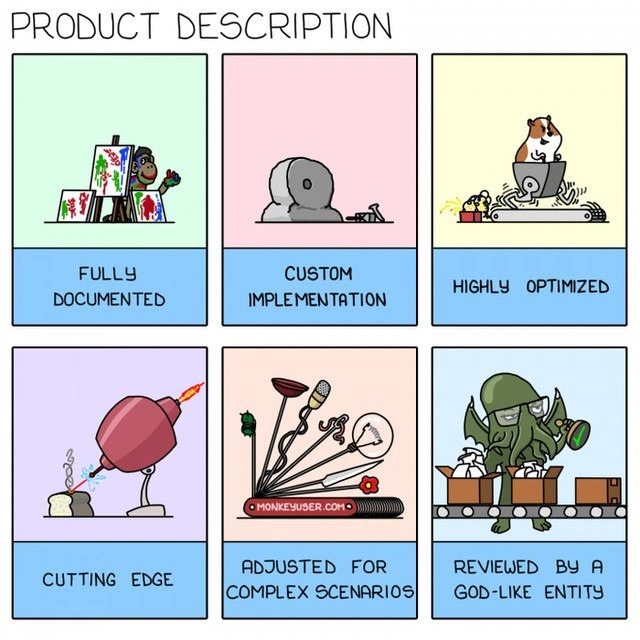
But when the toy arrives, you open the box and burst out laughing. Instead of a high-tech marvel, you find a goofy contraption taped together from odd parts. There’s a messy little booklet with finger-paint scribbles that hardly tell you anything. The “custom built” robot looks like someone reinvented a basic wheel out of a heavy stone – it barely rolls. “Highly optimized” turns out to mean it only runs if a hamster spins a wheel to power it. The “cutting edge” feature? It has a actual sharp saw blade with a rocket attached — it’s more likely to cause chaos than to help. It’s crammed with so many random gadgets (even a flower sticking out of it!) in an attempt to handle “complex scenarios” that it just becomes silly and hard to use. And that “expert approval”? You see a stamp on it that looks like it was marked by a big green tentacled monster rather than a real person.
It’s funny and ridiculous because what was promised and what you got are completely different. The fancy promises made you imagine something perfect, but the reality is more like a clumsy science fair project gone wrong. We laugh at this big difference – it’s like expecting a gourmet, multi-layered cake and instead getting a wobbly cake with too much frosting and a plastic toy stuck in it. In simple terms, the meme is showing how companies sometimes advertise one thing and deliver something else, and anyone who’s experienced that will find it both funny and true.
Level 2: Marketing Lingo 101
For a newer developer (or anyone new to MarketingVsReality jokes), this comic is basically translating tech buzzwords into their not-so-pretty reality. Let’s decode each phrase in simple terms:
"Fully documented" usually means the product is supposed to have complete documentation – guides, examples, explanations of how everything works. In ads, this sounds reassuring, like you’ll have a manual for every situation. But in practice, as the comic humorously shows, you might open the docs and find a confusing mess (the gorilla’s finger-paint art stands in for sloppy or useless docs). Every junior dev eventually finds an official README or help file that’s as helpful as random scribbles, learning the hard way that having documentation is not the same as having good documentation. (This is a classic bit of DocumentationHumor in development circles.)
"Custom implementation" implies a solution built uniquely for a specific need, rather than using a common or off-the-shelf solution. As a new programmer, that sounds impressive – custom means tailored and optimized just for you, right? The comic’s caveman with a stone wheel tells a cautionary tale: custom often ends up reinventing the wheel. In real life, a team might brag about a custom framework or in-house tool, but to developers it might mean “we ignored existing tried-and-true solutions and made our own buggy version.” The stone wheel is a perfect metaphor: yes, it’s a wheel made just for this cart, but it’s heavy, clunky, and far from the modern ideal. New engineers quickly learn that Not Invented Here syndrome (avoiding external solutions in favor of building your own) can lead to primitive results and lots of extra work maintaining that Custom creation.
"Highly optimized" in marketing-speak suggests the software or system runs extremely efficiently, squeezing out maximum performance. As a newcomer, you’d think it runs like a race car. But the comic literally shows a hamster on a treadmill powering a laptop and server rack – a silly image that says, “we claim it’s fast, but behind the scenes someone (or something) is working furiously just to keep it going.” In real terms, sometimes “highly optimized” code is just code that’s been tweaked in weird ways or needs special conditions (like a cache warmed up, or in jokes, a hamster running) to work okay. This teaches junior devs a valuable lesson: be skeptical of highly optimized claims, and remember that true optimization is often complex and not just a buzzword. It also nods to the idea that if you push optimization too far without thinking (like overclocking with a hamster-wheel contraption), the setup can become fragile.
"Cutting edge" means using the latest, most advanced technology – it’s the shiny new thing on the block. Early in your career, it’s exciting to hear a product is cutting edge; you imagine futuristic tech that outperforms everything. The cartoon’s rocket-propelled, laser-guided saw is a funny literal take: it’s definitely advanced (a laser and rocket on a saw is not old tech!), but it’s risky and looks a bit like an uncontrolled science experiment. The message for a junior developer: cutting edge tools can be powerful but also unpredictable. Maybe the framework is so new that it has bugs, or the device is so “advanced” that nobody knows how to fix it when it breaks. The term comes with glamour, but also the warning that “on the cutting edge, you might get cut.” The comic dramatizes this by showing debris and smoke — a visual way to say bleeding edge tech can blow up in your face. It’s a lighthearted lesson in not believing hype blindly: the newest tech isn’t always the best choice for stability.
"Adjusted for complex scenarios" suggests that a product can handle all sorts of complicated, real-world use cases. If you’re new, you’d interpret that as “wow, they thought of everything, so it will work no matter what we throw at it.” Enter the comic’s overstuffed Swiss Army knife (with the MonkeyUser logo on it and even a random flower sticking out). This is a playful jab at how trying to cover every scenario can make a design ridiculously over-complicated. For a junior dev, it’s a relatable discovery: adding features and handling edge cases is good, but if you keep bolting on attachments and special-case code for every possibility, you end up with a bloated, confusing system (an analogy often called a “Swiss Army knife” solution). That giant multi-tool in the panel is basically the code that started simple but had so many special features and fixes added that it’s now cumbersome. The phrase teaches that adjusted for complex scenarios might hide the fact that the product became overly complex itself. Simpler designs sometimes handle most needs better than one trying to literally handle everything.
"Reviewed by a god-like entity" is an amusing one. Normally, companies will say something like “reviewed by top experts” or “peer-reviewed by a distinguished engineer” to assure you that the code or product was checked for quality. If you’re new, you’d imagine a wise guru or maybe an advanced AI gave its blessing, and thus the product must be flawless. The comic twists this with a tentacled Cthulhu-like creature stamping approvals on a conveyor belt of products. For context, Cthulhu is a mythical ancient god/monster from H.P. Lovecraft’s stories – definitely not your typical code reviewer! The funny image tells a young developer two things: one, this claim might be pure exaggeration (a god-like reviewer is as unreal as Cthulhu); and two, even if some super-expert looked at it, that doesn’t guarantee quality – they might just rubber-stamp things. Many new engineers learn that a “code review” can sometimes be very cursory. Maybe a famous tech lead glanced at it, or an automated tool (which people jokingly call an “all-seeing AI”) approved it. It’s a tongue-in-cheek way to say: don’t put blind faith in grandiose claims of approval. Even something “reviewed by the best” can have bugs – gods or not, nobody catches everything!
In summary, each panel of this comic is translating fancy marketing jargon into a scenario a developer might actually encounter (with a humorous extreme). A newcomer reading this can learn the hidden truth behind common marketing_buzzwords:
- Fully documented? – There’s documentation, but it might be awful or useless.
- Custom implementation? – They built it themselves… possibly poorly, instead of using a standard solution.
- Highly optimized? – They claim it’s fast, but maybe it’s using strange tricks or extra effort to appear fast.
- Cutting edge? – Really new tech, possibly unstable or untested in real life.
- Adjusted for complex scenarios? – Features for every edge case, making it overly complex.
- Reviewed by a god-like entity? – Someone supposedly super smart looked at it, but that doesn’t guarantee perfection (the “god-like” bit is just for show).
For a junior developer or someone outside the field, the comic’s message is clear and comical: things are not always as advertised. Those big promises often come with caveats that only experience will teach you. This is classic DeveloperHumor – once you’ve been burned by a few buzzwords, you start to laugh at how predictably off-base they can be. The comic uses outrageous imagery to make sure even a newcomer can grasp the point: the fancy words on the box can hide some pretty wild, clunky realities inside.
Level 3: Buzzwords vs Reality
This six-panel MonkeyUser comic perfectly skewers the classic Marketing vs Reality dilemma in tech. It’s essentially a round of Buzzword Bingo where each winning term gets a hilarious literal twist. Seasoned engineers recognize these MisalignedExpectations instantly: marketing promises the moon, while the implementation barely lifts off the ground (or in this case, rockets off as a power saw). The humor lands because we’ve all watched shiny product descriptions get unmasked as primitive or chaotic solutions in practice. Let’s break down each buzzword claim versus the brutal truth it hides:
| Product Claim | Harsh Reality (Cartoon Interpretation) |
|---|---|
| Fully Documented | Documentation exists, yes – but it’s basically indecipherable finger-paint scribbles. A proud gorilla showing off messy crayon “docs” = code comments that might as well be gibberish. Seasoned devs have opened “comprehensive” manuals only to find outdated diagrams or a README with one line. The comic’s DocumentationHumor nails it: having docs is not the same as having useful docs. |
| Custom Implementation | “Built from scratch just for you!” often translates to reinventing the wheel – literally here, a caveman dragging a giant stone wheel. It’s a cheeky nod to NIH syndrome (Not-Invented-Here) where teams write their own tool instead of using a proven one. The DeveloperHumor kicks in because every senior dev has had that facepalm moment finding a Custom code module doing poorly what a standard library does well. In reality, custom can mean primitive, like a square wheel that barely turns. |
| Highly Optimized | Supposedly super-efficient tech, but the cartoon shows a hamster frantically running on a wheel to power a laptop and server rack. It’s a visual metaphor for a clunky performance hack: sure, it runs, but only thanks to extra (and absurd) effort. We chuckle because we’ve seen “optimization” claims that were just throwing hardware (or hamsters) at the problem. It echoes the adage “Premature optimization is the root of all evil.” In practice, Highly Optimized sometimes means an over-engineered, Rube Goldberg setup that might collapse if the hamster stops. |
| Cutting Edge | The favorite MarketingBuzzwords for “uses the latest tech.” Here it’s comically literal: a red laser-guided power saw blasting off with rocket fuel. It’s cutting and edgy alright – and totally out of control. This panel parodies how “Cutting Edge” products can be exciting but dangerously unstable. Think of a new framework or a beta technology that’s powerful but unproven – it might solve your problem and simultaneously create new ones (debris and smoke everywhere!). Seasoned engineers know that adopting bleeding-edge tech often makes you an unwitting tester, hoping the whole thing doesn’t explode in production. |
| Adjusted for Complex Scenarios | This screams “We thought of everything!” and the comic’s answer is an overstuffed Swiss Army knife labeled “MONKEYUSER.COM,” bristling with random tools (even a flower). It’s an absurd image of over-engineering: a product trying to handle every edge case ends up being comically complex. In real projects, when someone claims their solution handles all Complex Scenarios, it often means the code has become a monstrous multi-tool that’s hard to use (and even harder to maintain). Every junior dev’s first big project might start simple and then balloon with if-else clauses for new requirements until it’s as unwieldy as this cartoon knife. The humor lies in recognizing that the more features you cram in “just in case,” the more ridiculous and fragile the result can become. |
| Reviewed by a God-like Entity | The ultimate seal of approval, right? The comic portrays a Lovecraftian Cthulhu creature stamping boxes on a conveyor belt. It’s a dark jab at code reviews and CodeReviewPainPoints. Usually, “reviewed by experts” is meant to instill confidence, but here the “expert” is a helmeted elder god mindlessly rubber-stamping. This touches on the cynical truth that sometimes code reviews are perfunctory (rubber-stamp approvals) or done by an aloof architect who acts like an infallible God-like being. Seasoned devs swap horror stories of PRs approved without real scrutiny or reviewers who leave cryptic, inhuman suggestions. The Cthulhu visual exaggerates that feeling – as if an ancient god who doesn’t speak human just declared your code “LGTM” (Looks Good To Me). It’s hilarious and horrifying in equal measure, embodying that alien sense new devs get when a legendary guru blesses the code with hardly a glance. |
Each panel’s visual gag resonates because it uncovers the gap between slick product_description promises and the engineering reality. The comic format exaggerates these truths (gorillas, cavemen, hamsters, and Cthulhu – oh my!), but the core joke lands because of real-life experiences. Seasoned engineers have lived through the disappointment behind each claim:
- We’ve chased down nonsensical scribbles in “full documentation” at 2 AM, wishing for even one coherent paragraph.
- We’ve maintained a custom implementation that was sold as innovative but felt like dragging a stone wheel uphill, regretting not using off-the-shelf tools.
- We’ve been assured a system was “highly optimized” only to discover it’s maxing out CPU or held together with duct tape (or a hyper hamster) when traffic spikes.
- We’ve been lured by cutting edge tech—AI, blockchain, $newFramework—then spent nights battling its rough edges and critical bugs because nobody’s ever done this in production before.
- We’ve seen features piled on to handle “all scenarios,” creating a Frankenstein codebase with so many modes and flags that no one truly understands it end-to-end (the very definition of complexity adjusted solution gone awry).
- And we’ve definitely submitted code for review hoping for insightful feedback, but sometimes getting just a cursory “approved” from the resident rockstar (or cryptic, god-like pronouncements that are hard to decipher).
The comic is funny because it’s true. It satirizes the tech industry’s love of shiny descriptors that paper over messy innards. These panels collectively wink at the reader: “We know what’s really behind those buzzwords.” The next time you hear a startup brag about being “fully documented and highly optimized with a cutting-edge, custom AI solution reviewed by world-class experts,” you might just picture a banana-munching gorilla or a hamster on a wheel and chuckle. It’s a laugh borne of hard-earned insight – the kind of joke you appreciate more after you’ve seen the gap between PowerPoint promises and product reality one too many times.
Description
A six-panel comic from 'MonkeyUser.com' titled 'PRODUCT DESCRIPTION,' which humorously translates common marketing phrases into their grim technical realities. Each panel has a label at the bottom. 1) 'FULLY DOCUMENTED' shows a gorilla making a mess with finger paint, implying chaotic and useless documentation. 2) 'CUSTOM IMPLEMENTATION' depicts a crudely chiseled stone wheel, suggesting a primitive reinvention of existing solutions. 3) 'HIGHLY OPTIMIZED' features a hamster on a wheel powering a production line, indicating a fragile, high-effort, low-output system. 4) 'CUTTING EDGE' shows a powerful laser torch clumsily burning a slice of bread, symbolizing overkill and misuse of new technology. 5) 'ADJUSTED FOR COMPLEX SCENARIOS' displays an absurdly over-engineered Swiss Army knife with bizarre attachments, mocking feature bloat. 6) 'REVIEWED BY A GOD-LIKE ENTITY' shows the cosmic horror Cthulhu giving a thumbs-up on a factory line, satirizing rubber-stamp approvals from detached senior architects. The comic resonates with senior engineers who have learned to be skeptical of marketing claims that often obscure technical debt, poor design choices, and over-engineering

Comments
7Comment deleted
Our new platform is a 'cutting-edge, custom implementation' which means we used an unstable beta framework to build our own version of a message queue, and it's 'reviewed by a god-like entity,' meaning the original developer quit six months ago and no one dares touch it
“Fully documented” = README pointing to Jira, “custom implementation” = 4 000-line Bash script, “highly optimized” = cron at 2 a.m., “cutting-edge” = single Dockerfile from 2017, “complex-scenario ready” = 23 forgotten feature flags, and the “god-level review” was an intern clicking Approve because Jenkins was red
The only thing more terrifying than having Cthulhu review your code is realizing that your 'highly optimized' solution is actually a Rube Goldberg machine maintained by an octopus who learned programming from Stack Overflow - and somehow, it's still more maintainable than the legacy system it replaced
Ah yes, 'custom implementation' - that's enterprise speak for 'we couldn't figure out how to use the framework properly, so we wrote our own half-baked version that only one person understands, and they left six months ago.' The real kicker is when 'highly optimized' means you've achieved O(n²) performance by caching everything in memory until the OOM killer becomes your most frequent visitor. And don't get me started on 'reviewed by a god-like entity' - we all know that's just Jenkins auto-approving PRs because the senior architect is too busy in meetings to actually review the eldritch horror being merged into main
I’ve seen that product description in prod: docs in crayon, a bespoke square wheel, hamster‑optimized hot path, bleeding‑edge burns, a Swiss‑army god object, and an eldritch “LGTM” on the PR
Every time I read "fully documented, custom implementation, highly optimized," I brace for a hamster-powered rewrite of the wheel, a Swiss‑Army config, and a PR stamped by Cthulhu because no mortal understands the architecture
Hamster wheel 'optimization': 100% CPU, infinite loops, zero forward progress - classic busy-wait masterpiece