The Fragile Alliance Between Developers and Testers Before a Release
Why is this QA meme funny?
Level 1: Testing Friendship
Imagine two friends working on a school project together. One friend draws a big poster, and the other friend checks it carefully for any mistakes or missing pieces. They have fun while working on it — laughing, helping each other, and fixing little errors together. By the time they finish the poster, both friends are happy and excited because they think it’s great. Now comes the big moment: the teacher is about to look at their work. This is like the “release” in the meme – it’s the moment of truth when everyone will see the result. Right before the teacher walks over, the friend who was checking (the tester) spots something really wrong, like a big spelling mistake right in the middle. Uh-oh! At that moment, the friend who drew the poster (the developer) is not so happy with the friend who checked it. “How did we miss that?!” they whisper, upset. The checker friend might get defensive and say, “I tried to tell you, but we were in a rush!” Now both are a little angry and upset with each other, even though just a minute ago they were buddies. It doesn’t mean they’ve stopped being friends for real — it just means the stress of showing the poster to the teacher made them panic and point fingers. The meme is joking that developers and testers act just like those two friends: they’re best pals while working together quietly, but if a big problem pops up when it’s showtime, they might squabble. It’s funny in the way that seeing two friends fight over something silly can be funny — because we know deep down, they both just wanted the project to go well.
Level 2: Bugs and Blame
Let’s break down the scenario for a newer developer or someone just learning about the release cycle. In a software team, a developer is the person who writes the code for new features or fixes. A tester, often part of the QA (Quality Assurance) team, is the person who checks that code for problems (we call those problems bugs). The relationship between a dev and a QA can be pretty friendly during development. They work together to catch bugs early: for example, a tester might say, “Hey, when I click this button nothing happens,” and the developer will thank them and quickly fix the issue. Both want the product to be good. This is why in the first part of the meme the developer kangaroo happily says, “Cool, we can be friends.” During development and testing phases of the SDLC (Software Development Life Cycle), developers appreciate testers because finding bugs in-house (before users see the product) is a good thing. It’s a lot easier to hear bad news from your teammate early than from an angry customer later.
Now, what is meant by “release” and “production gate”? Release is when the software is packaged up and delivered to real users or customers. Production is the environment where real users use the software (as opposed to a test or development environment where only the team works with it). Many organizations have a checkpoint before releasing, sometimes informally referred to as a production gate or release gate. This is like a final review: Are all known bugs fixed? Did the new features pass all tests? It’s the last door your code passes through on its way to the outside world. When the meme says “the moment release hits the production gate,” it means the instant the software is about to go live for everyone. It’s a tense moment because everyone wants the release to go smoothly.
So why does the Dev-QA friendship “expire” at that point? Think of it this way: as long as you’re in development or testing, you’re on the same side fixing issues. But once you say “this is it, we’re shipping,” any problem that surfaces is a much bigger deal. A bug found after release (in production) is embarrassing and potentially costly. That’s when people start asking “How did this get through?” and things can get a bit uncomfortable. The developer might feel the tester should have caught it. The tester might feel the developer should have coded it better. This is where the blame game can start. It’s not that they suddenly hate each other, but stress and fear of failure can strain the friendship. Imagine preparing for a big school play: you and your friend are practicing lines together (teamwork!), but if on the day of the performance something goes wrong, you might snap at each other, right? In software terms, that performance day is the release to production. Everyone’s a bit on edge. This meme humorously captures that “uh-oh” moment: before release, high-fives and camaraderie; after release, awkward silence or nervous glares.
There’s also a classic joke in tech: “It’s not a bug, it’s a feature.” This is something developers jokingly say when a tester finds a defect – implying that the unexpected behavior was intentional. It’s tongue-in-cheek, but it reflects a real tension. Bugs vs Features is a lighthearted way to describe disagreements over what is an error versus what is acceptable behavior. When a release is on the line, a developer might downplay an issue (“Oh, that’s not really a bug, we can just explain it to users”), whereas a tester will insist it needs fixing (“Users will definitely see this as a bug!”). These conversations can get heated right before a deadline. There’s also the famous line “Works on my machine.” That’s when a developer cannot reproduce the bug on their own computer, hinting that maybe the tester’s environment or steps are the issue. From a junior perspective, it might come off as the developer shrugging off the bug report. In truth, it’s part of the CommunicationGap that can happen under stress: people talk past each other instead of to each other.
The categories here — Communication, QA, Bugs, SDLC — all play a role. Good communication can prevent the friendship from souring: for example, if the team discusses risk openly and plans for last-minute surprises, devs and QA remain allies even under pressure. But often in fast-paced releases, communication breaks down. The QA might report a bug in a tracking tool and feel they’ve done their job, while the developer, swamped with other tasks, overlooks it. Or a bug is discovered at the last minute and the developer feels ambushed. In any case, once the software is live (out of the testing phase), every bug is more painful. It’s common for new developers to feel defensive when a tester finds a flaw in their “baby,” and for new testers to feel frustrated if a developer doesn’t take their bug reports seriously. The meme’s joke is a bit of an exaggeration, of course — in healthy teams, developers and QA remain professional and cooperative even after release. But it is based on truth: that release time puts any team friendship through a “stress test.” If something goes wrong, folks might momentarily act more like rivals than friends, at least until the crisis is resolved. It’s a rite of passage in tech to experience that first big production bug and the tense meeting that follows. Over time you learn that pointing fingers doesn’t help, but early in your career it’s an emotional learning experience. This meme makes light of that very human reaction we have under pressure.
Level 3: Production Gate Frenemies
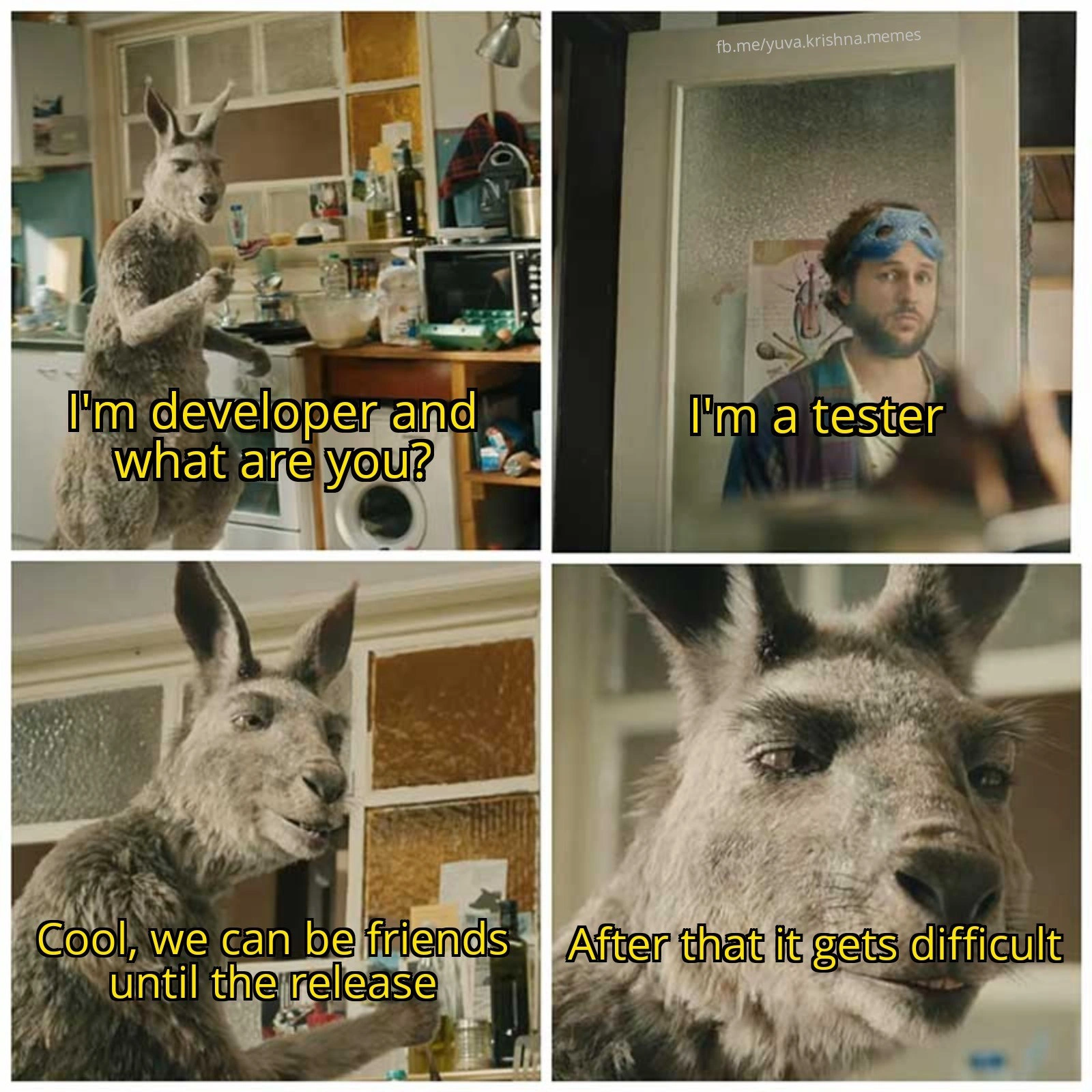
At the upper echelons of software development, developers and QA testers often share a tenuous alliance. During active development they collaborate under a common goal – shipping a solid product – enjoying a lighthearted camaraderie. But the moment the release hits the production gate, that friendship can turn on a dime into a cautious standoff. This meme hits on that exact post_release_tension: the developer (embodied by a wisecracking kangaroo) cheerfully tells the tester “we can be friends until the release,” implying an unspoken truth every seasoned dev understands. As soon as code is poised to go live, the dynamic shifts from buddy-buddy to a subtle blame game. The humor is a nod to how quickly SDLC allies become adversaries once real users – and real consequences – are in play.
Why does the relationship sour after release? It’s a classic case of shared goals but conflicting incentives. Before production, QAProcess and development efforts are aligned – testers want to find bugs, developers want to fix them (nobody wants a fiasco later). They joke, high-five over solved issues, maybe even grab a coffee together. It’s a phase of SharedPain with a common enemy: the Bugs in the code. But when release day arrives, priorities diverge. The developer is under intense ReleasePressure to push features out on schedule (management breathing down their neck, customers waiting). The tester’s job, however, is to ensure quality at all costs – even if that means waving a red flag at the 11th hour. The meme captures this turning point: “Cool, we can be friends until the release. After that it gets difficult.” Translation for senior engineers: once the code is live, if a bug pops up, all the polite niceties might be off the table. Each side fears being on the hook for any fallout. This is darkly humorous because it’s RelatableHumor in tech culture – we’ve all seen that friendly Slack chat between dev and QA devolve into a tense meeting once a severe bug is discovered in production.
In real-world SDLC flows, especially in older waterfall-style processes, there was often a literal “gate” before production – a final QA sign-off or go/no-go meeting at the end of a release cycle. It’s at this gate that the Dev-QA friendship gets truly tested. Suddenly, the jovial tester who paired with you to debug that hairy issue last week is wearing their “quality police” hat, scrutinizing every detail. And the developer, who was receptive to feedback earlier, might now get defensive: “That’s not a bug, it’s an expected behavior!” (the classic BugVsFeature debate rears its head). The shared mission of building software fractures into an us-vs-them CommunicationGap. The dev might be thinking: “Please don’t find any showstopper now, we’re too deep in to delay!”, while the tester is thinking: “Please let everything be perfect, I don’t want to be the one who says we can’t ship.” Both are anxious, and ironically both suffer from ReleaseAnxiety – just in different ways. The meme uses the kangaroo’s sly grin turning into a wary stare to illustrate that exact moment of friction.
Everyone with enough production deployments under their belt has a war story about the Dev-QA friendship going sour at the last minute. Perhaps QA found a critical bug right after deployment and the developer’s weekend went up in flames fixing a hotfix at 3 AM (cue the “it’s always the last-minute fix that breaks things” mantra). In those moments, the tone of conversations shifts dramatically: from “We’ve got this!” to “How did this get past testing?!” or “Why was this coded like that?!” – a cascade of finger-pointing that seasoned engineers know all too well. It’s funny because it’s true: the very people who were patting each other on the back in stand-up yesterday might be virtually tossing each other under the bus post-release. The DeveloperCulture has long poked fun at this love-hate relationship. We joke that QA’s unofficial motto is “Trust no code,” and devs quip back with “If it passes QA, it’s a feature.” This kangaroo meme distills that bittersweet reality: devs and testers are best buddies until a release goes out the door – after that, well, all bets are off. It’s a comical exaggeration of a shared pain point, reminding us that in the end, both sides really just want a successful release… even if they playfully (or sometimes not so playfully) clash when bugs slip through.
Description
A four-panel meme depicting a conversation between a developer and a tester, based on a scene from the German film 'The Kangaroo Chronicles'. In the first panel, a talking kangaroo in a kitchen asks, 'I'm developer and what are you?'. In the second panel, a man in a doorway, looking slightly sleepy with a sleep mask on his forehead, replies, 'I'm a tester'. The third panel shows the kangaroo smiling amicably, saying, 'Cool, we can be friends until the release'. The final panel is a dramatic close-up on the kangaroo's stern face, with the caption, 'After that it gets difficult'. The meme humorously captures the classic, often tense relationship between development and quality assurance (QA) teams. While they collaborate, their goals can conflict as a deadline approaches: developers aim to ship code, while testers are responsible for finding flaws, which can delay the release. The joke resonates with any experienced engineer who has felt the friction when a critical bug is found hours before a go-live
Comments
7Comment deleted
In a mature DevOps culture, devs and testers are on the same team. In most cultures, the relationship is best described by this kangaroo: a marsupial pouch full of last-minute bug tickets
“We’re inseparable until release - then the Dev-QA relationship turns into a distributed system: high latency, inconsistent states, and everyone’s convinced the bug lives on the other node.”
The real test coverage metric is how many friendships survive the post-mortem meeting when production is down and the CEO wants to know why the 'thoroughly tested' feature is causing data corruption at scale
The classic developer-QA relationship: perfectly cordial during development sprints when bugs are 'features in progress,' but the moment that release tag gets pushed and production issues surface, suddenly every tester becomes Sherlock Holmes with a vendetta and every developer develops selective amnesia about that 'works on my machine' code they shipped. The real test isn't the software - it's whether this professional relationship survives the post-mortem meeting
Our relationship implements eventual consistency; at merge freeze the quorum is QA's bug count and every 'wontfix' upgrades to SEV1 during the Go/No-Go
Dev - QA friendship ends at release: SLOs, Sev‑1s, and a rogue feature flag make the incident bridge feel like couples therapy
Devs & QA: Microservices of friendship - loosely coupled until release forces a breaking schema change