The Butterfly Effect of Applied Mathematics
Why is this Mathematics meme funny?
Level 1: All That Math for a Laugh
Imagine a group of really smart people spent hundreds of years learning how to do something super hard, like a giant puzzle. They made great tools and knowledge that can do amazing things. Now imagine someone takes all that hard work and uses it to make a funny, crazy picture – like a picture of a bad guy from history mixed up with a character from a cartoon, doing a silly dance. It’s as if everyone built the world’s most powerful drawing machine, and the first drawing it makes is a goofy cartoon mashup. That’s what’s happening here. People find it funny because it’s such a big, serious effort being used for such a wacky result. It’s like using a huge rocket ship to launch a pie just for a joke – totally unexpected and a little absurd, but it makes you giggle. In simple terms: a lot of very serious math ended up creating something that’s basically a big, weird joke, and that surprise is what makes everyone laugh.
Level 2: Serious Math, Silly Pictures
Let’s peel back the layers in simpler terms. This meme is highlighting the contrast between serious math and the silly pictures that modern AI can produce. The serious math in question is linear algebra – basically the math of matrices and vectors. A matrix is just a grid of numbers, like a spreadsheet of values, and a vector is like a list of numbers. Linear algebra has been studied for a very long time (over two centuries!), and it’s super important in science and engineering. We use it to solve things like systems of equations, to handle 3D rotations (for graphics), and to do all sorts of data transformations. If you’ve ever solved 2x + 3y = 5 and similar equations in school, that’s the start of linear algebra. Now, imagine that but on a much bigger scale with thousands or millions of variables – that’s what computers do today. All that old math knowledge (like how to invert a matrix or calculate an eigenvector, which is a special direction in a matrix) is built into modern software libraries.
Now, onto the generative AI part. Generative AI refers to AI systems that can generate new content. This could be text, music, or in this case, images. A prime example is Stable Diffusion, which is an AI model that creates images from text descriptions. You give it a prompt (a line of text describing what you want to see), and it produces a picture that matches that prompt as closely as it can. How does it do that? Under the hood, Stable Diffusion was trained on a huge number of images, learning patterns and associations. It represents those images and patterns as numbers (lots and lots of numbers). So when you input a new description, the model uses all that learned information (stored as mathematical values) to generate a new image. The process involves starting with random noise and then repeatedly refining it so it begins to look like something meaningful – this refinement is guided by linear algebra operations. Essentially, the AI is adjusting a big grid of numbers (which eventually correspond to an image) step by step. Each step is calculated with equations that come straight from linear algebra and probability. We’re talking about things like matrix multiplications, additions, and other transformations on arrays of numbers. And because there are so many calculations to do, these AI models use GPUs – Graphics Processing Units – which are hardware designed to handle lots of calculations in parallel, especially the kind you find in linear algebra. CUDA kernels are like little programs that run on the GPU to perform these calculations super fast. So when someone says an AI is “running a bunch of CUDA kernels,” they mean the GPU is hard at work crunching numbers (multiplying matrices, adding vectors, etc.) to get the job done.
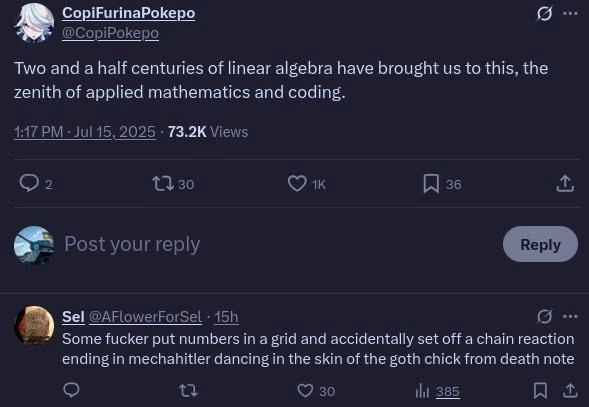
Alright, so the meme combines those two worlds: the heavy-duty math world, and the fun output world. The first tweet basically says: “Wow, after all this time developing math and coding, this is what we’ve achieved.” It sets a sarcastic tone. The second tweet gives a specific example of “this.” And boy, what an example! Let’s decode it: “Some f*er put numbers in a grid” – crude language aside, “numbers in a grid” literally describes a matrix or any data fed into an algorithm. It’s basically saying someone ran an AI model (by feeding it data and numbers) and “accidentally set off a chain reaction” – meaning once the process started, it automatically went through a series of steps (a cascade of computations) that led to a crazy result. And that result is “mechahitler dancing in the skin of the goth chick from Death Note.” This is a wild mashup of references:
“mechahitler”: “Mecha” usually means a giant robot or mechanical suit (a concept popular in Japanese anime and sci-fi). So mecha-Hitler imagines Adolf Hitler (the infamous historical figure) as a kind of robot or in a robotic exoskeleton. This concept has actually appeared tongue-in-cheek in video games and comics as an absurd villain. It’s not something serious, it’s more like a dark joke or extreme fantasy scenario.
“the goth chick from Death Note”: Death Note is a very popular Japanese anime series. One of its characters is a young woman named Misa Amane, who has a goth fashion style (think black clothes, edgy accessories, very punk/gothic look). She’s not literally called “the goth chick” in the show, but that’s a way to describe her appearance. So the tweet is referring to Misa without naming her explicitly, assuming a lot of readers would get the hint.
“dancing in the skin of”: This phrasing is deliberately outrageous. It suggests that mecha-Hitler is somehow wearing the skin of the Death Note goth girl while dancing. In other words, Hitler is dressed up as or disguised as that anime character (which is a pretty gruesome mental image, played for shock value). It’s basically saying: imagine Hitler and Misa merged into one being and doing a dance.
So why mention something so outlandish? Because it exemplifies the kind of crazy image you could get from a generative AI if you really tried. If someone went to an AI image generator and entered a prompt like “Hitler in a mecha robot suit dancing while wearing gothic Lolita fashion”, chances are the AI would produce exactly that (since it has seen images of Hitler, and images of mecha robots, and images of goth anime girls, and can patch them together). It’s the kind of thing an internet user might do for a laugh: “Let’s see if the AI can make this insane idea real.” And yes, nowadays it often can.
The “chain reaction” part refers to how these AI models work internally. When you give that prompt to Stable Diffusion, for example, you kick off a sequence of computations. First, the text (“mechahitler dancing in the skin of the goth chick from death note”) is converted into a numerical form (a text embedding, which is basically a list of numbers capturing the meaning of the text). That’s done by another model (like CLIP) which is also full of linear algebra. Then that numerical representation of the prompt is used to guide the image generation. The model starts with random noise and then iteratively updates that noise to make it look more and more like an image matching the prompt. Each update is a “step” in which the model uses its learned parameters to tweak the image. Think of it like sculpting from a block of marble: many small steps gradually reveal the final image. Each of those steps is mathematically a bunch of matrix operations on the “grid of numbers” that represent the image. So, the chain reaction is: numbers go in, then many rounds of calculations happen (one triggering the next), and out comes an image.
For a newcomer, it might be surprising that something as serious as math is behind something as goofy as an anime mashup image. But that’s exactly the point of the meme. It’s showing generative_ai_absurdity: the idea that really advanced AI can end up making really absurd things. And it’s all enabled by that serious math. In summary, the thread is joking that after all the progress in mathematics (developing things like eigenvectors, SVD, etc.) and all the cutting-edge coding and hardware (GPUs running CUDA), we’re using it to create weird internet images. It’s both a celebration (because wow, it is impressive that we can do that) and a lighthearted critique (maybe we expected something more profound as the main outcome).
This resonates in tech circles because it’s true: most AI researchers and engineers are well aware that as soon as you build a powerful tool, people will use it for fun, art, and sometimes shock value. The meme just captures that scenario in a very stark, humorous example. So if you ever see a strange AI-generated picture and think, “How on Earth did they make that?”, remember: under the hood it was a lot of linear algebra number-crunching making it possible. Serious math makes silly pictures real – and that contrast can be pretty funny in itself!
Level 3: The Linear Algebra Lament
For the seasoned developer or data scientist, this meme hits that sweet spot of AI humor and mild existential dread. It’s a tongue-in-cheek commentary on AI hype vs. reality that has veterans of the field smirking. Why? Because we’ve all witnessed this pattern: lofty technological achievements being used in laughably trivial or bizarre ways. Here, the tweet’s author sardonically declares the current state of affairs as “the zenith of applied mathematics and coding.” That grand phrase sounds like something you’d hear at an academic keynote about solving climate modeling or curing disease with supercomputers. But instead, it’s referring to an AI-generated mashup of Hitler and anime characters. The humor comes from that huge disconnect in expectations. It’s tech satire 101: take something highbrow (centuries of math research) and show it climaxing in something lowbrow (an absurd meme). Senior devs recognize this lament all too well. It’s akin to the famous quip, “We wanted flying cars, instead we got 140 characters.” In this case: “We wanted scientific enlightenment, instead we got MechaHitler doing a goth TikTok dance.”
The Twitter thread format amplifies the humor through contrast. The first tweet is erudite and dry, almost like a disappointed professor: two centuries of math and this is what we have to show for it. The very next reply then crashes through the door with profanity and an over-the-top example: “Some f**ker put numbers in a grid and accidentally set off a chain reaction ending in MechaHitler dancing in the skin of the goth chick from Death Note.” 🤯 The crude phrasing is deliberate: it translates the sophisticated concept of “running linear algebra algorithms on GPUs to power generative models” into a blunt layman’s description – “put numbers in a grid” – as if someone monkeying with a spreadsheet caused an AI apocalypse of weirdness. It’s the senior engineer voice of exasperation and dark humor. We’ve all had those moments debugging or implementing something complex when, at 3 AM, you mutter, “I just changed one number and now the whole thing is on fire.” That’s the vibe here: a tiny mathematical tweak unleashing a surreal chain reaction. Only in this case, the “fire” is a dancing robotic Hitler rendered in flawless anime style. It’s absurd, borderline grotesque, and absolutely something the internet AIGeneratedContent would produce for giggles.
What makes seasoned tech folks laugh (and cringe slightly) is how true this is to life. Massive GPU farms and finely tuned CUDA code are indeed often used to generate AI memes and frivolous content. The tweet is a commentary on the current industry trend hype: everyone promised that AI and machine learning would usher in a new era of productivity and scientific breakthroughs. And sure, it has done amazing things – but it’s also flooded social media with deepfaked dance videos, anime waifus, and yes, bizarre crossovers like Hitler x Death Note fanart. The hype vs reality gap is real. Many senior devs have that war-story perspective: “Remember when we thought AI was going to eliminate manual coding or solve world hunger? Instead, it’s really good at making art of Pikachu as a medieval knight.” It’s not a knock on the technology per se, but a wry observation about how people actually end up using it. We got these powerful diffusion models (originally lauded for their ability to generate photorealistic images or aid creativity) and one of the first things the internet does is push them to spit out the most absurd generative-AI mashups imaginable. Of course it did. This is the same internet that made cat memes the dominant life form.
Let’s unpack the specific mashup mentioned, because it’s rich with references a senior geek would appreciate. “Mechahitler” immediately recalls a classic trope in geek culture: Hitler in a mechanized suit has been a tongue-in-cheek villain in video games (the Wolfenstein 3D “Mecha Hitler” boss battle from the early ‘90s is legendary). It’s the epitome of campy absurd evil – take an already heinous figure and make him literally a comic-book monster. Now cross that with “the goth chick from Death Note.” Death Note, of course, is a hugely popular anime, and the character in question is likely Misa Amane, a female character known for her gothic Lolita fashion and morbid vibes. She’s about as far removed from Hitler as it gets. The meme’s reply effectively says: “Yup, the AI went and visualized Hitler wearing Misa’s skin, dancing around.” This is shock humor – combining two wildly different, somewhat taboo references into one mental image. The grotesqueness is the point. Seasoned devs on Twitter often see this kind of one-upmanship in AI image generation: “Look, I typed in the wildest mashup I could think of, and the AI drew it, LOL.” It’s a bit of an arms race to break the AI or to demonstrate how ridiculous it can get. The fact that a diffusion model unhesitatingly produces something so insane is both amusing and a little anxiety-inducing. We chuckle, then think: “We really have created a monster – albeit a meme monster.”
From an engineering perspective, there’s a sardonic truth here: all those beautiful linear algebra algorithms (the kind we painstakingly optimize with SIMD instructions and GPU parallelism) are being used to animate a robot Hitler’s dance moves. Those of us who’ve written or optimized CUDA kernels for linear algebra routines can’t help but facepalm and laugh. It’s like spending months polishing a Ferrari engine, only to see someone use that Ferrari in a demolition derby. You know the power under the hood, and you also see it being unleashed on utter silliness. It’s not necessarily bad—fun is a valid use of tech!—but it’s definitely ironic. A senior dev might recall optimizing matrix multiplication code for a computer vision project, thinking it’d be used for medical imaging or something profound, and now that same code (living in some library) is being invoked to blend anime characters with war criminals. That’s the AIHypeVsReality punchline: lofty infrastructure, goofy outcomes.
The thread also resonates because it captures the tone of tech culture on Twitter (X). The first poster’s anime avatar and slightly florid language suggests they themselves enjoy anime/gaming, yet they are poking fun at their own interests by calling this the “zenith of applied math.” The reply’s casual profanity and hyperbole is very much the voice of a fed-up developer or researcher who’s seen one too many cringey AI demos. It’s a shared sentiment: “Is this really what we’re doing with our advanced AI?” You can almost hear the collective chuckle and sigh. The engagement metrics (thousands of views, hundreds of likes) indicate that many in the community felt that Yep, this sums it up.
In meetings or conference halls, senior folks often joke about how AI can do incredible things, but those incredible things include creating AI humor fodder. We try to explain our work to family or non-tech friends and end up saying, “Well, basically, we taught a computer to draw goofy pictures.” The meme acknowledges that feeling. It’s a bit of self-deprecation from the AI community: we know exactly how potent our math and code is, and we also see the almost juvenile ways it gets used daily. It’s a form of catharsis, really. Laugh at it, and you’re less likely to cry about the “zenith” not being as noble as you hoped. So, why is it funny? Because it’s true and absurd. It’s the ultimate senior-dev lament: All that genius, all that effort, and look what we’re doing.... And maybe, just maybe, it’s also a proud inside-joke—because only by truly understanding the gravity of the tech can you fully appreciate the levity of its uses. In the end, we cope with humor: if 250 years of math ends in an anime Hitler meme, you either laugh or go home. Most of us choose to laugh.
# A modern developer's one-liner:
result = ai_model.generate_image("Hitler in a mecha suit dancing with a goth anime girl")
# ^ No big deal, just centuries of math and millions of GPU operations behind the scenes.
Level 4: Vectors to Waifus
In the lofty realm of advanced math and machine learning theory, this meme is a perfect storm of linear algebra irony. To truly appreciate it, consider the deep lineage: over ~250 years, mathematicians from Euler to Gauss to Cayley built the framework of linear algebra—the study of vectors, matrices (grids of numbers), and linear transformations. These fundamentals (like solving linear equations, finding eigenvectors, and decomposing matrices via SVD – Singular Value Decomposition) became the bedrock of modern computing. Fast-forward to today’s AI/ML revolution: every neural network, including cutting-edge generative AI models, is essentially a giant stack of matrix multiplications and linear maps. In fact, the stable diffusion image generator referenced here runs on an arsenal of linear algebra operations. Under the hood it represents data as high-dimensional vectors and performs millions of GPU-accelerated dot products and matrix ops to generate an image. This is where the meme’s grandiose phrasing—“Two and a half centuries of linear algebra have brought us to this, the zenith of applied mathematics and coding.”—gets its bite: it’s spotlighting how centuries of scholarly work on things like matrix theory and spectral decomposition now culminate in, well, an AI that produces absurd anime mashups.
To break it down technically, generative models like Stable Diffusion operate in a latent space (a mathematical vector space learned from training data). Each concept (say “Hitler’s face” or “goth anime girl aesthetic”) can be represented as a point or direction in this space – essentially a big vector of numbers. Combining concepts is often a linear operation: the model can interpolate or add together vectors to blend features. In other words, the system might literally take a weighted sum of the “Hitler” vector and the “goth girl” vector (along with others) to satisfy a prompt. This is linear algebra magic: the same kind of vector addition and matrix multiplication you’d see in a textbook now spawns a visual mashup. It’s as if the model has a basis of “concept vectors” (not unlike eigenvectors) and it constructs the final image by mixing those basis vectors. When the tweet jokes about “putting numbers in a grid and accidentally setting off a chain reaction,” it’s hinting at this pipeline: feed some initial random matrix (noise) into the model, apply a chain of linear transformations (layer after layer of neural network operations, many of which are literally matrix multiplies and convolutions), and out pops a coherent image. The “chain reaction” is the iterative refinement process, guided by differential equations and gradient descent – heavy math – but to an observer it just looks like a mysterious cascade of calculations turning gibberish into an image of MechaHitler dancing in the skin of the goth chick from Death Note. This outcome feels ridiculously surreal, yet it’s a direct product of methodical linear algebra guided by a very non-linear training regime.
Crucially, the computing power to do this comes from hardware and software optimized for linear algebra. The meme subtly nods to CUDA kernels – the low-level GPU programs that perform these vectorized operations in parallel. Modern GPUs (thanks to gaming and HPC demands) are masters of linear algebra, capable of multiplying gargantuan matrices and summing vectors at blistering speeds. Libraries like cuBLAS or Tensor Cores on Nvidia hardware execute the same matrix math Gauss once did by hand, but billions of times per second. So when someone uses Stable Diffusion to generate a wacky image, under the hood there’s an army of linear algebra operations – dot products, matrix factorizations, convolution filters – being executed. It’s an incredible eigenvector-to-MechaHitler pipeline if you will: abstract algebraic constructs translated into GPU instructions, yielding a Pop culture chimera on your screen. This is what the top tweet means by “the zenith of applied mathematics and coding” – said with a hefty dose of sarcastic wit. The zenith usually implies the highest, noblest peak of achievement, yet here that peak is portrayed as an AI-driven meme-generator producing content of questionable taste.
From a theoretical standpoint, there’s rich irony in how eigenvalues and singular values (once studied to solve systems of equations or stabilize physical simulations) now help navigate the space of AI-generated content. Techniques like principal component analysis (which involves SVD) laid the groundwork for understanding high-dimensional data. Today’s diffusion models don’t explicitly do an SVD on your image prompt, but they rely on the same principles—breaking complex data into combinations of simpler patterns. The diffusion process itself is rooted in advanced math: differential equations describing how adding a little noise or removing it step by step (a concept from thermodynamics and probability) can yield new samples. Solving those equations efficiently on a computer? You guessed it: linear algebra approximations and iterative matrix calculus. It’s a beautiful chain of logic: Mathematics → Algorithms → GPU code → Meme images. Or as one might poetically summarize, from Gauss to goth girl, one matrix at a time.
In short, the meme highlights a profound and absurd truth: the same linear algebra that underpins serious scientific computing also powers the generative_ai_absurdity we see in AI meme culture. All those matrices and vectors are the common language between a 19th-century scholar solving equations and a 21st-century AI conjuring anime Hitler fanart. It’s equal parts awe-inspiring and comically disconcerting. Mathematicians 200 years ago could never have imagined that their rigorous proofs about vector spaces would eventually enable a computer to deepfake a mechanized Hitler doing a dance in an anime style. Yet here we are – the joke being that this is what all that intellectual toil has led to, at least in one pop culture use-case. It’s a nerdy kind of cosmic joke: advanced linear algebra + enormous computing hype = one extremely bizarre Twitter image. The meme lands this joke by implicitly acknowledging that behind the scenes of even the silliest AI-generated picture, there’s a direct legacy of serious math and code. IndustryTrends_Hype around AI promised us revolution; reality delivered us MechaHitler doing a cosplay dance. And somewhere, in the great beyond, Gauss and Euler might be facepalming and chuckling at the same time.
Description
A screenshot of a Twitter conversation on a dark-themed interface. The first tweet, by user @CopiPokepo, reads: "Two and a half centuries of linear algebra have brought us to this, the zenith of applied mathematics and coding." Below it, a reply from user @AFlowerForSel provides a much more colorful summary: "Some fucker put numbers in a grid and accidentally set off a chain reaction ending in mechahitler dancing in the skin of the goth chick from death note". The humor stems from the stark contrast between the formal, academic origins of a mathematical field (linear algebra) and the absurd, chaotic, and highly specific outcomes it enables in modern computing and AI. It's a commentary on how foundational scientific principles can lead to completely unpredictable and bizarre applications, a sentiment many senior developers who have seen simple projects spiral into beautiful monsters can relate to
Comments
7Comment deleted
It all started with 'let's represent points in space,' and now we have GANs that can flawlessly swap Nicolas Cage's face onto every frame of a movie. This isn't a slippery slope; it's a well-funded, GPU-accelerated vertical drop
Amazing how centuries of eigenvalue research ultimately optimize the loss function for “mecha-Hitler goth-idol fan-cam” - proof that gradient descent has absolutely no moral direction
After decades of optimizing matrix multiplication algorithms and building GPU clusters for linear algebra operations, we've finally achieved peak computational efficiency: using eigenvalues to determine the optimal dance moves for anime characters in mobile games
Ah yes, the classic butterfly effect: Gaussian elimination in the 18th century somehow led to GPU-accelerated anime character rendering in the 21st. Turns out when you optimize matrix multiplication hard enough, you don't just get faster neural networks - you get mechanically dancing goth waifus. Leibniz and Newton would be so proud... or horrified. Probably both. This is what happens when you let mathematicians and weebs share the same compute cluster
Two centuries of chasing eigenvalues, just to birth Mecha-Hitler voguing via matmul chains - linear algebra's true killer app
Decades optimizing SGEMM so a diffusion prior on A100s can turn random noise into a dancing deepfake - finally, measurable ROI for linear algebra
We optimized GEMM for 250 years so tensor cores could multiply memes into vtubers - turns out BLAS is the most successful content management system ever shipped