My Laptop Spontaneously Became a Jigsaw Puzzle
Why is this Hardware meme funny?
Level 1: Puzzle Piece Laptop
Imagine you have a toy laptop, and one day you find it cut into two big puzzle-shaped pieces. Then your friend says, “I was just playing on it, and it suddenly snapped into a puzzle shape by itself! What do I do?” You’d probably laugh because everyone knows a toy doesn’t just break perfectly into a puzzle on its own – clearly someone cut or broke it. It’s like a kid claiming “the lamp fell over all by itself,” when you can see a ball lying next to the broken lamp. In this meme, the person is pretending their real laptop magically came apart in a jigsaw pattern, which is a pretty silly lie. We find it funny because the computer obviously didn’t decide to self-destruct into a puzzle – somebody must have done it – and there’s no easy fix for a laptop that’s literally broken in half.
Level 2: Hardware vs Software
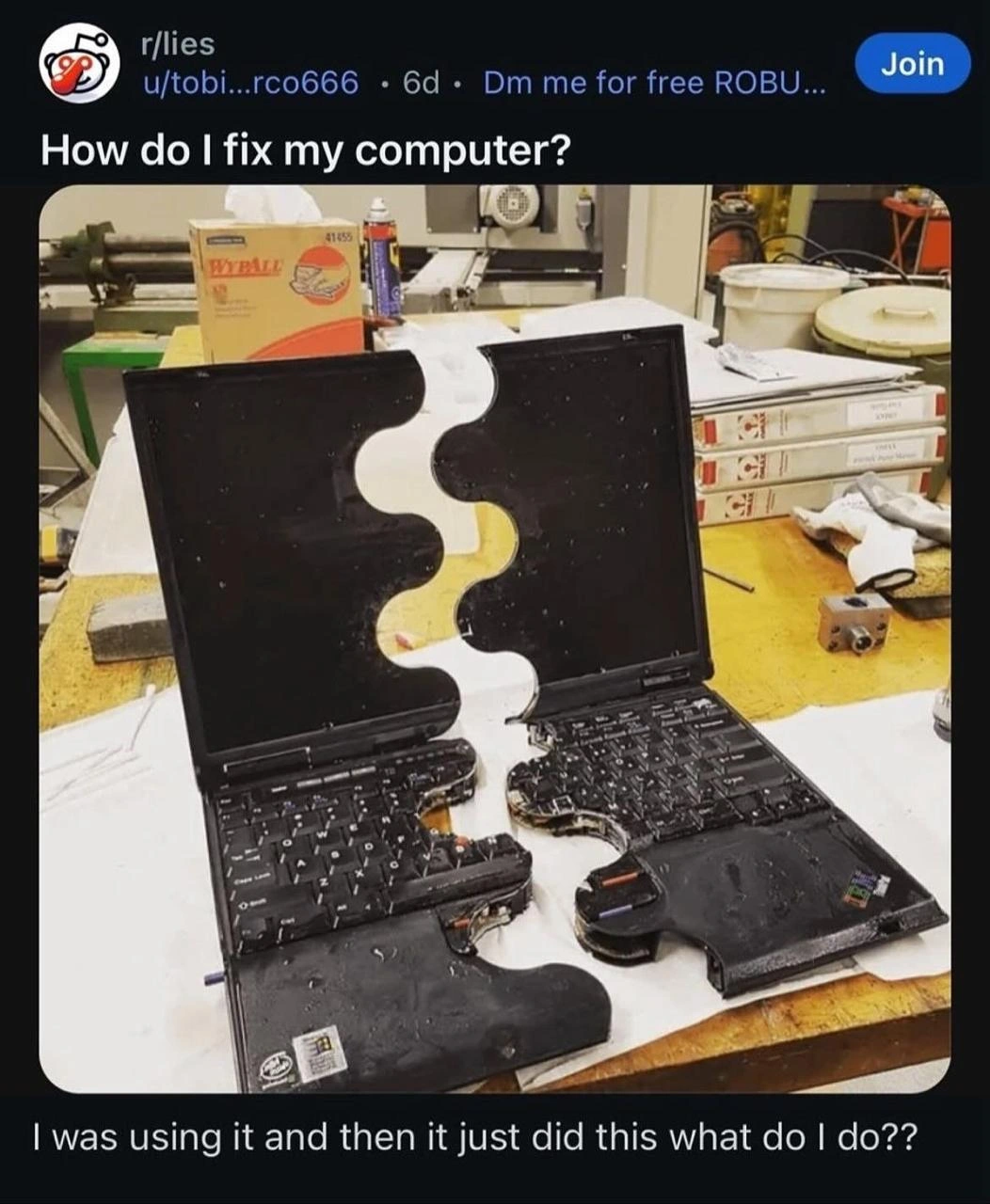
Let’s break down the joke in simpler terms. The user is basically saying their laptop broke into two pieces all by itself. The photo indeed shows a black laptop that has been split into a jigsaw-puzzle shape – both the screen part and the keyboard part have big, curved chunks missing, as if they were two mating puzzle pieces. You can see exposed circuit boards and broken keys along the jagged edges. Obviously, laptops don’t just fall apart like that during regular use! It looks like someone literally sawed the machine into that shape (the image background is a workshop with tools lying around, which is a big clue this was done on purpose).
Now, why call it a “literal segmentation fault”? In programming, a "segmentation fault" is a common error where a program tries to access memory that it shouldn’t. Think of it like the program taking a wrong turn and hitting a wall – the computer stops it to prevent damage, which usually crashes the program with an error message (like Segmentation fault). Importantly, that’s a software problem; nothing breaks physically when a segfault happens. It’s just the computer saying “this action is not allowed” and halting the program.
The meme takes this technical term and gives it a goofy literal meaning. Normally, a segmentation fault is just an error in code, but here the computer itself is “segmented” – literally broken into segments – and has faulted in the most extreme way. It’s as if the error escaped from the abstract world of software and cut the real machine in half. So “literal segmentation fault” is a pun: the phrase is usually metaphorical, but they’re pretending it happened for real.
This highlights the difference between a software bug and a hardware failure. A software bug (like a regular segfault in an app) can often be fixed by changing the code. A hardware failure (like your laptop’s screen cracking, or the whole thing being cut in two) can’t be fixed by any amount of programming or restarting – you have to repair or replace the physical parts. In this meme, the user is asking “How do I fix my computer?” as if it’s just a normal glitch, but the computer is clearly destroyed. No simple troubleshooting step or patch exists for a laptop that’s been sawed apart. That mismatch is what makes it funny to those of us who work with tech: it’s a problem way beyond the scope of turning it off and on again.
To put it plainly, this situation is not a typical bug at all – it’s more like someone took a hammer (or in this case a saw) to the hardware. Tech folks sometimes call this kind of thing a user error, meaning the real cause was the person’s actions, not some mysterious spontaneous event or software issue. The fact that it was posted in a community literally called “lies” is a wink to the audience: we’re not actually supposed to believe the laptop just did that on its own. It’s poking fun at the kind of far-fetched explanations tech support might hear.
For someone new to development or IT, the lesson here is that software problems and hardware problems are very different. If a program crashes with a message like “segmentation fault,” that’s a code issue you’d debug. But if your laptop is physically cracked in half, that’s a hardware disaster – you’re not going to fix it with any command or code. You’d probably just say, “Well, time for a new laptop.” The humor is in treating a completely wrecked computer as though it were a normal software bug report. It’s an exaggerated reminder that sometimes when people report a "technical problem," the cause might be something very basic (or in this case, very ridiculous). And no matter how good a programmer you are, you can’t debug a laptop that’s in two pieces!
Level 3: Impossible Support Ticket
Every seasoned engineer has faced a support request that makes them pause and think, "Wait... they want us to troubleshoot what?" This meme is that nightmare scenario dialed up to 11. The user in the screenshot claims, “I was using it and then it just did this, what do I do??” beneath a photo of a laptop cleaved into puzzle pieces. Right away, any experienced dev’s eyebrow hits the ceiling. Hardware doesn’t just spontaneously jigsaw itself mid-use; this is the textbook definition of an impossible support ticket (and appropriately, it’s posted in a subreddit called r/lies).
The humor here taps into a shared developer experience: being blamed for, or asked to fix, something that clearly isn’t a software bug at all. It’s the ultimate case of user error masquerading as a system failure. We’re looking at a catastrophic hardware mishap (or more likely, a prank or bizarre accident) that the user describes as if the computer “just decided to fall apart.” It’s like someone filing a bug report saying, “My monitor caught fire right after I installed the update – is this a known issue?” The disconnect between what actually happened and what they claim happened is hilariously wide.
From a troubleshooting perspective, this is a dead end. In software, when we hear "segmentation fault," we think of a memory bug in C/C++ code, not a laptop literally segmented by a saw. As senior devs, we’ve learned to ask the obvious follow-up when a report sounds fishy: “Did anything unusual happen right before this?” In this case, the “unusual” is hard to miss – the machine has a puzzle-piece chunk cut out of it! The photo’s background (a workbench, tools, a box of Wypall wipes) is a giveaway that someone took a physical tool to this poor computer. No amount of log diving or Stack Overflow searching will tell you “oh yes, the laptop chassis threw an exception and split in two at runtime” – real life doesn’t work like that. This situation isn’t really a software bug or even a normal hardware malfunction; it’s a full-on demolition. There’s nothing to debug – it’s a replace-the-hardware kind of problem.
The meme strikes a chord with developers because it exaggerates the kind of wild stakeholder expectations we sometimes face. Ever had a manager or client ask you to “just quickly fix” the impossible? Here the user (our hapless stakeholder) is essentially asking for a miracle: Can you somehow patch my computer back together? Seasoned engineers find this hilarious because we’ve all dealt with non-tech folks who think any issue can be solved if you’re “good with computers.” It’s like being asked to debug why a PC won’t turn on, only to discover it wasn’t plugged in – except here, the computer is literally in two pieces. The frustration here comes from the absurdity: you can’t exactly SSH into a machine that’s been hacked apart with a jigsaw. No software trick is going to un-saw that laptop.
There’s a tongue-in-cheek term, PEBKAC (“Problem Exists Between Keyboard And Chair”), used in IT support for when the “bug” is really user-induced. This scenario is a prime example. Laptops do not spontaneously shatter into puzzle shapes; the evidence screams that a person caused this (and is now playing innocent). A veteran engineer sees that photo and immediately knows: this isn’t a code issue or even a typical hardware failure – it’s someone covering up a colossal goof (or staging a joke). The comedy comes from imagining the straight-faced tech support reply you’d love to give: “Have you tried putting the pieces back together and then turning it off and on again?”
In the end, it’s funny because it’s a super-exaggerated version of a relatable tech support moment. It reminds us of those war stories from the help desk: the user who swears “I didn’t do anything, it just broke,” whether it’s a coffee-soaked keyboard or a phone run over by a car. As developers, we chuckle and cringe because we’ve been there – trying not to laugh on a call where the explanation defies all logic. This meme just pushes that scenario to the extreme. It’s the ultimate bug vs feature gag: turning your laptop into a jigsaw puzzle is definitely not an intended feature of any product, and it’s not even a normal bug – it’s a whole new level of “not my department!”
Level 4: SIGSEGV IRL
In low-level computing, a segmentation fault is a specific error that occurs when a program tries to access a memory address outside the region it’s allowed to use. This is a classic memory safety violation: the moment an application strays into memory it doesn’t own (for example, by dereferencing a NULL pointer or indexing past the end of an array), the CPU’s memory management unit raises a hardware exception. Historically, the term comes from an era of segmented memory architectures, where processes had designated memory segments (code, data, stack, etc.), and any illegal access outside those segments triggered a fault. On modern systems, this fault typically manifests as a SIGSEGV signal (short for “segmentation violation”) that crashes the program, often with the dreaded console message Segmentation fault (core dumped).
What the meme shows is a darkly literal twist on that concept: a literal hardware segmentation fault. The laptop in the image has been physically segmented – cleanly cut into two interlocking jigsaw-puzzle shaped halves. It’s as if the machine itself encountered a fatal error at the most fundamental level. Normally, a segmentation fault is a software issue contained in memory; here the “fault” has broken out into the real world. No operating system can handle this kind of error – it’s the laws of physics throwing an exception that the OS has no handler for. When the computer’s chassis and internal circuitry are literally divided, you’ve gone beyond any recoverable error state. There’s no core dump or debugger that can patch a sawed-off motherboard.
Engineers often speak of debugging through the stack from the application layer down to the physical layer. In this case, the bug isn’t in the code or even the operating system – it’s at the hardware level, a problem literally in the wires and silicon. Real hardware failures do happen (bad RAM chips causing random crashes, or a CPU overheating leading to system halts), but those issues are usually invisible to the naked eye. Here, the failure is spectacularly visible: the entire laptop has been bisected like a puzzle. It’s a pun come to life – the system didn’t just crash, it’s crashed in half.
No amount of software troubleshooting or memory dumps can fix a computer that’s literally in pieces. In high-reliability computing, we talk about redundancy and fault tolerance – things like ECC memory that can correct bit flips, and servers with backup components to survive failures. But no conventional design accounts for “my computer was cut into puzzle pieces.” This is beyond a kernel panic or a Blue Screen of Death – it’s akin to the machine executing a mythical Halt and Catch Fire instruction. Essentially, the laptop has hit an unrecoverable condition: a segmentation fault so extreme that it segmented the hardware itself. The only “debugging” here would involve a soldering iron or, more realistically, just getting a new machine. In fact, given the workshop setting (note the milling equipment and tools in the background), it looks like someone literally took a saw or CNC cutter to create this “bug.” To resolve it, one must step out of the digital realm altogether and into the realm of screwdrivers and circuit boards – a point where software engineers throw up their hands and hardware technicians take over.
Description
A Reddit post from r/lies shows a black laptop lying on a workbench, cleanly cut in half with an intricate, interlocking jigsaw puzzle pattern. The cut goes through the screen, keyboard, and body of the laptop. The Reddit post title asks, "How do I fix my computer?", and a caption below reads, "I was using it and then it just did this what do I do??". The visual absurdity of a laptop perfectly severed into puzzle pieces, combined with the deadpan, unbelievable claim of it happening spontaneously, creates a surreal and humorous image. The technical context is the common user trope of feigning ignorance about catastrophic hardware damage, blaming the device for what was clearly user-inflicted destruction. It's a commentary on end-user support tickets where the story doesn't quite add up

Comments
21Comment deleted
That's not a hardware fault, that's a feature. You've discovered the native support for distributed computing
Turns out the kernel panics when the chassis is compiled with --enable-puzzle-pieces; next time remind the user that segmentation faults are supposed to stay in memory, not the motherboard
This is what happens when you take 'microservices architecture' too literally and try to implement physical service decomposition on your hardware stack
When your laptop's kernel panic becomes so severe it achieves physical manifestation. This is what happens when you run 'rm -rf /' on the hardware layer - turns out the BIOS took 'split brain' architecture a bit too literally. The real question isn't how to fix it, but whether this qualifies as horizontal or vertical scaling
Hardware's brutal take on a fork bomb: splits itself right before the merge
Looks like a hardware-level segmentation fault - if your repro steps involve a jigsaw, the runbook is replace(), not patch(), and please attach logs, not sawdust
Triage notes: split-brain at layer 0 with aggressive sharding - recommend epoxy-based quorum rejoin and close the RCA as Layer 8
Oh, he suddenly put his laptop under a big laser, everyday routine Comment deleted
laser or waterjet? Comment deleted
I think it's a water jet because there's water in it. Comment deleted
Just zipper came apart Comment deleted
Reinstall windows Comment deleted
linux can fix it Comment deleted
Restarting the system fixes the issues most of the time, did you try already? Comment deleted
reboot Comment deleted
Maybe sell this computer as an art project and buy a new one Comment deleted
That's probably the best advice I've heard in this situation Comment deleted
Put it in rice Comment deleted
clearly I did something wrong here 3: Comment deleted
now, why these messages still don't get deleted? no fucking clue. Comment deleted
Did you tried to turn it off and then back on? Comment deleted