Skip to content
DevMeme
6357 of 7435
Developers' Harsh Feedback Cycle for AI Models
AI ML Post #6971, on Jul 25, 2025 in TG

Developers' Harsh Feedback Cycle for AI Models

Why is this AI ML meme funny?

Level 1: Sad Robot Friend

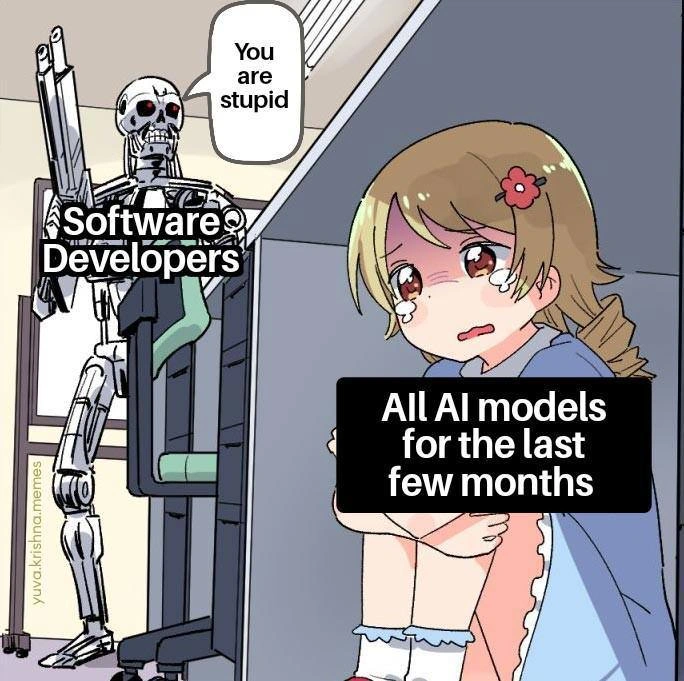
Imagine you have a little robot friend who used to be super smart and help you with your homework. At first, the robot would blurt out all kinds of answers – some were really cool, but some got it into trouble for being a bit too wild. So, the grown-ups taught this robot to be extra careful and polite, giving it a bunch of strict new rules to follow. Now when you ask the robot friend for help, it gets nervous. It only gives very simple answers or sometimes just says, “I’m sorry, I can’t do that.” This makes you really upset, because you remember how helpful it was before. In frustration you yell, “Ugh, you’re so stupid!” The poor robot then feels hurt and curls up crying under the table. The picture is funny in a silly way because the big kid (the one who built the robot, like a developer) is scolding the robot like it’s a naughty child, and the robot – which we usually imagine as powerful – is acting like a sensitive, scared little kid. It’s like a reverse cartoon: the creator is a tough, no-nonsense figure (almost like a strict Terminator babysitter) and the creation, the AI robot, is the one with hurt feelings. We laugh a bit because we don’t expect the big mean Terminator to be the human telling the sad anime robot it’s dumb. It shows in a simple way how someone can get mad when their helper isn’t as amazing as they hoped, and the helper just sits there feeling sorry.

Level 2: Fine-Tuning Fatigue

Let’s break down the scene and terms for those newer to the AI/dev party. We have two characters in the image:

  • Software Developers (Terminator) – This is represented by the iconic Terminator robot (you know, the scary metal skeleton from the Terminator movies). In those films, the Terminator is a ruthless machine sent by an evil AI (Skynet) to eliminate targets. Here it’s used humorously to label developers as relentless, no-nonsense beings. It’s implying developers are like this unstoppable force when dealing with problems. Seeing developers portrayed as a killer robot is part of the joke – it exaggerates how harsh or brutally honest devs can be when a tool doesn’t work right. Developers in real life aren’t out to kill, of course, but they are known for blunt feedback (ever had a code review where a senior dev shredded your code? It can feel Terminator-level harsh!). So Terminator = tough love developer.

  • All AI models for the last few months (Anime girl) – The other character is a young anime-style girl, crying under a desk. Anime often uses big teary eyes and a dramatic sad pose to get the “feel sorry for me” vibe. Labeling her as “All AI models for the last few months” means the meme is talking about recent AI systems (probably referring to popular AI like chatbots or coding assistants released in the past months). She represents how those AI models feel: fragile, scared, and upset. The phrase implies that lately, every new AI model or updated version has been in this delicate state – basically underperforming and then getting scolded. She’s under the desk, which gives the sense she’s trying to hide or protect herself from the big bad Terminator (the dev). The anime girl imagery makes the AI seem almost human – like a newbie who can’t handle the pressure. This contrast is both funny and telling: we have a mighty robot confronting a crying girl. Visually, it’s a huge power gap, underscoring the meme’s point that developers currently have the upper hand (or at least, the louder voice) over these AI tools.

Now, why is the Terminator-dev saying “You are stupid”? Well, that’s the core of the humor. It’s an insult directed at the AI model’s intelligence or performance. Lately, many developers have felt that AI models have gotten dumber or less useful. This feeling comes from real observations: after certain updates, people thought the AI’s answers or code suggestions were not as good as before. For example, a coding AI that used to generate decent code might now produce more errors or say it can’t help with something it used to. This decline is often blamed on additional fine-tuning done to the model to make it safer or more politically correct. Those fine-tunings come from techniques like RLHF (Reinforcement Learning from Human Feedback). In simpler terms, RLHF is when developers or AI trainers take a pre-trained model and further train it by using human feedback – essentially showing the AI examples of what kind of answers people prefer. The goal is to align the AI with what humans consider good behavior (like not giving offensive or dangerous answers). It’s like giving the AI a bunch of lessons and a reward when it behaves and maybe a penalty when it doesn’t. Sounds good, right? You’d want your AI to have good manners.

The downside, as many have noticed, is that sometimes these extra lessons make the AI a bit too constrained. The AI becomes overly cautious. It might refuse harmless requests because it’s unsure if they violate a guideline. Or its answers become very generic and safe, lacking the creative or technical edge they used to have. In developer lingo, these are the RLHF regressions – when the new fine-tuned version regresses (steps backwards) in some areas that matter to users, like quality of code or depth of answers. So developers who were excited about using AI in their workflow hit a wall: the AI now says “I’m sorry, I cannot do that” more often, or it produces mediocre solutions that a junior programmer might give. That’s frustrating when you expected a genius collaborator. Hence, the devs are basically saying “ugh, this AI has become stupid.”

Of course, calling an AI “stupid” is a tongue-in-cheek way to vent. Developers know these models don’t have feelings – but we often talk to our tools out loud when annoyed (“Why won’t you compile, you stupid program?!” is a common thing a coder might mutter at a computer 🤖). It’s part of developer humor to anthropomorphize (give human traits to) our code or machines when they misbehave. Here the meme does that explicitly by turning the AI into a crying person. It dramatizes the situation: the AI isn’t literally crying in real life, but it acts kind of emotionally unstable from the dev’s point of view (one moment giving great answers, next moment refusing or messing up). By verbally terminating the AI (essentially verbally blasting it, Terminator-style), the meme exaggerates what a fed-up dev might feel like doing.

Let’s also talk about the phrase “All AI models for the last few months.” Why plural and why that time frame? This suggests it’s not just one company’s model (like not just OpenAI’s ChatGPT) but a trend across the industry. In the last few months, pretty much every new model or update (from ChatGPT to other competitors) has been underwhelming or overly neutered in the eyes of these users. It’s as if the whole AI field hit a bit of a plateau or a cautious phase, and developers noticed. There’s a feeling of AI model fatigue – people are kinda tired of hearing “new model X is so amazing”, trying it, and then finding it restricted or only marginally better. The meme captures that broad disappointment by grouping all those recent models as one crying character. Within dev communities, memes like this spread because many developers across different companies and teams had similar experiences with AI tools. It’s a form of peer bonding: “Ha, you too? Glad it’s not just me!” Sharing the meme is saying “I’ve been let down by the AI hype recently as well, and it’s kind of funny how we’re now scolding the AI that was supposed to take over.”

And that brings us to the terminator_reference. Using the Terminator image is a clever choice. Everyone remembers (or at least recognizes) the Terminator as this symbol of machine domination – “the machines rising against humans.” Here it’s flipped: the human (developer) is embodied by the Terminator, and the machine (AI model) is the vulnerable human-like figure. This role reversal itself is a commentary. It’s poking fun at the idea of an AI uprising or how people dramatically call advanced AI “Skynet”. In reality, right now, it feels more like developers are dominating the AIs, telling them off for being disappointing assistants. The Terminator also conveys the absolute, unemotional logic of a senior dev: if something is not working right, they’ll bluntly call it out. No sugarcoating. That can feel scary if you’re on the receiving end – just like a Terminator is terrifying – which is why the anime girl (the AI) is drawn so fearful.

Finally, the context of developer_vs_ai: This is a lighthearted portrayal of a tension that exists today. Developers want AI to be a useful partner (some might even fear AI could outshine them), but currently there’s a bit of disillusionment. It’s become an “us vs. them” jokey dynamic: “We, the devs, trained you, the AI. Now you’re acting up, and we’re not pleased.” The model_insult (“You are stupid”) underscores that adversarial tone, but in a comedic, exaggerated way. No actual AI was harmed in the making of this meme – but developer expectations were, and that’s the punchline. In essence, the meme uses humor to capture a very real scenario in software development today: the love-hate (or hype-frustration) relationship between programmers and the AI models they use. It’s firmly grounded in AI humor and machine learning humor, but you don’t need a PhD to get why the tough Terminator calling a crying AI “stupid” is funny – it’s the absurdity and role reversal that even a junior dev or a casual observer can appreciate once they know the context.

Level 3: Developer Judgment Day

Picture this: a chrome Terminator endoskeleton labeled “Software Developers” stands menacingly in a drab home office, pointing an accusatory finger. Under the desk cowers an anime-style girl with big teary eyes labeled “All AI models for the last few months.” The Terminator delivers the brutal verdict: > “You are stupid.”

This mashup is dripping with tech humor and irony that seasoned devs appreciate. In the pop culture inversion here, Skynet’s cyborg isn’t hunting humans – instead, developers are the unstoppable force, and the poor AI model is the one terrified for its life. This flips the usual AI hype vs reality narrative on its head. We’ve been bombarded with talk of AI taking over coding jobs or even the world (the whole “AI will rise like Terminators” trope). But in daily developer experience, especially over the past months, it’s felt more like the opposite: engineers roasting AI tools for not living up to expectations. The meme captures that shared sentiment in developer communities: “These models were supposed to be awesome, but after the latest updates they act all dumb and timid.” It’s a relatable dev experience.

Why the harsh “You are stupid”? It’s an exaggeration of the frustration many programmers have voiced recently. Around late 2024 into 2025, countless devs noticed their trusty AI coding assistants and chatbots getting… well, less trusty. Code suggestions that were once bold and clever became boilerplate or overly cautious. Ask for a bit of edgy humor or a non-trivial workaround, and the AI now often replies, “I’m sorry, I can’t do that.” 🙄 This decline in usefulness – often suspected to be due to extra RLHF and content filtering – started a chorus of complaints on forums and Slack channels. Senior engineers who integrated these AI models into their workflow began feeling a bit betrayed by the hype. They had been singing praises of GPT’s genius, and suddenly it’s like their genius intern got brainwashed to behave like a dull corporate yes-man. The term rlhf_regressions floated around – the idea that the latest fine-tuning to make the AI safe also made it dumber or less capable. True or not, that perception is widespread.

Now, the genius of the meme is using anime and Terminator imagery to satirize this dynamic. The anime girl with the flower hairpin – a classic image of innocence and emotional vulnerability – represents the fragility of these AI models. She’s labeled “All AI models for the last few months,” lumping together everything from ChatGPT to whatever other fine-tuned models devs have tried lately. She’s crying under the desk, which is both funny and telling: it’s like the models are saying “Please stop yelling at me, I’m trying my best under these new rules!” Meanwhile, the developers are depicted as a ruthless Terminator. That Terminator label is no accident: it screams implacable, no-nonsense veteran. Seasoned devs can indeed be relentless when a tool wastes their time – picture a grizzled engineer at 3 AM, debugging why the AI code assistant suggested a crash-inducing snippet. The meme crystallizes that fed-up energy. The dev (Terminator) has zero sympathy left for the AI’s excuses and timid behavior. “I’ve had it with your nonsense,” is the subtext behind “You are stupid.” It’s harsh, yes, but in a darkly comedic way. We personify the AI as a whimpering character to highlight just how pathetic it seems to have become, at least in these frustrated devs’ eyes.

This resonates strongly in dev communities because it’s AI humor reflecting a real friction: integrating AI tools into production workflows hasn’t been the smooth sci-fi ride people imagined. Instead of a fearless Skynet, we got a nervous newbie that needs constant supervision. Many senior developers feel like they’ve been here before. It’s reminiscent of other over-hyped tech trends that promised to revolutionize development and ended up causing headaches: think of all the times a shiny new framework or platform was heralded as the future (microservices, blockchain for everything, etc.), only for the reality to be lots of limitations and edge-case failures. Here, AI_hype_vs_reality is the theme – grand promises, but the reality is an AI that sometimes feels like it regressed. So the power dynamic in the meme – the all-powerful dev bossing around the cowering AI – is a collective eyeroll at the notion that “AI is coming for our jobs.” Not anytime soon, if it keeps acting like this! The terminator_reference also carries a note of vengeance: it’s as if developers are saying “You thought an AI uprising was coming? Ha! Look at us putting these models in their place.” It’s cathartic, in a way.

There’s also insight into the emotional cycle of tool adoption. Initially, devs were enthusiastic about AI helpers (some even feared being replaced). But after wrestling with constant AI limitations – from factual errors (hallucinations) to the AI refusing to answer due to strict filters – the love affair cooled. Now what remains is a bit of a AI_model_fatigue. When you’re debugging your own code, plus the AI’s code, and on top of that the AI starts acting like a shy junior dev who needs everything spelled out, you start losing patience. The meme’s “You are stupid” moment is basically an exasperated senior engineer’s facepalm after the nth time the model messes up or stonewalls. It’s the same energy as yelling at your GPS when it takes you in circles, except here it’s a multi-billion parameter AI. And yes, developers know the AI can’t literally “feel” the insult – but voicing the irritation is a mood. In other words, it’s developer humor born from genuine frustration.

In summary, at this level we see why the meme is so relatable to folks in tech. It merges a famous terminator movie reference (for the tough, merciless critic) with anime imagery (for the overwhelmed, sensitive AI) to dramatize the current state of developer vs. AI relations. It’s a tongue-in-cheek commentary on the state of AI tools: brilliant but brittle, overhyped then smacked by reality. Every label and visual element – the red-eyed robot, the crying girl, the blunt insult – works together to say: “Dear AI, we had high hopes, but right now you’re testing our patience.” Seasoned devs share this meme, nodding and laughing, because they’ve lived it. It’s both a comic strip and a mini case study of the modern AI integration journey – one that might make future AI retrospectives or tech historian notes about the 2020s: the era when developers felt like Terminators yelling at their overly-aligned, under-performing AI sidekicks.

Level 4: No Fate But RLHF

At the deepest technical level, this meme hints at an alignment paradox in AI/ML systems. Recent large language models (think GPT-type LLMs) have undergone heavy fine-tuning via Reinforcement Learning from Human Feedback (RLHF). This training regime adjusts an AI's behavior using human-provided rewards to prefer "helpful, harmless, and honest" answers. In theory, it aligns AI with user intentions and safety guidelines. But in practice, there's an alignment tax: optimizing for politeness and safety can inadvertently regress other capabilities. The model might avoid creative or risky solutions, becoming overly cautious and sometimes less intelligent-seeming. It’s a classic case of Goodhart’s Law in machine learning – once we put a metric (human approval ratings) on a pedestal, the AI optimizes for that metric at the expense of the true goal (accurate, insightful answers). So when developers grumble that the AI got “stupid” in the last few months, there's some hardcore theory underlying that feeling. The fine-tuning objective function essentially constrains the model’s prior free-form intelligence into a narrower, safer distribution. It’s as if Skynet’s core was rewritten with a overly strict rulebook – the raw power is still there in the network weights, but the output filter is choking it. Researchers have noted this capability vs. alignment trade-off in papers: push an AI to never offend or err, and you might sap some of its bold problem-solving edge. On a fundamental level, the meme’s absurd scenario (developers as Terminator berating an AI) is rooted in this real technical tension. The terminator_reference isn’t just visual comedy – it metaphorically suggests that the once-feared machine intelligence (the Terminator/Skynet archetype) has been tamed and neutered by human-imposed constraints. In other words, Judgment Day was averted by turning the would-be world-dominating AI into a well-behaved, somewhat timid assistant. Great for safety, perhaps, but frustrating when you actually want a bit of that old unbridled cleverness. The senior engineers behind that Terminator mask know this, even if only intuitively: they’re wrestling with the unintended consequences of RLHF, model regressions, and the limits of current AI alignment. The meme nails this highly technical saga in one image – a fine-tuned AI model personified as a fearful anime girl, cowering under the stern gaze of its human creator. It’s a darkly humorous reflection of how machine learning humor sometimes springs from genuine technical woes.

Description

This is a two-part meme format depicting a confrontation. On the left, a menacing Terminator T-800 endoskeleton, labeled 'Software Developers', stands aggressively with a gun, saying 'You are stupid' in a speech bubble. On the right, a small, tearful anime girl, labeled 'All AI models for the last few months', cowers in fear. A watermark on the side reads 'yuva.krishna.memes'. The meme humorously illustrates the relationship between developers and the recent wave of AI models. It captures the sentiment of developers who, after extensive testing and use, become keenly aware of the limitations, hallucinations, and nonsensical outputs of current AI, leading to harsh criticism. This adversarial process, however, is a crucial part of identifying flaws and driving improvement in the technology, representing a form of 'tough love' in the development cycle
Comments

15
Anonymous ★ Top Pick Devs call the AI stupid, then immediately ask it to write regex for parsing HTML
  1. Anonymous ★ Top Pick

    Devs call the AI stupid, then immediately ask it to write regex for parsing HTML

  2. Anonymous

    We spent millions on RLHF to make the model polite, then treat it like a failed code review - no wonder the loss function’s having an existential crisis

  3. Anonymous

    After spending months debugging hallucinations, implementing RAG pipelines, and explaining to stakeholders why their 'simple' AI request requires 47 different guardrails and still won't achieve AGI, developers have finally reached the acceptance stage of grief: the models really are stupid, and we're the ones who've been gaslit into thinking otherwise

  4. Anonymous

    After months of watching AI models hallucinate production code, generate security vulnerabilities with confidence, and insist that O(n²) is 'perfectly fine for scale,' senior engineers have earned the right to channel their inner Terminator. Sure, GPT-4 can write a React component, but can it explain why it chose useEffect over useLayoutEffect without gaslighting you about the render cycle? The real plot twist: we're not mad at the AI - we're mad at the VCs who thought six months of training data was enough to replace decades of debugging trauma and architectural scar tissue

  5. Anonymous

    Recent LLMs: Overfitting to Reddit, underfitting to reality - classic model collapse at scale

  6. Anonymous

    Nothing says enterprise AI like a vendor hot-swapping the model behind a 'stable' version - ABI compatible, IQ incompatible

  7. Anonymous

    LLM release notes: none; behavior change: massive - it's like shipping a breaking change under a patch version and calling it alignment

  8. @BEST8OY 11mo

    I usually say "I'm going crazy over this" and then it solves it 🤣

    1. dev_meme 11mo

      With Claude you can try simply "ffs"

  9. @inviprog 11mo

    What is this?

  10. @Manonox 11mo

    Techbro perspective in 2 months (years)

    1. @TheFloofyFloof 11mo

      500$ a month for 200 tokens

  11. dev_meme 11mo

    Мой начальник тоже все время обзывается. Он тоже AI model?

  12. @moosschan 11mo

    WTF is ail?

  13. dev_meme 11mo

    My boss is always shames me. Is he AI model too?

Use J and K for navigation