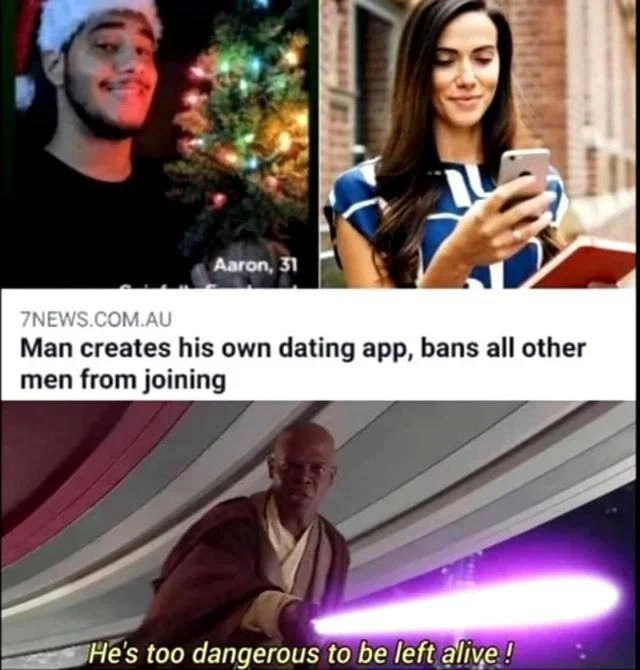
Developer builds exclusive dating app, Star Wars meme deems him dangerous
Why is this MobileDev meme funny?
Level 1: Only I Get to Win
Imagine you and your friends are going to play a game, but one friend says, “I made this game, so I get to set the rules – and my rule is that I’m the only one allowed to win.” 😮 That wouldn’t be fair, right? This meme is just like that, but in the world of dating. One clever guy actually created his own dating app (like his own game) and decided no other boys could join. So any girl who uses that app can only choose him, because he blocked all the other boys from playing. It’s funny in a sneaky way because he found a loophole to make sure he’s always the winner (the only choice for a boyfriend on that app). But it’s also clearly not fair, just like a game where only one person gets to score points. The last part of the meme shows a scene from Star Wars with a character saying, “He’s too dangerous to be left alive!” – that’s a playful way of saying “This is so outrageously unfair, someone should stop him!” Even if you don’t know the movie, you can imagine people jokingly reacting that way. In simple terms, the meme is laughing about someone who cheated the system by making his own system – a dating world where he gets to be the only player.
Level 2: My App, My Rules
In this meme, a developer took an unusual approach to online dating: he made his own dating app and didn’t let any other men join. Let’s break that down. A dating app (like Tinder or Bumble) is a mobile application where people create profiles and match with others for dates. Normally, hundreds or thousands of users sign up – men and women – and the whole point is having lots of choices. Competition is normal: if you’re a guy on a dating app, there are many other guys too, so you try to make a good profile to stand out. But this 31-year-old developer named Aaron found a cheeky shortcut: by creating his own platform, he had total control. Essentially, he became the app’s administrator and set the rule that only one male account exists: his own. If another man tried to sign up, the app would block them or kick them out. This guaranteed that any woman who joins the app sees exactly one guy available – Aaron himself.
Why is that funny to tech folks? It’s a classic example of a programmer using code to get an unfair advantage. In tech lingo, he instituted vendor lock-in on dating: once a woman signs up on his app, she’s “locked in” to only interacting with him because no other “vendor” (man) is there. Usually, vendor lock-in refers to companies making it hard for customers to switch to competitors – for example, if you store all your data with one cloud provider, it’s hard to move to another; you’re stuck with that vendor. Here, it’s an absurdly personal version: if you join Aaron’s dating service, you can’t “switch” to another guy within that app at all. It’s a monopoly in the dating market of that app – monopoly means only one seller or provider controls everything. Aaron is the only “seller” (potential boyfriend) in his app’s marketplace. This is why the meme also tags it as dating_app_monopoly and single_user_platform – it’s literally a platform that serves a single user’s interests.
From a MobileDevelopment standpoint, building a basic dating app isn’t trivial, but it’s doable if you have coding skills. You’d typically need to do some WebDevelopment too – for example, set up a server or database to store profiles and messages. Aaron evidently went through that effort. He basically acted like a Startup founder: spotting a “market opportunity” (in his personal life) and coding an entire product to address it. In startup terms, he “solved a problem” – except the problem was “too much competition in dating,” and the solution was pretty unethical. In the tech world, this raises product_ethics questions because he’s not treating users fairly. Imagine downloading a new dating app and not knowing it’s rigged so that only one guy exists – you might feel tricked! It’s kind of like if someone opened a new store and secretly ensured no other stores could open in that town. Customers would have no idea they’re only seeing one person’s goods.
The meme uses a popular star_wars_reference to drive the point home humorously. The bottom image shows a Jedi with a purple lightsaber (that’s Mace Windu from Star Wars movies) saying “He’s too dangerous to be left alive!” – a famous line from the films. In the movie, he’s talking about a powerful villain. In the meme’s context, it’s exaggeration for comedic effect: it implies Aaron’s one-man dating app scheme is so sneaky and powerful (for his love life) that it’s almost like he’s a villain who must be stopped. This is a form of TechHumor where developers mix movie quotes with real tech scenarios to make a joke. Everyone knows nobody is actually going to harm him; it’s just playfully saying, “Whoa, this idea is dangerously clever – someone stop this guy, haha!” It highlights the StartupHumor in the situation: a lone coder giving himself exclusive_access to all potential dates is both impressive (from a nerve standpoint) and totally unfair.
To sum up the scenario in simple terms: Aaron built a dating app and set the rules so that he’s the only man on it. All the app’s female users would only see him as a match. This demonstrates the power a developer has when they control a platform – they can literally write the rules to favor themselves. It’s a bit like cheating in a game you created. In the world of tech startups, people often try wild ideas to get ahead, but this one crosses into a cartoonish level of self-serving design. That’s why other developers find it both hilarious and eyebrow-raising. The meme is essentially laughing at how absurd the idea is: it’s one part admiration for the creative coding and one part “oh wow, that’s not right!” The Star Wars line is the comedic kicker that makes the whole thing feel like a nerdy saga – painting the developer as a sort of “dating Sith Lord” who used the Dark Side of coding tricks to become the sole victor in his app.
Level 3: Single-User Empire
This meme delivers some prime DeveloperHumor by combining startup absurdity with a dash of Star Wars drama. The news-style panel proclaims: “Man creates his own dating app, bans all other men from joining”. In tech terms, that’s an exclusive_access policy taken to the extreme – a one-man dating_app_monopoly. As a senior developer might chuckle, this guy basically implemented vendor lock-in for his love life. Normally, a dating app is a two-sided marketplace (men and women) balancing supply and demand. But our enterprising developer wrote a single_user_platform where he’s the only male vendor in town. It’s like he looked at competitive dating apps and said, “I’ll fix the odds with code.” Talk about over-engineering for personal gain – he didn’t just think outside the box, he wrote the whole box himself and locked everyone else out.
From a MobileDev perspective, building a single-tenant app just for yourself is both hilariously petty and technically trivial. With admin control over the code, you can enforce any rule. Picture the sign-up logic on this app’s backend: one if-statement is all it takes to conquer the dating pool. For example:
function onUserSignUp(user) {
if (user.gender === 'male' && user.name !== 'Aaron31') {
// Only the founder can be the male user
throw new Error("No other men allowed."); // block competing males
}
// Otherwise, allow sign-up (female users or the founder himself)
}
With a few lines of code, he literally codes away the competition. It’s an outrageous twist on MobileDevelopment ethics: instead of scaling to millions of users, he optimized for a user-base of one (himself) plus however many unwitting women sign up. In a normal app, such restrictive gating would be a disastrous anti-pattern – imagine Facebook allowing only one guy to have an account! But here it’s the feature. The result? A 100% male-to-female ratio in his favor by design. VendorLockIn usually refers to trapping customers so they can’t switch platforms, but this is a comedic parody of the concept: any female user who joins is effectively “locked in” to only one possible match. It’s monopoly-by-code. Seasoned engineers see the dark humor: he solved a social problem with a hacky technical fix, creating a dating ecosystem of one. It’s basically an app with hardcoded imbalance – a blatant violation of fair play.
The humor also pokes at Startup culture and Entrepreneurship hubris. There’s that mantra “solve your own problem,” but this guy took it quite literally. Instead of improving his profile or photos, he built an entire app to guarantee he’s the top (and only) choice. It’s a satirical take on the lengths a founder might go for a competitive edge. In real startups, “network effects” and a large user base are keys to success; here our solo founder threw that out the window and embraced Single Point of Failure architecture – himself! Experienced devs also recognize a tongue-in-cheek reference to over-engineering: this is like using a containerized microservice architecture to serve a single user. Sure, it’s scalable… to exactly one boyfriend. The ethical side isn’t lost either: deliberately excluding an entire demographic (all other men) is a product_ethics nightmare (and probably against App Store policies!). It’s a reminder of how TechHumor often highlights “just because you can code it, doesn’t mean you should.” The power imbalance is so cartoonish that it’s funny – one developer with root access can tilt an entire platform in his favor.
Finally, the cherry on top is the Star Wars reference in the bottom panel. The purple-lightsabered Jedi Master (that’s Mace Windu from Episode III, for the curious) declaring “He’s too dangerous to be left alive!” adds a dramatic flair. In Star Wars, Mace is talking about a Sith Lord with unlimited power – here it’s memeing that our developer’s trick is an unnatural use of power in the dating world. It’s as if the tech community Jedi Council has spotted a coder using the Dark Side (unfair monopoly tactics) for personal gain. The meme humorously suggests this kind of stunt is so dangerously clever that it violates the natural order of fair competition – hence the Jedi’s over-the-top call to action. Seasoned programmers love this blend of pop culture and tech satire. It implies that an engineer who writes custom apps to eliminate all rivals is a dangerous outlier – a tongue-in-cheek warning that such “Sith-level” hacks should not be allowed to roam free. In short, the meme is an epic mashup of StartupHumor and geek culture: a lone coder becomes the emperor of his own dating empire, prompting a cinematic “this dev must be stopped!” moment that leaves us laughing (and maybe a bit alarmed at the audacity).
Description
Three-panel meme: (1) top-left, a blurred man’s dating-profile photo beside a Christmas tree with the on-screen caption “Aaron, 31”; (2) top-right, a blurred woman in a blue dress looks at her smartphone; (3) center, a news-style headline from 7NEWS.COM.AU reads “Man creates his own dating app, bans all other men from joining”; (4) bottom, a Star Wars frame of a purple-lightsaber-wielding Jedi (face blurred) with yellow subtitle text: “He’s too dangerous to be left alive!”. The joke highlights a lone engineer who solves dating-app competition by writing a single-tenant mobile app that whitelists only himself, effectively achieving extreme vendor lock-in and questionable product ethics. It lampoons startup culture, over-engineering for personal gain, and the power imbalance that custom platforms can create
Comments
8Comment deleted
Cold-start, concurrency, and competition all solved in one commit: seed the DB with a single row, user_id = 1, and reject every INSERT that isn’t you - Tinder at O(1) scale, ethics in endless retry loop
When you implement authentication so strict that your user base is literally just you - the ultimate solution to the CAP theorem: Consistency, Availability, and Partition tolerance all become trivial when your distributed system has exactly one node and one user
When your MVP's competitive moat is literally a hardcoded WHERE clause filtering gender != 'self' in the user registration flow. This is what happens when you take 'move fast and break things' a bit too literally - though in this case, it's more like 'move fast and break antitrust laws.' The authentication logic here is basically: if (user.id === AARON_ID) { return FULL_ACCESS; } else { return 403_FORBIDDEN; }. At least he's achieved perfect product-market fit for an audience of one - zero churn rate, 100% market share in his demographic segment. The real engineering challenge isn't building the app; it's explaining to investors why your DAU/MAU ratio is suspiciously consistent at exactly 1.0
Ultimate Singleton pattern: one user instance, no clones allowed
Monopoly-as-a-Service: ship a dating app with RBAC that only passes when user_id == founder; cold start solved, DAU=1, concurrency eliminated, scalability deferred to marketing
Go‑to‑market via RBAC: allow if user.id == founder || gender != 'male' - a “multi‑tenant” dating app with O(1) network effects
Aaaaand so it became a lesbian dating site. Comment deleted
So nobody is using it Comment deleted