Skip to content
DevMeme
3598 of 7435
The Gom Jabbar Test for Legacy Java Code
LegacySystems Post #3935, on Nov 16, 2021 in TG

The Gom Jabbar Test for Legacy Java Code

Why is this LegacySystems meme funny?

Level 1: Hot Stove Dare

Imagine you have a big box full of tangled wires and cords in your garage that’s been sitting there for years. Your parent asks you to pull out one specific cable from that messy box. The catch? If you just yank your hand out too fast or pull the wrong cord, all the electronics might fall off the shelf 😨. So you have to slowly reach in, find the right cable in that knot, and endure all the dust and maybe a few cable scrapes on your hand. It’s uncomfortable and you really want to pull your hand out and stop, but if you do it carelessly, things could come crashing down. This meme is joking about that kind of situation. Old computer code that hasn’t been touched in ages is like that box of tangled wires. Trying to fix it feels scary and painful, kind of like a dare to hold onto a hot object. It’s funny because everyone knows touching that messy thing is a bad idea, so when someone has to do it, we tease that it’s like sticking your hand in a “pain box.” In simple terms: messing with old code can hurt (not literally your hand, but your brain from frustration!), and this joke compares it to the most extreme example of holding onto something super painful when you’d much rather let go. The humor comes from exaggerating a programmer’s challenge into a life-or-death dare – it’s a silly way to express how frustrating and scary fixing old code can feel, even though we all know it’s not actually lethal!

Level 2: What’s in the Box?

So, what exactly is inside this mysterious box causing so much agony? In the meme, the answer is “Legacy Java Code.” Let’s break that down. Legacy code means old, inherited code that a team has been relying on for years. It’s the kind of code that might have been written by developers long gone, using outdated practices or older versions of languages and frameworks. Here, it’s Java code from an earlier era. Java is a very popular programming language, especially for big enterprise systems. Over time, a Java program can grow huge and complex. If it wasn’t well-maintained, it turns into legacy software – hard to change, but too important to delete because entire businesses run on it.

When code is described as spaghetti code, it means the structure is all tangled up like a bowl of spaghetti. There’s no clear separation of modules or logic; everything is interwoven. For a newer developer (or any sane person), reading spaghetti code is confusing and frustrating. You fix one thing over here, something unrelated over there breaks – because, hidden in the tangle, the two were actually tied together. Technical debt is a term we use to describe shortcuts or poor design decisions in code that make future changes harder. It’s like taking on financial debt: you “borrow” time by hacking something together quickly, but you “pay interest” later in the form of big headaches and risky refactoring sessions. A legacy codebase often has tons of this tech debt built up.

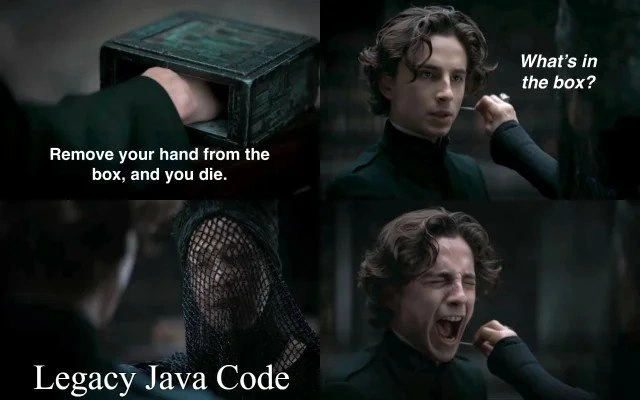
Now, the scene in the meme is referencing a famous moment from Dune (a sci-fi novel and 2021 movie). In that scene, a young hero is forced to stick his hand in a mysterious box as a test. He feels intense pain (like his hand is burning), but he’s told if he pulls his hand out early, he’ll be killed. It’s a test of his discipline and courage. The meme replaces the actual contents of the box with “Legacy Java Code,” implying that sticking your hand into a pile of old messy code is the ultimate pain test for a programmer. The veiled woman holding the deadly needle (in Dune she’s an authoritative figure testing him) represents the harsh reality or maybe an elder programmer saying, “Once you start fixing that old code, you must endure until it’s done, or things will go horribly wrong.”

For junior developers, the humor is in the exaggeration. Sure, working with old code can be tough, but here it’s portrayed as literally torture! The phrase “proceed at your own risk” is something you might even hear jokingly at work. Senior devs sometimes warn newbies: “Don’t touch that part of the system unless you absolutely have to.” Why? Because that part is so fragile that any change could cause outages or bugs (it’s risky refactoring to the max). It’s not that the code will actually burn you, but the consequences of messing up could “burn” the team with endless bug fixes or downtime.

In real life, touching legacy code might involve:

  • Reading through ancient Java classes that have hardly any comments or documentation.
  • Dealing with deprecated functions or libraries that nobody uses anymore.
  • Facing functions that are hundreds or thousands of lines long (imagine a single function trying to do everything – it’s overwhelming).
  • No automated tests to tell you if you broke something. So deploying a change feels like a scary leap of faith.

All of this can be pretty intimidating for a newer developer. You might ask, “What’s in this code that makes everyone so nervous?” The answer is exactly what the meme says: a bunch of Legacy Java Code with all the pitfalls that implies. It’s a rite of passage for many programmers to one day be tasked with updating an old system and then truly understand why people joke about “feeling pain” when doing it.

The categories and tags on this meme clue us in too: LegacySystems and TechnicalDebt are mentioned, which are all about old stuff that’s hard to deal with. Java is the language in question. And tags like LegacyCodebase and LegacySystemsAndModernization hint that this is a common scenario when trying to modernize or improve old software. The tag risky_refactoring nails it – refactoring (changing code structure without altering its behavior) is risky here because without tests or clear structure, you can’t be sure you’re not breaking something hidden.

To summarize this level: the meme is funny to developers because it dramatizes a very real feeling. It takes a cool sci-fi reference and uses it to say, “Hey, digging into that old code is basically a horror/sci-fi adventure. Be brave, or else!” As a junior dev, don’t worry – you won’t actually face a death box 😂. But you will eventually encounter some old, scary code that everyone else fears. And when you do, you’ll remember this meme and think, “Ah, so this is the pain they were talking about.” It’s a shared joke that also carries a nugget of truth about software development.

Level 3: The Gom JARbar Test

In the meme’s Dune-inspired nightmare, a developer’s hand in the box symbolizes diving into legacy Java code – and experiencing searing pain for daring to touch it. The line “Remove your hand from the box, and you die.” is darkly comical to senior engineers because it captures the ultimatum of tech debt: once you start refactoring that brittle module, backing out halfway could be even more disastrous than pushing through. The veiled figure (the Bene Gesserit from Dune) stands in for the grim voice of experience – perhaps a senior dev or architect – warning “If you bail on this refactor, the system (or your job) won’t survive.” It’s a trial by ordeal, or as we might pun it, the Gom JARbar test (where .jar hints at Java). Seasoned developers chuckle (and wince) because they’ve felt that exact mix of fear and resolve when dealing with a Big Ball of Mud codebase.

This scenario is painfully familiar: imagine a monolithic Java application first written in the early 2000s with J2EE-era practices, layered in frameworks from Struts to Spring, piled high with decade-old business logic. Over years, dozens of developers have applied quick fixes and band-aids, creating a snarled mess of dependencies – classic spaghetti code. There are likely global singletons for state, outdated XML configuration files, and methods thousands of lines long. The code might be so fragile that touching it (like pulling a single thread in a tangled knot) risks bringing the whole system down. No wonder the mere thought of modernizing a legacy system like this makes veterans break into a cold sweat.

Why is this funny? It’s gallows humor. Much like Paul Atreides endures excruciating pain to prove his humanity, developers often must endure brain-melting debugging sessions to prove their code won’t break production. The protagonist’s agonized grimace in panel 4 is basically an engineer at 3 AM, eyes bleary, stuck in a remote session with an ancient Java legacy system that’s misbehaving. They can’t just quit (servers might crash, customers might scream), so they soldier on through the “pain.” Everyone in the room (any developer who’s been around long enough) knows that feeling. We joke about it to cope: “I put my hand into the legacy code base, felt unimaginable pain as I traced through recursive if-else ladders, but I dared not stop or everything would catch fire.” It’s funny because it’s true.

The elements in the meme hit on real tech themes: Legacy Java often implies Java 6 or earlier, with code written in an era before modern IDE refactorings and unit tests were widespread. The tech debt accumulated means seemingly simple changes have unpredictable side effects. The code might lack documentation – only the original author (long gone) knew why a piece of logic exists. So asking “What’s in the box?” is every developer’s naive question before opening a legacy module. The answer – “Legacy Java Code” – is both the explanation and the punchline. It labels the unseen torment directly. Of course it hurts; it’s full of legacy Java!

Consider a notorious pattern from old enterprise Java: one giant method to handle everything, with extensive error suppression. A veteran dev has seen something like:

public void processAllTheThings(InputData data) {
    try {
        // ... 5000+ lines of tangled legacy logic ...
        legacyDao.update(data);
        LegacyCache.getInstance().setFlag(true);
        if (data.type == 42) {
            processAllTheThings(data); // recursive call?! (tech debt intensifies)
        }
        // ... more nested conditions and side effects ...
    } catch (Exception e) {
        // Swallow exceptions and pray it works
        Log.warn("Ignored error: " + e.getMessage());
    }
}

This “catch (Exception e) { }” is the embodiment of “Remove your hand and you die.” – because if you ever dared to let an error propagate or truly fix the underlying issue, who knows what else would break? 😂 Such code forces you to keep your hand in the box, enduring the pain and hoping nothing fatal happens. The humor here is edged with truth: legacy systems force developers into a corner where they must be either incredibly brave or utterly reckless to make changes. It’s a shared industry joke that even the bravest developers feel a spike of adrenaline (or terror) when told to “just make a small change” in these ancient parts of the codebase. We’ve learned (often the hard way) that tech debt exacts a price – and the longer it’s left untouched, the sharper the teeth it bares when you finally face it.

Description

A four-panel meme using the 'Gom Jabbar' pain box scene from the 2021 film 'Dune'. In the first panel, a character's hand is in a dark box with the caption, 'Remove your hand from the box, and you die.' In the second, the character, Paul Atreides, asks, 'What's in the box?' The third panel shows the ominous Reverend Mother with the label 'Legacy Java Code' at the bottom. The final panel depicts Paul screaming in agony. The meme draws a direct and humorous parallel between the excruciating test of humanity in the movie and the painful, high-stakes experience of working with a complex, fragile, and poorly understood legacy Java codebase. For senior developers, this resonates deeply, as changing anything in such a system can lead to catastrophic failures ('you die'), and the process of working within its confines is a form of mental torture
Comments

15
Anonymous ★ Top Pick The test is to see if you are a true developer or just an animal. An animal would try to refactor the 2000-line method; a developer knows to add another 'if' statement and pray
  1. Anonymous ★ Top Pick

    The test is to see if you are a true developer or just an animal. An animal would try to refactor the 2000-line method; a developer knows to add another 'if' statement and pray

  2. Anonymous

    Touching that 2006 J2EE module is our Gom Jabbar - if you can endure the endless Spring-XML, raw Vector casts, and silent catch(Exception e) blocks, we know you’re worthy of prod access

  3. Anonymous

    It's a 15-year-old Spring 2.5 monolith with hand-rolled XML configs, no tests, and the original team's custom ORM that predates JPA but somehow handles 40% of revenue

  4. Anonymous

    The Gom Jabbar test perfectly captures working with legacy Java: you're told the box contains 'just some business logic from 2003,' but inside is actually a 50,000-line God class with no tests, circular dependencies, reflection-based magic, and XML configuration files that generate more XML. Remove your hand and the entire payment processing system goes down. Keep it in and you'll experience pain beyond measure as you discover it's using deprecated APIs, custom classloaders, and a homegrown ORM that predates Hibernate. The original architects have long since ascended to principal roles at other companies, leaving only cryptic comments like '// TODO: fix this hack before production' dated 2007. You must not fear. Fear is the mind-killer that prevents you from running 'git blame' to see who's responsible for this abomination

  5. Anonymous

    What’s in the box? An EAR from 2007 - EJB2, Struts1, XML Spring, and a classloader leak; remove your hand and WebSphere will GC your weekend

  6. Anonymous

    Paul's test built character; legacy Java builds character through eternal servlet chains and zero IT budget for the rewrite

  7. Anonymous

    Gom JARbar: put your hand in a 2007 Java monolith - EJB2, Spring XML, JNDI; let go and the nightly batch dies

  8. @RiedleroD 4y

    real answer is "your hand"

    1. @solwayfirth8956 4y

      😂😂😂😂

  9. @Daler_XYZ 4y

    Legacy java code in telegram android

  10. @solwayfirth8956 4y

    Pain

  11. @SamsonovAnton 4y

    It is your hand that produces the legacy code, after all.

  12. @cptnBoku 4y

    Where is this scene from

    1. @SamsonovAnton 4y

      The new "Dune" remake, I assume.

  13. @cptnBoku 4y

    Oh

Use J and K for navigation