Legacy Code In Alien Syntax
Why is this LegacySystems meme funny?
Level 1: Mystery Recipe
It is like finding an old recipe where the steps, measurements, and oven times are written in a language you cannot read. You can tell it makes food, and people may still depend on it, but changing one ingredient could ruin the whole meal. That nervous guessing is why the image is funny.
Level 2: Readable To Whom
Legacy code is software inherited from the past. It may be old, under-documented, written in an outdated style, or simply unfamiliar to the current team. Technical debt means earlier shortcuts or constraints now make future changes harder. Refactoring means improving the internal structure of code without changing what it does for users.
The visual joke is that the editor looks normal at first: line numbers, colors, indentation, comments, and code blocks. But the actual words are unreadable. That makes it a perfect picture of poor code readability and maintainability. The program may have logic, but the meaning is hidden.
For newer developers, this is what it can feel like to join an existing project. You understand programming basics, but the local naming conventions, business rules, hidden assumptions, and old decisions make the code feel like a foreign language. The first job is often not writing new code; it is learning why the old code is shaped that way.
Level 3: Archaeology With Braces
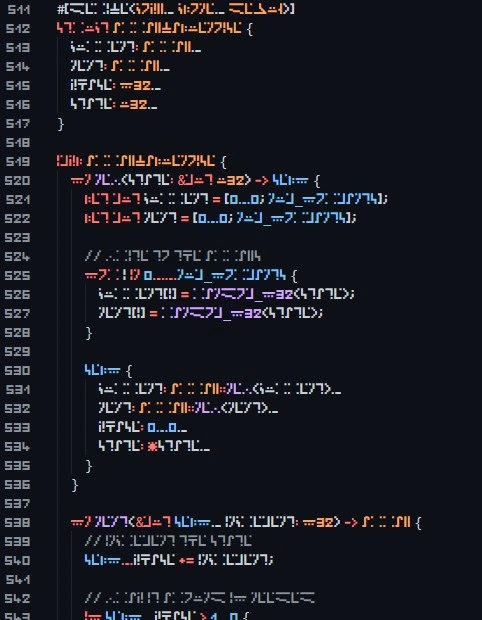
The image shows a dark code editor somewhere around lines 511 through 542. The syntax highlighting, indentation, braces, comments, arrows, and nested blocks all say "this is code." The identifiers and comments, however, look like alien glyphs. The post caption calls it:
Your average legacy codebase
That is the joke: legacy code usually is not literally unreadable, but it often feels functionally unreadable. The structure is recognizable enough to be dangerous. You can see blocks, assignments, function-like shapes, and conditionals. You can infer that something important happens around line 519, and something suspicious continues around line 538. What you cannot infer is intent. That is where the pain lives.
Experienced developers know the special misery of codebase archaeology. Old systems contain layers of decisions made under deadlines, product pivots, framework migrations, emergency fixes, departed team members, and "temporary" workarounds that bought a decade-long lease. The result may still run the business, which is why nobody gets to simply delete it with a heroic flourish. Legacy code is not bad because it is old. It is painful because the knowledge that made it understandable was never preserved in the code, tests, docs, or team.
The image exaggerates technical debt by turning every name into nonsense. That matters because names are one of the cheapest forms of design. A good variable name can preserve business meaning; a bad one can make an entire function feel encrypted. When names, comments, and abstractions stop explaining intent, maintenance becomes pattern matching: change the thing that looks related, run tests if you have them, pray the invoice pipeline does not learn about your optimism.
The really bitter part is that this code still appears syntactically organized. It is not a blank screen or a compiler error. It is worse: it looks plausibly valid. That is exactly why refactoring is hard. You can see enough to modify it, but not enough to know the blast radius. Every RefactoringNeeded instinct has to negotiate with production risk, missing tests, unclear ownership, and the terrifying discovery that the weird branch is there because of one enterprise customer from 2014.
Description
A dark-themed code editor screenshot shows line numbers roughly 511 through 542 and syntax-highlighted code, but the identifiers and comments are rendered as strange, unreadable glyphs. There are braces, nested blocks, arrows, punctuation, and colored tokens in red, orange, blue, and gray, making it look like real code whose intent has been completely lost. The caption says "Your average legacy codebase," comparing old, inherited systems to alien archaeology where control flow still exists but comprehension has decayed.
Comments
26Comment deleted
Legacy code is just a compiled oral tradition with comments preserved in a language nobody has budget to translate.
Yeet Comment deleted
Where can I download that font? Comment deleted
Wait, Minecraft? Comment deleted
Lol I knew I have seen this before Comment deleted
technically yes. It's the standard galactic alphabet from Kommander Keen, which has also been used as the enchanting table language Comment deleted
also the enchanting text is one of several randomized strings, and you can't guess what enchantment you get based on what's written. Comment deleted
Its no english Comment deleted
it is, technically Comment deleted
I think it's rust. Look, first line is directive and return type of a function with -> Comment deleted
huh, sounds about right Comment deleted
found it! https://github.com/Dimev/grail-rs/blob/d0f80e1e606d0a5a20831228c20f4ce6ad2fe26b/src/lib.rs#L513-L545 Comment deleted
yoo it's grailsort Comment deleted
or not, sad Comment deleted
Absolute legend Comment deleted
it was pretty easy actually... I began to translate it by inferring letter by letter from words known to me from rust syntax but then I just searched ArrayValueNoise in GitHub and it gave me only one result 😃 Comment deleted
…you know that there's already a solution key for the standard galactic alphabet, right? Comment deleted
in any case, good work. I was too lazy to do it. Comment deleted
yeah, I challenged myself to do it without any help :) Comment deleted
I used to be able to read that back when I was teen. Even downloaded the font and set it as default in KDE3 Comment deleted
damn Comment deleted
wicked sick lol :D Comment deleted
js Comment deleted
Standard Galactic Alphabet originates from Id Software's Commander Keen series. There are scattered hints throughout the game that show what is each letter in latin alphabet. And yes, it appears to be Rust. As many comments pointed out already. (-: Comment deleted
seems familiar to me Comment deleted
seems like someone is enchanting some stuff Comment deleted