Skip to content
DevMeme
6619 of 7435
LeetCode Grinder Gets Motivation From Neighbors at 3AM
Interviews Post #7252, on Oct 10, 2025 in TG

LeetCode Grinder Gets Motivation From Neighbors at 3AM

Why is this Interviews meme funny?

Level 1: Never Give Up

Imagine you’re trying to solve a really hard puzzle late at night. You’re tired, your eyes hurt, and you almost decide, “I can’t do this, I should just quit.” But just then, you hear someone next door shout, “Keep going, don’t stop!” Maybe they’re not even talking to you, but it feels like they are. Suddenly, you feel a burst of energy, like you just turned into a superhero with a glowing aura. You get back to the puzzle with new excitement and – wow! – you figure out the answer. 🎉 This meme is like that story: it’s showing a coder (computer puzzle-solver) who was about to give up at 3 AM but hears encouragement and then feels super-powerful, just like a hero in a cartoon powering up. The funny part is how unexpected the help is, and it reminds us that sometimes, when things are hardest, a little encouragement can make you feel invincible and help you finally win. It’s a big, funny way of saying: never give up, you might be closer to success than you think!

Level 2: Late-Night LeetCode

Stepping back to a more straightforward view, this meme is about a programmer struggling with a LeetCode problem late at night (3 AM) and then getting a sudden jolt of motivation as if they became a super-powered anime hero. Let’s break down the pieces:

  • LeetCode: This is an online platform where developers practice programming problems. These problems often involve algorithms and data structures – the building blocks of computer programs also known as CS fundamentals. Many software engineering Interviews include questions like “reverse a linked list” or “find the shortest path in a grid,” so people practice on LeetCode to prepare. It’s essentially doing brain-teaser coding puzzles to sharpen your skills.

  • Late-night coding: The meme specifically says 3 AM. That’s really late (or early morning)! Coding at 3 AM often means you’ve been at it for hours, possibly because you’re determined to solve a tough problem or because you procrastinated and now the deadline (or interview) is looming. At that hour, most people are asleep, and if you’re coding, you’re likely running on caffeine and sheer will. Sleep deprivation can make you loopy or desperate – you might start hearing things, or in this case, you literally hear your neighbors through the wall.

  • “Keep going, don’t stop!”: The text implies the neighbors are yelling this at 3 AM. Now, realistically, neighbors shouting encouragement at 3 in the morning is a bit odd (perhaps they’re actually yelling at something else, like a late-night sports game or... um... engaging in enthusiastic private activities). But the coder in the meme takes this as encouragement for them. Imagine you’re exhausted and about to quit, and suddenly someone yells “Don’t stop!” – you might laugh, perk up, and think, “Alright, universe, I got the message, I’ll push a bit more.” It’s an unexpected motivation. This part of the meme taps into developer frustration and how sometimes just a little encouragement (even accidental encouragement from strangers) can keep you going.

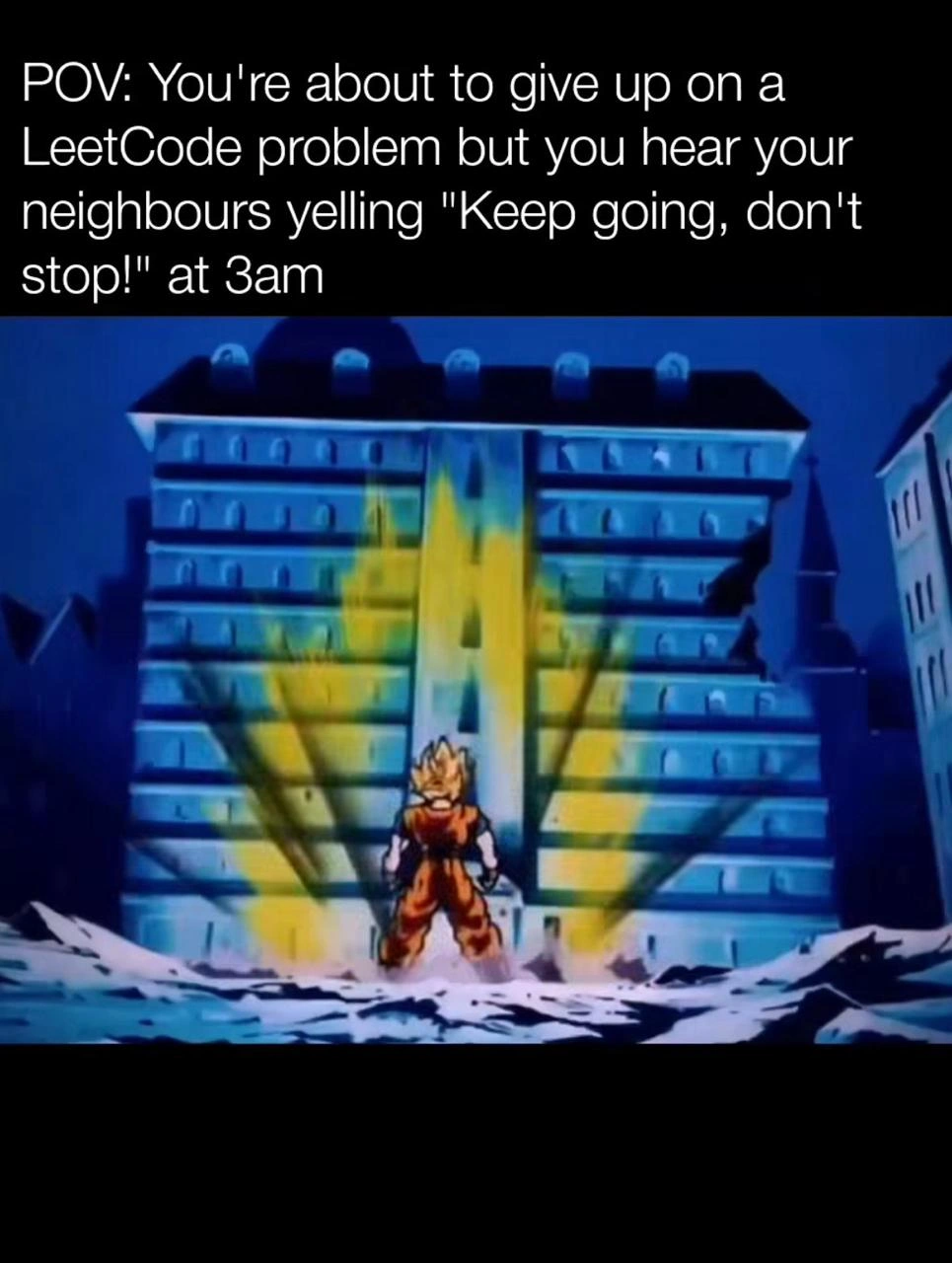
  • Super-Saiyan algorithm session: This mashes up a popular anime reference with coding. Super Saiyan is from the anime Dragon Ball Z, where the characters (who are powerful fighters) can transform into a stronger state called Super Saiyan. When they do, their hair turns blond and spiky, and they glow with a fiery aura. It’s a huge power-up. The meme is saying that the programmer’s late-night coding session turned into a “Super-Saiyan algorithm session,” meaning they suddenly became much better or more energized at solving the algorithm. Maybe they found a really clever solution or fixed the bug in an epic way. The bright yellow energy beams in the image are exactly how the show depicts a Super Saiyan powering up. So, the coder metaphorically “powers up” as well – from a normal tired person to an unstoppable coding warrior.

  • Algorithm humor and complexity: The tag AlgorithmHumor and AlgorithmComplexityAnalysis suggest the joke also lies in improving the algorithm. LeetCode problems often demand efficient solutions. For a newcomer (or even experienced devs), it’s common to try an approach that works but is too slow (like checking every possibility – what we call brute force). After banging your head for a while, you realize a smarter approach – maybe using a different data structure or a known algorithm – that makes the solution run fast enough. That realization is a huge relief! For example, if you were sorting numbers one by one by hand (very slow) and then remembered you can use a built-in sort function (much faster), that’s a boost from an $O(n^2)$ algorithm to an $O(n \log n)$ one, which is a significant improvement. The meme equates that “aha!” moment to going Super Saiyan. In simple terms, the coder finally applied some CS fundamental (like using a hash map, or a better mathematical trick) and the code went from slow to speedy. It’s both funny and satisfying when that happens, and developers often joke about these breakthroughs as if they discovered a new superpower.

  • Learning and perseverance: Underneath the humor, there’s a real LearningCurve here. Solving coding problems can be tough. Often you’re so close to the solution but feel stuck. The message “Keep going, don’t stop!” is exactly the advice any mentor would give: sometimes you need to persist a bit longer or look at the problem from a new angle. The meme dramatizes this advice in a comedic way. It’s basically saying: don’t quit, you might be about to have a breakthrough. And when that breakthrough happens (especially late at night), you feel incredibly proud and excited. Many developers remember the first time they solved a really hard problem on their own – it’s almost exhilarating. That positive feeling can fuel further learning, much like leveling up in a game.

  • Dragon Ball reference in developer culture: It’s worth noting that references to anime like Dragon Ball Z are pretty common in developer and gamer communities. Phrases like “It’s over 9000!” (meaning something is off the charts) or “this isn’t even my final form” (joking that one has more abilities in store) are memes themselves. So combining a coding scenario with a DBZ scene is a natural fit for the humor many coders appreciate. It mixes the pop culture we love with the work (or hobby) we also love/frustrate over. In this case, an exhausted coder turning into Goku is both absurd and epic – and that contrast is exactly why it’s funny.

In summary, at this level the meme is saying: “When you’re about to quit that ridiculously hard coding problem in the middle of the night, and you randomly hear someone yell encouragement, you suddenly feel like a supercharged anime hero andfinally solve it.” It’s a celebration of not giving up, using a fun cartoon analogy to highlight the surge of confidence and creativity that can come when you least expect it. And for anyone who has actually been up at 3 AM debugging or solving challenges, it’s a humorous reminder that sometimes breakthroughs happen at odd times – and that a little encouragement (even accidental) can go a long way.

Level 3: 3AM Algorithmic Ascension

From a seasoned developer’s perspective, this scene is all too relatable. Picture a coder deep in the LateNightCoding grind, hunched over a keyboard with bloodshot eyes, tackling a LeetCode problem that’s been gnawing at them for hours. It’s a classic Interviews prep scenario: tomorrow (or later today?) there’s a big tech interview, and here they are at 3:00 AM wrestling with a slippery dynamic programming puzzle or an elusive bug in their code. SleepDeprivation and DeveloperFrustration are at peak levels. They’re on the brink of giving up – maybe the brain’s fuzzy, the solutions all seem to lead to dead ends or dreaded “Time Limit Exceeded” errors.

In the meme’s setup, just as our intrepid coder nearly surrenders, a miracle occurs: through the paper-thin apartment walls comes a muffled but emphatic “Keep going, don’t stop!”. Whether these neighbors are actually cheering on the coder’s algorithmic endeavors or... engaged in some other 3 AM activities 🤨, the effect on the developer is the same. It’s as if they suddenly have their own personal hype squad yelling support. That absurd misinterpretation – taking a probably-not-for-you shout as motivational fuel – is exactly why this is hilarious to anyone who’s been in a similar spot. Every experienced programmer has a war story of a marathon coding session where encouragement (or desperation) pushed them into a late-night flow state. In that state, time melts away, and you might solve in 20 minutes what you couldn’t in the past 5 hours. It genuinely feels like a Super Saiyan transformation: a rush of clarity and energy, hair-standing-on-end (perhaps literally if you’ve had enough caffeine), and suddenly that intractable problem yields to a burst of inspired coding.

The Dragon Ball Z visual drives the point home. In the image, Goku (in his iconic orange gi) is powering up on a deserted street, golden aura blazing around him and illuminating an entire building. This is an over-the-top anime representation of gaining strength, and the meme smartly equates it to the coder’s sudden motivation boost. In developer terms, it’s the moment when your mental debugger finally kicks in or when a new approach materializes out of thin air. Maybe the solution was buried in the back of your brain – a piece of CS_Fundamentals you’d learned but not initially considered. For instance, you recall an algorithmic pattern like two-pointer technique or a data structure like a hash map that can cut through the problem’s complexity. The next thing you know, you’re furiously refactoring your code, fingers flying on the keyboard as tests start turning green. It’s an algorithmic ascension: the code that was broken or too slow an hour ago is now working efficiently.

To illustrate, consider a classic coding puzzle where you need to find two numbers in a list that add up to a target sum. At first, a tired brain might implement the straightforward double-loop solution, checking every pair – correct, but terribly slow (quadratic time $O(n^2)$). After enough frustration (and perhaps a jolt of neighborly “Don’t stop!” energy), the coder remembers a better way: use a set to track seen numbers while iterating just once (linear time $O(n)$). Suddenly the problem that seemed impossible to finish in time is solved elegantly. It’s like turning a clunky old car into a racecar mid-drive. In code, that leap might look like this:

# Brute-force approach: O(n^2) time - checks all pairs (slow but straightforward)
def two_sum_bruteforce(nums, target):
    for i in range(len(nums)):
        for j in range(i+1, len(nums)):
            if nums[i] + nums[j] == target:
                return True
    return False

# Optimized approach: O(n) time using a hash set (leverages CS fundamentals for speed)
def two_sum_optimized(nums, target):
    seen = set()
    for num in nums:
        if target - num in seen:
            return True  # found the complementary number
        seen.add(num)
    return False

In the bruteforce version, a coder might literally feel their life force draining as the clock ticks and code chugs along. But in the optimized version, we see a classic AlgorithmComplexityAnalysis win: trading space for time by using a set to achieve a dramatic speedup. Writing that improved solution at 3 AM feels like going from normal Goku to Super Saiyan Goku – you’ve tapped into some hidden reserve of knowledge and learning.

The humor for veteran developers also comes from a bit of dark truth: the industry’s InterviewHumor culture almost expects these absurd scenarios. Many of us have indeed been that person frantically grinding LeetCode problems in the wee hours, essentially training to perform under pressure. We laugh (and maybe cringe) because we know it’s not healthy – chugging coffee, staring at a screen of leaky greedy algorithms and half-baked Big O proofs while the world sleeps – yet it’s become a rite of passage. The meme plays on that shared experience: the unreasonable hour, the mix of frustration and determination, and the comically exaggerated source of motivation. It’s a parody of those inspirational coding montages that never quite show the real gritty side – here we substitute a neighbor’s dubious shouts for the triumphant music.

Crucially, the image of a lone warrior (developer) powering up in an empty street (quiet late-night world) facing a giant obstacle (the towering apartment building could symbolize the daunting problem or the looming interview). The cracked ground and shockwaves in the frame mirror the coder’s intense mental effort shaking up their environment. To a senior dev, there’s also an element of LearningCurve nostalgia here. We remember when tackling pointers or recursion felt like going to battle. Over time, you get stronger (just as Saiyans do after each fight), so what once required a midnight breakthrough might become routine. But in the moment, especially early in your career, overcoming a tough challenge can feel epic.

In summary, the meme is funny to experienced developers because it hyperbolically captures the grind and the passion behind learning algorithms for technical interviews. It satirizes our collective tendency to push ourselves to the limit (sometimes unnecessarily) and finds humor in the absurdity of those moments. The “Super-Saiyan algorithm session” is both a celebration of that rare rush of coder’s high and a gentle ribbing of the crazy lengths we go to in order to crack a problem. And hey, who wouldn’t want a personal Super Saiyan hype moment before finally smashing a nasty coding problem at 3 AM? This is the stuff developer legends (and memes) are made of.

Level 4: Power Level Over 9000

At the most theoretical level, this meme humorously hints at breaking through fundamental limits of algorithmic complexity by sheer willpower. In reality, no amount of late-night adrenaline can magically turn an NP-hard problem into an easy one – you can’t brute-force solve the Traveling Salesman at 3 AM just by yelling louder (unless P = NP, which would be a discovery over 9000 times more shocking than a Super Saiyan transformation!). However, what can happen is a sudden algorithmic insight that drastically reduces the complexity of a problem. Think of recognizing a hidden structure that lets you apply a known algorithm or data structure: for example, turning an apparently exponential brute-force search into a polynomial-time solution with dynamic programming. This is akin to discovering a secret algorithmic form beyond your normal powers. In Big-O notation, it’s the jump from a time complexity like $O(2^n)$ to $O(n^2)$ or even $O(n\log n)$ – a massive leap in efficiency that feels like unlocking a new power level. The meme’s Super Saiyan metaphor playfully exaggerates that eureka moment in algorithm design: the developer’s brainpower hits “over 9000” just as Goku’s scouter-breaking power level did in Dragon Ball Z. It’s a tongue-in-cheek nod to CS_Fundamentals: when a breakthrough in understanding strikes, the resulting code can conquer problems previously thought intractable (or at least, too hard at 2:59 AM). In academic terms, we’re dealing with the exhilarating but illusory notion of transcending computational complexity limits. Of course, even a Super Saiyan coder can’t defy the laws of computer science – if a problem truly requires exponential time, no amount of neighborly encouragement will change its growth rate. But in practice, many tricky LeetCode challenges have an optimal solution that’s just clever enough to feel like cheating the universe. The meme captures that geeky fantasy: the moment of clarity when a tired programmer leaps from a naive solution to an efficient one, transforming into an algorithmic hero in the dead of night.

Description

A meme with text 'POV: You're about to give up on a LeetCode problem but you hear your neighbours yelling "Keep going, don't stop!" at 3am' over a scene from Dragon Ball Z showing Super Saiyan Goku powering up with golden energy aura in front of a building at night. The joke is a double entendre -- the neighbors are obviously engaged in intimate activity, but the LeetCode grinder interprets their encouragement literally as motivation to keep solving algorithm problems

Comments

7
Anonymous ★ Top Pick Nothing motivates solving a dynamic programming problem at 3AM quite like your neighbors' O(n!) time complexity exploration next door -- at least someone's brute-forcing successfully tonight
  1. Anonymous ★ Top Pick

    Nothing motivates solving a dynamic programming problem at 3AM quite like your neighbors' O(n!) time complexity exploration next door -- at least someone's brute-forcing successfully tonight

  2. Anonymous

    Nothing like accidental thin-wall pair-programming to refactor your brute-force O(n²) into a Kamehameha-class O(log n)

  3. Anonymous

    The only time a senior engineer still grinds LeetCode at 3am is when they're interviewing at a company that thinks inverting a binary tree in 15 minutes determines if you can architect a distributed system that handles 10 million requests per second

  4. Anonymous

    The real O(n!) complexity here isn't the algorithm - it's explaining to your neighbors at 3am why you're screaming 'WHY WON'T THIS PASS ALL TEST CASES' while they're trying to sleep. At least they're supportive of your dynamic programming approach to career advancement, even if they think you're doing something entirely different

  5. Anonymous

    Nothing like unsolicited 3am stakeholder encouragement to refactor an O(n^2) brute force into a monotonic-deque solution - because nothing says senior engineer like optimizing sliding windows for a job that’s mostly PR reviews

  6. Anonymous

    Neighbors as your 3AM Kubernetes liveness probe: 'Keep going, don't stop!' or the pod restarts

  7. Anonymous

    Peak interview-prep architecture: a rogue keepalive from next door trips your autoscaler, you abandon exponential backoff for a spinlock, and the DP table materializes in O(n) like a Super Saiyan aura

Use J and K for navigation