Skip to content
DevMeme
6618 of 7435
Data Centers Single-Handedly Propping Up US GDP Growth in 2025
Infrastructure Post #7251, on Oct 10, 2025 in TG

Data Centers Single-Handedly Propping Up US GDP Growth in 2025

Why is this Infrastructure meme funny?

Level 1: Lemonade Stand Lesson

Imagine your country’s economy is like a big lemonade stand fundraiser. Everyone is selling or buying something, and the total money made is like the country’s score called GDP. Now, picture that one really rich customer comes along and buys a ton of lemonade – so much that it makes up almost all the money the stand earned that day. If you remove that one big spender’s purchase, you’d find out the stand actually made almost no money from everyone else. This meme is saying something similar happened in real life: the big spender is all the money companies spent building and running huge computer warehouses (what we call data centers) for things like the cloud and AI. If you don’t count that spending, the country’s “money made” (GDP) barely went up at all – almost zero growth, just 0.1%.

Why is that funny? It’s a bit like saying the whole class’s bake sale was saved only because one kid’s parent bought almost every cupcake. In tech terms, it feels as if all the new wealth and growth is coming from engineers and companies ordering more servers and cloud services – something usually seen as just a nerdy detail of running apps. The meme makes us laugh because it exaggerates a true idea: our cloud computing bills have gotten so huge that they’re noticeable at a national scale. It’s surprising and silly to think that when you or your team launches a new app or uses a bunch of online servers, you’re somehow helping the whole economy grow. It’s an exaggeration of course, but it’s poking fun at how enormous the tech world has become.

In simple terms, the lesson here is: big things often come from what seem like little actions. One developer adding more servers, or one company building a new data center might not seem like much alone, but when everyone’s doing it, it turns into a gigantic amount. So much so that even people who study the whole country’s economy notice it. And that idea – that your everyday tech work is a secret superhero boosting the economy – is what makes tech folks smirk at this meme. It’s taking a boring economic report and making it fun by saying, “Hey, thank your local coder, because their cloud is literally making the country richer (kind of)!”

Level 2: Server Farms & the Economy

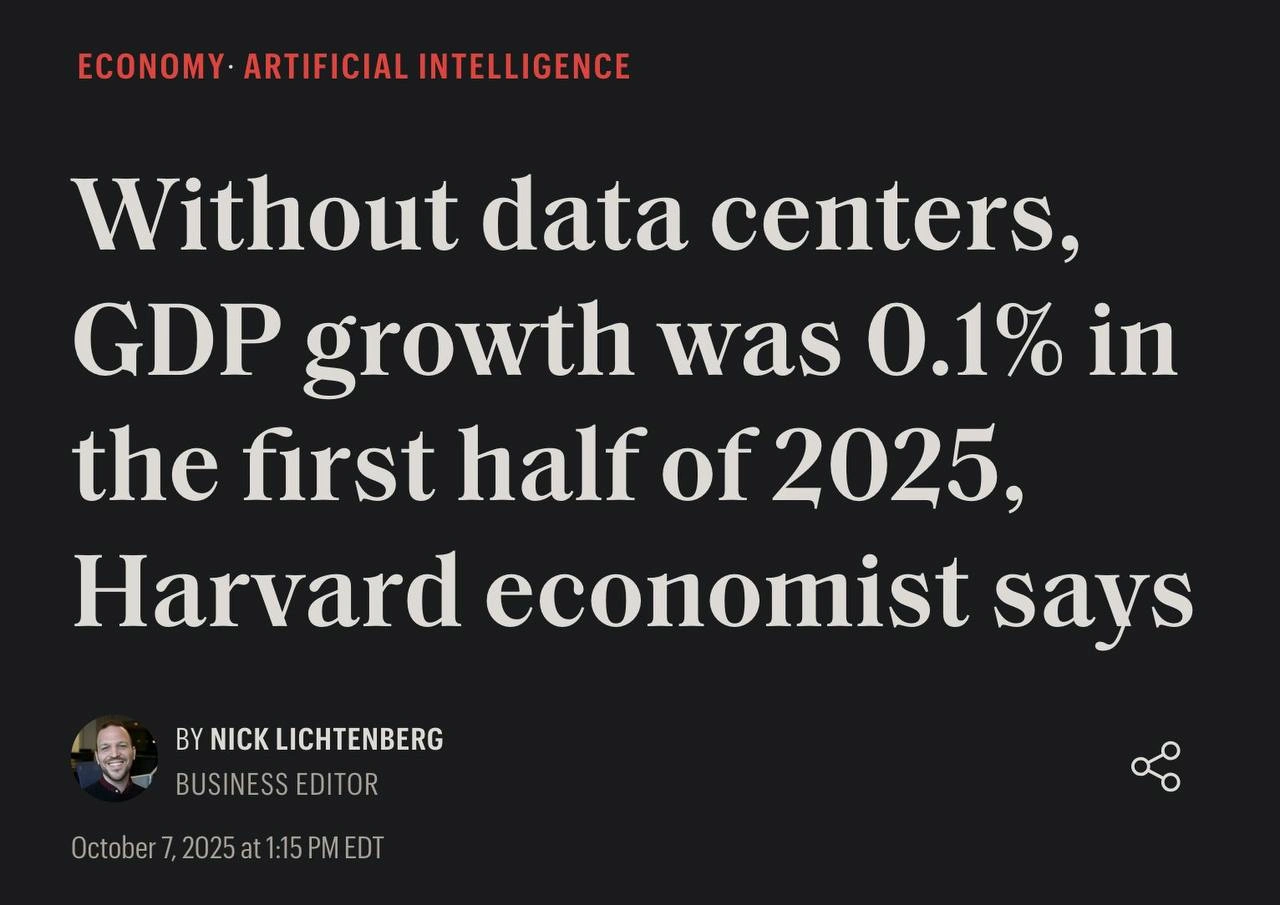
Let’s break down the humor in simpler terms. This meme is styled as if it’s a real news headline, claiming a Harvard economist said that without data centers, the economy’s growth was only 0.1% in early 2025. GDP – short for Gross Domestic Product – is basically the total value of everything a country produces. Normally, you’d expect GDP to grow a few percent each year from all kinds of spending (people buying things, companies building stuff, etc.). The joke here is that almost all of the growth came from companies building and running data centers (the giant buildings filled with computer servers that power cloud services and the internet). If you ignore that tech infrastructure spending, the economy barely grew at all (just 0.1%, which is almost zero).

Why is that funny to developers? Because it dramatically validates something we feel every time we see our cloud bill: that we’re spending crazy amounts on cloud computing. CloudComputingServices (like Amazon Web Services, Microsoft Azure, Google Cloud) let companies rent computing power and storage instead of running their own servers. This has become so popular that many companies have a huge monthly CloudInfrastructure bill – millions of dollars for some – just to keep their apps and AI models running.

In the meme, a “Harvard economist” pointing this out makes it official and absurd at the same time. It’s as if a serious researcher studied the economy and basically said: “Yep, all that money your company pours into AWS and new server racks is what kept the economy growing.” Engineers often joke about how expensive spinning up resources can be. For instance, running a cluster of GPUs (graphics processing units) for AI can burn money really fast. A GPU cluster is a bunch of powerful chips used to train AI models – think of dozens or hundreds of high-end graphics cards crunching data. These are not cheap to run; they consume a ton of electricity and cloud providers charge a lot for them per hour. So when a dev or data scientist hits the button to launch a big training job (that’s the “GPU cluster spin-up” referenced), it might cost thousands of dollars a day. Multiply that across many teams and companies all doing AI stuff, and you get an astronomical amount of money flowing into cloud providers.

Now tie that back to GDP: all that spending on cloud and data centers counts as part of the country’s economic activity. InfrastructureManagement costs – like buying new hardware, building data center facilities, or even just large cloud usage fees – are considered investments and expenses in the economy. So if in the first half of 2025 everyone was rushing to invest in AI and needed more servers, that would show up as a big blip in economic data. The meme’s headline specifically says “Without data centers, GDP growth was 0.1%,” implying with data center investments, GDP growth was much higher (perhaps a few percent). Essentially, building and upgrading tech infrastructure was propping up the economy’s growth rate.

To a junior developer or someone new to this, here’s why that’s humorous: it’s a huge contrast in scale. On one hand, you have the humble developer action like running kubectl apply – a command to deploy or update applications on Kubernetes (which is a system for managing containers on a cluster of machines). Engineers do dozens of kubectl apply deployments a day as routine work to roll out new code or services. On the other hand, you have GDP growth – a grand measure used by governments to gauge economic success. The meme is jokingly bridging those two worlds. It suggests that these everyday tech operations (like deploying an app or adding more server capacity) are now so expensive and widespread that they collectively influence nationwide economic stats. It’s like saying “Every time we push code to production and it scales up infrastructure, we’re doing macroeconomics.”

We should also explain CapEx since it’s central to this. CapEx means Capital Expenditure, which is money spent on assets that last a long time – like buildings, machinery, or in this case, data centers and servers. When companies invest in new data centers or big hardware purchases, it’s CapEx. An “AI data-center CAPEX boom” means companies are spending heaps of money buying new equipment and building facilities to support AI workloads. This is exactly what happened around 2024-2025 with the AI hype: cloud providers and even regular companies were investing a lot in infrastructure (more server racks, cooling systems, networking gear, you name it) to handle AI and cloud demand. Those purchases contribute to GDP because GDP counts investment in equipment and construction as part of its calculation.

The categories and tags mentioned (like Cloud, Infrastructure, IndustryTrends_Hype) indicate this meme is commenting on a big industry trend: the hype around cloud computing and AI driving real-world economic changes. IndustryTrends in tech can actually have economy-wide effects. Here, the trend is that every enterprise is going “all-in” on cloud and AI. The tag economist_hot_take suggests this is a spicy or surprising analysis from an economist linking tech spend to economic growth. And enterprise_aws_bill_as_macro_indicator is basically saying: imagine looking at how much companies pay AWS and using that to judge the economy, like how we use inflation or employment numbers. It’s hyperbole, but it’s rooted in the observation that these tech expenses are huge.

In summary, Level 2 is about explaining that the meme is joking how data centers (and by extension, those enormous cloud usage bills) have become so significant that they’re bolstering the whole economy’s growth. It’s funny because it’s kind of true – tech infrastructure spending was a major driver of growth in that period – yet it frames the everyday actions of developers (deploying apps, provisioning servers) as if they’re heroic economic contributions. You normally wouldn’t put “deploying code” and “national GDP” in the same sentence, so that contrast is what gets a laugh.

Level 3: The Cloud-Industrial Complex

At the highest level, this meme spotlights how our CloudInfrastructure habits have become entwined with macroeconomics. The headline proclaims that without data centers, GDP growth in early 2025 would have been a paltry 0.1%. In other words, nearly all of the economic growth came from companies pouring money into data centers. For seasoned engineers, this satirical “news” rings true in a darkly comic way. Just as the military-industrial complex once tied defense spending to the economy, we now have a cloud-industrial complex where hyperscale DataCenter build-outs prop up national GDP. The meme mimics a legit news article (complete with “ECONOMY · ARTIFICIAL INTELLIGENCE” tag and a serious serif headline) to drive home its point: our escalating cloud bills and Kubernetes clusters have gone from IT line-items to macroeconomic movers.

Think about the insane CapEx (capital expenditure) going into AI compute clusters around 2025. Tech giants and even cash-flush startups were racing to buy entire GPU farms to train large AI models. Those $100-million orders of NVIDIA chips and the construction of new server warehouses aren’t just tech news – they trickle into government economic reports as infrastructure investment. The humor is that every time we kubectl apply a new microservice or spin up a beefy GPU instance, some Harvard economist out there is nodding, attributing a slice of GDP growth to it. It’s a hyperbole, of course – a single developer’s workload won’t sway a $20 trillion economy – but when IndustryTrends reach a fever pitch (like the AI boom of the mid-2020s), the aggregate cloud spend across thousands of companies absolutely becomes macro-significant.

This resonates with anyone who’s witnessed InfrastructureManagement budget meetings. We joke that “my AWS bill is as big as the GDP of a small nation” – and here comes a headline essentially validating that jest. It satirically frames your company’s exorbitant CloudComputingServices expenses as a patriotic act of economic stimulus. enterprise_aws_bill_as_macro_indicator stops sounding like a ridiculous hashtag and more like a reality where Amazon’s quarterly earnings calls double as economic forecasts. There’s truth under the jest: analysts in 2025 really did note that surging investment in cloud data centers (often to support AI workloads) was propping up otherwise tepid economic growth. Remove that spending, and growth was near flat – hence the “0.1%” zinger in the meme.

From a senior dev perspective, the joke cuts deep. It highlights the absurd scale of modern cloud usage: compute and storage aren’t just supporting the business, they are the business (and apparently the economy too). The image’s deadpan news-presentation underscores a shared sentiment: our everyday work – deploying apps, scaling clusters, refactoring for performance – has ramifications beyond our product or team. In 2025, it felt like each time we provisioned a new Kubernetes cluster with auto-scaling, we were indirectly nudging some economic needle. The meme invites a wry smile at that notion. “Every kubectl apply is now a macro-economic event,” it implies – as if the economist_hot_take is that devs should get credit in the next GDP report. It’s validating our hunch that the cloud spending arms race has become so huge that even Harvard economists and Wall Street suits have to pay attention.

On a more serious note (delivered with a wink), this reflects how IndustryTrends_Hype – specifically the hype around AI – leads to tangible economic shifts. Historically, we saw similar spikes: the dot-com boom of the late ’90s drove massive telecom and data center investment, and the post-2007 smartphone revolution spurred entire new supply chains. Now the AI gold rush is doing it with cloud data centers. The meme hints that we haven’t just built a tech ecosystem, we’ve built an economy around it. Seasoned engineers might recall how after WWII, highway construction or NASA’s space program had large GDP impacts; in 2025, our “Apollo program” is upgrading from 64-core instances to 1024-GPU clusters.

And of course, there’s an undercurrent of cynicism: GDP growth (a key measure of a country’s economic health) being propped up by cloud spend is both impressive and a little alarming. It suggests a bubble-like dependency: What happens if that AI hype cools off? Will GDP fall because we finally cleaned up our cloud bills? The gdp_dependency_on_datacenters is funny as a meme, but it does poke at real questions about sustainability. For now, though, it gives us engineers a rare ego boost: deploying a new microservice might be a tiny act of economic heroism. Next time Finance grills you for that extravagant compute bill, you can quip, “Hey, I was just doing my part to boost the economy!” 🤷‍♂️

Description

A news article screenshot with categories 'ECONOMY' and 'ARTIFICIAL INTELLIGENCE' in red text, headline reading 'Without data centers, GDP growth was 0.1% in the first half of 2025, Harvard economist says.' Written by Nick Lichtenberg, Business Editor, dated October 7, 2025 at 1:15 PM EDT. The article highlights that data center construction and operations are essentially the only source of meaningful US GDP growth, with the rest of the economy barely growing at 0.1%

Comments

10
Anonymous ★ Top Pick The US economy is basically a data center with a country attached -- remove the GPUs and your GDP flatlines harder than a crashed prod server with no health checks
  1. Anonymous ★ Top Pick

    The US economy is basically a data center with a country attached -- remove the GPUs and your GDP flatlines harder than a crashed prod server with no health checks

  2. Anonymous

    When finance asks why your EC2 line item dwarfs office rent, just tell them you’re safeguarding national GDP

  3. Anonymous

    Ah yes, the classic 'correlation equals causation' play - next they'll tell us that without AWS bills, companies would have 99% higher profit margins. Though to be fair, given how much we're spending on GPU clusters to run models that generate slightly better marketing copy, maybe those data centers really are the only thing keeping the economy afloat

  4. Anonymous

    Turns out the real 'cloud' in cloud computing is the massive concrete buildings full of GPUs that now constitute 99.9% of GDP growth. Who knew 'infrastructure as code' would become 'infrastructure as economy'? At this rate, by 2026 we'll measure national prosperity in PUE ratings and rack density rather than manufacturing output

  5. Anonymous

    If GDP ex - data centers is 0.1%, then my capacity plan for 200MW and 40k H100s is now fiscal policy

  6. Anonymous

    Harvard quantifies what SREs live: data centers don't just scale pods, they scale entire economies - one TCO regret at a time

  7. Anonymous

    National accounts now have feature flags: turn off hyperscaler_capex and the economy enters maintenance mode; turn it on and your SREs start setting interest rates by tuning PUE and GPU allocation

  8. @NickNirus 9mo

    I love living in a historic time

  9. @f0cu53d 9mo

    Sure

  10. @Georgerozh 8mo

    админ спалился

Use J and K for navigation