Last-Minute Project Restrictions
Why is this ProjectManagement meme funny?
Level 1: So Close Yet So Far
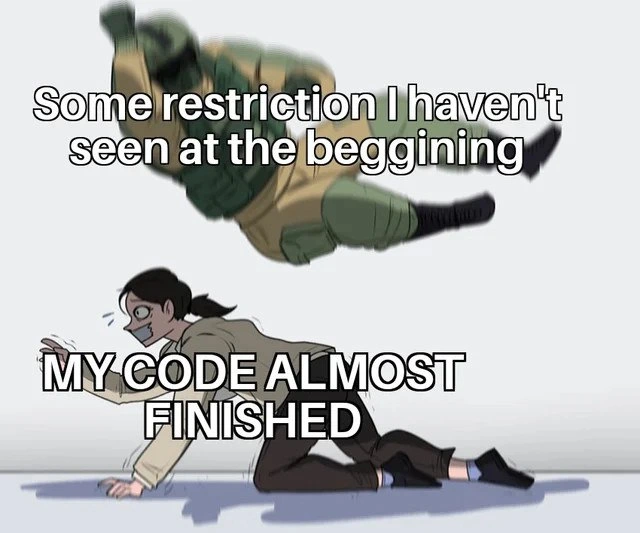
Imagine you’re running a race, and you can see the finish line up ahead. You’re exhausted but happy because you’re about to win. Then, out of nowhere, someone jumps in front of you and tackles you to the ground right before you cross that finish line. How would that feel? Probably pretty upsetting and unfair! That’s basically what this meme is showing, but in the world of coding. The “race” is the programmer finishing their project, and the “person who tackles them” is a new rule or requirement that nobody told the programmer about until the very end. It’s funny in a sorta painful way: you have to laugh a bit, because otherwise you’d just be mad. The picture makes it over-the-top dramatic (a full-on flying tackle!) which makes us laugh, but we laugh because we recognize that feeling. It’s the feeling of being so close to done and then suddenly not done at all because of one surprise. In simpler terms, it’s like almost finishing a big puzzle, and then your friend says, “Oh wait, the puzzle also needs a blue border that we didn’t mention before,” and dumps a bunch of new pieces in your lap. So the meme is joking about that last-second surprise that knocks you over just when you thought you had won.
Level 2: Now They Tell Us
Let’s break this situation down in simpler terms. In software development, scope creep refers to new features or requirements being added to a project after work has already started (or nearly finished). It’s like the project’s scope – what needs to be done – keeps creeping larger over time. This usually happens when stakeholders (the people who requested or will use the software, like clients or managers) change their minds or remember something late in the game. In the meme, “Some restriction I haven’t seen at the beginning” is exactly that: a requirement or rule that nobody mentioned at the start, popping up right before the end. The developer’s work (captioned “MY CODE ALMOST FINISHED”) is essentially done, and suddenly someone says, “Oops, we have to follow this rule or include this feature that we forgot about!” Cue the frustration.
This kind of last-minute surprise is a known pain point in the Software Development Life Cycle (SDLC). The SDLC is the process of building software, usually broken into phases like requirements gathering, design, coding, testing, and deployment. Ideally, all important requirements (what the software must do, and under what constraints) are identified in the first phase. Ambiguity in requirements – meaning the requirements were unclear or incomplete – can lead to misunderstandings. For example, maybe the requirement said “allow users to upload files” but didn’t specify a size limit or file type. The developer might implement a basic upload feature (thinking it’s almost done), and then very late someone says, “Actually, due to security policy, we can only allow images under 5MB.” That’s a surprise constraint if the developer wasn’t told from the start. Now the code needs changes to enforce file type and size restrictions, possibly reworking how the upload component was built.
Requirements Change Management is the practice of handling such changes in an organized way – usually by evaluating impact, adjusting timelines, etc. But in many real-world cases, especially if the deadline is near, the developer just gets a late “to-do” thrown at them without much ceremony. This meme’s humor is in how exaggerated yet relatable it is: an armored soldier tackling the developer symbolizes that sudden last-minute change hitting with force. Every junior dev eventually experiences this: you think you’ve met all the specs, you’re excited to wrap up, and then you hear “wait, it also needs to do X.” It feels like getting the rug pulled out from under you.
To make it concrete, here are a few typical scenarios that match the meme:
- Late Security/Compliance Rule: Imagine you built a website and right before launch, the security team says, “All user passwords must be stored with a stronger encryption.” If you weren’t told that initially, you might have to redesign part of your login system at the last second.
- Forgotten Stakeholder Request: Perhaps the client never mentioned that the app needs to work offline. You built it assuming constant internet. Days before delivery, they ask “Can it work without internet?” Now some restriction (the need for offline support) tackles you, forcing major changes.
- Environment/Compatibility Issue: You develop the app using the latest features of a library, feeling great. When you’re almost done, the deployment team says, “Our servers only run an older version of that library – you’ll have to make it compatible.” That’s a nasty surprise constraint requiring rewrites or finding workarounds.
For a junior developer, encountering this is a learning moment. It teaches why initial requirement gathering is so important, and why good communication with stakeholders matters. It also highlights the reality that requirements often evolve. Agile development processes actually expect and embrace some change (with frequent check-ins and iterations, so that new discoveries come out sooner rather than at the very end). But no process can eliminate surprises entirely – sometimes a requirement is truly overlooked until it’s almost delivery time. The best one can do is stay flexible and have a bit of buffer for the unexpected.
So in summary: “MY CODE ALMOST FINISHED” represents the developer’s nearly completed work. “Some restriction I haven’t seen at the beginning” represents a new requirement or limitation popping up very late. The result? A dramatic tackle – meaning the project is suddenly knocked off course, and the developer has to get back up and fix or redo things. It’s a comic way to describe a frustrating scenario that both newcomers and seasoned programmers eventually face. Now you know: when an older dev chuckles at mentions of last-minute changes or scope creep, this meme is exactly the kind of battle they’re remembering.
Level 3: The Hidden Requirement Ambush
This meme nails a classic SDLC sucker-punch: the scope creep or hidden requirement that blindsides you at the last moment. In the image, an armored soldier flying-tackles a crawling office worker. The labels tell the story: “Some restriction I haven’t seen at the beginning” (typo and all) is the armored assailant, and “MY CODE ALMOST FINISHED” is the poor developer inches from the finish line. It’s an exaggeration of a late-stage requirement ambushing a project, and trust me, every experienced developer has war stories of this exact scenario. It’s funny because it’s painfully true – we laugh to keep from crying.
In real projects, this "soldier" could be a last-minute compliance rule, a hidden security policy, or an unmentioned client expectation that shows up right before delivery. Perhaps the stakeholders forgot to mention that the app must support IE11, or a regulatory constraint (GDPR, anyone?) emerges during final testing. Suddenly the code that was “almost finished” is nowhere near done. The humor comes from the dramatic flying tackle imagery – it captures the shock and chaos of being hit with a new constraint out of nowhere. One minute you’re crawling toward the deploy line, the next you’re floored by a requirement that was AWOL in the kickoff meeting. It’s basically a project management nightmare condensed into an anime tackle scene.
The meme resonates because it satirizes a recurring industry pattern: requirements ambiguity leading to last-minute changes. It highlights the gap between ideal process and reality. In theory, all requirements are gathered at the start (especially in a Waterfall model of development). In practice, something crucial often slips through the cracks. Maybe a non-functional requirement (like “the system must handle 10,000 concurrent users” or “data must be encrypted at rest”) wasn’t stated upfront. By the time someone shouts “Oh, by the way, we need to also do X!”, the architecture might not support X at all. That’s when developers mutter curses under their breath and recall why RequirementsChangeManagement is a thing. The meme’s text being slightly misspelled (“beggning” instead of beginning) is almost poetic – it’s like the restriction popped up so suddenly that even the caption didn’t get a spell-check.
From a senior engineer’s perspective, the ambush of a late requirement is both hilarious and exasperating. It’s hilarious in a dark comedy way because we’ve all seen critical details emerge in the eleventh hour. We joke about “It’s always in the last place you look – like after you’ve built the whole darn thing!” But it’s exasperating because such surprises wreak havoc on timelines, budgets, and morale. Often, these late restrictions imply significant rework: maybe refactoring core modules, redesigning a UI flow, or rewriting that part of code that was “done” yesterday. The meme underscores a truth: in software, “Done” rarely means done – there’s always an out-of-scope feature lurking.
Why does this keep happening? Sometimes it’s poor initial communication (the client said they wanted a blog site but didn’t mention needing e-commerce until final review). Sometimes it’s evolving understanding – stakeholders themselves only realize what they truly need after seeing the product almost complete. And sometimes it’s just Murphy’s Law of Development: if something can trip you at the finish line, it will. Organizations try to prevent this with agile methods, iteration, and change control boards – yet surprise constraints still slip through. The meme’s broad relatability is a nod to systemic issues: incomplete specs, moving goalposts, and the eternal truth that “no plan survives first contact with reality.”
In short, this panel is a comedic take on developer frustration: it visually captures that gut-punch moment in projects when a new requirement or a forgotten restriction flips the table you were about to serve. The armored tackle is absurdly over-the-top, which is exactly how it feels when you hear, “We need to support multi-tenancy” at 99% completion. It’s a mix of shock, horror, and “of course this happens now” cynicism. And as every veteran dev knows, you’re not truly battle-hardened until you’ve been body-slammed by an eleventh-hour requirement.
# Pseudocode dramatizing the final moment surprise
try:
project.finish() # developer thinks everything is done
except UnseenRestrictionError as e:
print(f"Project tackled by a last-minute restriction: {e}")
implement_new_constraint()
refactor_existing_code()
That code snippet above is the story of our lives: you call finish() on the project, but instead of glory you catch an UnseenRestrictionError. Time to patch, refactor, and groan. The meme gets a chuckle because it’s a scenario so absurd yet so common that laughing is easier than screaming. It’s the “I’ve been there” moment shared across dev teams worldwide – we’ve all had our code crawling to completion, only to be WWE-slammed by a requirement we never saw coming.
Description
A meme illustrating a common developer crisis using a two-character action scene template. In the foreground, a terrified-looking woman labeled 'MY CODE ALMOST FINISHED' is crawling on the floor, seemingly trying to escape. Her mouth is taped shut, symbolizing her inability to protest. From the top of the frame, a heavily armored soldier, blurred with motion, is depicted mid-air, about to body-slam her. This soldier is labeled 'Some restriction I haven't seen at the beginning'. The meme powerfully visualizes the painful experience of being near the completion of a project, only to be blindsided by a previously unknown requirement, constraint, or stakeholder feedback that fundamentally breaks the existing work, requiring a massive, painful rework. The misspelling 'beggining' in the original text adds a layer of raw, unpolished authenticity to the meme
Comments
8Comment deleted
That 'restriction' is usually an undocumented API behavior, a non-functional requirement from security that just surfaced, or the client casually mentioning it also needs to run on a smart fridge
Nothing says “enterprise agile” like finishing all the stories and having compliance halo-drop in at the release gate: “Great demo - now make it FIPS, PCI, HIPAA and still run on that Solaris 10 box we forgot to mention.”
After 20 years in this industry, I've learned that 'code complete' is just the universe's cue to reveal that one critical security requirement buried in appendix J of a document no one mentioned existed until the security review
When you're 3000 lines deep into a generic implementation and the compiler casually mentions that your trait doesn't satisfy 'static + Send + Sync + Clone + Debug + PartialEq + Eq + Hash + Display + Default + From<T> + Into<U>' bounds. Sure, let me just refactor my entire architecture because you decided to mention this *now*
Nothing turns code‑complete into archaeology faster than the Friday ping: “also needs SSO, data residency, and idempotent writes” - the true final boss of the SDLC
‘Code complete’ until compliance dive-bombs with “air‑gapped, mTLS-only, no third‑party egress, and p99<50ms” - NFRs always unlock at the final boss
When the PO's 'one more thing' acceptance criterion spawns like an unknown unknown in your threat model
Where do you get this stuff from 🤣🤣🤣🤣🤣🤣 Comment deleted