Skip to content
DevMeme
986 of 7435
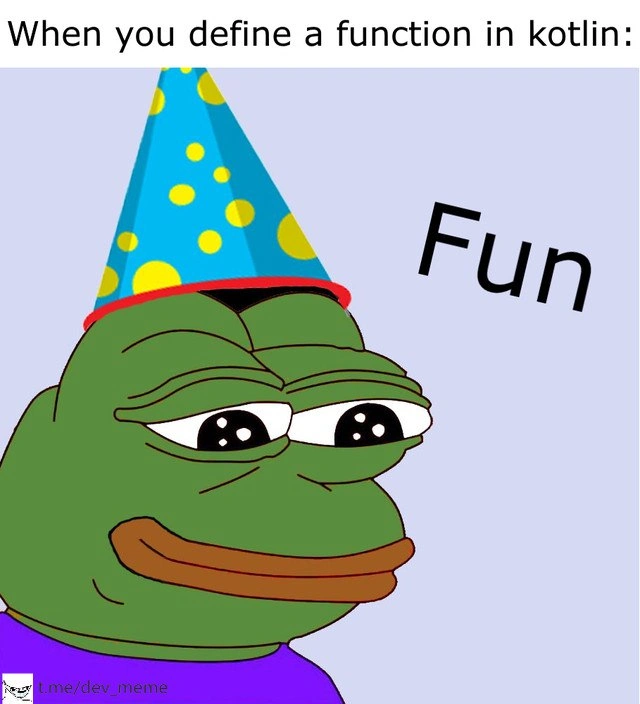
When Kotlin’s 'fun' keyword makes every function definition unexpectedly fun
Languages Post #1109, on Mar 6, 2020 in TG

When Kotlin’s 'fun' keyword makes every function definition unexpectedly fun

Why is this Languages meme funny?

Level 1: Starting with Fun

Imagine if every time you began a school assignment, your teacher made you put on a party hat and say the word “fun.” 😃 For example, before doing math homework, you announce, “Fun: solve 2 + 2!” It sounds silly, but it might make you smile and think, “Okay, I guess this will be enjoyable!” Writing a function in Kotlin is a bit like that. The language forces you to start with the word fun, almost like you’re saying “Hey, this is going to be fun!” even if you’re just doing normal work. The meme shows a frog with a birthday hat celebrating, which is exactly how it feels: every new task (function) in Kotlin comes with a tiny built-in celebration. It’s funny because in real life, we don’t throw a party for every little task – but Kotlin’s code makes it look as if we do. So the joke is simply that Kotlin tries to make a boring thing (defining a function) sound upbeat by literally calling it fun. Even if you don’t know coding, the idea of starting each job with the word “fun” is a cheerful twist that anyone can giggle at.

Level 2: Defining Fun

Let’s break down why this meme is amusing, especially if you’re newer to Kotlin or programming. Kotlin is a modern programming language (created by JetBrains) that runs on the Java Virtual Machine and is known for its concise syntax and friendly features. One of those features is how you define a function. A function is just a reusable block of code that performs a task, and many languages have a special way to declare one. In Kotlin, to declare a new function, you must start the line with the fun keyword. Yes, the actual word fun is typed in your code. This isn’t a joke by the compiler – it’s the official syntax. For example, if you want to write a function that prints a celebration message, you would do it like this:

// In Kotlin, use the 'fun' keyword to declare a function.
fun celebrate() {
    println("Yay, it works!")
}

Here, fun celebrate() { ... } defines a function named celebrate. The word fun tells Kotlin “here comes a function definition.” It’s short for “function,” similar to how some other languages use def (Python) or fn (Rust). But because fun is an English word meaning enjoyment, it creates a funny double meaning in the code. Every time you write fun, it reads like you’re saying “fun, here’s a new thing to do!”. This is the syntax wordplay the meme is pointing out.

Now, what does the meme show? At the top, it says:

When you define a function in Kotlin:

This caption sets up the joke. It’s like the meme is answering the question, “What happens when you write a function in Kotlin?” Of course, in reality nothing magical happens – you’re just writing code. But the meme imagines that because you wrote fun, something fun should happen. So next, it shows a picture of a cartoon frog (that’s Pepe the Frog, a well-known meme character) wearing a colorful party hat. Beside the frog, the word “Fun” is written in big bold letters. The frog looks content (maybe a little smug), and the party hat gives a celebratory vibe. This image is basically saying: “Defining a function in Kotlin is a fun celebration!” It’s a function_definition_joke brought to life. The frog with the party hat is an absurdly literal representation of the Kotlin fun keyword – as if the code itself threw a tiny party because you started a new function.

Why is this funny to developers? Because it’s a classic case of language quirks turning into humor. Kotlin’s fun keyword makes perfect sense to the compiler and to us as coders (it’s just how you write a function), but it also reads like a cheerful word in plain English. Developers have an inside joke here: most programming languages are full of dry, boring keywords, but Kotlin sneakily makes your code sound positive. The meme exaggerates that feeling. It resonates with anyone who has written Kotlin and noticed, “Haha, I’m literally writing ‘fun’ all over my code.” It’s light-hearted CodingHumor — a reminder that sometimes the tools we use have a sense of humor in their design. And for someone new to Kotlin, this meme also cleverly teaches you a fact: the way to define a function is by typing fun. Who knew documentation could be this meme-able?

Level 3: Function Fiesta

Kotlin developers literally have fun every time they write a function. In Kotlin’s syntax, the keyword to define a function is fun – a concise design choice that doubles as a playful pun. This means every function definition in Kotlin code begins with the word fun, making it look as if the language is declaring that coding is fun by default. For seasoned programmers coming from more verbose languages, this is both a refreshing bit of Developer Humor and a testament to Kotlin’s focus on developer experience (DX). It’s a small Language Quirk that can bring a smile: after years of writing boilerplate like public static void, a simple three-letter keyword feels like a party.

To put this into perspective, consider how different languages declare a function:

Language Function Declaration Syntax
Java No dedicated keyword – e.g. public void doTask() { } (inside a class)
Python def – e.g. def do_task():
Rust fn – e.g. fn do_task() { }
Kotlin fun – e.g. fun doTask() { }

In Java, you might start a method with a tangle of keywords and a return type; in Python you use the shorthand def (short for “define”). Kotlin, however, chose to go with fun – which not only stands out for its brevity but also reads as a real English word fun. The table above shows how Kotlin’s syntax turns an ordinary function definition into something that looks celebratory compared to its peers. This design decision is more than just aesthetics: it reflects Kotlin’s philosophy of reducing ceremony in code. By stripping away excess keywords and using a friendly shorthand, Kotlin improves readability and DeveloperExperience_DX, making everyday coding tasks feel a bit more enjoyable (or at least less tedious). You could say that Kotlin injects a little joy into routine function declarations.

The humor in the meme comes from taking this syntax literally. The meme’s top banner sets the scene: “When you define a function in Kotlin:”. Below it, we see the familiar Pepe the Frog character wearing a festive blue birthday hat, next to the big, tilted word “Fun” in bold. Pepe’s presence (a popular internet meme frog often used in coding jokes) plus the party hat visually scream celebration. It’s as if the act of defining a function triggers a mini party 🎉. Every time you write a fun in your Kotlin program, picture this frog grinning under a party hat — Function definition = fun times! This image strikes experienced devs as hilariously apt because, in a sense, the language itself is saying “Have fun writing this function!”

Beyond the visual gag, there’s an industry inside-joke here. Kotlin was created to address the frustrations Java developers faced: too much boilerplate and not enough modern language niceties. The fun keyword embodies Kotlin’s lighthearted solution to a serious problem – it dramatically simplifies function syntax. Seasoned programmers remember how defining a simple function in older languages could involve a dozen characters of setup; in Kotlin it’s just three letters and you’re off. The meme exaggerates that positivity: defining functions isn’t normally a celebratory event (especially if you’re debugging at 3 AM), but Kotlin’s syntax at least sounds cheerful. It’s a bit of syntax wordplay that resonates with developers who appreciate when a language’s design doesn’t take itself too seriously. In a world of enterprise code full of dense keywords and monotonous patterns, seeing fun peppered throughout your codebase feels almost like an inside joke the language designers shared with you. As a senior dev, you nod knowingly at this meme because you’ve been in those code reviews where someone quips, “You can’t spell function without fun,” and in Kotlin, that’s delightfully true. It’s KotlinProgramming culture in a nutshell: pragmatic improvements with a touch of playfulness.

Description

The meme has a white banner at the top with black text that reads, "When you define a function in kotlin:". Centered below, the familiar cartoon frog character wears a blue cone-shaped birthday hat decorated with yellow dots, all set against a light lavender background. To the right of the frog, the single word "Fun" is printed in large, tilted, bold black letters. A tiny watermark "t.me/dev_meme" sits in the lower-left corner. Visually, the joke exploits the Kotlin language keyword "fun" - used to declare functions - by literally portraying it as a celebratory moment, highlighting a playful language quirk that resonates with developers who appreciate concise syntax and wordplay in programming language design
Comments

6
Anonymous ★ Top Pick Kotlin makes you prefix every method with “fun,” but once it’s inline, suspend, reified, and an extension on a sealed generic, the only thing still having fun is the compiler
  1. Anonymous ★ Top Pick

    Kotlin makes you prefix every method with “fun,” but once it’s inline, suspend, reified, and an extension on a sealed generic, the only thing still having fun is the compiler

  2. Anonymous

    After 15 years of explaining why Java's verbosity is actually "enterprise-ready documentation," you switch to Kotlin and realize the real enterprise pattern was Stockholm Syndrome all along

  3. Anonymous

    Kotlin's designers knew exactly what they were doing when they chose 'fun' over 'function' or 'def' - it's the only language where your code reviews can legitimately start with 'this fun isn't fun enough.' Meanwhile, Java developers are still typing 'public static void' and wondering why their standups feel so formal

  4. Anonymous

    Kotlin calls it “fun”; the minute your suspend fun touches a Java callback, it becomes resumeWith(Exception)

  5. Anonymous

    Kotlin's 'fun': syntactic joy that inevitably funnels into Java interop regret

  6. Anonymous

    Kotlin guarantees at least one ‘fun’ per file - the rest waits behind a seven‑minute Gradle sync, a kapt round, and an IDE cache rebuild

Use J and K for navigation