Technical debt explained as soul payment in a dark Twitter meme
Why is this TechDebt meme funny?
Level 1: Candy and Cavities
Imagine you have a big bag of candy. You really want to eat it all now, and you don’t feel like brushing your teeth afterward because you’re busy having fun. So, you gobble up the candy and skip brushing for days. In the short term, you’re happy – you got the sweet taste and saved time not doing boring tooth-brushing. This is like taking a shortcut. But a week later, uh-oh! You end up with a bunch of painful cavities and have to spend a long time at the dentist, which is scary and no fun at all. Now you’re paying for that shortcut. You didn’t pay with money; you paid with pain and regret (and maybe a little bit of your happiness).
This meme is saying coding can be like that too. Sometimes a programmer is in a rush and writes messy code just to make something work quickly – that’s like eating all the candy. It feels good at the time because the feature is done faster. But later on, that messy code causes big problems (like the cavities), and the programmer has to fix it, feeling very stressed out (like a dreaded dentist visit for the soul 😢). Instead of paying dollars, the programmer “pays” with frustration, late nights, and stress – basically with a bit of their soul or spirit. It’s a funny way to describe a feeling everyone understands: if you take an easy way out now, you might face a bigger, nastier problem later. The reason it’s humorous is that it uses a dramatic example (paying with your soul!) to make a simple point: shortcuts can come back to bite you, and when they do, it hurts in a very personal way. It’s like saying, “Remember how great it was not doing the hard work earlier? Well, now the bill has arrived, and it’s going to cost you peace of mind.” That twist – treating your inner happiness as the currency – makes people laugh, because it’s a silly exaggeration that still feels kinda true.
Level 2: Sanity on Credit
In simpler terms, technical debt is what happens when programmers take shortcuts in code. It’s like when you say, “I don’t have time to do this the right way, I’ll just do it the fast way for now.” The term comes from the idea of debt in money: you “borrow” time now by not polishing the code, but you owe extra effort in the future to fix or maintain it. In this meme, a developer on Twitter jokes about explaining this concept to a therapist. The reply says, “It’s like normal debt, but instead of an actual currency, you pay with your soul.” This is a soul_payment_analogy – a darkly funny way to say that the “payment” for coding shortcuts isn’t money, it’s your well-being and sanity.
Let’s break it down. Normal debt (like a loan or credit card debt) means you owe money that you have to pay back later, usually with interest. TechnicalDebt means you owe work that you’ll have to do later to fix issues because you chose a quick fix today. The “interest” on tech debt is the extra problems and time-wasters that come up as a result. For example, imagine you’re a junior developer working on a website and there’s no time to write proper tests or clean up the code before launch. You comment // TODO: improve this later and move on. That’s incurring technical debt. The site might work fine for now (you “got the feature out”), but perhaps a month from now, that unfinished bit of code causes a bug that takes five hours of debugging. Those five hours and the stress are the interest payment on the debt you took.
Now, why involve a therapist in this joke? Therapists aren’t typically familiar with programming jargon, so the developer is asking how to explain a geeky concept in everyday terms. Debt is a universal concept a therapist would get, and saying “you pay with your soul” emphasizes how emotionally draining and painful tech debt can feel to a coder. It’s a bit of DarkHumor: combining a serious personal feeling (losing a piece of your soul, feeling burnt out) with a very technical situation (messy code you have to fix later). Developers often use exaggerated phrases like “this code is killing me” or “I sold my soul to meet that deadline” to describe burnout and frustration. Here, the joke is exactly that: too much tech debt at work makes you feel like each day you give up a bit of your happiness (existential_developer_cost).
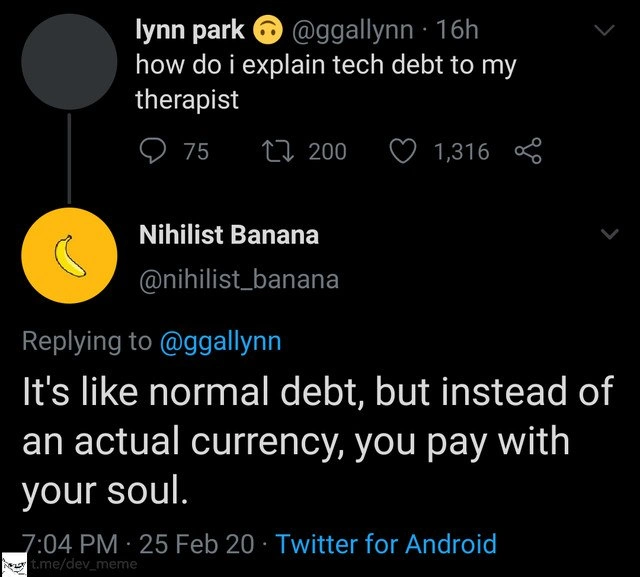
The Twitter format of the meme is also telling. We see the original tweet from lynn park (@ggallynn) asking, “how do i explain tech debt to my therapist”, followed by a reply from Nihilist Banana (@nihilist_banana). The dark background indicates Twitter’s dark mode, which aesthetically fits the dark humor of the content. The reply by “Nihilist Banana” (with a banana icon next to the name) adds to the silliness and gloom – nihilism means believing life is meaningless, so of course a Nihilist Banana would give an answer involving paying with your soul. The engagement metrics (75 replies, 200 retweets, 1,316 likes) show that many people found this reply relatable and funny – a lot of developers saw this and said “Yep, exactly how it feels!”
Let’s connect this to real developer life, especially if you’re new to the field. Imagine in your first job you’re asked to add a feature to an old application. The code is a bit messy, but you can make your feature work by copy-pasting some code from elsewhere and tweaking it. It works, you meet the deadline, everyone’s happy… until later, when that piece of code breaks something else or needs updates. Suddenly, it’s hard to change because it wasn’t done cleanly. You (or the next developer) spend lots of time untangling the problem, feeling frustrated by how fragile it all is. That frustration and extra time are you “paying” for the earlier shortcut. It didn’t cost money, but it sure cost nerves and time. If you’ve ever stayed late at work fixing a gnarly bug in a hurry, you know the exhausted, drained feeling that comes after. That’s the soul payment the meme refers to.
The phrase “pay with your soul” isn’t literal, of course. Soul here means your inner energy, patience, or happiness. It’s saying that dealing with lots of technical debt can make you miserable or burned out. This is where MentalHealth comes in: in the tech industry, people are starting to talk more about how constant stress (from things like impossible deadlines or bad code) affects developers’ mental well-being. The meme is funny to developers because it takes a serious truth – “bad code makes my job really hard and stressful” – and expresses it in an extreme, comic way as if a piece of your soul is the price. It’s an exaggeration that contains a kernel of truth, which is what makes it relatable humor.
Also, note the dynamic here: a developer wanting to explain a workplace issue (tech debt) to a therapist means work stress has become personal stress. The reply basically advises using a simple analogy: compare tech debt to debt in real life. This is actually good advice! If you ever need to explain a tech concept to a non-tech person, analogies like “it’s like a credit card” are super useful. In this case, you’d say: “We have something in programming called technical debt. It’s like when you don’t clean your house for weeks – eventually the mess is so bad that you spend an entire weekend cleaning. We saved time initially, but paid for it later with big effort. It’s the same in coding: skip proper steps now, pay with huge headache later.” The meme’s answer is just a more dramatic version of that: skip steps now, pay with your soul later.
For a junior developer or someone new to coding, it’s important to know what technical debt means, because you’ll definitely encounter it. You might hear a teammate say, “We’re taking on some tech debt to hit this deadline,” or “Refactoring that old module is paying off tech debt.” It essentially means trading quality or completeness for speed, then budgeting time in the future to make up for it. Think of it like building a shortcut in a video game: you skip to the next level quickly, but maybe you missed picking up a key item, and that makes the next levels harder. You’ll have to backtrack later, which is annoying and time-consuming. That’s tech debt. The tweet just adds the twist that this backtracking isn’t paid in coins or points, but with a bit of the player’s soul, i.e., their morale and energy.
In summary, this meme uses a slice of DeveloperHumor to make a point: Technical debt can really weigh on you. It might be a normal part of software development, but too much of it and you start feeling it personally. Saying “you pay with your soul” is a funny, melodramatic way to acknowledge that feeling. It gets a laugh from coders because we’ve all been there—staring at messy code and feeling our heart sink. Yet, we find it funny because humor helps us cope. We joke that a piece of us dies inside with each ugly hack we write, and in this meme, that’s exactly the currency being used.
Level 3: Debt of the Damned
In this meme, a weary developer on Twitter asks how to explain technical debt to their therapist, and a reply deadpans: “It’s like normal debt, but instead of an actual currency, you pay with your soul.” 🤖 TechnicalDebt here is being compared to a Faustian bargain in coding. We laugh (perhaps a bit bitterly) because it rings true: every quick-and-dirty code fix feels like swiping a credit card against the DeveloperFrustration account. Over time, the “interest” on these hacks accumulates until maintaining the software exacts a toll on your sanity – that’s the soul_payment_analogy.
Technical debt is an industry metaphor originally coined by Ward Cunningham to describe the cost of shortcuts in software. Like financial debt, it comes with interest: cut a corner now (say, hardcoding a value or ignoring a failing test) and you’ll pay compounded pain later when the kludge blows up. The tweet’s dark humor nails this: you save time today (no actual currency spent up front), but you will cough up payment in the future — not in dollars, but in debugger sessions, pager alerts at 3 AM, and sanity points. It’s a grim TechHumor twist on “Buy now, pay later.” Every seasoned engineer has felt that creeping dread working on a legacy codebase held together by duct tape and prayer. Each awkward workaround or // TODO: fix this is like another withdrawal from your mental health bank. Eventually, the “interest” – those extra hours of refactoring and bug-fixing – comes due, and it feels like it’s being extracted straight from your soul.
This tweet resonated widely (over a thousand likes) because it captures a universal DeveloperHumor truth: quick fixes mortgage your future. The response by Nihilist Banana (fitting name, right? 🍌) distills the RelatableHumor and despair of dealing with accumulated cruft. The meme sits at the intersection of TechDebt and MentalHealth, shining light (or rather, a dark glow) on something devs rarely admit outside stand-up meetings: carrying too much tech debt is soul-sucking. We’ve all inherited projects where just adding a small feature means untangling a decade’s worth of bad decisions. The code works, sure, but maintaining it slowly chips away at your motivation. It’s existential_developer_cost made explicit – codebase entropy converted into late-night stress and venting to your therapist.
Why is this so funny to those in the know? Because it exaggerates what we already feel. Explaining a deeply technical concept like explaining_technical_debt to a non-technical therapist forces a brutally honest analogy: “In my job, when we rush things, it’s like taking out a loan. But instead of money, I’m paying back that loan with my well-being.” That’s comically bleak, yet every engineer understands it immediately. DarkHumor thrives on truth, and the truth is that consistently living with massive tech debt can make even the most upbeat coder feel like a husk of their former self. The meme’s Twitter format (white text on black twitter_meme_format dark mode, complete with a tired emoji 😪 in the name) accentuates the mood. It’s as if the dev is sighing through the screen. And the reply’s analogy “you pay with your soul” isn’t just jokey exaggeration—it’s a candid acknowledgment of the personal toll that endless bugfixes, duct-tape solutions, and runaway TechnicalDebt exact on developers.
Picture a developer in a sprint planning meeting, voice trembling slightly as they say, “We really need time to address our tech debt,” while managers glare because new features have deadlines. That dev knows what’s coming: if they keep coding atop a shaky foundation, every new task will be harder, every on-call rotation will be rougher. They’ll be paying for those shortcuts with overtime, stress dreams, and yes, maybe conversations with a therapist about why work leaves them so drained. The tweet nails the irony: technical debt isn’t listed in the financial ledger, but experienced devs track a spiritual ledger of sorts. The more you postpone fixes, the more “soul interest” accrues.
In extreme cases, a codebase overloaded with tech debt becomes a haunted mansion for engineers: every attempt to change something awakens new ghosts (bugs) that torment the team. Cleaning it up feels like an exorcism. 😈 The veteran Cynical part of me chuckles because I’ve been there—refactoring a gnarly 10,000-line function at 2 in the morning, muttering “Never again” yet knowing it will happen again. Each ugly workaround we add to meet a release date is like striking a deal with the devil of deadlines: “I’ll give you this feature now, but in return I’ll curse the maintainers.” The “soul” in the meme is that intangible part of you that dies a little every time you have to dive into a monstrous, debt-ridden function named something like DoEverythingAndLegacySupport().
We also see a bit of Nihilist philosophy in the reply: a banana avatar proclaims a truth about suffering for one’s code. It implies an almost absurd acceptance: yes, tech work will hurt, and you just give a part of yourself to it. This is programmer cynicism at its finest. It’s funny because it’s phrased in a casual way (“you pay with your soul”) to describe something all too real. In an environment where burnout is common, a joke like this is a pressure release. It’s a way of saying “I’m not alone; we’re all paying off some invisible debt and feeling the burn.”
Finally, consider the context: a developer is asking their therapist how to describe this work problem. That’s a telling scenario. Therapists deal with human emotions, not code quality. So the developer has to translate tech troubles into everyday terms. The winning translation equates it to debt – a concept any adult understands – with a dark twist that the currency is one’s soul. It emphasizes just how personally draining tech debt can be, enough to belong in a therapy session. For seasoned devs, it’s a rueful laugh: “If only I could pay off tech debt with actual money instead of sanity, I’d gladly throw cash at it.” But instead, we often pay with late nights, frustration, and diminished MentalHealth. That’s the crux of the humor: it’s tragicomic. The absurd exaggeration (soul as payment) barely feels like exaggeration when you’re staring at 10,000 lines of untested spaghetti code. The meme holds up a mirror to developers, reflecting our collective RelatableHumor nightmare in one concise, viral tweet.
// Pseudo-code illustrating the tech debt trade-off:
if (deadline_is_immediate) {
implementQuickHack(); // take the shortcut now, incur tech debt
// (We'll "fix it properly later", famous last words)
} else {
buildRobustSolution(); // the ideal approach, if only we had time
}
// By choosing the quick hack, you're effectively borrowing time.
// The interest payment? All those future debugging sessions, of course.
Each time this code runs in real life (and trust me, it does all the time), an engineer’s soul counter ticks down a bit. 😅 The humor is cathartic: by joking that part of our soul is the price, we cope with the uncomfortable truth that bad code isn’t just a technical problem – it’s a psychological burden. In short, this meme speaks an ancient truth of the coding craft: “You can either spend effort now, or spend blood, sweat, and tears later.” And when you consistently choose “later,” don’t be surprised when the debt collector comes for your soul.
Description
Screenshot of Twitter in dark-mode. The first tweet, white text on black, reads: “lynn park 😪 @ggallynn · 16h how do i explain tech debt to my therapist” and shows 75 reply, 200 retweet and 1,316 like icons beneath it. An indented reply follows from a user with a banana avatar: “Nihilist Banana @nihilist_banana Replying to @ggallynn It's like normal debt, but instead of an actual currency, you pay with your soul.” A timestamp line at the bottom says “7:04 PM · 25 Feb 20 · Twitter for Android,” and a tiny “t.me/dev_meme” watermark sits in the lower-left corner. The image humorously equates accumulated technical shortcuts (technical debt) to financial debt, but with the existential cost of a developer’s “soul,” highlighting both the psychological burden and the software-engineering concept for an audience familiar with codebase decay

Comments
6Comment deleted
Technical debt is the corporate credit card with 0% interest until prod, then the APR converts to 3 a.m. PagerDuty alerts - payable in whatever’s left of your enthusiasm
Technical debt compounds at the same rate as your therapist's hourly fee, except one is measured in story points and the other in actual points you're trying to make about why refactoring that 2008 jQuery spaghetti is affecting your sleep schedule
Technical debt is the only loan where the interest compounds in existential dread rather than percentage points, and the collection agency is your own conscience at 3 AM wondering why you chose that 'temporary' workaround five years ago that's now load-bearing infrastructure
Tech debt: where 'quick fix' today means your future architect self pays compound interest in soul-crushing refactors and Jira tickets from hell
Tech debt is a negative‑amortization loan where interest compounds as onboarding time and MTTR, and the only accepted collateral is your weekends
Tech debt is a payday loan from future-you: interest compounds in cycle time and 3am pages, the principal lives in a 4k-line utils with global state, and Product keeps refinancing it as “MVP.”