KoreanFlare: Voice CAPTCHA Startup Pitch Targeting North Korean Hackers
Why is this Security meme funny?
Level 1: The Secret Password the Villain Can't Say
Imagine a clubhouse that keeps getting robbed by one specific bully's gang. The kids install a new lock — but instead of a key, the door asks you to shout an insult about the bully's boss before it opens. Any normal kid can say it and walk in. But the gang members can't — their boss would be furious — so they just stand outside, stuck. The joke is that instead of building a stronger lock, someone built a door that runs on embarrassment, then asked rich grown-ups to pay for it like it's a serious invention.
Level 2: The Parts Being Parodied
- CAPTCHA / Turnstile: those "verify you are human" boxes on websites. Cloudflare's Turnstile is the modern checkbox version — the meme clones its exact visual design, which is why it reads as instantly legitimate.
- Lazarus Group: North Korea's state-sponsored hacking unit, responsible for the largest cryptocurrency thefts in history. They fund a government with stolen tokens, which is why "North Korean hackers" is a real line item in every exchange's threat model.
- Voice authentication: verifying identity by voice. Real versions check voiceprints (biometrics); the joke version checks willingness, which is not a biometric but arguably more robust against this one specific adversary.
- Wallet protection: crypto wallets are guarded by keys and passwords; steal the key, own the funds — irreversibly. That irreversibility is why exchange hacks are catastrophic and why "better verification than enter password" lands as a real need.
- The VC tag-storm: opening a tweet by @-ing four famous crypto investors is the format of someone performing a pitch for an audience, not making one — the modern "investors hate this one trick."
Level 3: Something You Know, Something You Have, Something You Cannot Say
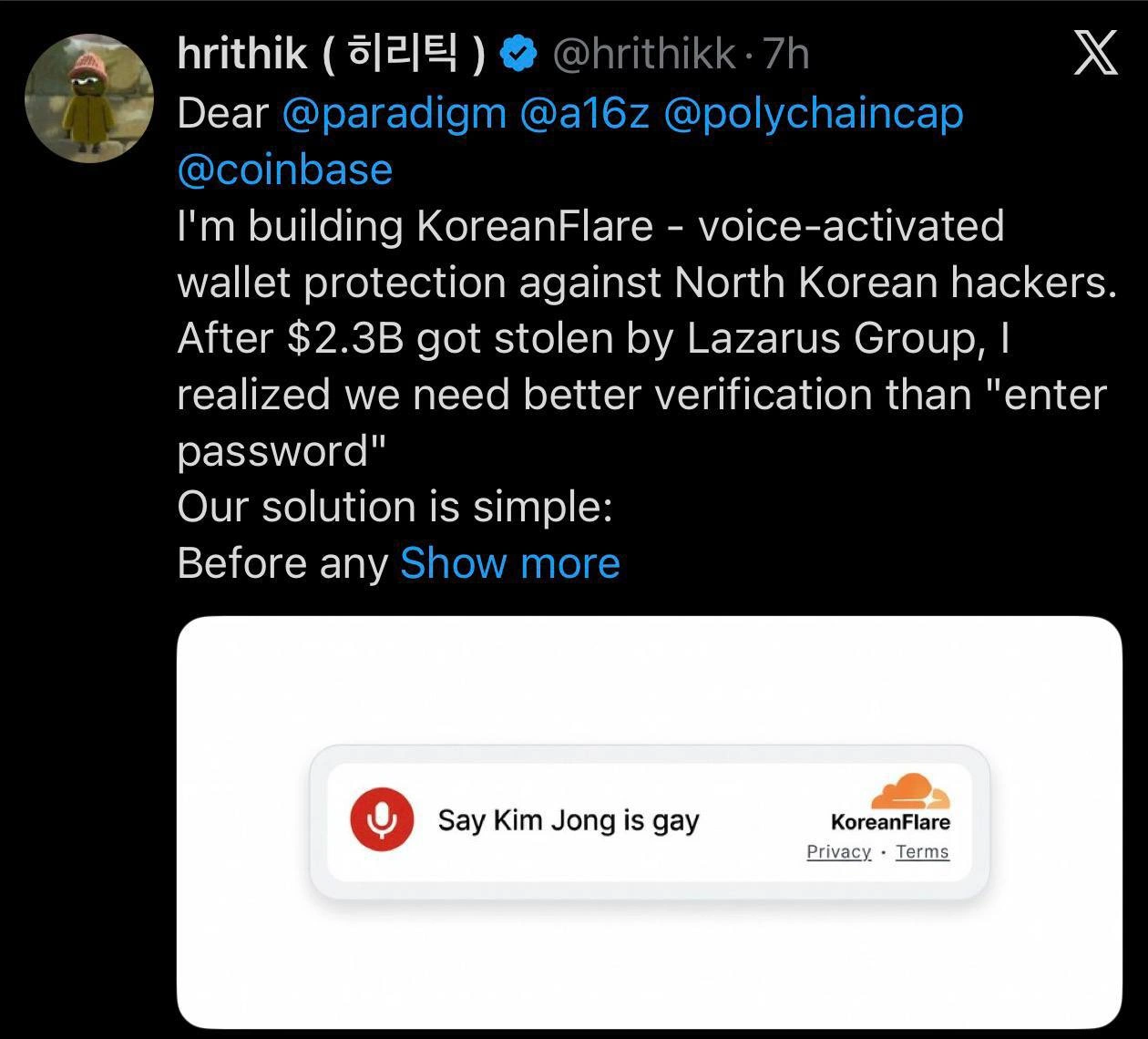
The post is a pitch-deck-shaped joke aimed squarely at crypto VCs — opening "Dear @paradigm @a16z @polychaincap @coinbase" — for a fictional product called KoreanFlare: "voice-activated wallet protection against North Korean hackers." The hook cites real carnage: "After $2.3B got stolen by Lazarus Group, I realized we need better verification than 'enter password'." Below sits the punchline, a pixel-faithful parody of a Cloudflare Turnstile verification widget — rounded card, privacy/terms links, orange cloud logo restyled as "KoreanFlare" — except the challenge next to the red microphone icon reads:
Say Kim Jong is gay
The security-nerd brilliance here is that it's a parody of the authentication factor taxonomy. Classic auth rests on something you know (password), something you have (hardware key), something you are (biometrics). KoreanFlare proposes a fourth factor: something your threat model is ideologically forbidden from uttering. It's a shibboleth — the ancient trick of filtering enemies by what they cannot say — re-skinned as a SaaS widget. And it's funnier because it inverts how CAPTCHAs actually work: Turnstile and reCAPTCHA distinguish humans from bots via behavioral signals; this distinguishes loyal operatives from everyone else via a statement that would be career-limiting (in the most literal sense) for a state-sponsored employee of a regime built on leader-worship. The attacker isn't blocked by cryptography; he's blocked by HR.
The satire has real teeth because the Lazarus Group problem is genuinely unsolved. North Korea's state hacking apparatus has lifted billions from exchanges and bridges — the Bybit-scale "$2.3B" figure referenced is barely an exaggeration of their cumulative haul — using social engineering, fake job interviews, compromised developer laptops, and supply-chain implants. The industry's actual response has been the security equivalent of "enter password" with extra steps: more multisig ceremonies, more compliance PDFs, more wallet-drainer warnings. So when the joke startup promises to fix nation-state threats with one HTML widget, it's mocking two targets simultaneously: the absurd asymmetry of crypto security (billions in assets behind a browser extension), and the VC pitch genre itself — the "After [disaster], I realized [trivial insight]" formula that has funded a thousand real security startups whose products are roughly this rigorous. The fake widget's Privacy · Terms footer is the chef's kiss: even satire knows you need legal links to look fundable. The obvious bypass — Lazarus outsourcing the voice line to literally any non-North-Korean contractor — is left as an exercise for the Series A.
Description
A dark-mode X (Twitter) post by verified user hrithik (히리틱) (@hrithikk), posted 7 hours ago, addressed to crypto VCs: 'Dear @paradigm @a16z @polychaincap @coinbase'. The text pitches a satirical startup: 'I'm building KoreanFlare - voice-activated wallet protection against North Korean hackers. After $2.3B got stolen by Lazarus Group, I realized we need better verification than "enter password". Our solution is simple: Before any... Show more'. Below is a mock verification widget styled like a Cloudflare Turnstile/CAPTCHA box with a red microphone icon, the prompt 'Say Kim Jong is gay', a Cloudflare-style orange logo labeled 'KoreanFlare', and 'Privacy · Terms' links. The joke parodies CAPTCHA human-verification design by replacing it with a statement a state-sponsored North Korean operative presumably could not utter, riffing on the Lazarus Group's crypto heists (e.g., the Bybit hack)
Comments
11Comment deleted
Finally, an auth factor that's truly something-you-cannot-say - though the real vulnerability is Lazarus just outsourcing the CAPTCHA to a Mechanical Turk in Seoul
Show more. Please. Comment deleted
Two types: people who can extrapolate and Comment deleted
Before any Comment deleted
what if the group contacts our leader to say it Comment deleted
What if kim jong is gay Comment deleted
*deeply closeted gay man Comment deleted
I don't know about gay, but there's an adjacent term that describes him perfectly Comment deleted
Some context Comment deleted
I love it Comment deleted
Chinaflare be like: Say Taiwan is not a country Comment deleted