Skip to content
DevMeme
2288 of 7435
The eternal struggle: pointers, performance, and Java threats
Languages Post #2545, on Dec 29, 2020 in TG

The eternal struggle: pointers, performance, and Java threats

Why is this Languages meme funny?

Level 1: Speed vs Safety

Imagine two friends building a go-kart. One friend is a total speed freak: he installs a rocket booster on the go-kart to make it go super fast. This is like using lots of fancy tricks (pointers) to make a program run fast. The go-kart with the rocket is indeed quicker, but it’s also now really hard to control. There are wires and fuel lines everywhere, and if you don’t handle it just right, the whole thing could veer off course or even crash.

The other friend has to help drive and maintain this go-kart, and he’s freaking out. He’s yelling, “Why did you put a rocket on this thing? We’re just racing in the backyard, not the Indy 500!” He can’t figure out how to safely drive it because it’s so complicated and unstable (that’s the readability problem). He’s so frustrated that he finally shouts, “If you don’t take that dangerous rocket off, I’m going to throw this go-kart away and get a normal safe one from the store!” Getting a normal store-bought go-kart (slower but easy to drive) is like rewriting the project in Java – it would be much safer and simpler, but not as blindingly fast as the rocket-powered version.

In the end, the speedy friend is so attached to his rocket (just like a coder obsessed with performance) that he’d rather literally smash something in anger than compromise. And the cautious friend is so fed up that he’s ready to ditch all that hard work and settle for a slower, safer solution to avoid the chaos.

It’s funny because we can imagine both sides: the thrill of something running super fast, and the exasperation of dealing with something that’s become too dangerous or complicated. The meme is basically showing that feeling when someone makes something too fancy and another person says, “I can’t handle this! I’d rather use the simple option.” In other words, sometimes trying to be very fast can backfire and you end up preferring very safe and simple, just to keep your sanity (and avoid flying chairs!).

Level 2: Pointers vs Readability

Let’s break down the technical feud in simpler terms. The argument is about pointers (a feature in languages like C and C++) and whether using them everywhere is good or bad for CodeQuality.

What’s a pointer? In C/C++, a pointer is a variable that holds the address of another variable. Think of it like a tag that says “the real data is over there, at memory location X.” By using a pointer, you can directly modify or access the data it points to without making a copy. This is powerful in LowLevelProgramming because it can make certain operations faster and use less memory. For example, instead of copying a large piece of data to give to a function, you pass a pointer to it – essentially handing the function a note that says “go look over there for the data.”

Here’s a quick illustration in C-style code:

// Without pointer: copying a value
int a = 5;
int b = a;      // b gets a copy of a's value (5)
b = 7;          // change b, a stays 5 (they're independent)

printf("a = %d, b = %d\n", a, b);
// Output: a = 5, b = 7

// With pointer: referencing the original
int x = 5;
int *p = &x;    // p is a pointer to x (stores x's address)
*p = 7;         // change the value at the address p points to (this changes x!)

printf("x = %d, *p = %d\n", x, *p);
// Output: x = 7, *p = 7  (both show 7 because p modified x directly)

In the first part, b is a separate copy, so changing it doesn’t affect a. In the second, p points to x, so *p = 7 actually changes x itself. This shows how pointers let you mutate data in-place.

Now, why would a developer use pointers "everywhere"? Mainly for performance. If x was a huge object or array, copying it to b could be costly. Using a pointer (p) means we don’t copy the whole thing; we just operate on the original. This saves time (no duplicate data to process) and memory (no extra storage for the copy). Game developers, OS programmers, or any performance-minded coders often use pointers to optimize hot code. It’s part of manual optimizations in languages like C/C++ where you manage memory yourself (ManualMemoryManagement).

What’s the downside? Readability and safety. When you see a pointer like p in code, you have to track what it points to. If many pointers are pointing all over the place, it gets hard to follow the program’s logic. You might ask, “if I change this value here, who else is affected?” With pointers, the answer could be lots of places, because different parts of the program might be accessing the same memory through different pointers. This can lead to bugs that are tricky to find, like accidentally writing to the wrong memory (imagine if p pointed to something it shouldn’t – that can cause a crash, known as a segmentation fault). Also, if you manually allocate memory (with functions like malloc in C or new in C++), you must remember to free it. Forgetting leads to memory leaks, and freeing incorrectly leads to dangling pointers (pointers referring to memory that’s gone), which can also crash the program or corrupt data.

So, in the meme, when the older dev says, “I can’t keep track of all that crap,” he’s complaining that the code is full of these tricky pointers. It’s like a web of wires everywhere in the code. He’s concerned about maintainability: can other programmers understand and modify this code without breaking it? If every function is using pointers, a junior developer or even a senior who didn’t write the code might struggle to figure out what’s going on or ensure they don’t introduce bugs. This is a CodeQuality issue — code isn’t just for computers, it’s also for humans to read.

He tells the younger dev to change everywhere a pointer was used, which implies refactoring the code. That might mean using simpler approaches, like passing copies of variables or using higher-level constructs. In C++, for example, one might use references (which are like safer pointers that can’t be null) or smart pointers (objects that manage memory automatically). Or perhaps he means to limit pointer use to only where absolutely necessary and use normal variables elsewhere for clarity.

Now, the big threat: “We’ll rewrite the project in Java.” This is drastic! Java is a completely different programming language from C/C++. One key difference is that Java doesn’t have manual pointers that you can manipulate. Java does have references to objects, but you can’t do pointer arithmetic (like adding to a pointer address) or point to arbitrary memory. And Java handles memory cleanup automatically with a Garbage Collector, so you typically don’t worry about free-ing memory or leaking. In essence, Java was designed to avoid the very pitfalls that C pointers can cause. The trade-off? You lose some low-level control and possibly some performance. Java runs on a virtual machine (the JVM), and historically it was a bit slower than C for raw operations (though modern JIT compilers have narrowed the gap a lot). Also, Java adds runtime checks and automatic memory management overhead.

So why would the older dev threaten Java? He’s basically saying: “If you can’t write understandable C code, let’s move to a language that enforces safety and clarity by design.” It’s a bit of a jab, too, because a C pointer guru might see Java as a less “elite” or more restrictive environment. It’s like telling a racecar mechanic “If you keep making this car too hard to drive, I’m replacing it with a bus.” It might solve the safety problem, but it’s also kind of an insult to the specialist’s skillset.

In simpler terms:

  • PointersInC vs Java references: C pointers let you do anything (good or bad) with memory; Java references are safer but have limitations.
  • ManualMemoryManagement vs Garbage Collection: C requires you to manage memory (bugs if you mess up); Java does it for you (at a performance cost).
  • LowLevelProgramming vs HighLevelProgramming: C gives you low-level power (closer to how the machine works), Java is higher-level (closer to how humans think in objects and managed environments).
  • Performance vs Maintainability: The younger dev chose performance (pointers) and the older dev cares about maintainability (clear code). Both have a point, and finding the right balance is key in real projects.

The meme’s comedic twist is blowing this common trade-off into a full-on fight. DeveloperHumor often exaggerates real scenarios: code reviews can be tense, but here it’s depicted with a WWE-level intensity. Seeing someone threaten a language rewrite over pointers is funny because it’s an overreaction, yet it symbolically represents frustrations many have felt. (Who hasn’t joked “This would be easier if we just rewrote it from scratch in X language” during a tough debug session?)

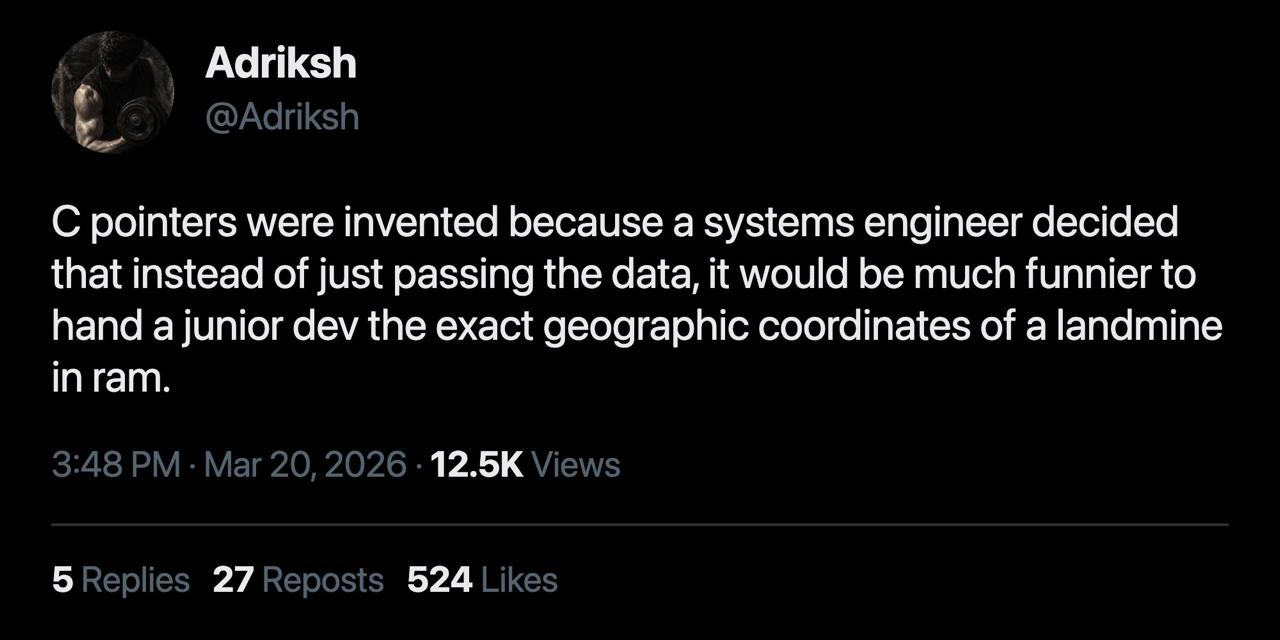
As for the American Chopper images: if you’re not familiar, they come from a reality TV show where a father and son (Paul Teutul Sr. and Jr.) argue loudly while building custom motorcycles. It became a meme template to caption any fierce argument. In this case, the meme creator chose it to illustrate a loud argument over code style. The father with the vast mustache and tattoos is the older dev, and the son in the cap is the younger dev. Even the action of the son throwing a chair in panel 4 matches the caption’s fury. It’s a visual punchline: we see a literal table-flip moment over something as nerdy as pointers.

In summary, at this level:

  • The meme is about a pointer vs readability fight in code.
  • Pointers make code run faster by avoiding unnecessary copies, but they can make code harder to understand and maintain.
  • The older dev cares about readability/maintainability, the younger dev cares about speed/efficiency.
  • The mention of Linus Torvalds (Linux’s creator) is to exaggerate how hardcore the pointer use was (like writing an OS kernel).
  • The threat to use Java highlights switching to a safer, pointer-free environment if things don’t change.
  • It’s funny because it’s a huge blow-up over a technical disagreement that many programmers can relate to, just shown in a very over-the-top way.

Level 3: Code Review Cage Match

This meme is a perfect dramatic_code_review scenario. It uses the famous American Chopper format – a father and son yelling and throwing chairs – to exaggerate a common developer argument: performance vs maintainability. Here we have one developer (the “son”) who went all-in on using pointers in C/C++ code for speed, and a code reviewer or team lead (the “father”) who’s furious because the code became a nightmare to understand. The captions read like dialogue straight out of a contentious pull request discussion:

Older dev: "You used pointers everywhere. Are you Linus Torvalds writing a Kernel?"
Younger dev: "That's faster than copying local variables every goddamn time."

Right away, the cultural references start flying. The older dev name-drops Linus Torvalds, the famed creator of Linux, implying that only someone writing kernel-level, performance-critical code (like Linus) has any business using pointers so pervasively. It’s a sarcastic way of saying, “Our project is not that low-level, you’re over-engineering!” This sets the stage: one side values raw performance and low-level control (like a kernel hacker), and the other side values CodeQuality and clarity (since our app probably isn’t an OS kernel!).

The younger dev’s comeback – “It’s faster than copying local variables every time” – is the classic defence of the performance enthusiast. He’s essentially saying: “I used pointers to avoid unnecessary copies and boost efficiency.” This is a common optimization instinct in low-level programming: passing around pointers (or references) to data instead of making new copies can indeed save time and memory, especially for large structures or in tight loops. Every C/C++ programmer learns that copying big structs or objects is expensive, and using pointers can make code run faster by reusing existing data. The younger guy clearly prides himself on being a savvy systems coder, squeezing out speed wherever possible.

But then the older dev’s frustration boils over: “I can’t keep track of all that crap. Change everywhere you used a f*ing pointer.” This is the maintainability smackdown. He’s basically saying the code is so pointer-heavy that it’s impossible to read or debug. With pointers pointing all over, you often have to trace through many functions to see where a value is modified, which is exactly what hurts readability and maintainability. It’s easy to imagine what triggered him: maybe he encountered a nasty bug like a segmentation fault or data corruption due to a stray pointer, or he simply spent hours untangling which pointer pointed to what. In a code review context, telling someone to change “everywhere you used a pointer” is essentially demanding a major refactoring. That’s a big ask — it means rewriting a lot of code to use a different approach (perhaps using local copies, higher-level constructs, or smart pointers that are safer). No wonder the younger dev’s next move is literally throwing a chair in protest!

By the fourth panel, the younger developer yells “HELL NO. I’d rather break this f*ing chair.” This over-the-top reaction mirrors a stubborn programmer refusing to budge on a code review criticism. It’s a humorously literal illustration of a heated dev argument: instead of calmly discussing, he’s so attached to his pointer-filled code that he’d rather smash furniture than make those changes. This is developer humor at its finest — we’ve all seen minor tech disagreements escalate in silly ways (though hopefully not to the point of actual chair throwing!). The meme exaggerates it to make us laugh, but it resonates because ego and pride often get mixed into technical debates.

Finally, the fifth panel delivers the knockout blow: the older dev threatens, “You better watch out, then. We’ll rewrite the project in Java.” In the programming world, that’s a LanguageWars mic drop. Java is infamous (at least among C/C++ folks) for abstracting away manual memory management — no raw pointers, and it uses a Garbage Collector to automatically handle memory. This line is hilarious because it’s the exact opposite of what the pointer-loving developer wants. For someone who painstakingly used pointers “everywhere” for performance, hearing “let’s redo it in Java” is like nails on a chalkboard. Java is viewed as a higher-level, slower environment by systems programmers; it won’t let you manually fiddle with memory addresses or likely achieve the same bare-metal performance.

So why threaten a rewrite_in_java? It’s an extreme way of saying, “If you can’t write clear, maintainable low-level code, we might as well move to a safer language where the manual memory management is taken out of your hands.” It’s the nuclear option in a pointer_vs_readability feud. In real life, full rewrites are usually dreadful last resorts (cue every developer’s memory of a failed rewrite project). But as a joke, it underscores just how fed up the older dev is — he’d rather throw away all the existing C/C++ code and start fresh in Java than deal with unmaintainable pointer soup. This also reflects a common workplace dynamic: a senior dev or manager might threaten a drastic measure (“We’ll use a different tech stack!”) to rein in a rogue developer who isn’t following guidelines.

The humor here also lies in shared experience. Many in the audience have witnessed arguments between the “performance-at-all-costs” programmer and the “keep it simple” code reviewer. It’s basically a meme-ified version of dev team banter:

  • The performance guru cites milliseconds saved and calls others oblivious to efficiency.
  • The maintainer guru cites future bugs and calls others reckless cowboys.
  • Someone drops a famous name (Linus Torvalds here) or a principle (“KISS – Keep It Simple, Stupid!” or “No premature optimization!”) to bolster their stance.
  • If it escalates, hyperbolic threats ensue (rewriting in another language, using an entirely different framework, etc.).

By using the american_chopper_meme template, the post author injects high drama and comedy into what could be a dry technical topic. The visual of two burly guys in a shouting match maps surprisingly well to nerds arguing over code style in a meeting room. The pointer_vs_readability clash becomes memorable and laughable when one imagines actual chairs flying in a code review.

In short, this meme works on multiple levels for developers:

  • Relatability: We’ve all had PR comments or tech debates that felt like this argument (minus the actual yelling).
  • Insight: It highlights a genuine software engineering issue: choosing between low-level performance tricks and clean, maintainable code. Everyone has to strike that balance.
  • Satire: The threat to use Java caricatures the “nuclear option” of tech arguments, poking fun at how developers sometimes dramatically propose huge changes when frustrated.
  • Cultural reference: Dropping Linus Torvalds and Java in the same fight is tongue-in-cheek. Linus once said “performance is fundamental,” whereas Java’s mantra might be “safety and portability over raw speed.” It’s a mini history of programming language philosophy wrapped in a joke.

Thus, the meme is both funny and illuminating: it exaggerates a real conflict (performance vs. maintainability) through a DeveloperHumor lens. It reminds us that using too many PointersInC (and by extension too much clever LowLevelProgramming) can lead to hard-to-read code, technical debt, and team tension. And it jokingly warns that if you push it too far, your colleagues might just haul your project into a completely different ecosystem (hello Java!) to tame the chaos. It’s a comical take on CodeQuality and LanguageWars rolled into one scene — a true code review cage match for the ages.

Level 4: Memory Address Mayhem

At the heart of this shouting match is a low-level memory management debate taken to the extreme. In languages like C, a pointer is literally a variable holding a memory address – it's as low-level as you can get without writing machine code. When the younger developer defends using pointers "everywhere," he's chasing raw performance by referencing memory directly instead of making copies. This is a classic case of chasing cache efficiency and minimizing memory copies: passing a pointer (just an address) is O(1) regardless of data size, whereas copying a large structure is O(n) in its size. In theory, fewer copies mean faster code, because the CPU isn't moving large chunks of data around.

However, pointers introduce aliasing and complexity: if multiple pointers reference the same data, the compiler’s optimizer has to play it safe. For instance, two pointers might point to overlapping memory, so the compiler often can’t assume things and register-optimize as aggressively. This can actually hurt performance if overused, a subtle point our hot-headed optimist might be overlooking. It’s a bit of low-level lore: sometimes copying a small variable into a CPU register is faster than dereferencing a pointer repeatedly, due to modern CPU caching and pipelining. The meme’s argument hints at this tension without naming it – the older guy is essentially saying “your micro-optimizations might be backfiring on readability, and maybe performance too.”

The Linus Torvalds reference drives the point that such hardcore pointer usage belongs in an OS kernel or similarly performance-critical system code. Linus is famed for writing the Linux kernel in C (loaded with pointers, direct hardware access, and manual memory management). Kernel code often demands these tricks for speed and control, dealing with interrupts and hardware registers where every CPU cycle counts. But in regular application code, this “kernel-level” pointer obsession is overkill. It’s like using a Formula 1 engine in a commuter car – powerful, yes, but finicky and hard to maintain. This also touches on a theoretical concept: safety vs. control. High-level languages (like Java) sacrifice a bit of raw speed to enforce memory safety (no raw pointers) via a garbage collector and strong typing, leaning on decades of computer science research to avoid classes of bugs like dangling pointers or buffer overflows. Low-level C code gives you maximum control (and performance potential) at the cost of having to manually ensure correctness and memory safety – a trade-off rooted in the fundamentals of computer architecture and PL (programming language) theory.

In summary, this meme’s conflict isn’t just personal – it’s touching on deep software engineering principles:

  • Referential transparency vs. side effects: Pointers mean functions can have side effects (changing data via aliasing), making reasoning about code harder (violating the ideals of pure functions in CS theory).
  • Premature optimization: The famous Knuth adage “Premature optimization is the root of all evil” echoes here. The younger dev’s pointer-happy code might be optimizing too early or in the wrong place, sacrificing clarity for speed that might not even matter or could be achieved differently.
  • Language design philosophy: C’s design gives power to the programmer (trusting them to not shoot themselves in the foot with pointers), whereas Java’s design guards the programmer from such footguns at runtime, reflecting two different schools of thought in language theory (manual vs automatic memory management, unchecked vs checked memory access).

So, beneath the meme’s yelling and chair-throwing is a rich vein of computer science concepts: how LowLevelProgramming techniques can lead to performance_vs_maintainability battles, and how fundamental constraints (like memory access cost and program correctness) manifest as heated debates in real-world code reviews.

Description

A five-panel meme using the 'American Chopper Argument' format to illustrate a heated debate between two developers. In the first panel, the senior figure yells, 'You used pointers everywhere! Are you Linus Torvalds writing a Kernel?'. The younger developer retorts in the second panel, 'That's faster than copying local variables every goddamn time.' The argument escalates in the third panel with the senior demanding, 'I can't keep track of all that crap. Change everywhere you used a fucking pointer.' The fourth panel shows the younger developer throwing a chair in defiance, shouting, 'HELL NO. I'D rather break this fucking chair.' In the final panel, the senior points accusingly and delivers the ultimate threat: 'You better watch out, then. We'll rewrite the project in Java.' This meme captures the classic and often religious war between low-level performance optimization (via pointers in languages like C/C++) and the push for code maintainability and safety, represented by the threat of moving to a memory-managed language like Java. It’s a conflict deeply familiar to experienced engineers who have had to balance these trade-offs
Comments

11
Anonymous ★ Top Pick The fastest way to end a debate about pointers is to mention garbage collection. It gives both sides something new to argue about
  1. Anonymous ★ Top Pick

    The fastest way to end a debate about pointers is to mention garbage collection. It gives both sides something new to argue about

  2. Anonymous

    Pointer economics: for every microsecond you save in C, you accrue a week of postmortem, three leaked structs, and a product manager shouting “just port it to Java” - compound that over two quarters and you’ve basically financed the next rewrite in Rust

  3. Anonymous

    The ultimate threat in systems programming isn't a segfault or memory leak - it's having your carefully optimized pointer arithmetic replaced with a garbage collector and a 200MB runtime. Nothing strikes fear into a kernel developer's heart quite like 'we're moving to a managed language for safety.'

  4. Anonymous

    The real tragedy here isn't the pointer debate - it's threatening a Java rewrite as the nuclear option. That's not conflict resolution, that's mutually assured destruction. At least with pointers you only have to worry about segfaults; with a Java rewrite, you're looking at AbstractSingletonProxyFactoryBean hell and three years of 'migration in progress.' Though I suppose if you can't track pointers, tracking enterprise design patterns across 47 layers of abstraction might be equally challenging

  5. Anonymous

    Microseconds saved avoiding copies, eternities lost chasing dangling refs in prod

  6. Anonymous

    If your 'pointers are faster' defense triggers a Java‑rewrite threat, congrats - you’ve found the only micro‑optimization that guarantees zero throughput: team velocity

  7. Anonymous

    Are we writing a kernel or a CRUD app? If the profiler screams memcpy, the reviewer will say “Java” long before the compiler says “restrict.”

  8. @feskow 5y

    void* funny = nullptr;

  9. @misesOnWheels 5y

    "software engineers" after they finish college

  10. @Vlasoov 5y

    "We'll rewrite the project in Java" But that means they'll use implicit shared_ptr everywhere 😄

    1. @tarasssssssssssssss 5y

      But they won't know that😏

Use J and K for navigation