No Time for Staging
Why is this Deployment meme funny?
Level 1: Try It On The Real Bridge
This is funny because it treats real users like a test lab. It is like building a bridge and saying, "There is no time to inspect it; let cars drive across so we can see what happens." The joke is the panic of skipping practice and using the real thing to discover whether the plan works.
Level 2: Test Before Users
In software, staging is a pre-production environment. It should behave enough like the real system that developers can check whether a deployment works before users see it. Production is the live environment. If production breaks, customers notice.
The meme is funny because it reverses responsible release order. Instead of testing code first, the caption says to deploy it live "to see what it does." That fits Testing, Deployment, DevOps_SRE, and OnCall_ProductionIssues because all of those areas exist to reduce surprise. Good teams use automated tests, staging checks, canary releases, feature flags, monitoring, and rollback plans so a release can fail small.
New developers often learn this difference the hard way. Local code may work on one laptop. Staging may reveal a missing environment variable. Production may reveal ten thousand users doing things nobody put in the test data. That is why mature release processes feel slow: they are trying to catch the expensive mistakes while they are still cheap.
Level 3: Production As Oracle
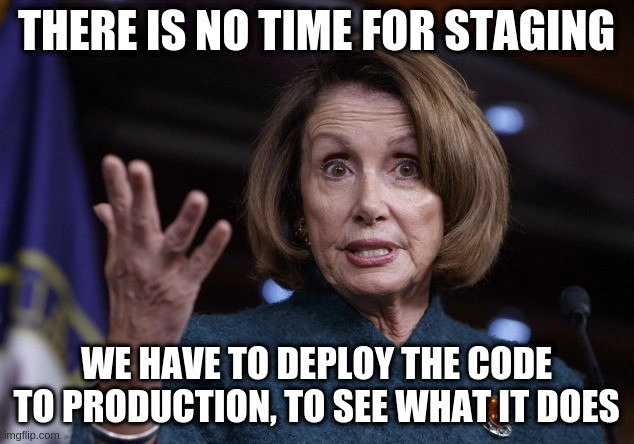
The image shows a politician-like podium scene with the kind of raised-hand urgency normally reserved for public crisis messaging. The overlaid text says:
THERE IS NO TIME FOR STAGING
WE HAVE TO DEPLOY THE CODE TO PRODUCTION, TO SEE WHAT IT DOES
That is the whole nightmare compressed into Impact font. Staging exists so teams can run a release in an environment that resembles production before real users, real money, and real pagers get involved. The meme's speaker skips that step and treats production as the only environment truthful enough to reveal the code's behavior. Every veteran engineer recognizes the logic, because it is both insane and, under enough organizational pressure, weirdly familiar.
The joke is not just "testing good, cowboy deployment bad." It is about the incentives that create reckless release culture. A manager needs the feature live. A deadline was promised before anyone understood the dependency graph. The staging environment has drifted from production so badly that nobody trusts it. The test suite is slow, flaky, or decorative. Observability is "we will check the logs after." Then someone says the forbidden sentence: the only real test is production. Somewhere, an on-call phone wakes up early just to stretch.
The visual seriousness makes the absurdity sharper. The speaker's urgent expression turns a bad DevOps practice into emergency policy. That matches how DeploymentRisks become ProductionIncidents: not through one dramatic villain, but through a chain of small exceptions that all sound practical in the meeting. Skipping staging saves hours before release and spends them later as rollback drills, customer support escalations, corrupted data cleanup, and the postmortem paragraph that begins "contributing factors included..."
Description
A meme image shows Nancy Pelosi speaking at a podium with one hand raised, overlaid with large white Impact-style text. The top caption reads, "THERE IS NO TIME FOR STAGING," and the bottom caption says, "WE HAVE TO DEPLOY THE CODE TO PRODUCTION, TO SEE WHAT IT DOES." The humor parodies reckless release culture: skipping staging and validation turns production into the test environment, with real users and real consequences.
Comments
4Comment deleted
Production is just staging with customers, invoices, and a pager that knows your sleep schedule.
Yes, it is. Comment deleted
Нет времени на раскачку Comment deleted
Everybody has a testing environment. Some people are lucky enough enough to have a totally separate environment to run production in. Comment deleted