Junior Dev vs. The JavaScript Framework Apocalypse
Why is this Frameworks meme funny?
Level 1: Which Pair to Wear
Imagine you’re at a friend’s house where everyone left their shoes by the door, and now there’s a big pile of sandals that all look almost the same. You’re standing there barefoot, feeling a bit lost, wondering which pair to wear. You know you need to put on shoes to go outside, but there are so many choices that you freeze up. It’s a little funny and a little frustrating: you keep picking up one sandal, then another, not sure which ones will fit or if someone will say, “Hey, those are mine!” This meme is just like that. The young developer is confused by all the look-alike options in front of him. It’s showing in a simple way how having too many choices — and not knowing the differences — can leave a person standing there not choosing anything at all. Just as you’d laugh at the silly situation of someone overwhelmed by dozens of similar flip-flops, we laugh because we understand that feeling of being new and not sure what to pick when everything looks both promising and puzzling. It’s a snapshot of that “uh-oh, what now?” moment that anyone can recognize, whether it’s about shoes or about tools for building websites.
Level 2: Too Many Frameworks
For someone new to coding, deciding which JavaScript framework to learn first can feel overwhelming. A framework is basically a pre-made collection of code and guidelines that helps developers build websites or web applications more easily. In frontend development (the part of a website that users actually see and interact with), frameworks provide ready-to-use structures and components to make dynamic features (like interactive forms, live updates without page reloads, etc.) simpler to create. Some popular examples of JavaScript front-end frameworks are React, Angular, and Vue. Each of these frameworks does similar things — they all help you create modern interactive web pages — but they have different ways of doing it.
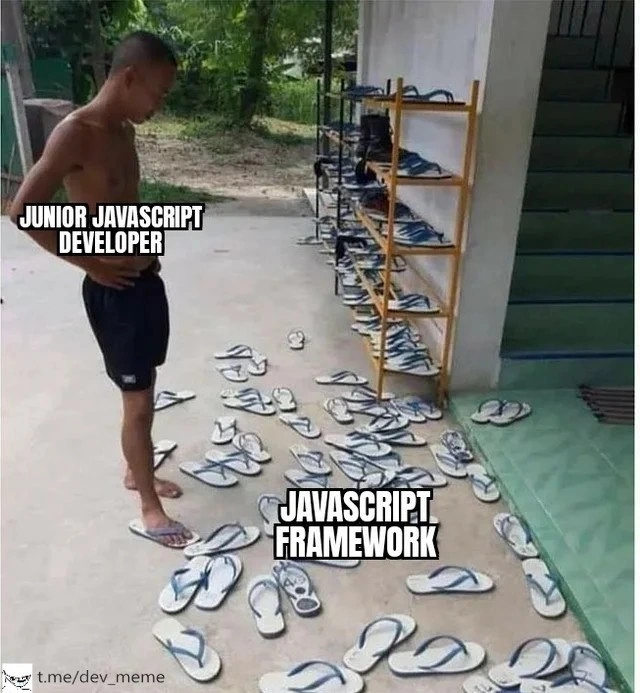
The meme shows a “Junior JavaScript Developer” confronted with a floor littered with many look-alike flip-flops labeled “JavaScript Framework.” This represents the newcomer’s dilemma: there are so many frameworks out there that it’s difficult to even tell them apart, let alone decide which one to pick up. It’s like being handed a toolkit with dozens of slightly different tools that all claim to do the same job; without experience, how do you know which one to use? In real life, a junior developer often Googles and finds lists of frameworks like React (known for using JSX and a virtual DOM), Angular (a full-featured framework that uses TypeScript and MVC patterns), Vue.js (lighter and flexibly progressive), Svelte (which compiles your code for better performance), and many more. At first glance, these can all blur together as “things I need to learn.” The pressure to choose “the right one” can cause decision paralysis — the person ends up not choosing at all because they’re overthinking it. This is exactly what analysis paralysis means: having so many options that you feel stuck, just like the junior dev in the meme stands there, not wearing any flip-flops yet because he can’t decide which pair to try on.
Another aspect of this frontend framework overload is the speed at which new options appear. The JavaScript community is very active: developers are constantly creating new libraries and frameworks to solve problems or to improve upon old solutions. This leads to a rapid cycle where today’s craze could be tomorrow’s old news. For a junior developer, it can indeed feel like an endless wall of names and versions: as soon as you learn one, a blog or tweet is hyping another. It’s a common FrontendHumor theme that every week there’s a “hot new framework” to check out. Of course, in reality you don’t need to know them all at once — usually teams pick one and stick with it for a project — but the meme humorously captures that initial shock a newcomer faces. The steep learning curve of just figuring out where to begin is a real hurdle. Experienced devs often advise juniors: start with one popular framework to build something, and you’ll gradually understand the rest. But in the moment, when you’re new, seeing that huge pile of frameworks (flip-flops everywhere!) is truly confusing. This meme takes that feeling and puts it into a single, funny image we can all relate to.
Level 3: Framework Fatigue Frenzy
The meme hilariously captures the framework churn in modern frontend development. A bewildered junior JavaScript developer stands barefoot before a chaos of flip-flops, each labeled JavaScript framework. This scene screams “analysis paralysis”—the state where having too many options paralyzes decision-making. Seasoned developers recognize this immediately: the endless stream of new JS frameworks can leave even experienced engineers feeling disoriented. It’s a tongue-in-cheek reference to “JavaScript fatigue,” a term coined for the exhaustion from keeping up with the ever-evolving JavaScript ecosystem.
In the past decade, front-end devs have witnessed a frenzy of frameworks rising and falling, much like dozens of nearly identical sandals scattered on the floor. First it was classic jQuery providing some relief from bare-bones JavaScript. Then came the MVC wave: Backbone, Ember, Knockout – each the hot new flip-flop for its moment. Soon AngularJS hit the scene (the sturdy but complex sandal from Google), only to be completely revamped as Angular 2+ a few years later, leaving everyone scrambling to try on a different shoe. Facebook’s React then burst into popularity with its component-based style (a comfy new flip-flop that suddenly everyone wanted to wear). Not long after, Vue.js became the lightweight contender, and new options like Svelte, Next.js, and countless others kept emerging. Every time a developer looked down, it seemed there was a new pair of sandals at their feet. 😅
The humor here comes from framework overload: all these frameworks serve a similar purpose (building interactive UIs for web apps), yet picking one feels like a monumental decision. The flip-flops in the image are nearly identical blue-and-white designs; likewise, many frameworks solve the same basic problems (DOM manipulation, state management, templating) with only slight differences in style or philosophy. To a newcomer, those differences aren’t obvious — React vs Angular vs Vue might as well be identical sandals scattered about. A junior faced with this heap is thinking, “Which one do I choose? What if I pick the wrong one?” Meanwhile, veteran devs smirk because they’ve tried on several of these “shoes” over the years. They know the truth behind the joke: no matter which framework you choose, something new (and supposedly better) will inevitably appear next season.
There’s an unwritten rule in the JavaScript world: if you don’t like any existing framework, just wait a few months (or write your own) — a new one will drop. This constant framework churn leads to the endless wall of choices depicted. It’s a shared FrontendPainPoints experience that unites developers in commiseration. We’ve all invested time learning a shiny new framework, only to see it become obsolete or overshadowed. (Many senior devs still recall the whiplash of mastering AngularJS, only to be told to re-learn everything for Angular 2, or the rush to adopt React as it took over job postings.) The meme deftly exaggerates this scenario: the Junior vs Senior perspective. The junior stands frozen by uncertainty, while seniors chuckle recalling similar moments of confusion in their past. It’s funny because it’s true: the JavaScript ecosystem evolves so rapidly that an endless wall of frameworks is an accurate, if absurd, visualization. The only thing moving faster than a JavaScript framework’s version number is the community’s tendency to flip-flop from one favorite tool to the next.
Description
This is a meme depicting a young man, shirtless and in shorts, with the label 'JUNIOR JAVASCRIPT DEVELOPER' over his head. He stands looking down at a huge, disorganized pile of identical-looking flip-flops scattered on the floor, which is labeled 'JAVASCRIPT FRAMEWORK'. To the right, a multi-tiered wooden shoe rack stands mostly full of neatly arranged pairs of the same flip-flops, completely ignored. The scene humorously illustrates the overwhelming and chaotic ecosystem of JavaScript frameworks that a junior developer faces. The messy pile represents the seemingly endless, undifferentiated options (React, Vue, Angular, Svelte, etc.), leading to analysis paralysis, while the neat rack might symbolize a more structured, but overlooked, path of learning fundamentals first. There is a small watermark in the bottom-left corner: 't.me/dev_meme'
Comments
7Comment deleted
The real problem isn't picking a framework from the pile; it's that by the time you've picked one, three more have been thrown on top, and the one you chose is now deprecated
Relax, kid - whichever flip-flop you choose will be deprecated and re-launched tomorrow as a “server-driven, hydration-free meta-framework,” and we’ll all be re-migrating our feet anyway
The senior dev watching this knows they'll spend next quarter migrating from the framework the junior picked today to whatever gets 10k GitHub stars tomorrow
The JavaScript ecosystem in 2024: where choosing a framework feels like navigating a minefield of flip-flops, and by the time you've mastered one, three new ones have spawned and the one you picked is now 'legacy.' At least with flip-flops, you can wear two at once - try that with React and Angular on the same project and watch your bundle size become sentient
JavaScript frameworks are like flip‑flops: indistinguishable on the rack, yet each leaves a unique dependency footprint you’ll be scraping off prod for years
JS frameworks are flip‑flops: let a junior “try a few” and the monorepo boots with React, routes in Angular, ships a Vue admin, and CI limps over both yarn.lock and package‑lock
Vanilla JS sits neatly on the shelf like reliable Crocs; frameworks scatter like lost flip-flops - pick one, lose the pair by next sprint