Skip to content
DevMeme
948 of 7435
The Inevitable Friday Afternoon Deployment Disaster
Deployment Post #1071, on Feb 28, 2020 in TG

The Inevitable Friday Afternoon Deployment Disaster

Why is this Deployment meme funny?

Level 1: Block Tower at Bedtime

Imagine you and your friends have built a big tower of blocks all day. It’s Friday evening, and it’s almost time to stop playing and go to bed (the weekend is about to start). Now, you notice one tiny block is a little out of place, and you really want to fix it to make the tower perfect. You say, “It’s just a small fix, I’ll do it real quick!” But all your friends suddenly get nervous and back away. They’re watching you with worried faces, kind of like, “Uh oh, here we go.” Why? Because everyone knows if you pull out the wrong block or even nudge it the wrong way, the whole tower could come tumbling down. And if it collapses right at bedtime, guess what – you’ll be up all night trying to rebuild it or clean up the mess, and nobody will get to relax. Your friends are thinking, “This is a silly risk to take now. It’s late, we’re tired, and if things go wrong, it’s going to be a disaster.”

This is exactly what the meme is joking about: one person is about to make a late change (fix a small thing) right before everyone goes off for the weekend (bedtime). The others are watching nervously because they’re afraid this little change will cause a big problem and ruin everyone’s time off. It’s funny in the picture because it uses a cartoon (The Simpsons) to show those emotions – the guy at the controls is like the kid fixing the tower, and the people watching are like your worried friends saying, “Oh no, he’s about to do something really not smart.” The humor comes from that feeling we all recognize: sometimes a tiny last-minute tweak can cause a huge mess, and everyone knows it’s a bad idea even while it’s happening. So the meme is a playful way to say, “fixing something small at the worst possible time? What could possibly go wrong…?!”

Level 2: Small Fix, Big Fear

Let’s break down what’s happening here in simpler terms. The meme shows a situation every developer and IT team dreads: someone is about to deploy (release) a code change to the production environment on a Friday evening. A deployment is basically when new code or a fix is moved from the testing area into the real live system where users use it. Now, deploying a change isn’t automatically bad – it’s how we get new features and fixes out. But the timing here (late Friday) and the attitude (“it’s just a small fix, no big deal”) sets off alarm bells. Why? Because Fridays are right before the weekend, and a lot of the team might not be around to help if things go wrong. This practice is often considered a taboo in DevOps: many teams have an unofficial rule “no deployments on Friday” to avoid exactly this situation.

The term hotfix or “small fix” implies this change is supposed to be tiny, maybe a quick patch for a bug that just can’t wait till Monday. It might be as simple as changing one line of code or adjusting a configuration. However, even a one-line change can cause big problems if it has unintended side effects. For example, imagine the fix addresses a typo in a config file. Seems harmless, right? But maybe that config file is read by dozens of servers, and the typo actually was the thing accidentally keeping a fragile balance. Fixing it might trigger all those servers to behave differently, possibly even crash if they can’t handle the “corrected” setting. This is a bit like pulling a loose thread in a sweater – sometimes the whole thing unravels. DeploymentRisks are real: even a small tweak can knock over a delicate balance in a complex system.

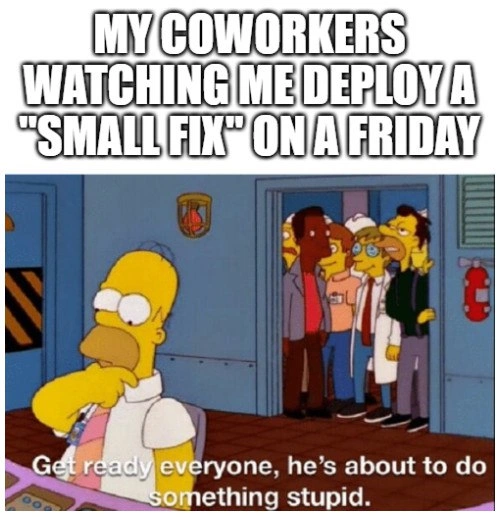
Now, why is everyone panicking and watching nervously? In the image (from The Simpsons), Homer represents the person doing the deploy – he’s at the controls of a (nuclear) system. His coworkers (Lenny, Carl, etc., peeking from the door) represent the other developers or the operations team. They’ve got these anxious, scared expressions, essentially saying “oh no, this might blow up.” The text overlay “Get ready everyone, he’s about to do something stupid” is obviously a humorous exaggeration – in real life your team wouldn’t call you stupid out loud – but it captures their fear that this action is unwise. It’s a mix of teasing and genuine concern. They’ve probably seen similar DeploymentPainPoints before. Maybe someone else’s so-called tiny change on a Friday caused an outage that became a ProductionIssue. Once you’ve lived through a bad deploy that broke the site, you get nervous whenever someone attempts it at a risky time again. It’s a form of DeploymentAnxiety that spreads through the team.

Let’s explain some of the terms from the tags and why they fit this scenario:

  • OnCall Duty: In many companies, engineers take turns being “on call,” which means if something goes wrong with the system outside normal work hours, a designated person’s phone will ring (or pager will buzz) and they have to respond. This is often managed through services like PagerDuty. If you deploy on Friday and something breaks Saturday at 3 AM, the on-call person has to wake up and fix it. That’s what we mean by OnCallNightmares – nobody wants to get that 3 AM emergency call, and a bad Friday deploy is a classic way to trigger it. So your coworkers might be extra nervous (or even annoyed) because they know they might be the ones dealing with the fallout while you’re off for the weekend.
  • ProductionIncidents: This refers to problems in the live system (production) that usually impact users – for example, the website going down, or a major feature not working. A “small fix” that causes a big error would be a production incident. These incidents often require urgent attention, because they affect real customers. If one happens late Friday, it might not even get noticed until users complain or automated alarms go off.
  • DevOps and SRE (Site Reliability Engineering): These are roles/practices focused on how code is released and how servers are managed reliably. People in these roles emphasize careful rollout, monitoring, and having a plan for failures. They are usually the ones who set rules like not deploying on Fridays, because they want to keep systems stable (and themselves sane). In this meme, the coworkers’ reaction (“oh no, this deployment is risky”) is exactly the kind of caution a good DevOps or SRE culture encourages. There’s even a common saying in these circles: “No deploy Fridays.” It’s half-joking, half-serious—meant to prevent exactly the panic shown in the image.

The humor in the meme comes from recognition and exaggeration. It’s exaggerating how everyone is peeking and expecting the worst, and even calling the act stupid. But it’s funny to developers because it’s a little bit true! We’ve all seen cases where something that’s supposed to be minor causes a ton of trouble. The bright, cartoonish Simpsons image makes it lighthearted, but it’s referencing a very real scenario that can give engineers cold sweats. It’s basically an inside joke among IT and developer folks: pushing code on Friday = living dangerously. If you do it, don’t be surprised if your teammates start hovering around, crossing their fingers, or telling you “good luck, we’ll be watching that error dashboard.” They’re not trying to be mean; they’re just genuinely worried because experience has taught them to be.

In summary, this meme is highlighting the deployment anxiety around late-week releases. FridayDeployments are considered risky because a “small fix” can unexpectedly break things, and then everyone’s off for the weekend or on minimal staffing. Your coworkers watching nervously signifies that shared concern: please let this not break production. And the caption’s blunt humor (“about to do something stupid”) is the cherry on top — it’s a tongue-in-cheek way of saying “this isn’t the smartest timing, and we all know it.” The whole thing is a comical warning: just because a change is tiny doesn’t mean it’s safe, especially not right before the weekend!

Level 3: Release Roulette

Deploying a hotfix on a Friday afternoon is basically an act of DevOps daring known to seasoned engineers as release roulette. The meme nails this perfectly with Homer Simpson at a control console — a goofy cartoon stand-in for a developer at the helm of a production deployment. His wide-eyed coworkers nervously peering from the doorway are the rest of the team bracing for impact. In big bold impact-font, the caption reads: “MY COWORKERS WATCHING ME DEPLOY A ‘SMALL FIX’ ON A FRIDAY.” In other words, everyone knows this is a risky move. The scene’s subtitle, “Get ready everyone, he’s about to do something stupid,” might as well be voiced by a battle-hardened SRE on the team, half-joking and half-dead-serious. This is classic DeploymentHumor drawn from real pain: pushing even a tiny code change right before the weekend often ends in a collective “Oh no, here we go…” from colleagues.

Why the dramatic panic? Because experienced ops folks have lived through the fallout. In complex systems, there’s really no such thing as a truly small fix. That one-line configuration tweak or “just a quick patch” can have far-reaching, non-linear effects in production. Maybe it disables a critical feature flag, overwhelms a downstream service, or introduces a subtle memory leak. At 5:00 PM on Friday, when that code hits the live environment (production), Murphy’s Law lurks in every shadow: anything that can go wrong often will go wrong—and usually at the worst possible time. The bright cartoon imagery here actually underscores a very real DeploymentRisk. Homer is literally in a nuclear power plant control room (danger vibes!) and his coworkers look as anxious as a NOC (Network Operations Center) team watching the graphs spike red. We chuckle because the impending disaster vibe is over-the-top, yet every DevOps veteran has felt exactly this fear.

In practice, many teams outright ban or heavily discourage FridayDeployments. It’s practically a weekend release taboo. The reason is simple: if a bug creeps in or something crashes, it will likely happen after hours or on Saturday morning. That leaves the on-call engineer scrambling while everyone else is offline enjoying their weekend. Picture an OnCall engineer’s phone buzzing at 2 AM Saturday: Critical alert – service down. This is the nightmare scenario the meme jokes about. The coworkers in the image aren’t just being dramatic; they’re imagining that “tiny hotfix” turning into a major ProductionIncident that wakes up half the team. They’ve likely endured OnCallNightmares before: spending all night (or all weekend) rolling back a bad deployment or patching a new bug introduced by a rushed fix. The meme draws on that shared trauma—er, experience.

There’s also a cultural aspect: in well-run DevOps_SRE circles, deploying right before two days of minimal staffing is considered playing with fire. Often there are policies like change freezes late in the week, or at least a rule of thumb: “No deployments on Friday”. If absolutely necessary, a Friday deploy might require extra approvals or a solid rollback plan. Teams have learned the hard way that even DeploymentAnxiety can’t save you from an unexpected cascade of failures. Maybe the “small fix” was to close a tiny bug, but it accidentally opened a hole elsewhere – say, a database migration that locked a table, causing queues to back up. By Monday, you could have a full-blown chaos scenario. Senior engineers trade these war stories like veterans recalling battles: “Remember that one time Bob’s 5-minute Friday patch took down auth and we spent 48 hours recovering? Never again.” The humor of the meme comes from just how predictable this foolishness is. It’s like a horror movie everyone’s already seen: the audience (your coworkers) covers their eyes because they know the jump scare is coming.

To put it bluntly, deploying a “small fix” late on Friday is the kind of tempting fate that makes grizzled ops folks sarcastically grin and say, “Sure, what could possibly go wrong?” The whole team’s reaction – crowding behind the door watching – implies they’re half-expecting an explosion (figuratively, we hope). The text “he’s about to do something stupid” is harsh but comically honest: in tech culture, doing this is kind of a running joke because it so often ends badly. The meme works as DeploymentHumor precisely because it’s painfully relatable. It’s a reminder that even if you’ve had a smooth Friday deploy once or twice, sooner or later fate catches up. Or as the cynical veteran admins like to say: Friends don’t let friends deploy on Fridays. 🚀🔥

Planned "Small Fix" Friday Reality Check
Tiny one-line code change Cascades into a critical bug in prod
“It’s just a minor config tweak” Service won’t start, config format error
Quick deploy at 5 PM, then leave PagerDuty calls at 2 AM, rollback time

Description

A two-panel meme using a scene from The Simpsons. The top panel has white text in an 'Impact' font stating, 'MY COWORKERS WATCHING ME DEPLOY A "SMALL FIX" ON A FRIDAY'. The bottom panel shows Homer Simpson at a control console, looking apprehensive. In a doorway behind him, a group of his colleagues are gathered, watching him with concerned and knowing expressions. A yellow subtitle at the bottom reads, 'Get ready everyone, he's about to do something stupid.' This meme perfectly captures a deeply ingrained superstition and best practice in software development: never deploy to production on a Friday. The so-called 'small fix' is notorious for causing unforeseen, catastrophic failures, leading to a stressful weekend of emergency debugging and rollbacks. The coworkers represent the experienced team members who know the risks and are bracing for the inevitable incident, highlighting the foolishness of tempting fate before the weekend

Comments

7
Anonymous ★ Top Pick The definition of a 'small fix' deployed on a Friday is a change with a blast radius that expands at exactly the same rate as your weekend plans
  1. Anonymous ★ Top Pick

    The definition of a 'small fix' deployed on a Friday is a change with a blast radius that expands at exactly the same rate as your weekend plans

  2. Anonymous

    Funny how a “one-line” Friday hotfix still manages to traverse eight microservices, corrupt two replicas, and perfectly demonstrate Conway’s Law before the CI badge even turns red

  3. Anonymous

    The "small fix" that touched 47 files because someone decided to rename a variable in the base class, but don't worry, the integration tests passed locally on my machine running a three-month-old database snapshot

  4. Anonymous

    The universal law of software engineering: the severity of a production incident is directly proportional to (1) how close it is to the weekend, (2) how many people are watching, and (3) how confidently you said 'it's just a small fix.' Bonus multiplier if you've already made dinner plans

  5. Anonymous

    The real definition of a “small fix” is one line of code plus two schema migrations, a cache flush, and a reindex - aka a weekend‑long chaos experiment with your SLO as the control group

  6. Anonymous

    “Small fix” on Friday: flip a default in a shared lib, canary’s green, prod’s cache goes cold, auth 401s our biggest tenant, and the SLO gets renamed to “Saturday.”

  7. Anonymous

    Senior dev wisdom: Never deploy on Friday unless you enjoy 72-hour on-call marathons with no rollback mercy

Use J and K for navigation