The unspoken hierarchy of curly brace styles
Why is this CodeQuality meme funny?
Level 1: Fancy Letters, Same Word
Imagine you are writing your name on a piece of paper. First, you write it plainly with normal handwriting. It looks ordinary and nobody really reacts – it's just your name written down. Next, you try something a bit fancier: you write your name in cursive with big curly loops on each letter, like you're trying to make it look elegant. Now it seems special and you feel proud showing it off; maybe a friend says, "Hey, that's pretty fancy." But then you go all out and rewrite your name with ridiculously elaborate swirls and decorative flourishes on every letter – so over-the-top that it's almost hard to recognize. When you show that version, you and your friends burst out laughing because it's just so silly. The letters might be insanely decorated now, but it's still the same name. You took something simple (writing your name) and made it absurdly complicated for no real reason, which is exactly why it's funny. That's pretty much what's happening with the curly braces in the meme: they start simple, get a bit fancier, then become hilariously overdone, even though their actual meaning (the content they hold) hasn't changed at all.
Level 2: Brace Style Basics
Curly braces { and } are characters used in many programming languages (such as C, C++, Java, C#, and JavaScript) to mark the beginning and end of a block of code. For example, if you write an if statement or define a function, everything between a { and the matching } is considered part of that block. Here's a simple illustration in C-like pseudocode:
// Using braces on the same line (K&R style)
if (x > 0) {
printf("Positive\n");
}
In the code above, the opening curly brace { comes right after the if (x > 0) condition on the same line. Some programmers prefer this because it's concise and keeps the code compact. Alternatively, you could place the brace on the next line:
// Using braces on a new line (Allman style)
if (x > 0)
{
printf("Positive\n");
}
Now the { is on its own line below the if condition. This style spaces the code out vertically a bit more. Some people feel this makes the structure of the code more obvious at a glance. Brace style refers to this choice of where to put the { and } in your code. The two styles shown above are common: the first is often called K&R style (after Kernighan & Ritchie, who wrote the original C book) and the second is called Allman style. Many codebases pick one of these styles and use it everywhere.
The important thing is that brace style is purely about code formatting and readability. It does not change what the code does. The computer doesn't care which style you use – both of the examples above behave exactly the same when run. It's entirely about making the code easier for humans to read. Different teams or projects usually adopt one style and stick with it so that the codebase looks consistent. They often document this in a code style guide (basically a set of rules for how to format code in that project, including things like brace placement, indentation, naming conventions, etc.). Consistency in style is part of writing clean, quality code – when every file looks like it was written with the same conventions, it's easier to follow and understand. This is one of the ideas behind writing clean code: your code should be easy for others (and future you) to read, and having a uniform style helps achieve that.
Despite being a cosmetic preference, brace style can become a surprisingly passionate topic among developers. It's similar to the famous Tabs vs Spaces debate about how to indent code. Both are about personal/team preference, yet people can have very strong opinions on them. There's even a term "bikeshedding" to describe when people spend too much time on unimportant details like these. The idea comes from a story where a committee tasked with designing a nuclear plant spent the majority of their meeting arguing about the design of the plant's bike shed (a much simpler issue) instead of the reactor – because everyone could weigh in on the easy part. In programming, debating code style is a classic example of bikeshedding: it's easier for everyone to argue about where braces go or whether to use a tab or 4 spaces than to solve the hard logic problems or fix complex bugs. So sometimes developers will fixate on indentations or { } placement during code reviews, even though it doesn't affect the program’s output at all.
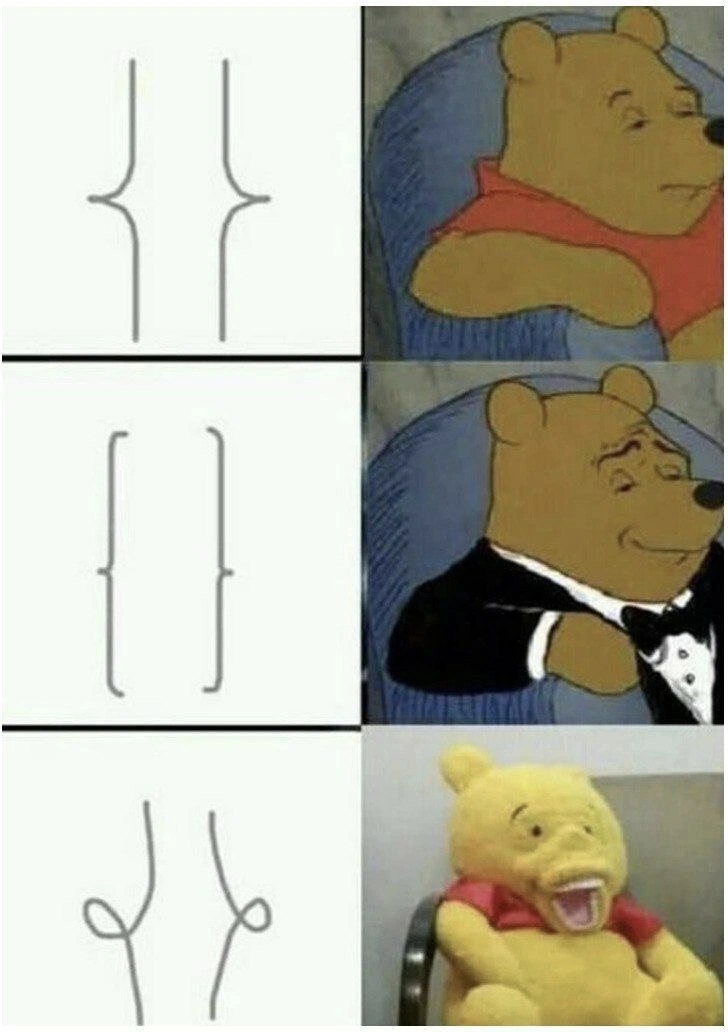
Now, let's connect this to the meme. It uses Winnie-the-Pooh (the beloved cartoon bear) in three different poses to represent three reactions to brace styles:
First panel: On the left side, there's a pair of very plain, ordinary curly braces drawn upright. On the right side, Pooh is in his normal form (no fancy outfit), looking a bit bored or indifferent. This suggests that the first brace style shown is basic and nothing to get excited about. It's like writing code with the default, standard formatting – no one really notices it because it's so common. Pooh's expression says, "Meh, just normal braces."
Second panel: On the left, the braces appear a bit more refined or formal (imagine them drawn with a nicer, more precise stroke). On the right, Pooh is now wearing a tuxedo and has a smug, satisfied look on his face. This Tuxedo Pooh image is a meme symbol for feeling classy or superior. Here it implies that a slightly different, perhaps more meticulous brace style is being treated as the "fancy" proper way. In real coding terms, this would be like a programmer who insists on a particular brace placement (for example, moving from the first style to a new-line style or vice versa) and feels very pleased with this choice, as if it's more sophisticated. Pooh in the tuxedo is basically that developer feeling proud and refined about using an "improved" brace format.
Third panel: On the left, the braces are extremely exaggerated and decorative – they have big loopy curves, almost like a calligraphy or a crazy font version of
{ }. This is not a style you'd ever actually use in code; it's an intentionally ridiculous exaggeration. On the right, we see a plush toy Pooh leaning forward and laughing hysterically with his mouth wide open. This image is often used to show someone cracking up with laughter. The combination here means that the ultra-fancy braces are so over-the-top that it's comical. The developer (Pooh) has taken the brace styling to such an extreme that even he finds it ridiculously funny. We use the word overengineered to describe something made far more complicated or fancy than it needs to be. So this last panel is joking that the brace style has become hilariously overengineered, and Pooh can't help but laugh at how absurd it is.
The progression in the meme mocks how a programmer's concern for brace style can go from normal, to pretentiously fancy, to outright absurd. It's highlighting the idea that while it's fine to have a consistent style (for clarity), obsessing over it to the point of inventing crazy new brace designs is laughable. This is very much developer humor — programmers poking fun at themselves. We all recognize that, yes, we do spend time debating little things like this, and taken to an extreme it looks pretty silly. The meme basically says: "At first you code normally (boring braces, boring Pooh). Then you discover a fancy style and feel sophisticated (nice braces, tuxedo Pooh). But if you keep pushing that idea, you'll end up with something so unnecessarily elaborate that it's laughable (crazy braces, laughing Pooh)." It's a lighthearted reminder that while code style consistency matters, you don't want to go too far and lose perspective. After all, whether the braces are plain or fancy, the actual code logic inside them remains the same. The joke is that we sometimes make a big deal out of something that, in the end, doesn't change the actual program at all.
Level 3: Baroque Brace Bikeshedding
In the grand hierarchy of code controversies, curly brace style stands as an ironically iconic example of bikeshedding. Among veteran developers it's well known that trivial debates like brace placement often eclipse more critical discussions. This meme nails that phenomenon: taking the humble { } and escalating its form from plain to absurdly ornate, as if the secret to high-quality software were hidden in the curvature of a curly brace. It's illustrating how developers sometimes spend more energy on formatting preferences than on actual architectural problems.
This obsession is a textbook case of Parkinson's Law of Triviality. In tech circles we call it "bikeshedding": people devote disproportionate time to trivial details everyone can grasp (like how to format braces) and avoid the harder, substantive issues they don't want to face (like concurrency bugs or messy architecture). Arguing about brace position is comfortable territory – it's visible, easy to have an opinion on, and feels important even though changing it won't fix a single bug. As a result, entire code review threads or heated Slack debates can erupt over whether an opening { should go on the same line or drop to a new line, while real code quality issues languish unnoticed.
For instance, one classic holy war in C-style languages is K&R vs Allman brace style. K&R style (named after Brian Kernighan and Dennis Ritchie, the C language pioneers) keeps the opening brace on the same line as the control statement or function signature. Some devotees half-jokingly call it the One True Brace Style or Egyptian braces (because the brace hugging the end of the line looks a bit like an Egyptian hieroglyph with outstretched arms). In contrast, Allman style (favored in many enterprise codebases and old-school style guides) puts the { on a new line, aligned vertically under its matching if, while, or function declaration. Allman yields a more formal vertical block structure. Neither style changes how the code executes; it's purely about human readability and consistency. Yet developers can be fiercely loyal to "their" brace style as if it were a matter of functionality or moral principle.
To keep the peace, teams adopt code style guides that decree one style or the other. Modern linters and auto-formatters (like clang-format for C++ or Prettier for JavaScript) will automatically reflow your curly braces to the approved style, sparing everyone from nitpicking in pull requests. It's an approach rooted in Clean Code ideals: reduce cognitive load by making all code look familiar. When every file follows the same conventions, you spend less time mentally parsing formatting and more time understanding logic. In theory, these tools and guides should end the debate. In practice, programmers still find ways to argue – if not about braces, then about which tool or rule set to use for formatting. We just can't help ourselves.
Leave it to programmers, too, to overengineer a solution for even a trivial problem. The meme parodies this perfectly. In the first panel, we see plain, no-nonsense braces – think of it as the default style most newbies start with – and Pooh is completely unimpressed, almost bored by the lack of sophistication. In the second panel, the braces have a bit more flair (slightly wider curves, as if drawn with a nicer font or a steadier hand), and now Pooh dons a tuxedo and smirks in approval. This represents the developer feeling smug after adopting a fancier, "proper" brace style (imagine someone who just converted their project to Allman style and is feeling oddly proud about those line breaks). Then comes the final evolution: an absurdly decorative brace style with huge loops and flourishes – something no real programming language uses, basically a joke version of an overly ornate format. At this stage Pooh is depicted as a plush doll cackling with laughter, leaning forward as if wheezing at the ridiculousness. This juxtaposition highlights how silly it is to treat braces like high art. It's as if the developer went from using ordinary braces, to calligraphic braces, to some baroque masterpiece of curly braces, laughing maniacally at their own creation.
For seasoned engineers, the humor cuts close to reality. We've all witnessed critical issues (like memory leaks or failing integration tests) get side-lined because a code review devolved into a code formatting squabble. It's the classic "polishing the bike shed while the nuclear reactor is leaking" scenario. A cynical veteran knows that when you're paged at 3 AM due to a production outage, you couldn't care less whether the codebase uses K&R or Allman style – you're just praying the system comes back online. Yet in calmer moments, those same engineers might find themselves arguing in earnest over curly brace placement during a meeting or code review. There's an absurd, almost endearing irony to that. We pride ourselves on rationality and efficiency, yet something as inconsequential as brace style can ignite our passions. The meme uses Winnie-the-Pooh's evolving expressions to poke fun at that quirk: we go from meh, to refined taste, to literally LOL over what amounts to choosing a different way to draw a squiggly line.
This brace-style saga is a close cousin to the infamous tabs vs spaces debate. Both are long-running battles of programmer preference with zero impact on a program’s actual output. They persist because they’re easy to have opinions on and they tie into personal habit and team identity – “I code this way, therefore it must be the right way.” The tags and context (TabsVsSpacesDebate, CodeStyleGuides, etc.) hint that the meme is gently mocking these eternal stylistic holy wars that every developer eventually encounters. It's a form of developer humor that resonates because almost every coder has sat through a pointless argument about indentation or bracket placement. We all recognize that feeling of spending far too long choosing the "perfect" way to do something that doesn't matter in the end.
Ultimately, the meme is laughing at ourselves. Code is meant to be read by humans and run by machines – and the machines don't give a darn how fancy our braces are. That elaborate third brace style doesn't improve the quality or reliability of the software; it's just peacocking. The humor works because it's simultaneously ridiculous and familiar. We see our own tendencies exaggerated: the transformation of a brace style from basic to comically overdone is a mirror of how programmers can take a tiny preference and blow it wildly out of proportion. It's a light-hearted reminder not to get too carried away with the bikeshed paint jobs and to remember to focus on what truly matters in our code.
Description
A three-panel 'Tuxedo Winnie the Pooh' meme format comparing different styles of writing curly braces. The first panel shows a standard, slightly curved pair of braces next to a regular image of Winnie the Pooh, implying this is a normal, acceptable style. The second panel displays a perfectly formed, classic set of curly braces next to an image of Winnie the Pooh in a tuxedo, signifying a sophisticated and superior style. The third and final panel presents a bizarre, loopy, and unevenly drawn pair of braces next to a cursed, off-model plushie of Winnie the Pooh, humorously mocking this unconventional style as chaotic or amateurish. The meme jokes about the subtle but strongly-held opinions developers have about code formatting and syntax aesthetics, a common topic in developer culture
Comments
15Comment deleted
The first developer ships code. The second one gets a standing ovation in a code review. The third one's code looks like they tried to draw a treble clef from memory after three days of no sleep
Org maturity model: default {}, mandated house-style {}, and finally the artisanal Unicode braces that crash diff tools - because nothing says “enterprise” like merge conflicts in your font files
After 15 years of wrestling with distributed systems, I've learned that the real CAP theorem is Curly braces, Arrays, and Parentheses - you can have consistency with two, but the third will always find a way to break your parser in production at 3 AM
This perfectly captures the evolution of every senior engineer's relationship with code formatting: starting with 'whatever works,' graduating to 'we must follow K&R for consistency and historical correctness,' and finally arriving at 'I've seen things in legacy codebases that would make you question reality itself.' The real horror isn't the loop-de-loop braces - it's realizing you've spent 3 hours in a PR review arguing about brace placement while the actual architectural decisions sailed through unchallenged. At least Prettier ended the war... or did it just create new factions?
Bracket CAP theorem: {} picks Consistency+Availability, [] Consistency+Partition, () neither - just screams
Post-Prettier, the last unsolved ADR is which monospaced font’s { } glyphs look senior enough to get a +1
K&R braces? Meh. Allman? Very tux. Run clang-format and the repo becomes a 5k-line “brace migration” - typography-driven development, with git blame pointing to the formatter
wat Comment deleted
}{ Comment deleted
<| |> Comment deleted
<% %> Comment deleted
or to make you feel worse ??< and ??> (deleted in C++17) Comment deleted
what are those? I can't find anything about ??< and ??> Comment deleted
trigraphs Comment deleted
Perfect just how I like it Comment deleted