The 'Simple' Task That Isn't
Why is this Stakeholders Clients meme funny?
Level 1: Shiny Toys vs Old Reliable
Imagine a group of kids arguing loudly over which new video game console is the best – PlayBox vs. XStation vs. Nintendoodle – they’re even wrestling over it. Meanwhile, in the corner, there’s an older kid quietly playing with a simple toy that’s been around forever, like a trusty old ball, and most other kids in the world are actually still playing with that ball. In this analogy, the fancy game consoles are the new JavaScript frameworks (Angular, React, Vue, Svelte) and the simple old toy is jQuery. The kids are so busy fighting over the new and shiny thing that they don't notice the old toy is still what most people are using to have fun. The humor comes from this contrast: all that noise and fighting over something modern, while the old reliable thing just calmly keeps doing its job for everyone. It’s funny and a bit like saying, “Sometimes the flashy new things aren't as dominant as we think – the old familiar thing is quietly everywhere, holding it all together.”
Level 2: Front-End Showdown
Let’s break down the scenario for a newer developer or someone outside the web-dev bubble. The fighters in the meme are four JavaScript frameworks/libraries, each represented by a person in a brawl:
- React – Often called a library (not a full framework) for building user interfaces, created by Facebook. React is very popular in modern web development. It uses a concept called a Virtual DOM to efficiently update the web page. Many new web apps (especially single-page applications) are built with React.
- Angular – A comprehensive front-end framework originally from Google. (There are actually two “Angulars”: the old AngularJS from 2010, and the modern Angular completely re-written around 2016. Here we mean the modern one.) Angular is a full-fledged framework with lots of built-in features (routing, forms, state management). It’s often used in large enterprise applications.
- Vue.js – A lighter, flexible framework that originated from the developer community (Evan You created it after working with AngularJS). Vue is known for being approachable and having an easy learning curve, while still capable of building complex apps. It has a passionate community, and many developers love it for its simplicity and power.
- Svelte – A newer, cutting-edge framework (or compiler) created by Rich Harris. Svelte’s key idea is that it compiles your code to minimal, plain JavaScript at build time, meaning there’s no heavyweight framework running in the browser. It’s praised for great performance and a clean developer experience, but it’s the newest of the bunch and still gaining adoption.
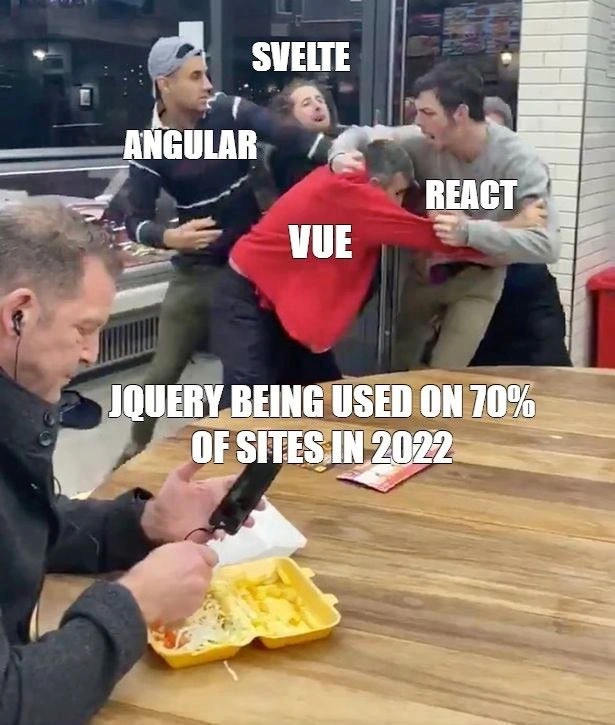
In the meme, three guys labeled Angular, Svelte, and React are ganging up on the guy in the red sweater labeled Vue. This represents the often silly conflicts or rivalries between these tech communities. Developers sometimes argue: “React vs Angular: which is better?”, “Vue vs React: who will win?”, or “Have you tried Svelte? It’s so much faster!”. These debates can get heated, almost like a fist-fight (though usually it’s just on Twitter or Reddit!). The meme exaggerates this by showing an actual physical brawl. Vue (the one in red getting shoved) might be depicted as the underdog here, or it could just be the one being attacked for comic effect. In reality, all four have their share of fanboys and critics.
Now, who is the calm guy in the foreground with the fries? He represents jQuery. jQuery is an older JavaScript library (from 2006) that was incredibly popular in the past. It’s not a full "framework" like the others; instead, jQuery focuses on making it easier to do common tasks in plain JavaScript, especially things like selecting HTML elements and manipulating them, handling events (like clicks), and making AJAX network requests. Back in the 2000s and early 2010s, web browsers were very inconsistent (different APIs, bugs, quirks), and jQuery smoothed all that out. It let developers write code that worked reliably across Internet Explorer, Firefox, Chrome, etc., without fuss. Its slogan was “Write less, do more”, because it provided shorthand ways to accomplish tasks that would take many more lines in plain JavaScript.
Even though you might not hear about jQuery as much nowadays in tutorials or tech news, it’s still everywhere. The text on the meme says “jQuery being used on 70% of sites in 2022”. This is referencing real surveys (for example, W3Techs surveys of top websites) that found that a huge percentage of all websites include the jQuery library. Think about that: for every 10 websites you visit, roughly 7 of them have jQuery running! That includes tons of older sites, small business websites, blogs, government websites, etc. Many of those sites were built years ago when jQuery was the go-to solution for any interactive feature, and they haven’t been rebuilt since. Also, many modern sites that use CMS (Content Management Systems) like WordPress, Drupal, or Magento include jQuery by default for themes and plugins. So jQuery is quietly embedded in a lot of the web’s infrastructure.
Meanwhile, the new frameworks (React, Angular, Vue, Svelte) tend to dominate discussions and job postings. If you search for front-end developer jobs in 2022, you’ll see React and Angular mentioned everywhere, and often Vue too. Svelte is newer so it might appear less in job ads, but it has a lot of buzz in the dev community. This focus can make it seem like “everyone” is using these, and that jQuery is obsolete. Yet, statistically, jQuery is still more widely present (especially among all websites, not just tech-forward companies). The meme finds humor in this contrast: the frameworks are aggressively fighting each other (implying their communities are fighting for framework supremacy), but jQuery doesn’t even bother to join the fight – and still wins by sheer numbers. It’s like an older, experienced pro who doesn’t need to prove himself in a squabble among rookies.
For a junior developer, it’s useful to understand why all these tools exist and differ. jQuery is great for adding simple interactive behavior to a web page. For example, if you just want to show/hide something when a button is clicked or do a quick form validation, jQuery is straightforward:
<!-- Including the jQuery library from a CDN -->
<script src="https://code.jquery.com/jquery-3.6.0.min.js"></script>
<script>
// Using jQuery to change content when the DOM is ready
$(function() {
// This code runs when the page has loaded
$('#welcome').text('Hello from jQuery!');
$('#myButton').on('click', function() {
$('#message').toggle(); // show or hide the element with id "message"
});
});
</script>
In the snippet above, $ is jQuery’s function (yes, $ is actually a function in jQuery) for selecting elements and doing things with them. $('#welcome') finds an element with the id "welcome" and .text('Hello from jQuery!') sets its text content. We also set up a click handler on #myButton to toggle the visibility of #message. Back in the day, doing this in plain JavaScript was more verbose and had cross-browser issues; jQuery made it easy and reliable.
Now, modern frameworks like React or Vue take a different approach. They are used to build single-page applications or complex interactive interfaces where the state of the UI changes dynamically in response to user actions. Instead of manually querying and updating DOM elements (like jQuery does), frameworks let you structure your app as components or templates that automatically update when data changes. For example, in React you might have a component that renders a message and a button, and the message is shown/hidden based on some component state. When the state changes, React re-renders the component efficiently. This approach is better for large apps with lots of interactive parts because it’s easier to manage and reason about as your codebase grows. However, using React/Angular/Vue also requires a build setup (with tools like Webpack or Vite), and loading a larger bundle of JavaScript on the page. It’s often overkill for a simple static site or a mostly-server-rendered site that just needs a little interactivity. That’s why many smaller sites stick with jQuery or vanilla JS for their needs.
The phrase “framework wars” or “framework churn” refers to how quickly the front-end landscape changes. One year everyone is excited about Angular, the next year React overtakes it, then Vue emerges as a fantastic alternative, and then Svelte comes along as the hot new thing. It can be overwhelming – hence “FrameworkFatigue” – trying to keep up with what’s in vogue. But an important lesson for newer developers is that real-world usage lags behind hype. Just because something is trending doesn’t mean all existing projects switch to it. A bank’s website from 2014 that uses jQuery isn’t going to magically rebuild itself in React just because React is cool now (unless there’s a compelling business reason). Often those older tech choices stick around for a long time.
So in simple terms: The meme is saying “While all the front-end developers are busy arguing about whether React, Vue, Svelte, or Angular is superior, the classic jQuery is quietly running on the majority of websites even in 2022.” It’s highlighting a funny gap between what developers hype up vs what most websites are actually using.
Level 3: The Silent Majority
The meme brilliantly satirizes framework wars and hype-driven development. In the scene, React, Angular, and Svelte (three popular JavaScript frameworks) are brawling with Vue (another major framework). This chaotic fight mirrors endless debates among developers over which front-end framework is "best". Yet at the table sits jQuery, calmly scrolling on a phone, labeled with "being used on 70% of sites in 2022". The joke lands because despite all the noise and innovation around modern frameworks, the older jQuery library still quietly dominates actual web usage.
From a senior developer’s perspective, this hits close to home. We've seen waves of new frameworks (Angular vs. React vs. Vue, and now Svelte) vying for mindshare. Conferences, blog posts, and Twitter threads are full of heated arguments about virtual DOM efficiency, reactive state management, bundle size, or the latest meta-framework. It often feels like a fast-food restaurant brawl – noisy and over-the-top. Meanwhile, out in the real world, a huge portion of websites continue running on plain old jQuery (or other legacy tech), unaffected by the fracas. This is the long tail of tech: once a technology like jQuery achieves massive adoption, it doesn’t disappear overnight. Companies have neither the time nor incentive to rewrite stable legacy code every six months just to chase the newest hype. FrameworkChurn and FrameworkFatigue are real – front-end devs joke about being exhausted by "yet another JS framework" announcements. But underneath that hype, legacy_dominance persists. jQuery’s continued presence (around 70% of all sites in 2022, according to industry stats) exemplifies inertia and backward compatibility in the web ecosystem.
There’s rich irony here. Modern frameworks are sophisticated — React introduced a component-based approach with a virtual DOM, Angular (the modern Angular, not to be confused with AngularJS) offers a full structured MVC/MVVM framework, Vue.js provides a flexible progressive framework, and Svelte compiles your code for optimal runtime performance. Each has passionate proponents and distinct philosophies. They frequently tussle in conversations: React vs Vue performance, Angular’s learning curve, Svelte’s no-virtual-DOM approach, and so on. These debates can get intense (just like the brawl in the meme), with devs almost treating frameworks like sports teams. But while this noisy battle rages in blog comments and HackerNews, jQuery sits in production quietly doing its job on millions of sites. It’s like an old champion past its prime in buzz, yet still the reigning champion in sheer numbers. Many senior engineers chuckle at this because they've lived through similar cycles. We remember older fights (e.g. MooTools vs Prototype vs jQuery back in the late 2000s) and saw jQuery win that war. Now we watch history rhyme: new fighters emerge, but the incumbent clings on far longer than trendy thought pieces would suggest.
Why does jQuery remain so widespread? Several reasons rooted in real-world practicality: First, inertia. If a site was built with jQuery years ago and it works, there's often little business value in rewriting it using a new framework. Rewrites are costly and risky; decision-makers often apply "if it ain’t broke, don’t fix it". Second, compatibility. jQuery was ubiquitous in the era of IE6-8 and solved HTML DOM inconsistencies across browsers. It became a standard part of web pages, sometimes included by default in templates and CMSs (looking at you, WordPress). As a result, countless sites include jQuery for features like image sliders, form validation, or AJAX calls. Those features keep running year after year. Third, ease of use. jQuery’s learning curve is gentle: you just include a <script> and use $() to select and manipulate elements. There’s no build process, no complex component structure – perfect for adding a quick interactive tweak to an otherwise static page. In contrast, modern frameworks often require a whole app build setup (bundlers, transpilers) and are geared towards Single Page Applications. Not every project needs that heavy machinery. For a simple company website or a small project, sprinkling a bit of jQuery might be far more pragmatic. In fact, many junior developers first learn a bit of jQuery for basic web tasks before diving into frameworks. So jQuery persists not because it’s better in a modern sense, but because it’s good enough and already everywhere.
The meme also hints at the disconnect between online hype and reality. If you lurk in web developer communities (Dev.to, Stack Overflow, Reddit’s r/Frontend), you’d think nobody uses jQuery anymore – it’s often portrayed as archaic or “legacy”. New learners sometimes feel pressure: “Should I even bother learning jQuery? Isn't everything done in React now?”. The truth is more nuanced. Yes, modern SPA frameworks build richer, more maintainable applications at scale. But the statistics remind us that a vast majority of websites are not rich web apps built from scratch in the last 5 years – they’re part of the long tail: older sites, small business pages, admin interfaces, or heavily use CMS platforms. These often still include a dash of jQuery. It’s common for a company to have one flagship app written in React or Angular, while their marketing site, internal tools, or legacy content still runs jQuery scripts written a decade ago. Maintenance of those falls to old-timers or whoever inherits the code. There’s a certain dark humor in that: while teams of engineers at big tech argue architecture over the latest framework, somewhere an understaffed IT department is keeping an old jQuery-dependent site alive and revenue-generating. The meme’s fast-food restaurant fight setting is apt — the flashy scuffle draws all the attention, but the real business (people quietly eating their meals, akin to websites just doing their job with jQuery) continues regardless of the outcome.
Ultimately, this image pokes fun at IndustryTrends_Hype. The framework du jour might dominate Twitter discussions, but legacy resilience is strong. Frontend dev has a notorious hype cycle: something new every year claiming to solve all our problems. And indeed, frameworks do solve many problems that jQuery can’t (structured state management, modular components, performance optimizations, etc.). But the joke’s on us if we forget that most of the web doesn’t turn over that quickly. The caption "jQuery being used on 70% of sites in 2022" is a cold splash of reality. It’s both funny and a bit humbling. Even in 2022, a technology from 2006 quietly underpins a majority of the web while its younger cousins wrestle for spotlight. As an experienced dev, you laugh because you’ve seen this dynamic over and over — the more things change, the more they stay the same. This meme cleverly captures that contrast between bleeding-edge debates and the stubborn legacy that actually runs when you check under the hood of the internet. In other words: modern JavaScript frameworks may flex, fight, and trend on GitHub, but jQuery just keeps calmly chugging along, serving up content like the seasoned veteran it is.
Description
This meme likely portrays a developer's reaction to being given a task that sounds simple but is actually incredibly complex. It might use a format like the 'Anakin and Padme' meme, where Padme says, 'It's just a small change, right?', and Anakin (the developer) gives a knowing, pained look. This is a classic scenario for experienced developers, who have learned that there's no such thing as a 'five-minute fix.' The humor comes from the shared pain of dealing with non-technical stakeholders who underestimate the complexity of software development
Comments
12Comment deleted
The three most dangerous words in software development are 'just one more thing.' The three most delusional are 'it's a simple fix.'
Let the frameworks debate hydration vs. compilation - real uptime still depends on that anonymous 24 KB jQuery file in /legacy/ that nobody’s brave enough to git blame
The real plot twist is that the jQuery sites are probably more performant than half the over-engineered SPAs built with 500KB of framework code just to display a contact form and three paragraphs of text
While React, Vue, Angular, and Svelte wage holy wars over virtual DOM implementations, reactivity models, and bundle sizes in conference talks and Twitter threads, jQuery sits there like a battle-hardened COBOL mainframe - unfashionable, unloved by the cool kids, yet somehow still processing 70% of production traffic because that enterprise CMS from 2015 isn't getting rewritten anytime soon, and honestly, `$('.modal').fadeIn()` still just works
While React, Vue, and Angular argue about hydration and signals, the revenue‑critical checkout still runs jQuery 1.x injected via GTM - no repo, no owner, just production
jQuery: deprecated everywhere, deployed on 70% of sites - true technical debt immortality
Let them fight over hooks, signals, and hydration; the checkout flow still runs on a 2012 jQuery plugin we keep because it’s a transitive dependency of revenue
why is Svelte not outside the door? Comment deleted
JQuery is a king 👑 Comment deleted
svelte gang, arise Comment deleted
Where is Blazor? Comment deleted
So what? What's the point of meme? Comment deleted