Fragile Production Code
Why is this TechDebt meme funny?
Level 1: Held Together with Tape
Imagine you have a toy car, and one of its wheels keeps falling off. Instead of fixing the wheel properly (which might be hard or take time), you grab some tape and stick the wheel on so it stays in place. Now the car looks kind of funny with tape on its wheel, but guess what – you can still play with it! It rolls around and works, even though the fix is messy. You know deep down that if you pull the tape off, the wheel might fall off again, but as long as you don’t mess with it, the car is okay.
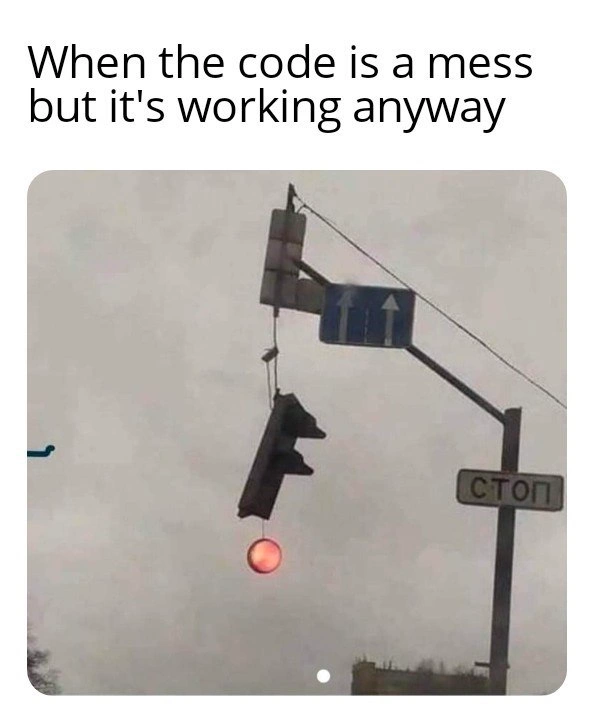
That’s exactly what’s happening in the picture of the traffic light. The traffic light is like that toy – it’s broken and hanging in a sketchy way, but someone managed to patch it up just enough so the red light still works. It looks wrong (the whole traffic light is sideways!), yet cars are still stopping because the red light is on. It’s a bit silly and a bit amazing: something so broken-looking is still doing its job.
The reason this is funny is because it reminds us of times when things in life are a mess but somehow still work out. Think of a wobbly table at home with one short leg – instead of repairing the leg, you might put a folded piece of cardboard under it to stop the wobble. The table looks goofy with that cardboard piece under one leg, but you can eat dinner on it just fine. It’s not a perfect fix, but it’s good enough for now. Everyone can relate to that feeling: “It’s not pretty, but hey, it works!” So the meme is like saying, in a joking way, that sometimes even grown-up engineers end up doing the equivalent of taping the toy or propping up the table. The code (or traffic light) is a mess, but since it’s working anyway, people just shrug and carry on. It makes us laugh because we know it’s true – we’ve all seen something held together with tape that really ought to be fixed properly, yet we’re glad it’s at least working for the time being.
Level 2: Spaghetti in Production
Imagine you’re a newer developer who’s always been told to write clean, well-structured code. You learn about coding best practices and maintainable design in school or bootcamp. Then you join a real company project and – surprise! – you discover part of the codebase is held together by quick fixes and weird tricks. It’s confusing and messy, yet everyone says, “Don’t worry, it works. Just don’t touch it.” 😅 This meme highlights that exact situation. The traffic light hanging sideways symbolizes messy code (often nicknamed SpaghettiCode because of how tangled it is) that somehow still runs correctly in production (the live environment where real users/customers are affected). To understand the humor, let’s break down a few terms and concepts here:
Spaghetti Code: This is code that is tangled and haphazard, like a bowl of spaghetti. There’s no clear structure; one part jumps to another in unpredictable ways. It’s hard to follow or modify. If you’ve ever written a quick 300-line script with lots of nested
ifstatements and duplicate logic just to get something working, you’ve created spaghetti code. It might get the job done, but changing one thing in it could accidentally affect something else far away (just like pulling one noodle can jostle a whole plate of spaghetti 🍝). In the meme, the broken, dangling traffic light represents spaghetti code – it’s definitely not how you’d design it from scratch, but it’s what we ended up with.Technical Debt: This is a metaphor comparing bad or quick-and-dirty code to debt. When you rush to write code that “works for now” but isn’t clean, you’re taking on technical debt. Like financial debt, technical debt accumulates interest – the “interest” is the extra effort and risk you’ll deal with later when you have to modify or fix that code. For example, skipping writing tests or not refactoring a messy module saves time today (like taking a loan), but it might cause big headaches in the future (paying interest). In our dangling light analogy, not fixing the pole properly is a debt: it’s faster to tie it up and leave, but eventually someone will have to pay time/effort to properly re-mount or replace that light (hopefully before it literally falls).
Legacy Code: This refers to old code that is still in use. Often, it’s code written by people who might no longer be around, using older styles or technologies. It may not follow current best practices, but it’s still critical for the business (“If it ain’t broke, don’t fix it” in action). Maintaining LegacySystems is tricky because you have to deal with decisions and quirks from the past. The Cyrillic "СТОП" sign in the image is a good metaphor here: it’s like finding comments or documentation in an old codebase that feel like they’re in a foreign language. Legacy code might even literally be written in an outdated programming language or framework that newer developers find alien. Yet, just like that old traffic light, it’s still running and must keep running, because people rely on it.
Production: This means the environment where the software is actually being used by real users (as opposed to your local computer or a testing environment). When we say “it works in production,” we mean the code is deployed and running in real life without obvious failures. Production is where reliability matters most. So a production bug is a bug that affects users right now, and a production system is the live system. In the meme, the traffic light is a production system for traffic control – it’s out in the world, doing its job. If that light goes out or falls, real people (drivers) are impacted immediately. Same with a messy code in a live app: if it stops working, your customers notice. That’s why even messy production code is treated carefully; it may be ugly, but as long as it functions, everyone is a bit afraid to mess with it unless they have a very good reason.
“Hold it together with duct tape” (context tag meaning): This is a phrase meaning a solution that is not elegant or robust, but was slapped on quickly using whatever was available – like fixing something with actual duct tape. In software, a duct-tape solution might be a quick script or a hard-coded value put in place to stop a system from crashing. It’s not how you’d architect a solution long-term, but it’s quick and works for now. In the image, the traffic light seems to be literally hanging by its cable – basically a duct-tape fix in civil engineering terms. There might even be some rope or tape holding pieces together up there! For a junior dev, think of a time you might have fixed a bug by just bypassing a check or hardcoding a return value because you weren’t sure of the proper fix, but you needed your program not to crash. It feels gross, but it works. That’s duct-tape coding.
Code Maintainability: This refers to how easy it is to understand, modify, and extend the code. High maintainability means new developers can read the code and quickly figure out what it does, and you can change one part without breaking others. Low maintainability (like in our messy code scenario) means the code is so convoluted that even small changes are risky; it’s hard to tell what impacts what. The dangling traffic light obviously scores low on maintainability: if you want to fix it or change it, you basically have to take the whole thing down and redo it properly. The meme humorously implies that the code is in the same state – hard to maintain, but we’re living with it because it mostly works.
All these terms paint the picture of why the meme is relatable. In simpler words: the codebase is an ugly mess, but it's a working ugly mess. The red light shining is like the program giving the correct output or the server staying up, even though the setup is sketchy. For a newcomer, it’s a bit of a shock that such situations exist in professional environments – after all, we aspire to write clean code. But due to real world trade-offs, like tight deadlines or lack of manpower, teams sometimes end up with code that’s “good enough for now.” The expectation is always to go back and clean it up later, but “later” can keep getting pushed off, especially if the system keeps working. This meme is basically every dev’s cheeky acknowledgement that “later” may never come, and we often end up supporting some truly oddball, precarious solutions in production.
If you look again at the image: the traffic light is sideways and hanging. That’s clearly not by design. Similarly, no one designs a software system to be confusing and fragile on purpose. It happens over time. The bent blue direction sign in the photo even points upward despite the chaos, which is like saying, “Yeah it’s all bent out of shape, but technically it’s still pointing in the right direction!” 🤷 In software, we sometimes justify messy code by saying, “Well, it produces the correct result.” The sign still points up, the light still shows STOP – the essential function is there, just not in the pretty form.
For a junior developer, the takeaway humor is: working code isn’t always pretty code. That dangling light should have been fixed properly, just like bad code should be refactored. But in practice, as long as the program is delivering value (like that light telling cars to stop), people tolerate a surprising amount of mess behind the scenes. It’s a bit scary, a bit funny, and very true to life in engineering. You’ll definitely encounter this in your career: perhaps a script or module that everyone warns you “Don’t change too much, it’s fragile but it works.” You might even add your own duct-tape patch to it one day. And you’ll understand why this meme hits the nail on the head about LegacySystems and EngineeringTradeoffs between doing things right and just making sure things keep running.
Level 3: Hanging by a Thread
This meme perfectly captures that nightmare scenario every seasoned dev knows: a piece of production code so janky and brittle that it's practically held together by digital duct tape, yet it somehow hasn't crashed... yet. The dangling traffic light with its single red bulb lit is a dead-on metaphor for a system running on hope and prayers quick fixes. It's spaghetti code incarnate: the structure is twisted and dangling, but hey, it still shows a red light, so everyone carries on as if things are fine. Experienced engineers see this and chuckle (or cringe) because they've inherited apps or services exactly like this—where the architecture violates every known CodeQuality principle, but nobody dares touch it because “it works in production.”
In the photo, the infrastructure is one gust of wind away from catastrophe, yet doing its job. In real projects, we've seen modules that are one bad deploy away from bringing everything down, yet management points at the uptime graph and says, “See? All green!” This ironic humor hits hard: it’s essentially a portrait of TechnicalDebt in a LegacySystem. The codebase is riddled with hacks and kludges (just like that broken traffic light rigged to keep functioning). Seasoned devs recognize the pattern: a messy_but_functional system that violates every clean-code practice, born of countless RealWorldTradeoffs. Deadlines, quick patches, and EngineeringTradeoffs over the years turned it into a precarious contraption. And still, it dutifully handles real traffic day after day.
For extra effect, there’s a street sign reading “СТОП” (Russian for "STOP") in the image. That detail nails the foreign territory vibe of LegacyCode. Often diving into such a codebase feels like reading comments in Cyrillic – you’re not sure what it says or if it’s warning you to stop, but it’s probably important. 🛑 The whole scene screams “proceed at your own risk.” This is the unspoken truth veterans share: we’ve all seen critical code that might as well be hanging by a fraying cable, with some cryptic SpaghettiCode comments from 2009, yet everyone agrees: don’t touch it unless absolutely necessary. There’s even an official name for this architecture style: the “Big Ball of Mud” – basically a system with no clear structure, full of ad-hoc fixes. The humor (and horror) comes from recognizing that big-ball-of-mud systems somehow work, much like that swaying stoplight still managing to direct traffic.
How do we end up with a production stoplight dangling in the wind? Typically through years of “temporary” fixes that became permanent. Imagine a rush deployment Friday night where something broke in the traffic light pole (akin to a core module). Instead of a full repair, someone ties a rope just to get it working for now. But then Monday comes, it’s still hanging by that rope, and everyone is too busy to properly re-mount it. In code terms, that’s a quick patch or hotfix that wasn’t elegant, but it stopped the errors, so it stayed in place... maybe forever. Over time, you get layer upon layer of such patches. Each one fixes an immediate problem but adds a bit of structural mess. Eventually, the whole thing looks absurd from the outside (just like this light dangling sideways), but internally it’s achieved a delicate balance where if you change one thing, who knows what else breaks. This is why teams adopt the motto “If it ain’t broke, don’t fix it,” with a mix of sarcasm and resignation. They know it is kind of broken, but not broken enough to justify a risky overhaul. Better to leave it be and hope the cable holds.
Why is this funny (and painful)? Because it’s true. We laugh seeing this “works anyway” stoplight because we remember that one critical program running on an ancient server under someone’s desk, or that module nobody has refactored since 2010 because “it’s fragile, just leave it.” The tension between working code and well-designed code is at the heart of the humor. On paper, we strive for clean architecture and CodeMaintainability. In practice, we sometimes end up with a dumpster fire ProductionReady service that’s anything but clean, yet does the job. It’s like deploying a feature and discovering the core logic is a thousand-line function named doEverything() with zero tests: horrifying, yet it ships revenue and no one wants to risk breaking it. Everyone who has been in the industry a while has stories of such haunted sections of the codebase. This meme speaks to that shared experience: the uneasy pride and shame of having something held_together_with_duct_tape but running in production. It’s the collective understanding that “working” often wins over “pretty” in the triage of real-world software development.
To put in perspective how far reality can drift from best practices, consider a quick comparison between ideal code and the kind of hanging-by-a-thread code being joked about:
| Clean Code Ideal 🏗️ | Messy Code Reality 🏚️ |
|---|---|
| Well-structured, modular design (SOLID, MVC) | Monolithic "God function" that does everything |
| Meaningful names, clear logic flow | Variables named data1, data2 and spaghetti logic |
| Comprehensive docs & comments explaining why | Comments like // FIXME: temporary hack (from 5 years ago) |
| Thorough tests and CI checks | “Tested in prod” 😅 – i.e. users will find the bugs |
| Easy to change one part without breaking all | Touch one thing, everything might break (so we don’t) |
| Planned refactoring and updates over time | “Next quarter we’ll rewrite it” (said every quarter, forever) |
Looking at this table, it’s easy to see why the dangling traffic light resonates. The Reality column is basically a snapshot of high TechnicalDebt and zero CodeMaintainability, yet it’s what many devs deal with daily. The humor’s edge comes from knowing how absurd that reality is, and yet how common.
We can even imagine what code from a system like this might look like. Probably something like:
// Example of messy production code - proceed at your own risk:
function processData(data) {
result = []; // global variable (oops, forgot 'let')
data.forEach(item => {
try {
// Process item if it has the expected structure
if (item.value) {
result.push(item.value);
} else {
throw "Missing value"; // Throwing a string, because why not 🙃
}
} catch (e) {
// Log the error and skip this item (no proper error handling)
console.error("Error processing item, skipping:", e);
}
});
// No return statement - relies on global 'result' being magically used elsewhere
}
processData(inputData);
console.log("Processed items:", result);
This little snippet is horrifying to any experienced developer (global variables, throwing raw strings, swallowing errors, implicit outcomes), yet code like this exists in the wild 🐆. It probably started as a quick script to handle a corner case at 2 AM, and then it became mission-critical. Linters and best practices would scream at this, but in that crunch moment someone likely said, “I know it’s ugly, but if it works, it works.” And indeed, it worked… so it got deployed and never rewritten. The meme’s comedy comes from this exact absurdity: the notion that something so obviously flimsy and wrong by design is trusted simply because it hasn’t failed yet. Every senior dev reading the caption “When the code is a mess but it’s working anyway” nods knowingly, recalling their own version of a dangly broken stoplight in code form. It’s funny because it’s true, and it’s also a bit of a horror story – a tongue-in-cheek reminder that “running” doesn’t always mean “sound.”
Description
A meme with the caption 'When the code is a mess but it's working anyway.' Below the text is a photograph of a traffic light in a state of severe disrepair. The main housing of the light is broken off its pole and hangs precariously from a single cable, tilted at a sharp angle. Despite the physical damage, the bottom red light is clearly illuminated against a gloomy, overcast sky. In the background, a road sign with the Cyrillic word 'СТОП' (STOP) is visible. The image serves as a powerful visual metaphor for a legacy system or a piece of poorly written code that is fragile, chaotic, and seemingly on the verge of collapse, yet inexplicably continues to function correctly in a production environment. For senior developers, this resonates deeply with experiences of inheriting 'spaghetti code' or systems held together by technical debt, where any attempt to refactor or even understand the code is fraught with the risk of causing a complete system failure
Comments
7Comment deleted
That code is held together by a single deprecated library and the fear of the one person who knows how it works. We don't deploy on Fridays because we're pretty sure the server is only stable due to the gravitational pull of the moon
That moment when the architecture review board gasps, but the uptime dashboard stays green - guess we’re refactoring in FY Never
This is what happens when you deploy on Friday afternoon and the senior engineer who wrote the critical infrastructure code left the company three years ago - but hey, the monitoring dashboard is still green, so we're calling it a microservice architecture pattern
This is the architectural equivalent of that 10,000-line God class with no tests that's been in production for 8 years - everyone's terrified to touch it, the original author left the company in 2016, it violates every SOLID principle, and somehow it's still the most reliable part of the system. You know the one: it's held together by global state, has cyclomatic complexity off the charts, and the last person who tried to refactor it triggered a P0 incident. So now it just sits there in the codebase with a comment that says '// DO NOT MODIFY - LEGACY CODE' while the red light dutifully blinks on, processing millions of transactions a day
That’s our payment service - dangling from a global mutex and a Friday hotfix, still meeting SLOs; nobody wants to be the hero who “refactors” it into a Sev1
The ultimate legacy pattern: defies gravity, flunks SonarQube, nails 99.999% uptime
Like that dangling light, our service hangs off a global singleton and two cron jobs - SLOs are green, so the JIRA for refactor stays red forever