Skip to content
DevMeme
3074 of 7435
The Eternal Java vs. JavaScript Confusion
Languages Post #3389, on Jul 8, 2021 in TG

The Eternal Java vs. JavaScript Confusion

Why is this Languages meme funny?

Level 1: Shiny New Toy

Imagine you're playing with your best friend, and you two have been a team for a long time. Let's say your friend’s name is Ava. Suddenly, a new kid walks by on the playground. This new kid has a super cool, shiny toy that you've never seen before. The new kid's name sounds a bit like your friend’s – maybe it's Ava-Script or something – but they've got all the latest and greatest gadgets. You get so excited seeing that awesome new toy that you run off to play with the new kid, forgetting all about your friend Ava for the moment. Ava is left standing there in disbelief, with a face that says, "Did you seriously just leave me for that?!"

This scene is funny because it's something we can all recognize: people (especially kids) can get distracted by the next cool thing so easily. One minute you're loyal to your old friend or toy, and the next minute you're chasing after something new and trendy. In the picture, that's exactly what's happening. The guy (J) basically forgets his old friend (Ava) because he's drawn to someone new with something exciting (AvaScript). It's like watching a friend ditch their perfectly fine toy to grab a brand new one just because it's shiny. We feel a little bad for Ava (since being left behind hurts!), but we also laugh because the whole situation is exaggerated and cartoonish. It reminds us of how getting tempted by something new can make us act a bit silly. The meme shows that idea in a simple, over-the-top way that anyone who's ever wanted the latest toy or gadget can definitely understand.

Level 2: Java is Not JavaScript

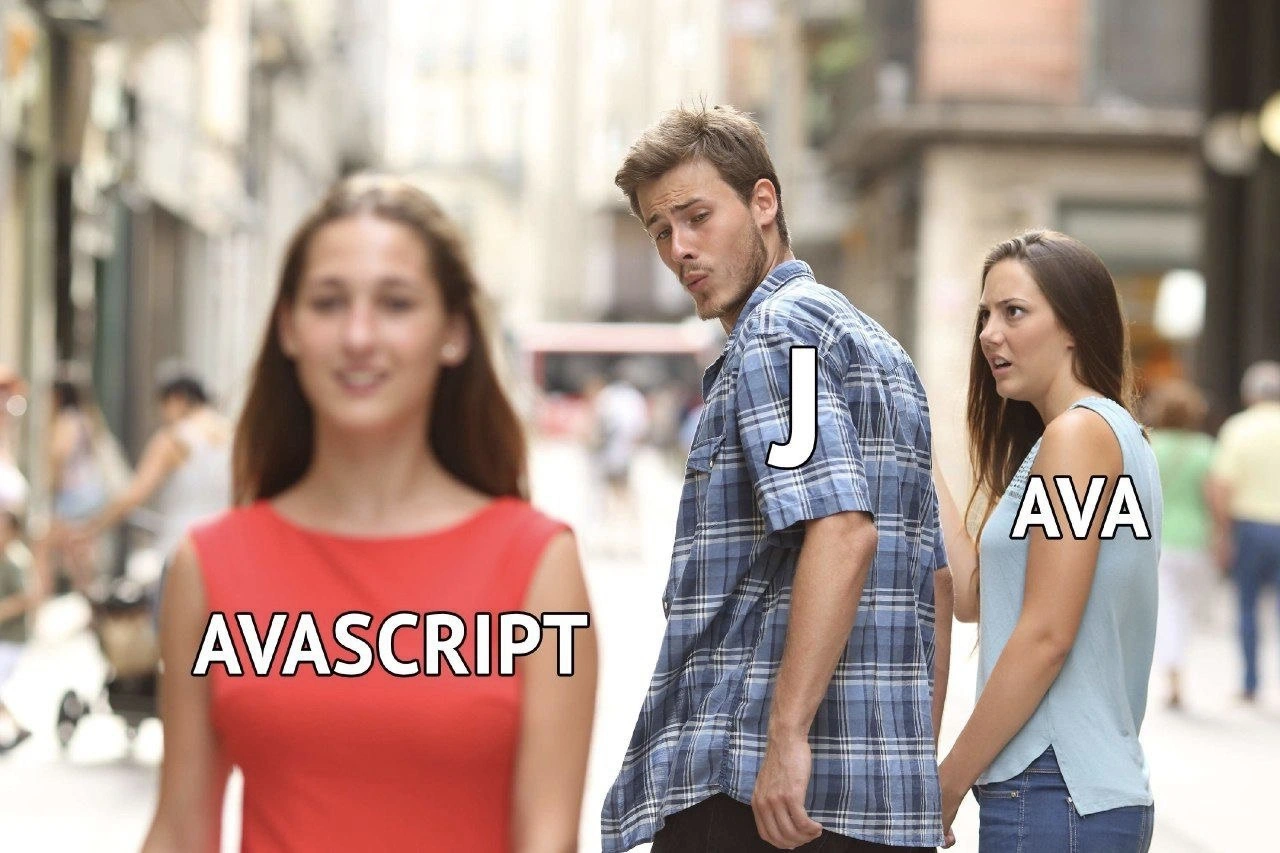
Let's break down the joke in simpler terms. The meme uses the popular "distracted boyfriend" format, where one character (the boyfriend) is tempted by something new while his current partner looks shocked. In this version, those characters are labeled to represent programming languages. The guy in the plaid shirt has a big "J" on his torso, and the woman next to him (his girlfriend) is labeled "AVA". When they're together, side by side, their labels form the word "JAVA". Java is a well-known programming language. Now, the twist is that the guy is turning his head to gape at another passing woman in a red dress labeled "AVASCRIPT". If you put "J" in front of "AVASCRIPT", suddenly you get "JAVASCRIPT". That's exactly what the meme is showing: the letter J character is leaving "AVA" and effectively joining "AVASCRIPT" to create the word "JavaScript". It's a visual way to say Java (represented by J + Ava as a couple) is being abandoned in favor of JavaScript (J + Avascript as the new pairing).

So why is this funny to developers? It's because Java and JavaScript are two completely different programming languages that just happen to share four letters in their names. A lot of beginners understandably assume they're related – some think JavaScript is a spin-off or a scripting version of Java – but that's not true. Java is not JavaScript, just like car is not carpet (they sound similar but are totally unrelated things). Java (the one represented by the upset girlfriend "AVA" in the meme) is a language originally created by Sun Microsystems in the mid-90s. It's used in many big, traditional software projects. For example, banks might use Java to handle transactions, or a big company might use it to run the back-end of their website. Java is known for its strict syntax and the need to compile code (turn it into bytecode that runs on any machine with a Java Virtual Machine). Many computer science students learn Java early on, and it's considered a very solid, if somewhat conservative, language choice. JavaScript (the woman in red) is another language that also came out in the 90s, but it was made for web browsers. Whenever you click a button on a webpage and something changes without the whole page reloading – that's probably JavaScript at work. It's a dynamic, interpreted language, which means you don't compile it ahead of time like Java; instead, the browser (or a runtime like Node.js on a server) reads and executes the code on the fly. Over the years, JavaScript became the language of front-end web development – basically every modern website uses it. And thanks to technologies like Node.js, you can even use JavaScript outside the browser, like on servers or to build desktop and mobile apps. This versatility caused a huge surge in JavaScript's popularity.

Now, the meme is making fun of the trend where developers move away from older languages (like Java) to work with whatever is currently hot (like JavaScript and its countless libraries and frameworks in today's case). This is where the idea of the "distracted boyfriend" fits perfectly. The J character can be seen as a Java developer or the essence of the Java community. He's literally turning his back on AVA (Java, the long-time partner) and is mesmerized by AVASCRIPT (JavaScript, the exciting newcomer). The girlfriend's shocked face labeled "AVA" basically says, "Are you serious? You're leaving me for that?". It's the same face a Java veteran might make upon hearing their team wants to rewrite a stable Java back-end using Node.js just because "JavaScript is cool now."

For a junior developer or a student, this meme is also a light lesson in tech trends. Technology moves fast, and there's often a "flavor of the month" programming language or framework. People talk about these trends in terms of hype. IndustryTrends_Hype in the tags refers to how everyone might be excited about a certain technology (for example, how JavaScript frameworks have been extremely hyped in recent years). It's not that Java suddenly became bad; it's that JavaScript became very popular and flexible, especially for new kinds of applications (like interactive web apps, smartphone apps via frameworks, and so on). Many developers didn't want to miss out, so they started paying more attention to JavaScript. If you're newer to the developer world, you might have noticed lots of tutorials, bootcamps, and job postings focusing on JavaScript (and things built with it like React, Angular, or Vue). It's because in the realm of Frontend (the part of software that deals with what users see and interact with, like websites and mobile app interfaces), JavaScript is the dominant language. This meme is like a little story of that dominance: Java (which was more dominant in the past especially on servers) is feeling left out as everyone flocks to JavaScript for the new frontiers of web development.

To put it simply: Java is an older, respected language used for heavy-duty applications and a lot of back-end work. JavaScript is the hip, modern language that powers the web and beyond, and these days it's getting all the attention. The meme is relatable because many of us have experienced the pressure to learn JavaScript if we started with Java or another language. It's common early in a developer's career to realize that "Oh, the cool project or job requires JavaScript, maybe I should pivot." It's kind of like if you were really good at one thing but suddenly everyone starts talking about a different thing – you'd consider switching too. The tags like LanguageComparison and LanguageWars hint that there's a bit of a playful battle between communities: some people swear by Java, others by JavaScript, and they like to poke fun at each other. This meme takes Java's own name and uses it to elevate JavaScript, which is cheeky. But it's all in good fun as a TechMeme that almost any programmer can chuckle at. Even if you're a newbie, you can appreciate it once you know that Java and JavaScript aren't parent and child, but more like distant neighbors – and one neighbor just threw a wild party that everyone's running to.

Level 3: Hype-Driven Development

In this meme, a well-worn distracted boyfriend stock photo is repurposed into a multi-layered programming joke about language trends. The man in the plaid shirt is labeled J, his girlfriend is labeled AVA – together they form the word “JAVA” – and the passing woman in the red dress is labeled AVASCRIPT. The humor hinges on a literal letter-split gag: the letter J breaks away from "AVA" to attach to "AVASCRIPT," forming “JAVASCRIPT” right before our eyes. It's an ingenious visual pun that personifies programming languages: the J (standing for Java, or perhaps a Java developer) is literally walking away from AVA (Java) to chase AVASCRIPT (JavaScript). The poor girlfriend "AVA" is left shocked, effectively abandoned as the leading "J" from her name joins someone else. This clever composition simultaneously spells out the punchline and sets up a familiar scenario in tech.

Beyond the wordplay, the meme is poking fun at the real-world dynamics of programming language popularity. Java and JavaScript might share a prefix, but they're entirely different languages, each with its own ecosystem and philosophy. Java, the once-dominant enterprise workhorse (known for its "write once, run anywhere" mantra and coffee-cup logo), has been a staple for back-end systems, Android apps, and large-scale, object-oriented development since the mid-'90s. JavaScript, on the other hand, started in 1995 as a simple browser scripting language (originally called LiveScript) to make web pages interactive. Fast-forward to the 2010s: thanks to Node.js and powerful front-end frameworks (like React and Angular), JavaScript exploded far beyond the browser. It became possible to build entire applications front-to-back with one language, and the industry buzz around full-stack JavaScript skyrocketed. The meme captures this shift in a tongue-in-cheek way: the "J" in Java suddenly finds JavaScript more alluring. It's a scenario many senior developers recognize: an engineer or organization turning away from a long-term, battle-tested technology in favor of the shiny new tool that's all the rage. There's even a nickname for this kind of behavior: Hype-Driven Development. Teams start picking tech stacks less because they suit the problem best, and more because "everyone's talking about it." This notorious tendency leads to scenes exactly like our meme – a sort of tech temptation where a previously loyal Java programmer might start daydreaming about writing console.log() instead of System.out.println() because, well, that's where the excitement (and perhaps the job postings) are.

Seasoned professionals chuckle (and cringe) because we've seen this movie before. Today it's Java developers pivoting to JavaScript for web and startup glory, but the pattern is cyclic. In the late 1990s, plenty of C++ and COBOL folks were the ones dropping everything to chase Java itself, when Java was the hot new platform promising garbage collection and "network ubiquity" in the internet age. A decade later, many Java or PHP developers were lured by the cool simplicity of Ruby on Rails, or by Python, during the web 2.0 startup booms. The specifics change – Angular vs React, Java vs Go, etc. – but the distracted-boyfriend dynamic keeps replaying in our industry. It's an endless language war of attrition and attraction. This meme distills that phenomenon to one frame: Java (the established incumbent) is left slack-jawed as its own initial "J" steps out, symbolizing how developers flock to the next big thing. The fact that the next big thing here is JavaScript is rich with irony. Remember, back in 1995, JavaScript was named in a marketing ploy to ride on Java’s popularity (Netscape basically said, "Java is cool, let's hitch our wagon to that star"). Now the tables have turned: JavaScript is arguably the most ubiquitous language (from browser to server to mobile via frameworks), and it's Java trying to cling to relevance in an app world dominated by JavaScript. There's an old quip that "Java is to JavaScript as car is to carpet," highlighting that the two have as much in common as a car does with a carpet (basically, almost nothing beyond some letters). This meme plays with that notion by actually welding the words together through that wandering "J". It's funny because it acknowledges the misleading naming, but instead of a straightforward comparison, it dramatizes a relationship breakup: Java’s letter literally divorces her to marry into JavaScript, as if to say "if you can't beat 'em, join 'em."

The resulting scene resonates on multiple levels for developers. It's a perfect storm of DeveloperHumor: a programming in-joke about naming, a comment on IndustryTrends_Hype, and a relatable scenario that many in the field have experienced or at least observed. The girlfriend labeled "AVA" has a face of scandalized betrayal that mirrors how some die-hard Java fans felt watching the rise of Node.js and front-end JavaScript frameworks eating into Java’s mindshare. Meanwhile, the casually smirking guy J is that part of the developer community (or that one colleague) eagerly following the crowd to the latest JavaScript framework du jour. And the woman in red, JavaScript, is depicted as the attractive new opportunity no one wants to miss out on. It's relatable humor because, truth be told, tech folks often do have a bit of that "distracted boyfriend" tendency when it comes to new tech. The meme exaggerates it in classic fashion: one letter swaps companions and suddenly JavaScript steals the spotlight, leaving poor Java fuming in the background. For anyone who's ever been swept up in a tech hype cycle, or had to maintain legacy Java code while all the buzz was about front-end development, this image hits home and tickles the funny bone at the same time. In short, it's a witty encapsulation of how fickle our industry can be – one moment you're the beloved go-to language, the next moment your developers are eyeing something trendier across the street.

Description

This meme uses the popular 'Distracted Boyfriend' format to make a classic joke about programming languages. The boyfriend in the blue plaid shirt is labeled with the letter 'J'. His current girlfriend, looking on with disapproval, is labeled 'AVA'. The woman in the red dress who has caught the boyfriend's attention is labeled 'AVASCRIPT'. The visual pun works by splitting the names of two distinct programming languages, Java and JavaScript, across the characters. The 'J' is literally being distracted from 'AVA' (forming 'JAVA') to look at 'AVASCRIPT' (forming 'JAVASCRIPT'). The humor is rooted in the long-standing confusion between these two languages, a common annoyance for developers who frequently have to explain that despite the similar names, they are completely unrelated. The name 'JavaScript' was a marketing decision to capitalize on Java's popularity at the time
Comments

20
Anonymous ★ Top Pick Java is to JavaScript as car is to carpet. One got us to enterprise scale, the other is everywhere, impossible to get rid of, and someone always spills something on it
  1. Anonymous ★ Top Pick

    Java is to JavaScript as car is to carpet. One got us to enterprise scale, the other is everywhere, impossible to get rid of, and someone always spills something on it

  2. Anonymous

    J ditched AVA because “the JVM’s too heavy.” Three million transitive npm packages, two left-pad incidents, and one supply-chain audit later, it’s longing for that single fat JAR

  3. Anonymous

    After 20 years in the industry, I've realized the greatest architectural decision wasn't microservices or event sourcing - it was Netscape's marketing team deciding to ride Java's coattails in 1995, forever cursing us to explain to recruiters why a 'Senior Java Developer' role doesn't mean we know JavaScript

  4. Anonymous

    After 25 years of JavaScript's existence, we've gone from 'Java is to JavaScript as car is to carpet' to creating so many JS variants that even JavaScript itself can't resist checking out the competition. Meanwhile, AVA (the testing framework that's been solid since 2015) is giving that look every senior engineer knows too well - the one that says 'we literally just finished migrating the test suite last quarter.'

  5. Anonymous

    J leaving AVA for AVASCRIPT: the tiniest diff with the biggest blast radius - overnight you’re “full‑stack” with 10k node_modules and types optional until prod

  6. Anonymous

    The only time J ever uses strict mode is when Ava's watching

  7. Anonymous

    J ditching AVA for AVASCRIPT - the canonical diagram of a 'Java shop' after hiring five React teams; the JVM becomes the legacy service behind a Node BFF

  8. @slnt_opp 5y

    Yes

  9. @AuroraStudio 5y

    J son

    1. @ZgGPuo8dZef58K6hxxGVj3Z2 5y

      SWEET HOME ALABAMA

  10. @nuntikov 5y

    j lang

  11. @nuntikov 5y

    quicksort=: (($:@(<#[), (=#[), $:@(>#[)) ({~ ?@#)) ^: (1<#)

  12. @jor_ban 5y

    same but reversed

  13. @declonter 5y

    "Saying that Java is good because it works on all platforms is like saying anal sex is good because it works on all genders."

    1. @RiedleroD 5y

      that is a good quote - where did you get it from?

      1. @declonter 5y

        From internet :)

        1. @RiedleroD 5y

          (:

  14. @Quibique 5y

    Julia 😢

  15. @misesOnWheels 5y

    Oracle C#

  16. @ZgGPuo8dZef58K6hxxGVj3Z2 5y

    COD physics

Use J and K for navigation