
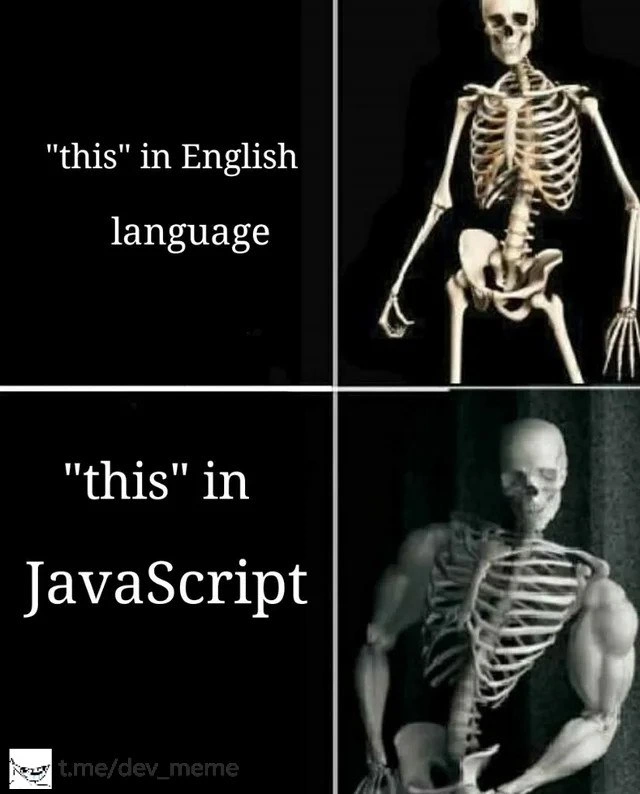
The Duality of the 'this' Keyword
Description
This is a two-panel 'weak vs. strong' comparison meme. The top panel has the text '"this" in English language' next to an image of a normal, frail skeleton. The bottom panel has the text '"this" in JavaScript' next to an image of a skeleton with an absurdly muscular physique overlaid. The meme humorously contrasts the simple, demonstrative pronoun 'this' in everyday English with the notoriously complex and powerful `this` keyword in the JavaScript programming language. For developers, the `this` keyword is a constant source of both utility and confusion, as its value is dynamically bound depending on the execution context (how a function is called). This complexity can lead to subtle bugs but is also fundamental to object-oriented programming in JavaScript, making it a 'strong' or heavyweight concept compared to its simple linguistic counterpart. A watermark for 't.me/dev_meme' is in the bottom left corner

Comments
7Comment deleted
In JavaScript, 'this' isn't a pronoun; it's an identity crisis that changes depending on who's asking, what the occasion is, and whether it was an arrow function's party
"this" in JavaScript is what happens when .call(), .apply(), .bind(), and an arrow function all take the wheel - you reach the callback, but your execution context needs a chiropractor
After 15 years, I still console.log(this) before every method just to see which parallel universe JavaScript decided we're in today - could be window, could be undefined, could be that random object from 2018 we forgot to unbind
Ah yes, JavaScript's 'this' keyword - where the context depends on how you called the function, not where you wrote it. It's the language feature that turns every senior engineer into a philosopher pondering 'what is this, really?' Arrow functions tried to save us, but now we have juniors who've never experienced the existential dread of losing 'this' in a callback. Truly, 'this' is JavaScript's way of reminding us that in a dynamically-typed, prototype-based language with first-class functions, even the simplest pronoun requires a PhD to understand
English: "this" points to the obvious; JavaScript: "this" points to whoever invoked it - unless an arrow function made it lexical or strict mode left it undefined
JS 'this': the keyword that single-handedly justified TypeScript's existence for anyone past their first callback nest
JavaScript's "this" is the enterprise org chart - reports to whoever made the call, goes bossless in 'use strict', and with arrow functions permanently reports to the author