When JavaScript Chooses You Instead of the Other Way Around
Why is this Languages meme funny?
Level 1: The Uninvited Friend
Imagine you're playing in your yard and a friendly stray dog wanders over. You never asked for a dog, but it follows you home and refuses to leave. Now it’s sitting on your porch every day. You didn’t choose to have this dog, but now it’s part of your life! This meme is joking that JavaScript is like that dog – it shows up in your programming project even if you never planned to use it, and it sticks around no matter what. In super simple terms, the joke is saying sometimes you don’t get to pick what tools or toys you play with; they sort of pick you by just being everywhere you go.
Level 2: JavaScript Everywhere
JavaScript is the programming language that pretty much runs the web. It makes websites interactive: whenever a button clicks and something changes on the page without reloading, that's likely JavaScript doing the work behind the scenes. Web browsers (Chrome, Firefox, Safari, etc.) understand JavaScript natively, and for a long time it’s been the only choice for front-end scripting in webpages. This means if you're building a website and want anything beyond static text and images, you end up using JavaScript to do it.
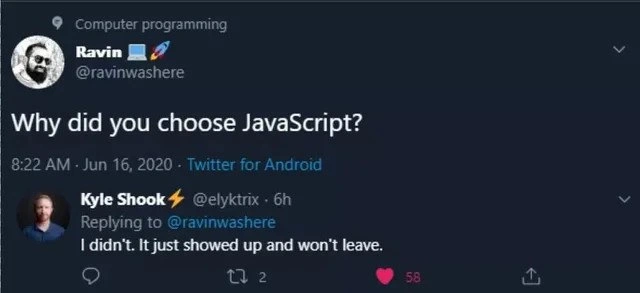
This meme highlights a common joke among developers: we don’t so much choose JavaScript as JavaScript chooses us. In the screenshot (a Twitter post under the "Computer programming" topic), someone asks, “Why did you choose JavaScript?” and the reply says, “I didn’t. It just showed up and won’t leave.” It’s funny because normally you expect a programmer to intentionally pick a language for a project, but here it's like the language forced itself into the project uninvited. Many developers find this relatable – they might start a new app in a different language, but sooner or later they have to add a bit of JavaScript.
Why does JavaScript keep showing up? One big reason is that it’s necessary for web development. For example, imagine you're a new coder making a small website. You might write your server code in Python or PHP, but if you want a nice interactive form or a live update on the page, you'll use JavaScript for that part. It’s almost unavoidable if your project has any kind of web interface. Plus, JavaScript isn’t limited to the browser these days. With tools like Node.js, you can run JavaScript on a server or even on your own computer for scripts. Node.js became popular for building back-end services and workflow tools, so JavaScript moved into those areas too. This means even if you don’t plan on it, you often encounter JavaScript when setting up projects – for example, installing an npm package to bundle your files or using a JS library to automate tasks.
Developers like to joke about this inevitability. On forums and social media (Stack Overflow, Twitter, etc.), you'll see jokes and memes about how JavaScript is everywhere. The image we have is a screenshot of a Twitter conversation in dark mode, which is a common way devs share humorous observations. The small numbers below the tweet (replies, retweets, likes) show that quite a few people agreed and found it funny. In simple terms, JavaScript is one of the most popular and pervasive programming languages in the world, so chances are high that you'll end up using it whether you meant to or not. The meme is a lighthearted way of saying “sometimes you don’t get to choose the tools – the tools kind of choose you.”
Level 3: The Uninvited Guest
It's a familiar story in developer culture: you're minding your own tech stack, happily coding in your language of choice, when suddenly JavaScript appears. The meme's tweet exchange nails this with a touch of sarcastic truth. The initial question asks, "Why did you choose JavaScript?" – a query we've all heard in job interviews or dev meetups. But the punchline reply flips the script: "I didn't. It just showed up and won't leave." This lands because it's a riff on the classic joke "I didn't choose the ___ life; the ___ life chose me," and here the blank is filled by everyone's favorite ubiquitous scripting language. Seasoned programmers smirk at this reversal because it rings so true.
Why is this so relatable to experienced devs? Because JavaScript's infiltration into projects is almost inevitable. In theory, developers like to believe they choose their tools by careful evaluation. In practice, when building anything for the web, JavaScript isn’t really optional – it's the default. Every major browser understands only JavaScript for client-side code. So the moment you decide “let’s make this web page interactive” or “we need a nice UI for our app,” guess who's at your doorstep? That's right: JavaScript. You might start a simple site in Python or Ruby, but as soon as someone asks for a dynamic button or a fancy dropdown, JavaScript sneaks into your codebase. (Browsers did have plugins for other languages in the past – think Java applets or Adobe Flash – but those went extinct, leaving JavaScript as the last one standing.)
Over time, JavaScript has quietly become the lingua franca of not just the browser, but many other layers of development. It finds a way into almost every stack:
- Front-end web: Every modern web page that does more than display static text relies on JavaScript for interactivity. It's literally the only programming language web browsers execute natively, so if you want pop-ups, dynamic forms, or a live updating feed, you're inevitably writing (or importing) JS.
- Back-end servers: Thanks to Node.js (a runtime for JavaScript outside the browser), many teams use JavaScript on the server side too. Even if your server is written in Java or Python, you'll likely use Node-based tools for building or deploying. It's common to end up running
npm installand maintaining anode_modulesfolder full of JS packages just to support your front-end or build process. - Desktop & mobile apps: JavaScript even powers desktop applications via Electron (which bundles a mini browser to run web code for apps like VS Code or Slack). Mobile isn't safe either – frameworks like React Native let you build iOS/Android apps with JavaScript. In short, JS has crept into every domain from your browser to your server and even your phone.
Atwood's Law – an ironic adage among developers – states that "any application that can be written in JavaScript, will eventually be written in JavaScript." In other words, given enough time, JS finds its way into everything. That’s exactly why this meme lands so well: the developer in the joke never really stood a chance of avoiding it!
The meme pokes fun at this inevitability by personifying JavaScript as a persistent guest. The reply "It just showed up and won't leave" paints JS as that colleague who volunteers for every task or a houseguest who unpacks their bags in your spare room and settles in. It’s humor through camaraderie – experienced devs laugh (and groan) because they’ve lived it. Many of us have tried to dodge JavaScript by using some fancy compile-to-JS language like TypeScript or CoffeeScript, only to realize those are just masks – underneath, it’s still JavaScript doing a cha-cha slide through our codebase.
Online developer communities love to commiserate about this. The screenshot (in Twitter dark mode) shows an actual tongue-in-cheek Q&A between programmers. The modest retweet (2) and like (58) counts might not be viral, but they confirm plenty of folks went “ha, so true” at this exchange. It highlights JavaScript’s massive popularity: year after year, it's ranked among the top (often the top) languages in usage. Translation: almost every developer bumps into JavaScript, whether by choice or not. The meme perfectly captures that resigned feeling of “well, I guess I’m using JavaScript… again.” Veteran devs chuckle because at some point they’ve all said, “I didn’t pick JavaScript – it picked me.”
Description
Dark-mode Twitter screenshot under the topic line “Computer programming.” The original tweet by Ravin (@ravinwashere) reads: “Why did you choose JavaScript?” and is time-stamped 8:22 AM · Jun 16, 2020 · Twitter for Android. Beneath it, Kyle Shook (@elyktrix) replies: “I didn’t. It just showed up and won’t leave.” The UI shows small reply, retweet (2), and heart (58) icons in light blue and pink against a nearly black background. The humor plays on the ubiquity of JavaScript in modern development, capturing the feeling that the language embeds itself in every project regardless of a developer’s intent, a relatable frustration within dev communities discussing language adoption
Comments
8Comment deleted
JavaScript sneaks in as “just a tracking pixel” and six quarters later it’s the cornerstone of your event-driven microservices platform - while management swears it was your idea
After 20 years in tech, I've learned JavaScript is like that production MongoDB instance from 2011 - nobody chose it, it just happened during a hackathon, and now it's handling 40% of your traffic while everyone's too afraid to migrate away
JavaScript is like that houseguest who arrived for the weekend in 1995, promised they'd leave after helping with some DOM manipulation, and somehow ended up running your backend, mobile apps, desktop applications, IoT devices, and now wants to compile to WebAssembly. You didn't choose the JS life - Brendan Eich chose it for you in 10 days, and now it's everyone's problem. At least it brought npm with 2 million packages, though 1.9 million are left-pad dependencies
No one chooses JavaScript; you choose “runs in a browser” and spend forever paying HOA dues to V8 and a thousand transitive npm dependencies
No one chooses JavaScript; it’s the internet’s transitive dependency
JavaScript: the only language that prototypes your career choices without asking
I choose C++ Comment deleted
koi8-r 4ever Comment deleted