When your programming meme faces the syntax judges in comments
Why is this DevCommunities meme funny?
Level 1: Correcting the Joke
Imagine you’re telling a funny story to your friends, and right in the middle of the punchline, one friend interrupts and says, “Wait, you used the wrong word,” or “Hey, you forgot to pause at a comma.” Feels frustrating, right? The joke’s momentum breaks, and the laughter dies because someone got too hung up on a tiny detail. That’s exactly what this meme is about, but in a programming setting. A person shares a goofy coding joke online, hoping everyone will laugh. Instead, a bunch of people act like strict teachers or grammar police, zooming in on small “mistakes” in the joke.
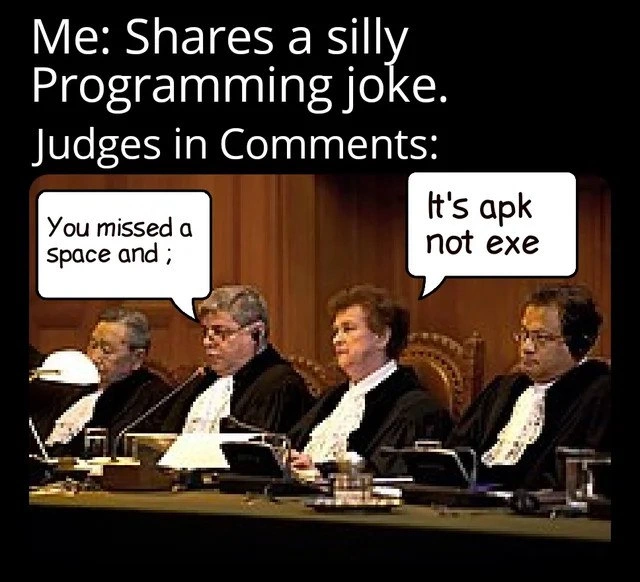
It’s like the joke is on trial in a courtroom. The meme even shows real judges sitting at a bench, as if the joke-teller is standing accused before them. But what are the “charges”? Not a crime, just silly little errors: maybe a missing punctuation mark or mentioning the wrong kind of computer file. In the speech bubbles, one judge basically says, “You forgot a tiny bit of punctuation (a semicolon) and a space,” and another says, “Actually, it should be this file type, not that one.” They’re treating the joke super seriously, as if those tiny details are the whole point (when they’re not!).
The humor (and the relatability) comes from how over-the-top this reaction is. The person meant to share something funny, but the commenters acted like official inspectors grading an exam. It’s funny because it’s a bit ridiculous — instead of just laughing at the joke, these “judges” fuss about technical minutiae. It’s also a little exasperating, because many of us have experienced this: you try to be light-hearted, and someone kills the vibe by being overly correct.
In simple terms, the meme is saying: programmers sometimes take things too seriously. They can forget to just enjoy the joke and instead start correcting it. If you don’t know much about programming, think of it like telling a joke and someone butting in to fix your grammar or fact-check a tiny detail. The end result? The original joke isn’t as fun anymore because the flow got interrupted. We can laugh at the scene in the meme because it’s such a clear exaggeration – a whole panel of judges nitpicking a joke – and it reminds us not to be that friend who corrects every little thing. Sometimes, it’s okay to ignore the small stuff and just laugh along.
Level 2: Syntax Police Academy
So what’s going on in this meme? It’s showing how sharing a programming joke online can trigger an unexpected code review from commenters. The top of the meme says, “Me: Shares a silly programming joke. Judges in Comments:” This sets up a scene: I, the programmer, post a light-hearted coding joke, and the “judges in comments” respond seriously. Below that text, we see a picture of an actual courtroom panel – five judges in robes behind a bench – implying that the commenters act like a stern judging panel scoring the joke. They’re not literally judges, of course; it’s a metaphor. Those commenters are treating a simple joke as if it were code that must meet strict standards.
In the image, two judges have speech bubbles with their “verdicts.” Let’s break down those comments because they’re packed with typical programmer nitpicks:
“You missed a space and ;” – Here a judge is pointing out two tiny errors: a missing space and a missing semicolon. In programming, syntax (the rules for writing code) is a big deal. A semicolon (
;) in many languages (like C, C++, Java, C#) is used to mark the end of a statement. If you forget one, the code often won’t run at all – the compiler (the program that turns your code into an executable program) will throw a syntax error and complain. It’s equivalent to forgetting a period at the end of a sentence in English, but even less forgiving: the whole program might “break.” So programmers are trained to always catch missing semicolons. The “missing space” part refers to whitespace style – for example, some style guides or linters require a space after commas, around operators, or between keyword and parenthesis (like writingif (instead ofif(). Missing a space doesn’t usually break the code (except in Python where indentation is syntactically meaningful), but it can make the code less readable or just violate agreed-upon style rules. In many dev teams, there are conventions: e.g.,function myFunc() { … }should have a space betweenfunctionand the parenthesis, or after//in a comment you put one space. They’re very small details. Seeing “You missed a space and ;” in the meme shows a commenter obsessing over formatting/punctuation in a joke. It’s like a teacher marking grammar errors on a funny comic strip – technically correct, but kind of missing the point.“It’s apk not exe” – The other judge corrects a technical detail: the file type mentioned. .exe and .apk are file extensions for two different kinds of programs. An
.exe(executable) is a Windows application file – when you double-click an.exeon a Windows PC, it runs a program. An.apk(Android Package) is the file format used to install apps on Android devices. They’re not interchangeable; if someone said “install the exe on your phone,” that’s incorrect because phones use APKs, not EXEs. In the context of a meme, maybe the original joke casually mentioned an.exefile for something Android-related (or just used.exeas a generic term for a program). A pedantic commenter couldn’t resist stepping in to say “Um, actually, you meant.apkfor Android.” This is a classic move in online dev communities – focusing on a factual slip instead of the joke or discussion itself. It’s as if someone telling a story says “I drove 10 km” and a listener interjects “10 kilometers, not km – spell it out!” The correction is technically right but adds no real value to the story/joke being told.
These judges in the meme symbolize the “syntax police” – a nickname for programmers who habitually correct others on small syntax or formatting issues (like missing semicolons, minor spelling mistakes in code, wrong terminology, etc.), especially in informal contexts. The meme humorously portrays them as a stern judge panel, which is an exaggeration but not by much! If you’ve spent time in developer forums, comment sections, or even doing code reviews at work, you’ve likely encountered this behavior. For example, a newbie might share a snippet of code or ask a question on a forum. Instead of directly answering or laughing at the joke, several replies might first point out that they used = instead of == in an if statement, or that their code screenshot shows 3-space indentation instead of 4. The poor newbie just wanted help or to share something funny, and suddenly it feels like they’re being scolded for style errors.
Let’s connect this to real life developer practices:
- Code Reviews: In software teams, before code is merged, peers review it. They look for bugs, suggest improvements, and yes, often point out style issues (like “add a space here,” “rename this variable to follow convention,” “missing semicolon,” etc.). This process is meant to maintain code quality. However, it can sometimes overemphasize trivial issues if reviewers aren’t careful. Many teams use linters and auto-formatters (like ESLint, Prettier for JavaScript, or clang-format for C++) to automatically catch and fix these minor things, precisely so that code review discussions can focus on the important stuff (like logic and design). Still, old habits die hard. Some engineers almost enjoy spotting a misplaced comma or an extra space – it’s straightforward and objective to comment on.
- Online Communities: Places like Stack Overflow, Reddit (e.g., r/ProgrammerHumor, r/coding), or Discord chats have a mix of people. Some will answer your question or laugh at your meme, but others can’t resist the urge to correct any little mistake. Did you mention Python but use a Ruby syntax in the joke? Someone will call it out. Wrote a pseudo-code that wouldn’t actually compile? You might get the “syntax judge” treatment. They see it as helping or just showing their knowledge, but it often comes off as nitpicky or tone-deaf when the context is meant to be light.
In the meme’s scenario, I just wanted to share something funny. The “judges in comments” represent those community members who respond as if they’re grading an exam. The contrast is what makes it humorous and relatable. On the one hand, you have a casual, joking tone (that’s “Me” sharing a silly joke). On the other, you have super serious responses tearing into the syntax and correctness of that joke. It highlights a small irony of developer culture: we’re so detail-oriented with code that sometimes we act the same way in everyday communication. It can be frustrating if you’re on the receiving end (“Geez, it was just a meme, not production code!”), but when shown in this exaggerated court scene, it’s also laughable. We see how absurd it looks when five judges are frowning over a missing semicolon in a joke – and it gently pokes fun at those of us who may have done something similar in all seriousness.
For a junior developer or someone new to these communities, the meme is basically telling you: this happens a lot. You might post something innocent and get back a flood of “Actually…” comments. Don’t take it too hard – it’s almost a rite of passage. Seasoned devs have learned to either double-check anything they post (even jokes) for silly mistakes or just roll their eyes when the nitpicking comments appear. And if you’ve unknowingly been that nitpicky commenter once – well, this meme is a playful nudge saying “hehe, maybe relax a bit.”
To sum it up, the meme uses the courtroom judge imagery and speech bubbles to show how developer communities can turn a fun meme into a strict code review. It’s pointing out common pain points in how we communicate:
- We often value technical accuracy so highly that we insert it into every conversation, even where it’s not necessary.
- There’s a fine line between helpful corrections and overkill. The meme lands squarely on the side of “overkill, but in a funny way.”
When you’re new, it might be confusing: “Why are they so serious? Did I do something terribly wrong?” The answer is usually no – you just encountered the syntax/style enthusiasts. The best approach is to recognize the humor in it, learn what you can (okay, now you know .apk is the Android format!), but also understand that your original intent (the joke) wasn’t actually “bad.” This meme is a lighthearted way to commiserate about those overly strict comment-section code judges that every developer meets sooner or later.
Level 3: The Syntax Tribunal
In every developer community, there’s an unofficial courtroom in the comment section. A harmless programming joke gets treated like serious code on trial. The meme captures this perfectly: you share a silly coding meme expecting a chuckle, but the “judges” in the comments pounce on trivial errors as if ruling on a Supreme Court case of code style. It’s funny because it’s true – many of us have seen friendly posts turn into CodeReview sessions. Instead of enjoying the humor, commenters become a panel of robed experts nitpicking details.
The image literally shows judges in black robes, faces blurred, sitting behind a bench like they’re about to hand down a verdict on your code. Two judges have speech bubbles highlighting classic nitpicks: one says “You missed a space and ;”, and another corrects “It’s apk not exe”. These are comically petty critiques:
- Missing a space or semicolon – trivial formatting issues that do not change the joke at all. In real code, a missing semicolon
;can break a build or throw a compile error, and extra/missing whitespace might violate a style guide. But here, treating that like a fatal flaw in a meme is hilariously overblown. It’s as if a judge yelled “Order! This joke is out of order – there’s a semicolon missing!” - Wrong file extension (
.apkvs.exe) – a pedantic factual correction. An APK is an Android app package, an EXE is a Windows executable. If the meme’s punchline mentioned an.exewhen it technically should be an.apk, some know-it-all commenter just has to chime in with “Actually, it’s apk, not exe.” It’s the classic “well, technically…” response that completely misses the spirit of the joke.
For seasoned developers, this scenario is painfully relatable. We share a funny observation about coding, and immediately someone treats it as a pull request that must pass all style checks. The humor comes from contrast: the original poster is casual (“Me: shares a silly programming joke”), but the responders are dead serious (“Judges in Comments”). It’s an exaggeration of real life code reviews where minor issues can overshadow bigger ones. In a real code review (a peer CodeReview of your code changes), it’s common to get comments about indentations, missing semicolons, or naming conventions. Yes, consistency and syntax are important for real projects – a missing semicolon will make a C++ compiler throw errors, and using the wrong file format might confuse users – but in a meme or casual post, those strict standards are comically out of place.
Developer culture has this tongue-in-cheek concept of the “syntax police” or “code style judges.” These are folks (often well-actually types) who derive a bit of joy or ego from catching others’ mistakes, however minor. A meme like this exaggerates them as a whole bench of judges poised to deliver a verdict on your joke’s correctness. The black robes and courtroom setting lampoon how DevCommunities sometimes handle jokes as if they were serious matters of law. It reflects a common Communication problem in technical circles: the inability to switch off pedantry. After all, we’re trained to be precise with code – a single-character mistake can break a system. Seasoned engineers carry that exactitude into every conversation. The result? Even when someone just wants to share a laugh, there’s inevitably a highly literal commenter examining the setup and punchline for accuracy.
This meme resonates because it’s a shared DeveloperHumor experience: you post something for laughs, and instantly the comment section turns into a nitpick fest. The humor has an edge of frustration – we’re laughing at those judges, even as we recognize a bit of them in ourselves. (Who hasn’t at least once pointed out a minor mistake, forgetting to just laugh?) The relatable humor here taps into the mild exasperation of having your lighthearted content judged by strict coding standards. It’s a satire of CodeReviewPainPoints: sometimes code reviews (or comment threads) zoom in on the tiniest issues and miss the bigger picture. We laugh because the judges’ hyper-serious faces and nitpicky quotes mirror real interactions we see on Stack Overflow, subreddit threads, or team chats. The meme is essentially calling out: “Chill, it’s just a joke – not production code!”
On a deeper level, there’s an irony that experienced devs appreciate: the syntax nitpickers often focus on something easy and objective (like a semicolon or filename) because it’s a quick win. It’s much simpler to correct someone’s file extension or punctuation than to engage with the actual humor or idea. We’ve all observed this pattern:
- In a code review for a critical feature, dozens of comments will be about spacing or naming, while the complex logic gets one “Looks good” stamp. It’s so much easier to say “add a newline here” than to deeply analyze algorithmic correctness.
- Online, a contributor might pour effort into a clever joke or insightful post, only for the top comment to be a minor correction. The meme exaggerates this by depicting five judges seriously convened – as if a whole committee was required – just to call out minor issues.
The shared “trauma” being poked at is that many of us have felt the sting (or annoyance) of overly harsh feedback on trivial issues. It’s funny because it’s disproportionate: like bringing a lie detector to a stand-up comedy show. The comment section critique becomes a performance of its own, overshadowing the original content. This is a gentle roast of our own developer culture: we value correctness so highly that we sometimes forget to lighten up. The meme is winking at all the times a fun coding anecdote turned into an impromptu linting session by strangers. It’s a cautionary chuckle – maybe next time, let the joke be a joke. Or at least, correct the semicolon after you’ve laughed. 😉
Description
The meme has a black background with white text at the top that reads, "Me: Shares a silly Programming joke. Judges in Comments:". Beneath the header is a courtroom photo of five robed judges seated behind a long wooden bench; their faces are blurred for anonymity. Two judges have comic-style speech bubbles: the left bubble says, "You missed a space and ;" while the right one says, "It's apk not exe". The visual gag contrasts the light-hearted intent of sharing a joke with the harsh, nit-picky tone of online commentators, echoing real-world code-review culture where trivial formatting and file-type corrections often eclipse the humor or larger point. Technically, it references common developer pain points - missing semicolons, whitespace pedantry, and confusing executable formats - highlighting how developer communities can devolve into meticulous code-style policing rather than enjoying the joke
Comments
13Comment deleted
Every time I drop a programming meme, the comments auto-scale into a linter cluster: five senior reviewers, zero laughs, and a PR insisting the punchline be refactored into microservices - because monolith jokes don’t scale
The same developers who'll spend three sprints debating whether to use tabs or spaces will somehow miss the entire point of your architecture diagram because you used the wrong shade of blue for the database icon
This perfectly captures the Stack Overflow effect: you post a lighthearted meme about null pointer exceptions, and within minutes you've got three comments explaining why your example wouldn't compile, two pointing out you're using deprecated syntax, and one lengthy dissertation on why you should've used Optional<T> instead - completely missing that it was just a joke about production crashes at 3 AM
Posted a throwaway gag and the thread spun up Linter‑as‑a‑Service - quorum reached: it’s APK, ASI is unreliable, and humor failed code review at the gate
Dev forums: Where a missing semicolon gets you life in comments, but monolith-to-microservices migration? Crickets
Posting a dev meme is like opening a PR against the internet: 0 approvals, 14 'nit:'s on semicolons and 'APK != EXE', and an architect demanding benchmarks proving the punchline's p99 laugh latency
You have missed curly brackets... Comment deleted
You missed the funny Comment deleted
продам гараж Comment deleted
Your int method doesn't return anything Comment deleted
Чтож за год, люди самое ценное продают) Comment deleted
You have missed the *text* brackets. Comment deleted
You have missed picture text. Me: Shares a silly Programming joke. Judges in Comments: – You missed a Space and ; – It's apk not exe Comment deleted