Teaching a Baby JavaScript, Starting with Floating Point Grief
Why is this Languages meme funny?
Level 1: Bubble Bath Math
Imagine you’re trying to mix exact amounts of shampoo and soap for a baby’s bath, but your measuring cups are a little funny. You pour a tiny cup labeled “0.1 oz” of shampoo and a tiny cup labeled “0.2 oz” of soap into a bottle. You expect to have 0.3 oz total – that’s just simple addition, right? But when you look at the side of the bottle, the mark is weirdly at 0.20000000000000004 oz instead of a nice neat 0.3 oz! That looks totally wrong in real life (and frankly, a bottle wouldn’t ever have such a bizarre measurement). This silly little scene is like what sometimes happens inside a computer when it does math with certain decimals – the computer ends up with a teeny extra amount, an answer that’s almost right but not exactly. It’s as if the measuring cup was just a tiny bit off. People who write programs find this funny because we know computers can be strangely bad at simple math like 0.1 + 0.2 (due to how they handle numbers internally). The whole joke here is pretending you’d try to teach a tiny baby something as odd as that. Of course, a one-month-old baby has no clue about any math, let alone “floating-point” numbers, but imagining it is ridiculous and that’s why we laugh. It’s a goofy mix of everyday baby bath time with a math mistake that only a computer would make – a recipe for a good chuckle among tech-savvy folks.
Level 2: Baby’s First Bug
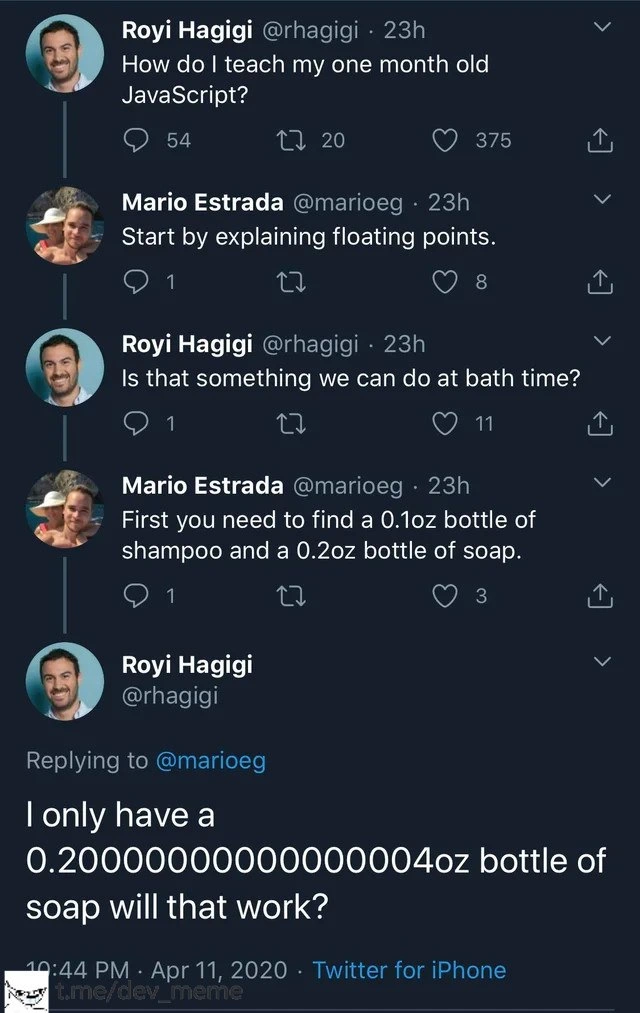
Let’s break down what’s happening in this meme in simpler terms. The image is a screenshot of a Twitter conversation, which has been shared on a developer meme channel. In the first tweet, a user named Royi Hagigi asks, “How do I teach my one month old JavaScript?” Clearly, this isn’t a serious question – a one-month-old baby can’t even talk or sit up, let alone learn to code! Right away, this sets a humorous tone. It’s poking fun at the idea of teaching an infant programming, which we understand is ridiculous. Sometimes developers joke about getting their kids into coding early, and this tweet plays on that for laughs.
Now, another user, Mario Estrada, replies: “Start by explaining floating points.” Here’s where the developer humor kicks in. JavaScript (the language in question) handles all its numeric values as floating-point numbers by default. A floating-point number is basically how computers represent real numbers (numbers with decimal points). The reply suggests that the very first lesson for this baby should be about floating-point numbers. That’s funny because in reality, floating-point behavior is a fairly tricky concept – even adult beginners find it confusing at first! It’s a core CS_Fundamentals topic that you usually encounter after you’ve learned basic programming. By saying this should be lesson one for a newborn, Mario is intentionally exaggerating to make a joke. This is a hint that something specific about floating-point math is going to be the punchline.
Royi goes along with the gag and asks, “Is that something we can do at bath time?” This line mixes up the meaning of “floating.” In computing, “floating point” has nothing to do with physically floating objects – it’s about the decimal point “floating” in a number representation. But Royi’s response pretends to take it literally: as if “floating points” could be explained by things floating in bath water. It’s a playful pun. Bath time is a common daily routine with a baby (picture rubber ducks and soap bars floating in the tub), so Royi is jokingly suggesting, “Maybe I can combine this technical lesson with something as mundane as giving the baby a bath?” This makes the conversation even more absurd and funny, blending a normal parenting scenario with a coding lesson.
Mario then replies with a concrete (albeit silly) plan: “First you need to find a 0.1oz bottle of shampoo and a 0.2oz bottle of soap.” Now, on the surface, he’s continuing the bath-time theme – talking about shampoo and soap. But pay attention to those very specific measurements: 0.1 oz and 0.2 oz. Why such oddly small amounts? This is a direct reference to a famous floating point precision issue in JavaScript (and other languages). In programming, if you add the numbers 0.1 and 0.2, you might expect to get 0.3 exactly. But due to the way computers handle decimal numbers, you actually get a tiny bit more: 0.30000000000000004. It’s a well-known bug (or behavior) often cited when discussing JavaScript’s quirks. By telling Royi to use 0.1 oz of shampoo and 0.2 oz of soap, Mario is setting up a scenario that mirrors adding 0.1 and 0.2 in code. It’s like he’s saying, “Let’s demonstrate this concept in a baby-friendly way: with real objects in the bath.”
Of course, finding containers measured in 0.1 oz or 0.2 oz in real life is impractical – those amounts are tiny (0.1 ounce is about 3 grams)! This adds to the silliness. It’s intentionally impractical to signal that we’re in the realm of fantasy and humor. The numbers are chosen not for realism, but for their significance in the coding world. LanguageQuirk and LanguageGotcha are terms we use for odd things a programming language does that can trip you up. Using 0.1 and 0.2 is pointing to a JavaScript quirk that many new developers find surprising.
Finally, Royi responds with the punchline of the joke: “I only have a 0.20000000000000004oz bottle of soap will that work?” This is where the Twitter thread reveals itself as a classic developer joke. The number 0.20000000000000004 is extremely specific and looks awkward – but if you’re a programmer, it jumps out immediately as the kind of output you get when a floating-point calculation doesn’t give a clean answer. Let’s connect the dots:
- If you were to add 0.1 and 0.2 in actual JavaScript code, the result would be 0.30000000000000004.
- If you imagine pouring 0.1 oz of shampoo and 0.2 oz of soap together, you’d expect 0.3 oz total, right? But Royi’s joke is that somehow he ended up with a bottle containing 0.20000000000000004 oz – which is a playful way of saying “the result wasn’t the 0.3 I expected.” He specifically says 0.20000000000000004 oz (not 0.3) to mirror one of the addends but with that funny extra 0.00000000000000004 part on it.
Why 0.20000000000000004 and not 0.30000000000000004, you might wonder? It could be that Royi is humorously implying he couldn’t even find a proper 0.2 oz because the tiny error got in the way. The conversation’s logic is a bit loopy (intentionally!), but the core joke is clear: they’re referencing the well-known fact that 0.1 + 0.2 in JavaScript isn’t 0.3 but 0.30000000000000004. Royi’s reply basically says, “Uh oh, the soap I have is already showing that goofy extra ...0004 at the end – is that okay?” It’s as if the bug has manifested in real life, in his baby’s bath!
For a junior developer or someone not yet familiar with this, here’s what all this means:
- Floating-point precision error: Computers sometimes can’t represent decimal numbers exactly due to binary rounding. So calculations that we think are simple (like 0.1 + 0.2) can produce a very close but not exact result.
- In JavaScript, all numbers (aside from a newer thing called BigInt) are floating-point numbers under the hood. This is why JavaScript is often the poster child for this example.
- The number
0.30000000000000004is famous in programming circles. It’s the result of 0.1 + 0.2 in many languages. The meme uses0.20000000000000004to hint at that famous result (close enough to remind people of it, and fitting the bath items story). - When developers see a weird number like 0.20000000000000004, a lightbulb goes off: “Aha, floating-point issue!” It’s practically an inside joke because we’ve all had to explain that “gotcha” at some point.
- The dialogue style (on Twitter) and the dev_meme watermark indicate this was shared as a joke for programmers. Each tweet building on the last is how a lot of coding humor is delivered in text form.
To put it simply, Mario and Royi are role-playing a scenario where a bug/quirk in JavaScript math is being “taught” to a baby using bath materials. The baby obviously isn’t learning anything – the real audience is us, the developers, who find it funny. It’s a relatable humor setup because it blends something very domestic and non-technical (giving a baby a bath) with something very nerdy and technical (JavaScript math oddities). The contrast makes it amusing. And for those who know, the mention of 0.1, 0.2, and that long 0.20000000000000004 number is an immediate tip-off about the joke’s subject. It’s referencing a classic JavaScript FloatingPointPrecision problem in a novel way. If you’re a new developer and this is your first time hearing about it, don’t worry — the baby might not get it, but eventually you will! The takeaway lesson (in real life, not for the baby) is that when using floating-point numbers, tiny rounding differences can happen. That’s why in serious applications (like financial calculations), developers use strategies to avoid these floating-point surprises. But in this meme, it’s all in good fun, highlighting the quirk without any real harm done — except maybe an extra drop of soap in the tub.
Level 3: Floating-Point Fatherhood
From a senior developer’s perspective, this Twitter thread is a goldmine of inside jokes and shared experiences. The original question—“How do I teach my one month old JavaScript?”—is clearly tongue-in-cheek. JavaScript is a programming language known for being approachable, but not THAT approachable! The absurdity of trying to teach an infant a coding language sets the comedic tone immediately. It hints at how enthusiastic developers sometimes joke about raising their kids to code early, or it could be poking fun at overly ambitious parenting. Either way, it’s a playful setup. And then comes the brilliant follow-up reply: “Start by explaining floating points.” Any experienced coder reading that likely chuckled, because floating-point precision issues are infamous — they’re the classic LanguageGotcha that even grown developer “children” struggle with. It’s as if Mario (the replier) is saying, “Alright, you want to create a prodigy programmer? Better start with one of the toughest, most fundamental concepts right off the bat!” It’s a witty exaggeration that implies even a one-month-old should learn about JavaScript’s number quirks early since dealing with them is inevitable. This is the kind of darkly funny advice only a battle-scarred programmer would give with a straight face.
Royi (the parent in the joke) then asks, “Is that something we can do at bath time?” Here we see a clever pun unfold. The phrase “floating points” gets interpreted in the most literal, non-technical way – things that float during bath time. This is a classic comedic setup: a technical term is misunderstood (perhaps deliberately) as a normal phrase. Bath time for a one-month-old is a familiar, mundane scenario, far removed from coding. By bringing the concept of floating into a bathtub context, Royi is playing along with a bit of goofy literalism. He’s effectively asking, “Can this computer lesson be turned into a fun bath activity with actual floating objects?” It’s a silly image – imagine a parent in full Enthusiastic Educator mode, rubber ducky in one hand and a math lesson in the other, trying to illustrate coding principles to a babbling infant. This mix of parenting_and_code is inherently funny because it juxtaposes a high-level geeky concept with one of the most basic routines of caring for a baby.
Mario’s next tweet ramps up the nerdiness in a wonderfully absurd way: “First you need to find a 0.1oz bottle of shampoo and a 0.2oz bottle of soap.” This line is the giveaway that we’re heading into floating_point_precision_error territory. Why such oddly specific measurements? To seasoned devs, 0.1 and 0.2 are a red flag (or rather, a flashing neon sign) that the joke is referencing the legendary 0.1 + 0.2 problem. Mario is essentially proposing a physical reenactment of the JavaScript quirk. The idea of finding a 0.1 ounce bottle of shampoo is intentionally ridiculous – products aren’t measured that way in real life because 0.1 oz is an extremely tiny amount (about 3 milliliters). Similarly, a 0.2 oz bottle of soap is equally bizarre. But those precise values are crucial setup for the punchline. This is relatable humor for developers because it takes a scenario we’ve seen on our screens (adding two numbers and getting a strange result) and imagines it happening IRL with real objects. It’s the ultimate “if programming concepts were real life” gag. Seasoned programmers have seen countless code examples and Stack Overflow posts using 0.1 and 0.2 to demonstrate why naive math can go wrong, so seeing it described with shampoo and soap bottles is hilariously fresh and developerhumor-y. We’re basically being told a mini story: Mommy/Daddy is giving Baby a bath and also a lesson in why 0.1 + 0.2 is not as simple as it looks.
Finally, Royi delivers the punchline of the thread: “I only have a 0.20000000000000004oz bottle of soap will that work?” And there it is — 0.20000000000000004 — the unmistakable fingerprint of binary floating-point arithmetic gone quirky. For any programmer who knows the joke, this line lands perfectly. It’s framing the infamous result of 0.1 + 0.2 (which in JavaScript yields 0.30000000000000004) in terms of a physical object’s quantity. Of course, in a real bathroom you’d never measure soap to 17 decimal places of an ounce! The sheer absurdity of a parent holding a bottle labeled “0.20000000000000004 oz” is what makes it so funny. It’s rounding_error_comedy at its finest – highlighting how laughably precise and wrong that number is in a context where we’d expect a neat simple answer (0.3 oz total, perhaps). This tweet also cheekily echoes a common newbie question: “I only have this weird number, will that work?” In forums, juniors often ask, “I got 0.30000000000000004 instead of 0.3 — is something broken?” Here the phrasing “will that work?” mimics that innocent confusion. The senior devs reading this meme can almost hear the echoes of countless Q&A threads. It’s funny because we’ve been there; we’ve confronted that same befuddling number and learned why it happens.
The humor hinges on shared knowledge. If you know about the 0.1 + 0.2 problem, you’re in the club and the joke is hilariously relatable. It’s the kind of thing that gets an “oh no, here we go again 😅” reaction from veteran coders. Even the structure of the conversation parodies a typical Q&A or troubleshooting discussion:
- Someone asks a question (here, an absurd one about teaching a baby).
- A cheeky expert gives a suggestion that sounds reasonable only if you’re in on the joke (“explain floating points” – as if that’s step 1 to teach an infant, ha!).
- The original asker seeks clarification in a literal way (bath time?).
- The expert sets up the scenario with specifics (0.1 oz and 0.2 oz bottles, akin to saying “write code to add 0.1 and 0.2”).
- The asker reports back a predictable, goofy “problem” (the weird soap measurement, echoing the code result).
It’s basically a bug report in a baby bottle. We’re all laughing because Royi’s final tweet reads exactly like a snippet from a developer’s console. If you actually open a browser console and do the following in JavaScript:
console.log(0.1 + 0.2); // → 0.30000000000000004
console.log(0.1 + 0.2 === 0.3); // → false (because 0.1+0.2 is not exactly 0.3)
you’ll see that infamous 0.30000000000000004 result. The meme effectively took that console output and turned it into a bottle_size_precision gag. It resonates with developers because it’s exactly the sort of surprise we encounter early in our careers and never forget. Every senior developer remembers the first time they had to explain to someone (or learn themselves) why a computer thinks 0.1 + 0.2 equals a tiny bit more than 0.3. It’s practically a hazing ritual in the programming world. By presenting it as a twitter_thread_meme, the joke is packaged in a format we’re used to consuming tech humor: quick back-and-forth tweets with a punchy payoff, complete with a dev_meme_watermark to signal its place in the online dev culture.
Also noteworthy is the tag BugVsFeature in this context. Seasoned devs often quip “It’s not a bug, it’s a feature!” about things exactly like this. Technically, nothing is broken in JavaScript – it’s doing what it’s designed to do (binary math). But from a user’s naive standpoint, it sure looks like a bug. This meme lives in that irony. We’re laughing at JavaScript as if it just goofed up basic arithmetic (“haha, silly language can’t even add 0.1 and 0.2”), while simultaneously everyone with experience knows this is just how floats work universally (“sigh, yes, that old problem... still trips people up”). The baby-in-bath scenario adds a layer of silliness that makes the whole thing lighthearted rather than frustrating. It’s a form of collective commiseration: “We’ve all dealt with this wacky numerical behavior, let’s joke about needing to teach it from the cradle!”
In summary, from the experienced viewpoint, this meme is chuckle-inducing because it compresses a bunch of shared developer experiences into a neat, five-tweet skit:
- Infant programmer joke (the absurdity of teaching a newborn).
- Key JavaScript quirk (floating-point math weirdness).
- Physical-world analogy (bath time bottles, making the abstract issue concrete and silly).
- The punchline number that we immediately recognize (
0.20000000000000004oz– gotcha, it’s the float thing). It’s a nod to both the challenges of coding (even simple math can get complicated under the hood) and the sometimes overzealous nature of tech folks (imagine being so into coding that you’d try to teach it at bath time!). In the end, Floating-Point Fatherhood here is both a celebration and gentle roast of our developer life: we deal with bizarre issues like these so often that they become the stuff of bedtime stories — or in this case, bath-time tales — we joke about.
Level 4: Double Precision Dilemma
At the heart of this joke is a classic floating-point precision quirk grounded in computer science fundamentals. When we write a number like 0.1 in a program, the computer doesn’t actually store it as an exact 0.1 in base-10. Instead, it uses a binary representation defined by the IEEE 754 double precision standard (JavaScript’s default for numbers). In binary, many simple decimals become repeating fractions. For example, 0.1 (one tenth in base-10) converts to an infinite recurring binary fraction:
0.1 (decimal) = 0.000110011001100110011... (binary)
This repeating sequence can’t be held with perfect accuracy in a finite number of bits. A 64-bit double precision number allocates 52 bits for the fraction (mantissa), so it rounds 0.1 to the closest possible binary value it can represent. The same happens for 0.2. Each is stored with a tiny rounding error at the far end of that 52-bit mantissa. When you add these two approximations, the small errors combine, resulting in a sum that’s just a hair off of the true 0.3 value. In fact, the binary result for 0.1 + 0.2 ends up slightly greater than 0.3, and when converted back to decimal for display it appears as 0.30000000000000004. This isn’t JavaScript being capricious – it’s an artifact of binary floating-point math that exists in virtually all languages (C, Java, Python, you name it) that use binary floats. The humor here leans on this deep truth: even CS_Fundamentals like number representation can lead to moments where the computer’s “math” looks counterintuitive to humans.
What makes this a Double Precision Dilemma is that there’s no easy fix without changing how numbers are represented. We could use decimal floating-point or arbitrary precision libraries to get exact decimal math, but those come with performance trade-offs. The IEEE 754 standard was designed in the 1980s to make floating-point arithmetic fast and consistent across systems, at the cost of these tiny precision errors. It’s a trade-off that almost every platform accepted. So, the 0.30000000000000004 outcome is essentially a feature of how our hardware and languages handle decimals, not a bug that slipped through. However, it feels like a bug when you first encounter it, which is why it’s a notorious LanguageQuirk. This meme cleverly demonstrates that quirk by dragging a very technical issue into an everyday, absurd scenario – measuring shampoo for a baby’s bath. It’s putting the floating_point_precision_error on full display, in a place we’d never expect to see so many decimal places of detail. The joke lands because those in the know recognize that ghostly ...0004 at the end of a number as the telltale signature of binary rounding. It’s the same tiny phantom many of us have chased in debugging sessions or learned about in computer architecture classes. By referencing a 0.1 + 0.2 scenario, the meme evokes the almost inevitable moment every developer has when they first scratch their head and say, “Wait, why doesn’t 0.1 + 0.2 equal 0.3?” It’s a rite-of-passage bug—here turned into a bath-time teaching moment.
Adding a bit of historical and theoretical context: the inability to precisely represent 1/10 in binary is analogous to how 1/3 in decimal becomes 0.3333… – no finite digits will ever give exactly one third. Computers work in base-2, so any fraction that isn’t a sum of negative powers of two (like 1/2, 1/4, 1/8, etc.) will end up as an endless repeat in binary. The floating-point arithmetic system chops that off after a fixed number of bits, producing a tiny rounding difference. The number 0.20000000000000004 is actually the machine’s honest attempt to represent the simple concept of “one fifth” plus “one tenth” in base-2 form. The fact that every language that uses IEEE floats agrees on this weird result is a testament to how well-defined the standard is. It’s a kind of deterministic quirk – the answer is wrong by human math standards, but predictably wrong by computer math standards. This consistency is why we call it a BugVsFeature scenario. Seasoned developers know it’s coming and design around it (for instance, by rounding results for display or using integer math for money), but we still affectionately label it a “bug” when joking about it. After all, it’s more fun to tease a language like JavaScript for “not knowing math” than to delve into binary fractions every time. Here the meme is essentially doing both: teasing JavaScript on the surface, while actually alluding to the deep, inescapable math of binary floating points. It’s a brilliant case of rounding_error_comedy – using a subtle technical truth as the punchline of a joke.
Description
This image is a screenshot of a humorous Twitter exchange between users Royi Hagigi and Mario Estrada. Royi starts with the absurd question, 'How do I teach my one month old JavaScript?'. Mario sarcastically replies, 'Start by explaining floating points.' The conversation continues with Royi asking if this can be a 'bath time' activity. Mario plays along, suggesting they use 'a 0.1oz bottle of shampoo and a 0.2oz bottle of soap.' Royi delivers the punchline by replying, 'I only have a 0.20000000000000004oz bottle of soap will that work?'. The entire thread is a well-crafted joke for developers, specifically targeting the notorious floating-point precision issues in JavaScript (and other languages using IEEE 754). The humor lies in the fact that simple decimal arithmetic like 0.1 + 0.2 doesn't evaluate to exactly 0.3, but to a number with a tiny precision error, like 0.30000000000000004. It's a fundamental, often frustrating concept, making the suggestion of teaching it to an infant a perfect piece of cynical developer humor

Comments
7Comment deleted
The first rule of Floating Point Club is you do not talk about precise decimal representation. The second rule is you use a library like Decimal.js and pretend the problem doesn't exist
Bath-time syllabus: 0.1 oz shampoo + 0.2 oz soap = 0.30000000000000004 oz lather - an early reminder that every abstraction, right down to IEEE-754, leaks suds
After 20 years in this industry, I've explained IEEE 754 to junior devs, product managers, and VCs, but explaining why 0.1 + 0.2 !== 0.3 to a crying baby at 3am might actually be easier than convincing a PM it's not a bug we can just "fix real quick."
This is the JavaScript equivalent of teaching your kid to count: 'One, two, 0.30000000000000004...' - a masterclass in why every senior engineer has that moment of existential dread when they realize they need to explain IEEE 754 binary floating-point arithmetic to justify why their financial calculations are off by fractions of a cent. The real question isn't whether the 0.20000000000000004oz bottle will work - it's whether you're ready to explain to a one-month-old why we still use floating point for currency in 2024
Teach IEEE-754 at bath time - otherwise they'll grow up shipping billing logic where 0.1oz + 0.2oz reliably invoices 0.30000000000000004oz
Baby’s first JavaScript lesson: 0.1oz + 0.2oz of soap = 0.30000000000000004oz - welcome to IEEE 754, where even bath time uses fixed-point accounting
Teaching JS floats to infants: Because even after 20 years, we're still debugging why 0.1 + 0.2 won't commit